
Top 12 Best Spotting Scope and Sky Telescope Revealed!
Trying to get a clear view through a cheap or poorly chosen scope can be frustrating. Blurry images, weak magnification, and awkward handling often ruin the experience.
The best spotting scope and sky telescope provide sharp views whether you’re watching wildlife or stargazing, making those moments much more rewarding and less of a hassle.
Good spotting scopes and sky telescopes typically feature high-quality glass with anti-reflective coatings, which improves clarity and brightness. Magnification power matters too; 15x to 60x for spotting scopes and variable power with stable tracking functions for telescopes help in getting clear, detailed images. Build quality, including waterproof and fog-proof materials, plus ease of maintenance like removable lenses, also set the better models apart from the rest.
Need a Quick Check?
| Image | Product | Price |
|---|---|---|
Our Top Picks 1  | SVBONY SV28 Scope | Check Price |
Our Top Picks 2  | Smart Telescope Refractor | Check Price |
Our Top Picks 3  | Pro Auto-Focus Digital Scope | Check Price |
Our Selected Top 12 Spotting Scope and Sky Telescope for Different Needs
This list features carefully chosen spotting scopes and sky telescopes designed for various uses, from casual stargazing to serious observation. Each review explains the performance, ideal users, strengths, and limitations to help you find the best fit for your needs.
1. SVBONY SV28 Spotting Scope
Great for anyone starting out in birdwatching or casual scenery observation, the SVBONY SV28 Spotting Scope offers easy to adjust 25-75x zoom. Its strongest feature is the large 70mm objective lens, which lets in plenty of light for clear views, even at the higher zoom levels.
Setting it up involves mounting it on a tripod, which works well since it’s compatible, and manually focusing through its zoom eyepiece is straightforward. The built-in sunshade on the barrel helps reduce glare when outdoors. A non-slip finish means handling stays secure, even when the scope is wet.
Changing magnification is smooth enough for quick adjustments while observing birds or landscapes.
Performance is solid for the price, showing detailed images throughout the zoom range with reasonably good light gathering thanks to the 70mm lens. The waterproof design adds durability against sudden weather changes, making it a practical choice for outdoor use.
The main complaint relates to manual focusing, which some find less precise compared to more advanced models.
Most praise centers on the bright, clear views from the large lens and effective zoom range. On the downside, manual focusing requires more effort and practice, which some find tricky. The waterproof and non-slip design help keep it reliable outdoors.
Anyone new to spotting scopes looking for solid image quality and durability should find this a good fit. Those wanting faster or automatic focusing might want to explore other options with more advanced focusing systems.
Pros
- Easy focus and magnification adjustment
- 70mm lens gathers plenty of light
- Waterproof with built-in extendable sunshade
- Non-slip finish for secure handling
Cons
- Manual focus can be less precise
- Equatorial mount might be complex for some beginners
| Specification | Details |
|---|---|
| Zoom Ratio | 3:1 |
| Focal Length Description | 380 millimeters |
| Field Of View | 64 feet |
| Eye Piece Lens Description | Zoom eyepiece |
| Mount | Equatorial Mount |
| Coating | FMC |
2. Smart Telescope Refractor Auto-Focus
Aluminum alloy frames the optical tube, giving a solid and durable feel that suits anyone serious about astronomy or long-distance viewing. Its strongest asset is an 80mm aperture combined with a 300mm focal length that allows remarkable clarity and brightness in various observing conditions.
Setup is straightforward with a tripod mount and auto-focus, which removes the guesswork for crisp images. Operating through a mobile app or an 85-foot wireless remote offers convenient dual controls, allowing you to keep your hands steady while capturing 4k video or 30mp stills. Compatible with computers, tablets, and smartphones, it fits naturally into a tech-savvy routine without needing standard batteries.
Optical performance delivers sharp, bright images even at 350x magnification, holding details well under low light and moon-viewing conditions. The build feels sturdy, focusing smoothly without jitters, thanks to shake-free imaging features.
Praise revolves around the stellar image quality and versatile remote controls, while the main downside lies in reliance on nonstandard batteries.
The auto-focus and shake-free 4k imaging deliver exceptionally clear and stable views while capturing high-resolution photos and video without much manual tweaking. Most reports highlight the image quality as outstanding, with the nonstandard battery requirement being the most frequent inconvenience.
People who want detailed astronomy images and easy remote control will find this telescope very rewarding. Those looking for a more traditional or simpler device might prefer something without app dependency and special battery needs.
Pros
- Crystal-clear brightness with 80mm aperture
- Auto-focus feature simplifies focusing tasks
- Shake-free imaging for blur-free astrophotography
- Wireless remote control extends range to 85 feet
Cons
- Requires nonstandard batteries
- Setup may feel complex without prior experience
| Specification | Details |
|---|---|
| Aperture | 80mm |
| Focal Length | 300mm |
| Magnification | Up to 350x |
| Focus Type | Auto Focus |
| Control | App & Remote Control |
| Camera | 4K Astrophotography |
3. Professional Auto-Focus Digital Refractor Telescope
High magnification and crystal-clear views stand out immediately with this digital refractor telescope, making it ideal for anyone keen on exploring planets, deep-sky objects, or wildlife in vivid detail. Its 350x zoom capability is the key selling point for those wanting to get as close as possible without losing clarity.
Setting up is straightforward since focusing is fully automatic, so no fiddling with knobs trying to get a sharp image. The dual-screen view is great for sharing what you’re seeing with friends, one screen in the eyepiece and another fold-out screen for easy group observations. The anti-glare hood helps keep reflections down, even in tricky lighting.
Rechargeable batteries and wireless app control make it comfortable and convenient for longer sessions outdoors.
Visual details come through sharply with high contrast thanks to the starlight-grade sensor and 80mm aperture. The build feels solid and thoughtfully designed to handle outdoor conditions.
The biggest compliment is how it handles low-light environments without much grain or blur. The common drawback mentioned involves the requirement of nonstandard batteries, which can be inconvenient to replace.
Users appreciate the crystal-clear, high-contrast viewing experience even under low-light conditions, though many find the reliance on nonstandard batteries inconvenient for extended use. The automatic focusing feature removes typical focusing frustrations.
Anyone seeking detailed views of celestial objects or distant wildlife with minimal setup will find this telescope well suited. Those who prefer standard battery types or require longer battery life might want to consider other options.
Pros
- 350x zoom reveals sharp planetary details
- Dual screens for solo and group viewing
- Starlight-grade sensor for low-light clarity
- Automatic focusing simplifies observations
Cons
- Uses nonstandard batteries, harder to find
- Rechargeable battery life varies with use
| Specification | Details |
|---|---|
| Focus Type | Auto Focus |
| Finderscope | Reflex |
| Focal Length | 300mm |
| Additional Features | Auto Focus, Dual Screens, Wireless App Control, Remote Control |
| Magnification | Up to 350x |
4. Professional Auto-Focus Digital Refractor Telescope
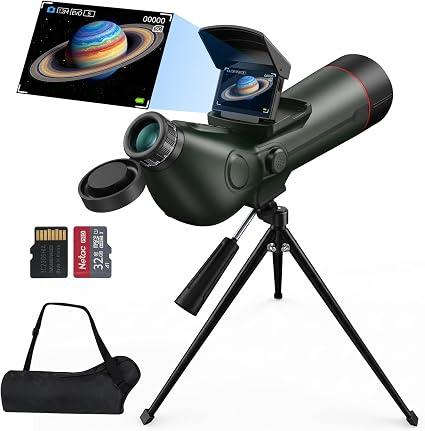
Perfect for anyone serious about both stargazing and wildlife observation, this telescope shines with its auto-focus and 4K resolution capabilities. Its biggest strength lies in capturing crisp, bright images even in low light, setting it apart from cheaper scopes that often struggle with clarity.
Setting up involves just positioning it and turning it on, thanks to the auto-focus feature that eliminates manual adjustments. Day-to-day use benefits from dual screens, making it easy to frame shots or observe details without switching devices. The built-in 4K camera lets you capture photos and videos on the spot, so you don’t miss any moment of your observation.
Pulling in bright and sharp images with an 80mm lens and 350X zoom, it handles low-light conditions impressively well. The build feels solid but not overly bulky, which helps in carrying it outdoors. Most praise goes to its imaging quality and ease of focus, while some note the need for nonstandard batteries as inconvenient when replacements run out.
Image clarity and auto-focus capabilities receive consistent praise, making it simple to capture detailed photos of planets and wildlife. Commonly mentioned drawback revolves around the use of nonstandard batteries, which can be inconvenient if spares aren’t readily available.
Anyone focused on combining astrophotography with wildlife spotting will appreciate this scope’s features and image quality. Those looking for a lightweight, battery-friendly option might consider alternatives without special battery requirements or with less magnification.
Pros
- Auto-focus for quick, precise adjustments
- 4K camera for high-resolution photos and videos
- Dual screens for easier viewing and framing
- 80mm lens gathers plenty of light for detail
Cons
- Requires nonstandard batteries, not easy to replace
- Relatively high zoom can be tricky to stabilize
| Specification | Details |
|---|---|
| Focus Type | Auto Focus |
| Finderscope | Reflex |
| Number of Batteries | Nonstandard Battery batteries required. |
| Focal Length Description | 300mm |
| Zoom Ratio | 350 |
| Additional Features | 4K Astrophotography Camera, Auto-focus, Dual Screens, Photo & Video Modes |
5. Celestron C90 Maksutov Spotting Scope

Spotting a bird on a distant branch or catching a clear view of the stars calls for sharp optics in a compact package. The Celestron C90 Maksutov Spotting Scope delivers bright, focused images in a size that’s easy to carry. It suits anyone wanting detailed observation without lugging heavy gear.
Setting up involves manual focus and an equatorial mount that keeps things steady for both daytime spotting and night sky viewing. Its compact size comes from the Maksutov-Cassegrain design folding light inside, which means you can easily bring it along on hikes or to your favorite viewing spot.
Using the included 8×21 erect image finderscope helps in locating distant targets quickly. Attaching a smartphone for digiscoping is straightforward, making it a versatile tool for photos too.
The 90mm aperture and 1250mm focal length create crisp views with a 39x zoom multiplier, ideal for distant objects both on land and in space. Constructed with multi-coated optics, the scope reduces glare to deliver high-contrast images. Many praise its portability and image quality, while some note the manual focus requires patience for perfect sharpness.
The scope delivers crisp, high-contrast images suited to spotting both wildlife and celestial objects, praised for its portability and compact form. The most frequent complaint is about the manual focus requiring some effort to get the perfect image.
Ideal for nature observers and amateur astronomers who appreciate a lightweight, versatile scope. Not the best choice for those wanting fast autofocus or a wide field of view. People seeking quick target acquisition may want to look elsewhere.
Pros
- Compact and lightweight for easy portability
- Bright, sharp views with multi-coated lenses
- Camera adaptable for digiscoping with smartphones
- Equatorial mount stabilizes viewing experience
Cons
- Manual focus can be tricky for quick adjustments
- Small field of view limits wide-angle observations
| Specification | Details |
|---|---|
| Eye Piece Lens Description | Plossl |
| Mount | Equatorial Mount |
| Focus Type | Manual Focus |
| Zoom Ratio | 39 multiplier x |
| Field Of View | 9.7 degrees |
| Focal Length Description | 1250 millimeters |
6. Smart Telescope Refracting Digital Electronic Telescope

300mm focal length paired with an 80mm aperture makes it ideal for stargazing and moon observation. Easily suits amateur astronomers who want sharp, vivid images combined with user-friendly features.
The standout aspect is the dual-screen setup allowing shared viewing without crowding around the eyepiece.
Setting it up is straightforward, especially with the auto focus handling most adjustments. The foldable 3-inch external display is perfect for sharing in real time, and the built-in sunshade helps maintain clear images during daytime use. The straight-through finderscope aids in quick target acquisition, making each viewing session smooth and enjoyable.
Excellent optics deliver stunning clarity with fully coated glass lenses protecting eyes from strain. Solid build quality feels reliable, though some users may find the zoom ratio of 350 a bit challenging to control at maximum magnification. Generally, it captures detailed shots with its 4K astrophotography camera.
A common complaint is the external screen’s size, which might feel small to some.
Optical clarity and ease of sharing views stand out as strong positives, while some find the smaller external screen somewhat limiting. The auto focus manages to reduce manual adjustments but zooming to high levels can introduce some shakiness.
Ideal for beginners and casual stargazers who want simplicity and clear images with some photography capability. Those needing bigger displays or steadier zoom functionality might want to consider other options.
Pros
- Auto focus eases sharp viewing
- Dual-screen for shared observation
- Fully coated optics reduce eye strain
- Built-in sunshade improves daylight visibility
Cons
- External screen may feel small
- High zoom ratio requires steady hand
| Specification | Details |
|---|---|
| Focus Type | Auto Focus |
| Finderscope | Straight-Through |
| Focal Length Description | 300mm |
| Zoom Ratio | 350 |
| Additional Features | 4K Astrophotography Camera |
7. Flagship 20-60×80 Spotting Scope with Tripod

Ideal for birdwatchers, archers, and campers, this spotting scope covers a wide range of outdoor viewing needs. Its biggest strength lies in the powerful 20x to 60x magnification paired with an 80mm objective lens that delivers bright and sharp images over long distances.
Setup includes attaching the altazimuth tripod and adjusting the smooth manual focus. Zooming is easy thanks to the variable 20x to 60x magnification, while the fully multi-coated lens keeps visuals clear in changing light.
The reflex finderscope helps pinpoint subjects quickly, and the smartphone adapter allows capturing what you see without hassle.
Performance delivers crisp, bright views with the BAK4 Porro prism enhancing light transmission effectively. The build feels solid and water-resistant, suited for diverse outdoor conditions.
The clear plus from the reviews is the impressive image clarity. Common complaints mention the manual focus requiring patience, especially at higher zoom.
Brightness and clarity stand out as the strongest features, making distant subjects easy to see in detail. The manual focus system needs steady hands and patience, especially when pushing zoom towards 60x. The tripod mount requires a flat, steady surface to keep images sharp.
Ideal for outdoor enthusiasts wanting versatile zoom and quality optics in one package. Those needing quick, autofocus or something lightweight for travel may prefer a different model better suited for rapid adjustments or compactness.
Pros
- Variable zoom from 20x to 60x makes long-range viewing flexible
- Bright, clear images thanks to BAK4 Porro prism and multi-coated lens
- Water-resistant design holds up outdoors well
- Works easily with smartphones for photos
Cons
- Manual focus feels slow at high magnifications
- Relatively large and requires stable tripod setup
| Specification | Details |
|---|---|
| Zoom Ratio | 60 multiplier x |
| Field Of View | 82.9 feet |
| Mount | Altazimuth Mount |
| Focus Type | Manual Focus |
| Coating | Fully Multi-Coated |
| Compatible Devices | Smartphone |
8. Celestron Heavy-Duty Alt-Azimuth Tripod

Heavy-duty support designed specifically for large optics sets this tripod apart. It suits anyone needing a reliable and steady base for spotting scopes, binoculars, or small telescopes.
Its biggest strength lies in the precision slow-motion controls allowing smooth, accurate tracking of objects in both altitude and azimuth directions.
Setting up the tripod is straightforward thanks to two-section adjustable legs that let you find just the right height for comfortable viewing. An included center brace ensures stability while a metal accessory tray keeps your gear within easy reach during extended sessions. Handling is natural, with two slow-motion control handles that let you track objects with fine adjustments without disturbing the view.
Performance in tracking is smooth and precise, making it ideal for both astronomy and land-based observation. The build feels solid, constructed to support heavy equipment steadily.
Positive feedback highlights the smooth tracking and sturdy design. Some users noted the tripod’s weight could make transport a bit cumbersome for casual use.
Quiet, smooth tracking and a sturdy build stand out as the most praised features, ideal for long viewing sessions. Users often mention that the tripod’s weight can make carrying it less convenient when moving between locations frequently.
Perfect for anyone needing a solid, stable platform for large optics and serious observing sessions. Those seeking a lightweight, highly portable option may prefer to look elsewhere.
Pros
- Heavy-duty design supports large optics
- Slow-motion controls for precise tracking
- Adjustable height with two-section legs
- Metal accessory tray keeps gear handy
Cons
- Relatively heavy for frequent transport
- Limited to small telescopes and scopes
| Specification | Details |
|---|---|
| Brand | Celestron |
| Model Number | 93607 |
| Item Length | 45 inches |
| Unit Count | 1 Count |
| Included Components | Tripod |
| Warranty Description | TWO-YEAR LIMITED WARRANTY |
9. Celestron C70 Mini Maksutov Spotting Scope

Celestron C70 Mini Maksutov Spotting Scope is designed for those who need clear, bright views of distant targets without lugging heavy gear. Its compact and lightweight build stands out, making it perfect for bird watchers and nature lovers who want something easy to carry and quick to set up.
Setting up involves attaching the scope to the tabletop tripod and using the manual focus to zero in on your subject. The built-in zoom eyepiece offers three levels of magnification, so switching between wide views and detailed close-ups is simple. Multi-coated lenses improve image brightness, and the included reflex finderscope helps in quickly locating and tracking objects.
Performance delivers sharp views up to 700mm focal length, and the Maksutov-Cassegrain design keeps images crisp. Despite its solid build, some users mention the manual focus takes a bit of patience to get perfect. The scope’s portability is a huge plus, but limited zoom levels might not satisfy those wanting stronger magnification.
Bright and clear visuals are the scope’s strong point, enhanced by multi-coated lenses and a long focal length that effectively brings distant subjects into view. Reviews note the built-in zoom is handy but the manual focus can be fiddly, especially when trying to capture fast-moving birds or targets.
Anyone looking for an easy-to-carry scope for casual birdwatching or nature spotting will find it suits their needs well. Those wanting higher magnification or faster autofocus might want to explore other options better tailored for those features.
Pros
- Compact and lightweight for easy transport
- Multi-coated lenses for bright, sharp views
- Built-in zoom eyepiece for quick magnification changes
- Tabletop tripod with slow motion controls included
Cons
- Manual focus requires patience for sharp images
- Zoom limited to 3x, less for distant details
| Specification | Details |
|---|---|
| Aperture | 70MM |
| Focal Length | 700 millimeters |
| Focal Ratio | f/10 |
| Zoom Ratio | 3x |
| Weight | 2 pounds |
| Length | 11 inches |
10. Celestron Travel Scope 80mm Telescope Kit

Bright views come through clearly with sharp details, making it a great choice for beginners curious about star-gazing or daytime spotting. Easy to carry and quick to set up, it suits both adults and kids looking for a no-fuss way to explore planets or landscapes outside.
Setup takes just minutes without needing any tools, thanks to the full-height tripod and simple manual focus. The whole kit fits neatly into its backpack, encouraging you to take it on trips or just around the yard. The smartphone adapter adds a modern touch, letting you capture or share what you find.
Image quality is impressive thanks to its 80mm fully coated optics, producing bright and sharp views both day and night. Built sturdy enough for outdoor use but still light enough to carry comfortably.
Some users wish the zoom ratio was higher, but the balance of power and portability works well enough for casual observing.
The telescope delivers crisp, bright images that many find rewarding for both lunar and planetary observation. The no-tool assembly and compact design promote quick outings. However, the limited zoom and manual focus mean it won’t satisfy users seeking detailed high-magnification views.
People wanting a straightforward, easy-to-carry telescope with good optics for casual observing will appreciate this kit. Those needing stronger zoom capabilities or motorized focusing might want to look elsewhere.
Pros
- Bright, sharp views with fully coated lenses
- Lightweight and travel-ready design
- No-tool setup with easy tripod assembly
- Includes smartphone adapter and backpack
Cons
- Zoom ratio limited to 2x
- Manual focus requires steady hands
| Specification | Details |
|---|---|
| Aperture | 80mm |
| Focal Length | 457 millimeters |
| Mount Type | Altazimuth Mount |
| Eye Piece Lens | Barlow |
| Finderscope | 5×24 |
| Coating | Fully Coated |
11. 20-60×80 HD Spotting Scope with Tripod

Ideal for outdoor enthusiasts, this spotting scope offers clear, adjustable magnification that suits both casual bird watchers and serious long-distance viewers. Its standout feature is the flexible zoom that lets you shift easily between a wide view and detailed close-ups.
Setup is straightforward with the included tripod, making it stable for extended use. Switching from 20x to 60x magnification helps quickly locate subjects and then focus on finer details. The dual focusing system offers both speedy target acquisition and the ability to sharpen images precisely, which simplifies tracking moving objects or scanning wide landscapes.
Optical performance stays sharp across the zoom range, delivering clear images in daylight conditions. The solid build feels durable enough for regular field use, though some users note the eye relief at 4.5 millimeters can cause slight discomfort during prolonged viewing.
Most appreciate the wide 86.4-foot field of view for ease in spotting targets but sometimes wish the weight was a bit lighter for travel.
The clear images and the ease of switching magnification make focusing on distant subjects practical and effective. Some find the limited eye relief a bit uncomfortable when using the scope for long periods. Handling remains stable thanks to the tripod, although the setup is somewhat on the heavier side.
Those who need a strong zoom range with clear optics and don’t mind carrying a bit of extra weight will find this scope valuable. A user needing lightweight gear or longer eye relief might want to consider a different model that better fits those priorities.
Pros
- Variable 20–60x magnification for versatile viewing
- Dual focusing system for quick and fine tuning
- The wide field of view makes it easier to find your subject
- Sturdy tripod included for stable use
Cons
- Eye relief may cause discomfort during long sessions
- Weight can be cumbersome for extended carrying
| Specification | Details |
|---|---|
| Magnification Maximum | 60 x |
| Objective Lens Diameter | 8 centimeters |
| Magnification Minimum | 20 x |
| Eye Relief | 4.5 millimeters |
| Field Of View | 86.4 feet |
12. Celestron NexStar 102SLT Computerized Refractor Telescope

Lightweight aluminum and a computerized mount make the Celestron NexStar 102SLT ideal for those wanting easy star tracking with a portable, reliable refractor design. Perfect for casual stargazers and families, its biggest strength lies in the computerized system that locates over 40,000 celestial objects with precision.
Setup involves attaching the single fork arm mount and inserting batteries, a process straightforward enough for a weekend trip or a quick backyard session. SkyAlign technology simplifies alignment, while the StarPointer red dot finderscope helps initially point at objects before the telescope tracks them.
Compact size makes it easy for users of all ages to carry and assemble.
Optical quality delivers clear views of planets like Saturn’s rings and Jupiter’s cloud bands thanks to its 102mm aperture and refractor design. Construction feels solid with multi-coated lenses reducing glare. Biggest praise highlights accuracy in automatic tracking.
Most common complaint touches on manual focus requiring patience to get sharp images.
Automatic tracking accuracy stands out as a major strength, making it enjoyable to locate and follow planets and stars. Some users mention the manual focus demands patience to sharpen views, especially at higher magnifications.
Stargazers wanting a straightforward setup with automatic object tracking will appreciate this scope. Those prioritizing quick focus adjustments or fewer batteries might consider an alternative model better suited to those preferences.
Pros
- Computerized star locating with 40,000+ objects database
- Compact and portable for easy transport
- Multi-coated optics for clearer views
- SkyAlign tech simplifies setup
Cons
- Manual focus can take getting used to
- Requires multiple batteries not included
| Specification | Details |
|---|---|
| Eye Piece Lens Description | 20mm and 9mm eyepiece |
| Mount | Computerized Altitude-Azimuth Single Fork Arm |
| Focus Type | manual focus |
| Power Source | 12 VDC – 8xAA Batteries (not included) |
| Finderscope | StarPointer™ red dot finderscope (CR2032 button cell battery included) |
| Focal Length Description | 660mm (26) |
Best Spotting Scopes and Sky Telescopes Comparison
| Product | Focus Type | Mount | Focal Length | Zoom Ratio |
|---|---|---|---|---|
| SVBONY SV28 Scope | Manual | Equatorial | 380 mm | 3:1 |
| Smart Telescope Refractor | Auto Focus | Tripod | 300 mm | 350 |
| Pro Auto-Focus Digital Scope | Auto Focus | – | 300 mm | – |
| Pro Auto-Focus Digital Scope II | Auto Focus | – | 300 mm | 350 |
| Celestron C90 Maksutov | Manual Focus | Equatorial | 1250 mm | 39x |
| Smart Digital Refractor Telescope | Auto Focus | – | 300 mm | 350 |
| Flagship 20-60×80 Scope | Manual Focus | Altazimuth | 20 mm | 60x |
| Celestron Heavy-Duty Tripod | – | Altazimuth | – | – |
| Celestron C70 Mini Maksutov | Manual Focus | Equatorial | 700 mm | 3x |
| Celestron Travel Scope 80mm | Manual Focus | Altazimuth | 457 mm | 2x |
| 20-60×80 HD Spotting Scope | – | – | 8 cm lens | 20-60x |
| Celestron NexStar 102SLT Telescope | Manual Focus | Computerized Altitude | – | – |
- Focus TypeManual
- MountEquatorial
- Focal Length380 mm
- Zoom Ratio3:1
- Focus TypeAuto Focus
- MountTripod
- Focal Length300 mm
- Zoom Ratio350
- Focus TypeAuto Focus
- Mount–
- Focal Length300 mm
- Zoom Ratio–
- Focus TypeAuto Focus
- Mount–
- Focal Length300 mm
- Zoom Ratio350
- Focus TypeManual Focus
- MountEquatorial
- Focal Length1250 mm
- Zoom Ratio39x
- Focus TypeAuto Focus
- Mount–
- Focal Length300 mm
- Zoom Ratio350
- Focus TypeManual Focus
- MountAltazimuth
- Focal Length20 mm
- Zoom Ratio60x
- Focus Type–
- MountAltazimuth
- Focal Length–
- Zoom Ratio–
- Focus TypeManual Focus
- MountEquatorial
- Focal Length700 mm
- Zoom Ratio3x
- Focus TypeManual Focus
- MountAltazimuth
- Focal Length457 mm
- Zoom Ratio2x
- Focus Type–
- Mount–
- Focal Length8 cm lens
- Zoom Ratio20-60x
- Focus TypeManual Focus
- MountComputerized Altitude
- Focal Length–
- Zoom Ratio–
How to Choose the Perfect Spotting Scope or Telescope
Choosing the right spotting scope or telescope depends on factors like magnification, lens quality, and portability to ensure clear images and ease of use. Selecting the right features saves money by avoiding unnecessary upgrades and prevents frustration from poor performance during use.
Optical Quality
While trying to get a crisp image of a distant bird or a faint star, poor magnification and blurry views can quickly cause frustration. Scopes with a magnification range around 15x to 60x usually handle most day and night viewing needs well.
The aperture size plays a crucial role: a larger diameter (often 50mm or more) lets in more light, making images brighter and details clearer especially in low light.
Optical quality also depends on the glass used and coatings applied to the lenses. Multiple anti-reflective coatings reduce glare, improving contrast and sharpness. Entrusting viewing to scopes with fully multi-coated lenses and high-quality optical glass can make a big difference in clarity, reducing eye strain and delivering richer detail.
Portability and Size
Carrying a heavy, bulky scope into the field quickly drains energy and can make setup a chore. Models weighing under 3 pounds with compact dimensions fit better into backpacks and get ready to use faster.
Collapsible designs or scopes that break down into smaller parts make transport easier, especially during long hikes or travel.
The durability of materials matters a lot during outdoor use. Aluminum bodies provide solid resistance to bumps and drops without adding much weight.
Rubber armor improves grip and protects the scope against scratches and minor impacts. Skimping on build quality often means dealing with damage or wobbling later on.
Mount and Stability
Trying to hold a scope steady by hand at high magnifications usually results in shaky, unusable views. A solid tripod or mount is essential for clear observation. Tripods with adjustable heads allow smooth aiming and fine-tuning without losing stability.
Some prefer tabletop mounts for quick setup on uneven surfaces.
Compatibility with additional accessories extends the scope’s usefulness. Being able to attach smartphone adapters lets users capture images easily.
Checking the mount type and attachment options beforehand saves trouble when upgrading or adding gear.
Ease of Use and Focus Mechanism
Zooming in on the subject often requires constant focus adjustments. A smooth and precise focusing knob prevents overshooting the target or lag, crucial during birdwatching or star gazing sessions lasting hours. Some scopes offer interchangeable eyepieces, allowing users to switch between wide views or higher magnifications without hassle.
Comfort features such as adjustable eyecups with decent eye relief reduce strain and allow comfortable viewing for people with glasses. Also, flexible angles in the eyepiece or rotating prisms reduce awkward neck positions during extended use.
Weather Resistance and Durability
Taking a scope outside means exposure to dew, dust, and sometimes rain. Well-sealed models with waterproof and fog-proof capabilities reliably deliver clear views even in damp or dusty conditions.
Without these features, lenses fog up quickly, ruining observation sessions.
Using tough materials like magnesium alloy or reinforced polycarbonates adds impact resistance and extends the product’s lifespan. Protective lens covers shield glass surfaces during transport. Many models include carrying cases, which help prevent accidental knocks and keep accessories organized.
Maximizing Your Viewing Experience: Tips for Using Spotting Scopes and Sky Telescopes
Choosing the right position for your spotting scope or sky telescope is crucial to get the clearest view. Always set up on stable, flat ground to prevent shaking, which blurs the image. Use a sturdy tripod instead of holding the scope by hand, as this will allow for steady adjustments and longer viewing sessions without fatigue.
When observing distant objects, let your eyes adjust to the darkness for about 15 minutes to reduce glare and improve contrast. Adjust the focus carefully; with most devices, turning the fine focus knob slowly can help lock on to sharp details.
For sky telescopes, tracking celestial objects requires small, precise movements, so practice controlling the mount’s motion smoothly. Keep any lens covers off while viewing, and avoid touching the lenses directly to prevent smudges. Small adjustments in the angle and elevation can reveal more, so don’t hesitate to reposition the scope steadily.
Proper Cleaning and Maintenance for Longevity of Spotting Scopes and Telescopes
Spotting scopes and telescopes need regular cleaning to keep their lenses free from dust and smudges. Use a soft brush or a gentle air blower first to remove loose debris; wiping lenses directly without this step often causes scratches. After dust removal, apply lens cleaning fluid sparingly to a microfiber cloth designed for optics.
Avoid household cleaners, which can damage coatings. Inspect the device for any moisture or dirt inside, especially after outdoor use in humid or dusty conditions.
Store scopes and telescopes in a dry place with covers on to protect from environmental damage. Periodically check tripod screws and mounts for tightness to prevent wobbling during use. Regular maintenance not only preserves image quality but extends the life of your gear, making sure every viewing session feels fresh.
Common Mistakes to Avoid When Setting up and Using Your Spotting Scope or Telescope
One common mistake is setting up a spotting scope or telescope in a poor location where heat rising from asphalt or rooftops causes blurry images. Always pick ground with minimal heat distortion and avoid direct sunlight on the lenses.
Another frequent error is rushing the focus or using high magnification immediately; start with low power to locate objects and then zoom in carefully. Skipping the tripod or using an unstable one leads to shaky images, which makes detailed observation difficult. Some users forget to balance the telescope after mounting, causing strain on the motors or manual controls.
Lastly, neglecting to protect the lenses from dirt or rain leads to buildup that’s hard to clean, so carry protective covers and clean regularly.
People Also Asked
How Do I Properly Clean and Maintain My Spotting Scope?
Use a soft brush or air blower to remove dust before wiping the lens gently with a microfiber cloth. Avoid using household cleaners or tissues, as they can scratch the lens. Keep the scope covered and stored in a dry place to prevent moisture damage.
What Size Spotting Scope Is Ideal for Birdwatching and Hiking?
A 20x to 60x magnification with an objective lens around 50mm to 80mm works well for birdwatching and hiking. This size offers a good balance between clear, detailed views and portability without heavy weight.
Are There Safety Concerns When Using a Sky Telescope at Night?
Avoid pointing the telescope at the sun, even briefly, to prevent serious eye damage. When setting up, use a red flashlight to preserve night vision and be mindful of trip hazards in the dark to stay safe.
How Long Do Sky Telescopes Typically Last with Regular Use?
With careful handling and regular cleaning, a well-made sky telescope can last several years. Replacing worn-out parts like eyepieces or batteries helps keep it functional over time.
What Common Problems Should I Watch for in Spotting Scopes?
Look out for fogging inside the lens, loose focus knobs, and alignment issues, as these reduce image clarity. Regularly check seals and tighten screws to maintain stability and prevent internal dust buildup.
Conclusion
Choosing the right spotting scope or sky telescope comes down to clear optics, stable mounting, and ease of setup. Good image quality matters most, along with how steady the device stays during use.
Portability and durability also affect how enjoyable the viewing experience will be.
Consider where you’ll use the scope and how often before deciding on size and price. A bulkier model suits a fixed spot, while a lighter one fits better for travel.
Check the comparison table and the picks above to find the best fit for your needs and budget.