Top 12 Best Scope Reticle for 22LR Benchrest Shooting Revealed!
Struggling to keep steady shots and consistent groupings is a common annoyance without the best scope reticle for 22lr benchrest shooting. A poorly chosen reticle can clutter the sight picture or fail to provide clear reference points for windage and elevation adjustments, making precision difficult.
The challenge lies in balancing clarity and functionality to ensure each shot can be dialed in accurately.
Good reticles for 22lr benchrest setups usually feature fine crosshairs or subtensions measured in minutes of angle, allowing shooters to make subtle adjustments. Reticles etched on glass tend to hold up better over time and offer clearer visibility under varying light conditions.
The reticle size and thickness should neither dominate the target nor be too thin to see, with line thickness around 0.1 to 0.2 MOA being a typical sweet spot for detailed aiming without obscuring the target.
Need a Quick Check?
| Image | Product | Price |
|---|---|---|
Our Top Picks 1  | Nightforce Precision 12-42×56 | Check Price |
Our Top Picks 2  | Vortex Triumph HD 3-9×40 | Check Price |
Our Top Picks 3  | Simmons Pro Rimfire 3-9×32 | Check Price |
Our Selected Top 12 Scope Reticle for 22lr Benchrest Shooting Worth Considering
This list features carefully chosen scope reticles designed specifically for 22lr benchrest shooting, highlighting how each performs in precision and clarity. Readers will discover which reticles suit different shooting styles and gain insights into their advantages and potential drawbacks.
1. Nightforce Precision Benchrest 12-42×56 Riflescope
Precision shooters looking for a reliable scope suited for 22LR benchrest competitions will appreciate the clarity and fine detail offered. Its standout strength lies in the exceptional resolution from the 56mm multi-coated lenses, letting you spot tiny marks at long distances with great confidence.
Setting it up is straightforward, with an adjustable objective that sharpens focus and corrects parallax from 25 yards to infinity. The target turrets click in true .125 MOA increments, allowing you to dial in your shots with precise adjustments.
The coil spring plunger system helps keep your zero locked once sighted in, making everyday adjustments feel solid and repeatable.
Performance delivers where it counts: pinpoint aiming at high magnification settings up to 42x. Built tough yet not overly heavy at 36 oz, the 17-inch length balances well on a benchrest rifle.
Praise mostly centers on its clear imaging and crisp turret feedback. A recurring complaint notes the scope’s considerable size and weight might not suit all shooters.
Sharp and detailed optics rank highest in praise, helping shooters distinguish tiny targets easily. The size and weight are common sticking points, making it less comfortable for those looking for a lighter, more compact setup. The consistent turret feedback and reliable zero tracking stand out as strong features.
Anyone focused on benchrest shooting indoors or at fixed long distances will find the scope meets their precision needs. Shooters who prioritize lightweight gear or want a smaller scope might prefer exploring alternatives better suited to those priorities.
Pros
- Precise .125 MOA target turrets for fine adjustments
- Adjustable objective for parallax correction from 25 yards
- High maximum magnification of 42x for detailed sight picture
- Coil spring plunger system maintains turret position accurately
Cons
- The 17-inch length might be too bulky for certain setups
- Weight of 36 oz adds noticeable heft to the rifle
| Specification | Details |
|---|---|
| Magnification Minimum | 12 |
| Magnification Maximum | 42 |
| Objective Lens Diameter | 5.6 centimeters |
| Eye Relief | 7.5 centimeters |
| Field Of View | 6.7 feet |
| Reticle Type | NP-R2 |
2. Vortex Triumph HD 3-9×40 Riflescope Kit
Designed for hunters wanting straightforward, reliable gear, the Vortex Triumph HD 3-9×40 Riflescope Kit stands out with its clear optics and easy setup. It suits anyone looking for solid performance without getting bogged down in complications, providing dependable clarity at both low and medium magnifications.
Setting up the scope is simple, thanks to the included 1 Hunter Rings and neoprene case that keep everything protected and ready. Daily use is practical with the 3-9x magnification range, which offers flexibility across various distances. The fully multi-coated lenses help maintain a crisp image even in dim light, making it easier to hold steady shots on a 22LR target.
Optical clarity is where this scope shines, with its HD glass reducing color distortion and delivering sharp edges across the field of view. The Dead-Hold BDC reticle aids in aiming precision at different ranges, matched well to the 22LR’s trajectory. Build quality is reliable without feeling overly heavy, though some mention the low height rings may require adjustment on certain setups.
The scope provides excellent clarity and color accuracy in varied light conditions, making target identification easier for benchrest work. However, some users note the included low height rings require some adjustments to fit rifles optimally. The scope delivers dependable sharpness but might not suit setups needing higher magnification ranges.
People focused on 22LR benchrest shooting seeking straightforward optics with solid light transmission will appreciate this setup. Shooters wanting more specialized reticles or higher magnification options should consider alternatives better suited to extreme precision or long-distance work.
Pros
- Clear HD optics with minimal chromatic aberration
- Fully multi-coated lenses for better light transmission
- Comes with low height 1″ Hunter Rings included
- Neoprene case for protection during transport
Cons
- Low height rings may not fit all rifles perfectly
- Limited maximum magnification for long-range precision
| Specification | Details |
|---|---|
| Magnification Minimum | 3 x |
| Magnification Maximum | 9 x |
| Objective Lens Diameter | 40 millimeters |
| Reticle Type | Dead-Hold BDC |
| Mounting Type | Ring Mount |
3. Simmons Pro Rimfire 3-9×32 Riflescope
Simmons Pro Rimfire 3-9×32 Riflescope is built specifically for rimfire shooting, especially at 50 yards. Its biggest strength is the .22 Drop Zone reticle that helps you aim precisely for benchrest shooting with a fixed parallax set to the ideal distance for this caliber.
Setting it up is straightforward because it comes with 1-inch Weaver-style rings compatible with most mounts. The 3-9x magnification allows you to zero in on targets at various distances, while the 32mm objective lens and fully coated glass deliver a clear sight picture.
The fixed parallax at 50 yards means you don’t have to adjust for focus every time, which makes repeated shots easier during practice sessions.
It performs well in typical rimfire benchrest conditions, providing sharp images and reliable reticle hold. The rugged IPX7 waterproof and fog-proof design means it stays clear and functional even when weather turns rough.
Most praise centers around its sharp optics and reticle clarity. A common complaint is the fixed parallax distance, some wish for more adjustment, especially at longer ranges.
Sharp optics and a dedicated .22 Drop Zone reticle get consistent praise for accuracy and clarity at the standard 50-yard rimfire distance. Some users find the fixed parallax limiting when trying to shoot beyond those set distances.
Shooters focusing on 50-yard benchrest shooting will find this scope well suited to their needs. Those who require parallax adjustment for varying distances or who want a larger tube for extra accessories might want to consider other options.
Pros
- Fixed 50-yard parallax simplifies aiming at rimfire distances
- Fully coated lenses for crisp, clear images
- IPX7 waterproof, fog-proof, and shockproof for rough conditions
- Comes with compatible Weaver-style mounting rings included
Cons
- Fixed parallax limits adjustment for targets beyond 50 yards
- Only 1-inch tube may restrict mounting options on some rifles
| Specification | Details |
|---|---|
| Magnification Maximum | 9 x |
| Magnification Minimum | 3 x |
| Objective Lens Diameter | 32 millimeters |
| Mounting Type | Weaver Mount |
| Reticle Type | Drop Zone |
4. Primary Arms Classic Series 6×32 Rifle Scope

Compact and lightweight, the Primary Arms Classic Series 6×32 Rifle Scope suits those focused on .22 LR benchrest shooting. Its standout feature is the ACSS 22LR reticle, which combines holdovers, ranging, and wind holds tailored specifically for .22 LR cartridges, delivering precision without fuss.
Setting it up is straightforward because it fits most standard mounts through its 1-inch tube diameter. Adjusting windage and elevation on the finger-friendly 1/4 MOA capped turrets feels natural and precise.
The 7.9 cm eye relief and ambidextrous design make daily shooting smooth whether you’re plinking or target shooting.
The scope performs well for its intended rimfire use, with reliable holdover marks for range and wind compensation helping with accuracy. It’s constructed to last, managing wear from regular use without issue. Praise often goes to the clarity and practical reticle, while some find the fixed 6x magnification limiting when needing more zoom.
Highly precise reticle features help with accurate holdovers and wind compensation, praised for its practical design. Common concerns focus on the fixed 6x magnification, which may not suit users looking for variable zoom options.
Shooters who want a straightforward scope tailored specifically for .22 LR benchrest or target sessions will appreciate its setup and durability. Those needing variable magnification or higher zoom should consider alternative models better suited for those demands.
Pros
- Reticle specifically calibrated for .22 LR cartridges
- Compact and lightweight at 11.7 oz
- 1/4 MOA finger-adjustable capped turrets
- Durable build for regular rimfire use
Cons
- Fixed magnification limits versatility
- Only 6x magnification available
| Specification | Details |
|---|---|
| Magnification | 6 x |
| Objective Lens Diameter | 32 millimeters |
| Reticle Type | MOA (ACSS 22LR) |
| Eye Relief | 7.9 centimeters |
| Tube Diameter | 1 inch |
| Adjustment Travel | 50 MOA windage and elevation |
5. Nightforce Precision Benchrest 8-32×56 Riflescope

Perfect for precision shooting with .22LR rifles, the Nightforce Precision Benchrest 8-32×56 riflescope offers a magnification range built to deliver clear views at varying distances. Its standout feature is the ultra-fine .125 MOA click adjustments, designed specifically for tight shot groups in benchrest competition.
Setting it up is straightforward, with turrets calibrated in true .125 MOA increments, so windage and elevation can be dialed in with great accuracy. The option to reset turrets to zero after sight-in helps maintain consistent tracking.
Daily use benefits from the large 56mm objective lens, which improves clarity even at maximum 32x magnification. Eye relief at 7.5 centimeters makes it comfortable to use throughout extended sessions on the bench.
The cross reticle combined with high magnification helps shooters spot even the tiniest details on targets with excellent performance. The build feels solid and reliable, centered around the coil spring plunger return system that keeps tracking precise.
A frequent comment praises its reliability in tracking adjustments, while some mention the magnification range sometimes feels a bit overkill for shorter ranges within typical .22LR use.
The precision of the .125 MOA adjustment system is highly valued, ensuring very reliable and repeatable aiming points. Common feedback points out that the extremely high magnification can feel excessive for standard benchrest distances and sometimes narrows your sight of the target environment.
Shooters wanting fine-tuned control and crystal clear optics in long-range benchrest work will appreciate this scope. Those focused on closer ranges or needing a wider view might consider alternatives with less extreme zoom to match their practical needs better.
Pros
- True .125 MOA clicks for precise adjustments
- Large 56mm lens for excellent target visibility
- Turrets can reset to zero after sight-in
- Coil spring plunger system ensures reliable tracking
Cons
- High magnification often more than needed outdoors
- Field of view narrows noticeably at max zoom
| Specification | Details |
|---|---|
| Magnification Minimum | 8 x |
| Magnification Maximum | 32 x |
| Objective Lens Diameter | 5.6 centimeters |
| Eye Relief | 7.5 centimeters |
| Reticle Type | Cross |
| Field Of View | 9.4 feet |
6. Armstrong Precision Rimfire 4-16×44 Rifle Scope

Constructed with precision for rimfire shooters, the Armstrong Precision Rimfire 4-16×44 Rifle Scope suits shooters focused on benchrest accuracy with .22 LR rifles. Its biggest strength lies in the lockable and resettable adjustment turrets, which make fine tuning and returning to zero straightforward and reliable.
Setting up this scope is convenient thanks to the side parallax focus, adjustable from 15 yards to infinity, which ensures sharp clarity on closer targets typical for .22 LR shooting. The MIL-DOT reticle calibrated at 16x magnification helps with ranging and holds promise for those familiar with mil-dot systems.
Eye relief is generous, making it comfortable to use over long sessions.
Performance matches its design intentions well, offering about 17.5 mils (roughly 60 MOA) of elevation adjustment that covers significant holdover. The build quality is solid with user reports highlighting how the turrets lock securely to avoid unintended movement. Some noticed the magnification range starts at 4x, which might limit use in very close-range settings but suits benchrest purposes effectively overall.
The lockable turrets that reset to zero receive strong praise for keeping adjustments reliable during shooting. Common critique focuses on the 4x starting magnification, which some find restrictive for very close-range target focus in rimfire shooting.
Shooter looking for precise elevation control and easy turret adjustments will appreciate this scope. Those wanting very low magnification or simpler reticle systems might consider alternatives better suited to casual or less technical rimfire use.
Pros
- Lockable and resettable turrets for precise adjustments
- Side parallax focus from 15 yards for close targets
- MIL-DOT reticle calibrated at 16x for accurate ranging
- Generous eye relief for comfortable long sessions
Cons
- Magnification starts at 4x, limiting close-up flexibility
- Not ideal for shooters unfamiliar with mil-dot ranging
| Specification | Details |
|---|---|
| Magnification Minimum | 4 x |
| Magnification Maximum | 16 x |
| Objective Lens Diameter | 44 millimeters |
| Reticle Type | Mil-Dot |
| Field Of View | 15 yard |
| Mounting Type | Rimfire |
7. Vector Optics Sentinel 10-40×50 Riflescope

Sharpness and precise targeting stand out immediately when looking through this scope, built mainly for 25m benchrest shooting and airgun competitions. Tweaked for high magnification and a center dot perfectly sized for the target, it suits shooters focused on exact, tiny targets at close range.
Setting it up is straightforward, thanks to the fast-focus eyepiece that lets you adjust diopter compensation between -2 and +1.5. You’ll find clear images at 40x magnification, perfect for your competition needs. The 1/8 MOA click adjustments and 50 MOA total elevation and windage make fine-tuning easy. Side parallax adjustment reduces any blurring, while the 50mm lens ensures a bright view.
Performance-wise, the etched reticle is precise, with a 1.5mm center dot that really matches the small target size you’re shooting at. The scope handles adjustments smoothly with 60 clicks per rotation, offering detailed control. Build quality aligns with its purpose, sturdy enough for benchrest conditions.
Some mention the scope’s focus range is specialized to short distances but clear for that range.
The etched reticle with a 1.5mm center dot is praised for perfectly matching 2mm targets, making precise aiming easy during 25m benchrest shooting. A commonly noted limitation is the scope’s focus and optimization mainly being useful only for very short distances, restricting versatility.
Shooters who compete or practice at 25 meters and need exact reticle sizing will appreciate this scope. Those looking for more general-purpose or long-range use should consider scopes with broader focus ranges and larger fields of view.
Pros
- Clear 40x magnification for detailed targeting
- Fine 1/8 MOA click adjustments
- Fast-focus eyepiece with diopter compensation
- Large 50mm multi-coated objective lens
Cons
- Specialized for 25m range only
- Limited field of view at max magnification
| Specification | Details |
|---|---|
| Magnification Maximum | 40 x |
| Objective Lens Diameter | 50 millimeters |
| Magnification Minimum | 10 x |
| Reticle Type | Etched |
| Aiming Scope Sight Pin Size | 1.5 millimeters |
| Mounting Type | Weaver Mount |
8. Caldwell Steady Rest NXT Adjustable

Ideal for precise .22LR benchrest shooting, the Caldwell Steady Rest NXT Adjustable offers steady and customizable support. Its modular design suits shooters who want both flexibility and firm firearm stability during target practice or competition, making it stand out over cheaper, fixed rests.
Setting it up involves choosing between one or two-piece configurations depending on your rifle or pistol. The neoprene-padded supports gently protect your gun’s finish while holding it firm. An elevation wheel lets you fine-tune the front rest height quickly, so adapting to various shooting positions doesn’t slow you down.
Lightweight and easy to break down, it fits well in a range bag for transport.
Its main job of holding a firearm steady gets handled well, helping deliver consistent shots thanks to the adjustable elevation and protective padding. Made from polymer, the build is solid without adding extra weight. Positive feedback highlights the adjustable elevation and gentle support, while a few mention the polymer feels less durable compared to metal rests.
The adjustable elevation and neoprene padding provide consistent stability while protecting the firearm. Most users find it reliable, though some feel the polymer frame isn’t as sturdy as metal alternatives. Assembly flexibility is appreciated.
Shooters seeking a lightweight, adjustable rest suitable for bench and field use will appreciate this product. Those needing heavier-duty metal rests might want to look elsewhere for greater durability.
Pros
- Adjustable elevation with an easy-to-use wheel
- Non-marring neoprene padding protects finishes
- Modular design works with rifles, shotguns, pistols
- Lightweight polymer frame is portable and strong
Cons
- Polymer construction may feel less durable than metal
- Only one unit count, no multi-pack options
| Specification | Details |
|---|---|
| Brand Name | Caldwell |
| Item Highlight | Rifle and Pistol Rest, Adjustable Elevation, Portable, Polymer |
| Manufacturer | American Outdoor Brands |
| Unit Count | 1 Count |
| Model Number | 548664 |
| Warranty Description | 1-year manufacturer |
9. Nightforce Competition 15-55×52 Riflescope

Finding a riflescope that offers clear, detailed sighting for 22LR benchrest shooting can be tough. Here’s a scope that fits shooters needing sharp clarity across a wide range of magnifications.
The strongest feature is its consistently excellent image quality throughout the entire zoom range, making long sessions feel less straining on the eyes.
Setting up involves a simple Weaver mount that keeps the scope securely in place. The fast-focus eyepiece helps dial in sharp reticle focus quickly after mounting. At 27.8 ounces, it’s noticeably lighter than similar models, reducing weight burden during extended benchrest sessions.
Eye relief stands at 8 centimeters, giving a comfortable shooting position without sacrificing field of view.
Performance centers on ED glass that improves color contrast and resolution, making it easier to distinguish small targets precisely. The build feels solid yet lighter in hand than older competition scopes, thanks to advanced construction techniques. Most praise highlights the clarity and consistent focus at all magnifications.
The main complaint is its narrow 6.91-yard field of view at 55x magnification, which may feel tight for some users.
Outstanding clarity throughout the wide magnification range earns praise, while the limited field of view at maximum zoom is the most frequent drawback mentioned. The scope’s precise optics help when detail is critical, but working with a narrower view requires patience.
Experienced shooters who prioritize high resolution for benchrest competitions will appreciate this scope. Those seeking a wider field of view or longer eye relief might prefer alternatives better suited for positional flexibility and broader target tracking.
Pros
- Exceptional clarity at full 15-55x magnification
- Lightweight design for its class
- Sharp, quick-focus European-style eyepiece
- Enhanced color contrast with ED glass
Cons
- Narrow 6.91-yard field of view at max magnification
- Relatively short 8 cm eye relief limits head movement
| Specification | Details |
|---|---|
| Magnification Maximum | 55 |
| Objective Lens Diameter | 5.2 centimeters |
| Eye Relief | 8 centimeters |
| Reticle Type | CTR-3 |
| Weight | 27.8 ounces |
10. Vector Optics Sentinel 10-40×50 Riflescope

Magnification reaching up to 40x makes the Vector Optics Sentinel 10-40×50 suited for precise 25m benchrest shooting with .22LR rifles. Its 1.5mm illuminated center dot reticle is designed specifically for matching a 2mm target, giving it a clear edge for tight group shooting and competitive air gun applications.
Setup involves mounting it on a Picatinny or Weaver rail, with a fast-focus eyepiece that lets you adjust the diopter from -2 to +1.5, making the reticle sharp even during extended sessions. Adjusting side parallax and 1/8 MOA click elevation or windage lets you fine-tune your aim without fuss.
The 11 levels of illumination adapt well to varied lighting throughout the day.
The scope holds accuracy and clarity well under magnification thanks to its 50mm multi-coated objective lens, delivering sharp images key for small targets. Solid build quality offers consistent 1/8 MOA adjustments that feel precise.
The most praised feature is its perfectly sized illuminated center dot at high magnification, while the main drawback can be the 19.89 feet field of view, which feels tight for spotting moving targets or scanning.
The most praised aspect is the center dot size that matches perfectly with 2mm targets, which works exactly as intended for precision at 40x magnification. The common complaint involves the limited field of view feeling small, which some find restrictive during use beyond static targets.
Anyone focused on 25m benchrest shooting with .22LR or air guns will appreciate the clarity and precision provided. Those wanting a wider field for dynamic shooting or longer distances might want to consider other optical options better suited for those needs.
Pros
- Precise 1.5mm illuminated center dot at 40x
- 11 illumination levels for changing light
- Adjustable side parallax for crisp focus
- 50mm multi-coated objective lens clarity
Cons
- Field of view is narrow at 19.89 feet
- Diopter adjustment limited to -2 to +1.5 range
| Specification | Details |
|---|---|
| Magnification Maximum | 40 x |
| Objective Lens Diameter | 50 millimeters |
| Magnification Minimum | 10 x |
| Reticle Type | Illuminated Center Dot |
| Aiming Scope Sight Pin Size | 1.5 millimeters |
| Mounting Type | Picatinny Mount, Weaver Mount |
11. Barska Crosshair Reticle Rifle Scope
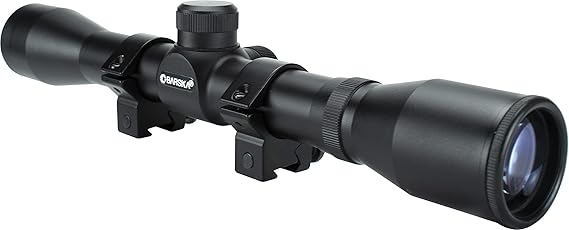
Anyone focused on precision benchrest shooting with a .22LR rifle will appreciate a straightforward and reliable scope like this one. It’s best suited for shooters looking for clear targeting at short to moderate distances and values consistent adjustments to fine-tune every shot.
Installation is simple, thanks to the included 3/8 dovetail rings that snugly fit most rimfire rifles. Once mounted, the 4x fixed magnification keeps the sight picture clear without being overly complex. Adjustments click at 1/4 MOA increments, giving control for minute changes that matter in benchrest shooting.
The parallax-free design at 50 yards means you don’t have to worry about reticle shifts at typical shooting distances.
The scope’s 30/30 reticle offers a clear aiming point with enough visibility to track the target without distraction. Its fully coated optics provide decent clarity under various light conditions.
The rugged build feels solid; it stands up to water, fog, and shocks, which adds longevity. Praise often mentions its accuracy and solid construction, while some note its limited 4x magnification and smaller 1 tube might restrict light gathering compared to larger scopes.
Barska Crosshair Reticle Rifle Scope offers clear optics and precise 1/4 MOA click adjustments that help with accurate aiming, especially with 22lr shooting. Its 4x magnification and parallax-free setting at 50 yards make it easy to hit close targets. However, some find the 1-inch tube a bit limiting for mounting options compared to larger diameters.
Shooters looking for an affordable and straightforward scope for benchrest and general target shooting will appreciate the clear 30/30 reticle and durable construction. Those wanting more zoom or advanced features like variable magnification or illuminated reticles might want to consider other models better suited for precision long-range shooting.
Pros
- 1/4 MOA click adjustments for precise tuning
- Parallax free at 50 yards for accurate close range
- Waterproof, fogproof, and shockproof rugged design
- Includes dovetail rings for easy mounting
Cons
- Fixed 4x magnification limits long-range use
- 1″ tube diameter may limit brightness in low light
| Specification | Details |
|---|---|
| Magnification Maximum | 4 x |
| Objective Lens Diameter | 32 millimeters |
| Reticle Type | Cross |
| Mounting Type | Dovetail Mount |
| Field Of View | 29 feet |
12. CVLIFE JackalHowl 4×32 Rifle Scope

Designed for benchrest shooting with .22LR rifles, the CVLIFE JackalHowl 4×32 stands out mainly for its Enhanced BDC reticle. It helps quickly zero in across various distances without messing with elevation turrets, making it a great fit for shooters wanting straightforward, accurate aiming up to 500 yards.
Setup is simple with a Picatinny mount, so attaching it feels secure and fast. The 3.9 inches (9.8 cm) of eye relief adds comfort during longer sessions without straining your eye.
Multi-coated lenses provide good clarity, which helps when lighting isn’t perfect, so you can easily spot targets without fussing over adjustments.
Performance shines due to the clear BDC aiming points designed for 200 to 500 yards, making distance shots more manageable without turret tweaks. The body is solid, giving confidence in durability. Clear optics deliver edge-to-edge sharpness.
Some users note the 4x magnification feels a bit limited for very distant targets, but that’s expected given the product specs.
Precision at set distances without adjusting elevation turrets is the top benefit here, making it straightforward to use during benchrest shooting. The main downside mentioned is the limited magnification, which means very distant targets might require a stronger scope.
Shooters focused on medium-range .22LR sessions with consistent distances will find this scope meets basic needs well. Those wanting higher power or larger optics for detailed distant shots may want to look beyond this model.
Pros
- Specialized BDC reticle for quick distance aiming
- Comfortable 3.9 inch eye relief for longer shooting
- Fully multi-coated lenses improve low-light visibility
- Easy to mount securely on Picatinny rails
Cons
- Maximum 4x magnification may limit long-range detail
- Objective lens diameter is relatively small at 20mm
| Specification | Details |
|---|---|
| Magnification Maximum | 4 x |
| Objective Lens Diameter | 20 millimeters |
| Eye Relief | 9.8 centimeters |
| Reticle Type | BDC |
| Mounting Type | Picatinny Mount |
Best Scope Reticles for 22LR Benchrest Shooting Comparison
| Product | Magnification Maximum | Objective Lens Diameter | Reticle Type | Eye Relief |
|---|---|---|---|---|
| Nightforce Precision 12-42×56 | 42x | 5.6 cm | NP-R2 | 7.5 cm |
| Vortex Triumph HD 3-9×40 | 9x | 40 mm | Dead-Hold BDC | – |
| Simmons Pro Rimfire 3-9×32 | 9x | 32 mm | Drop Zone | – |
| Primary Arms Classic 6×32 | 6x | 32 mm | MOA | 7.9 cm |
| Nightforce Precision 8-32×56 | 32x | 5.6 cm | Cross | 7.5 cm |
| Armstrong Rimfire 4-16×44 | 4x | 44 mm | Mil-Dot | – |
| Vector Optics Sentinel 10-40×50 | 40x | 50 mm | Etched | – |
| Caldwell Steady Rest NXT | – | – | – | – |
| Nightforce Competition 15-55×52 | 55x | 5.2 cm | CTR-3 | 8 cm |
| Vector Sentinel 10-40×50 | 40x | 50 mm | Illuminated Dot | – |
| Barska Crosshair Scope | 4x | 32 mm | Cross | – |
| CVLIFE JackalHowl 4×32 | 4x | 20 mm | BDC | 9.8 cm |
- Magnification Maximum42x
- Objective Lens Diameter5.6 cm
- Reticle TypeNP-R2
- Eye Relief7.5 cm
- Magnification Maximum9x
- Objective Lens Diameter40 mm
- Reticle TypeDead-Hold BDC
- Eye Relief–
- Magnification Maximum9x
- Objective Lens Diameter32 mm
- Reticle TypeDrop Zone
- Eye Relief–
- Magnification Maximum6x
- Objective Lens Diameter32 mm
- Reticle TypeMOA
- Eye Relief7.9 cm
- Magnification Maximum32x
- Objective Lens Diameter5.6 cm
- Reticle TypeCross
- Eye Relief7.5 cm
- Magnification Maximum4x
- Objective Lens Diameter44 mm
- Reticle TypeMil-Dot
- Eye Relief–
- Magnification Maximum40x
- Objective Lens Diameter50 mm
- Reticle TypeEtched
- Eye Relief–
- Magnification Maximum–
- Objective Lens Diameter–
- Reticle Type–
- Eye Relief–
- Magnification Maximum55x
- Objective Lens Diameter5.2 cm
- Reticle TypeCTR-3
- Eye Relief8 cm
- Magnification Maximum40x
- Objective Lens Diameter50 mm
- Reticle TypeIlluminated Dot
- Eye Relief–
- Magnification Maximum4x
- Objective Lens Diameter32 mm
- Reticle TypeCross
- Eye Relief–
- Magnification Maximum4x
- Objective Lens Diameter20 mm
- Reticle TypeBDC
- Eye Relief9.8 cm
How to Choose the Best Scope Reticle
Choosing the right scope reticle for 22lr benchrest shooting depends on clarity, fine aiming points, and minimal distraction to ensure precise targeting. Getting these factors right improves accuracy, reducing wasted time and costly mistakes during practice or competition.
Reticle Type and Design
Many shooters notice their reticle becoming difficult to see clearly as daylight fades or bright sun causes glare. A reticle with clean, sharp markings makes it easier to maintain precise holdover and windage corrections throughout a shooting session.
Thin lines can disappear against certain backgrounds, while overly thick ones block target details.
Reticles designed with simple crosshairs or fine duplex styles often provide the best balance between visibility and precision. Some offer illuminated points or subtensions to assist in low light.
Consistent visibility helps when making minute adjustments, avoiding guesswork that introduces errors at longer benchrest distances.
Compatibility with 22lr Ballistics
Shooters using .22 caliber rimfire rounds benefit from reticles that match typical bullet drop and drift at their chosen targets, usually between 50 and 100 yards. Reticle subtensions spaced appropriately allow for quick compensation based on experience or estimation charts without lifting the rifle.
Standard subtensions that correspond to common ballistic data for this cartridge simplify range and wind corrections. Designs that offer holdover marks at useful increments reduce the need for dial adjustments during each shot string, speeding up the process and enhancing consistency.
Optical Quality and Coatings
Sharpness and contrast of the reticle against the target can make a remarkable difference in aiming confidence. Lenses with good anti-reflective coatings reduce glare from sunlight or artificial lights, keeping the reticle crisp and the target clear.
Durable coatings maintain this clarity despite repeated cleaning or exposure to dust and moisture during field use. A reticle that stands out without washing out helps prevent squinting or eye strain after long periods on the bench.
Adjustment Mechanisms and Feedback
Adjustment knobs that provide firm, audible clicks give immediate feedback, letting the shooter know how far the point of impact will shift. Smooth, reliable mechanisms that hold zero prevent frustrating surprises after recoil or transport.
Graduations finely tuned to the reticle’s subtensions allow for precise and repeatable corrections. When dialing windage and elevation, consistent feedback backs up visual holdoff marks, keeping shot placement tight over multiple rounds.
Durability and Build Quality
Scopes that withstand the mild but repetitive recoil of rimfire rifles without reticle shift provide long-term reliability. Materials like aircraft-grade aluminum help maintain structural integrity under environmental stress such as moisture, dust, or temperature changes.
Etched reticles tend to last longer than wire ones as they resist bending or breaking. Strong construction means the scope can survive the occasional bump during transport or setup without losing accuracy, making for a dependable companion on the bench.
Optimizing Reticle Selection for Various Benchrest Shooting Conditions
Precision is key when selecting a scope reticle for benchrest shooting with a .22LR. The reticle should allow fine adjustments to hold the crosshairs steady on small targets at varying distances.
Different lighting and background conditions affect reticle visibility; for example, thin lines can disappear against dark backgrounds while thick lines can obscure tiny details on light surfaces.
Practical considerations include:
- Choosing reticles with varying line thickness for contrast adjustments depending on shooting environment.
- Using reticles with clear, evenly spaced hash marks to estimate holdover and windage without guesswork.
- Considering illuminated reticles when shooting in low-light or shaded areas to maintain visibility.
Matching the reticle style to your specific shooting setup and typical range conditions helps reduce aiming errors and improves shot consistency. Simple designs with useful reference marks usually work best for .22LR benchrest work.
Common Mistakes to Avoid When Using Reticles in 22LR Benchrest Shooting
Common errors weaken accuracy more than the reticle itself. One frequent mistake is relying too heavily on reticle marks for range estimation without verifying actual distances. The subtle bullet drop of a .22LR means small miscalculations can throw off point of impact.
Another issue is improper parallax adjustment. Neglecting to eliminate parallax can cause the reticle to shift against the target as the shooter’s eye moves, leading to inconsistent shots. Always set parallax specifically for the target distance.
Shooters often overlook windage influences, assuming the reticle’s center covers all conditions. Ignoring even light crosswinds causes invisible but impactful drift.
Using a reticle without practicing with it in various conditions also limits potential. Spend time understanding holdover points, their spacing, and how they compensate for common shooting variables.
Comparing Reticle Types: Duplex, Mil-Dot, and BDC for Precision Accuracy
The Duplex reticle features thick outer lines that narrow toward the center, providing a clear aiming point with minimal clutter. It’s straightforward and helps maintain focus on small targets, but lacks detailed hold marks for precision adjustments.
The Mil-Dot reticle includes a series of evenly spaced dots along the crosshairs. These dots assist in measuring distance and estimating bullet drop and wind drift without external tools. For .22LR benchrest shooting, this reticle can provide practical reference points to compensate for subtle trajectory changes over distance.
The BDC (Bullet Drop Compensation) reticle has hash marks calibrated for specific bullet trajectories at standard velocities. These presets may not always align perfectly with .22LR rounds due to their unique ballistic characteristics, requiring confirmation and adjustment by the shooter.
Choosing among these involves balancing simplicity against measurement capability. Mil-Dot tends to offer the best compromise for fine adjustments in 22LR benchrest shooting given its clear, quantifiable reference points.
People Also Asked
How Do I Choose the Right Scope Reticle Size for 22lr Benchrest?
Choose a reticle size that remains visible without overwhelming the target at typical 22lr benchrest distances, like a fine duplex or simple crosshair. Smaller reticles avoid obscuring small targets, and some shooters prefer subtensions to help with holdover and windage adjustments.
What Is the Proper Way to Clean and Care for a Reticle?
Clean your reticle gently using a soft brush or microfiber cloth to remove dust and avoid scratching the glass. Avoid applying too much pressure or using harsh chemicals; a bit of lens cleaner made for optics works best if needed.
Are Certain Reticle Styles Better for Long-Term Durability and Accuracy?
Reticles with etched glass tend to offer better durability and maintain accuracy over time compared to wire reticles. They hold zero better because they are less susceptible to movement and damage from recoil and handling.
How Do I Ensure My Reticle Is Compatible with My 22lr Scope?
Verify the reticle design comes with the scope manufacturer or matches your model’s specifications. Checking magnification range and whether the reticle adjusts properly with parallax is important for ensuring it works well on a 22lr setup.
What Common Problems Should I Watch for When Using a Reticle?
Watch for reticle drift or misalignment caused by improper mounting or continual adjustments. Also, poor illumination settings in low-light conditions can make the reticle hard to see, so ensure the brightness matches your shooting environment.
Conclusion
Choosing the right scope reticle for 22lr benchrest shooting comes down to clarity, precision, and ease of use. A reticle that allows for accurate windage and elevation adjustments without being cluttered is important.
The ability to make quick, precise shots and to clearly see the target during different lighting conditions also matters a lot.
Consider how close your shooting setup is, your budget, and how often you plan to shoot before making a choice. A practical reticle that fits your shooting distance and regular conditions will serve better than the most complex design. Check the comparison table and the detailed picks above to find what matches your needs best.