Top 12 Best Scope Reticle for Long Range Shooting Revealed!
Poor visibility and confusing markings can ruin a long-range shot, especially if the reticle isn’t suited for the task. The best scope reticle for long range shooting makes it simpler to estimate holdover and windage adjustments quickly, avoiding missed targets or wasted ammunition.
A reticle that’s cluttered or too faint often leads to frustrated seconds counting down while you fiddle with adjustments under pressure.
Durable etched glass reticles tend to hold up better under rough conditions than painted ones, staying clear despite weather or recoil over time. Clarity at higher magnifications, usually between 10x and 25x, matters because the reticle shouldn’t blur or distort your target image. The reticle’s design also affects aiming speed; mil-dot or MOA systems offer practical reference points for range estimation and bullet drop compensation, making calculations more straightforward in the field.
Need a Quick Check?
| Image | Product | Price |
|---|---|---|
Our Top Picks 1  | Vortex Triumph HD | Check Price |
Our Top Picks 2  | DISCOVERYOPT HD GEN2 | Check Price |
Our Top Picks 3  | CVLIFE EagleBlaze | Check Price |
Our Selected Top 12 Scope Reticle for Long Range Shooting Worth Buying
This list features carefully chosen scope reticles designed for long range shooting, highlighting their performance, ideal users, and key advantages and disadvantages. Each review provides clear information to help readers find the best option to match their shooting needs and preferences.
1. Vortex Triumph HD 3-9×40 Riflescope
Ideal for hunters who want reliable optics without fuss, the Vortex Triumph HD 3-9×40 riflescope focuses on clear visuals and simple setup. Its biggest strength lies in combining quality glass with an easy-to-use Dead-Hold BDC reticle, making it easy to trust in varied light conditions.
Setup is straightforward with the included 1 Hunter Rings, which sit low enough for most rifle setups. Day-to-day use benefits from fully multi-coated lenses that improve light transmission, helping you spot targets clearly even when light starts to fade. The neoprene case is handy for protecting the scope between outings.
Performance lives up to its design with sharp images and minimal chromatic aberration, maintaining clarity across the entire view. Build quality feels durable, and the optical system reliably delivers color accuracy.
Common praise highlights how bright and crisp the image stays, while some mention the 3-9x magnification range could feel limiting for very long-distance shots.
Users appreciate the bright, clear image quality and the simplicity of the Dead-Hold BDC reticle, while some find the max 9x magnification insufficient for very distant targets. The scope’s build supports reliable day-to-day hunting use without unnecessary complication.
This riflescope suits hunters needing dependable optics for mid-range shots and easy setup. Those aiming for extreme long-range precision might want to consider scopes offering higher magnification options and more specialized reticles.
Pros
- Sharp and color-accurate HD optical system
- Fully multi-coated lenses for improved clarity
- Simple setup with included low-height rings
- Includes protective neoprene case
Cons
- Magnification limited to 9x maximum
- Not ideal for extremely long-range shooting
| Specification | Details |
|---|---|
| Magnification Minimum | 3 x |
| Magnification Maximum | 9 x |
| Objective Lens Diameter | 40 millimeters |
| Reticle Type | Dead-Hold BDC |
| Mounting Type | Ring Mount |
| Compatible Devices | Rifle |
2. DISCOVERYOPT HD 5-30×56 GEN2 PRS FFP Rifle Scope
Long-range shooting demands precision in spotting your target and adjusting for distance and wind. A scope designed with a clear reticle and consistent zero can make all the difference. Ideal for shooters who need reliable adjustments and sharp visuals at varying distances, its standout feature is the combination of a 5-30x magnification range with a 34mm tube for extensive elevation and windage travel.
Setting up involves mounting it securely on a Picatinny rail and dialing in the zero stop for quick return points. The first focal plane MRAD reticle ensures ranging and holdover are accurate no matter the zoom level.
With 0.1 MRAD click adjustments on the turrets, you can fine-tune without overthinking. The fully multi-coated lenses retain clarity and performance even in low light, making day-to-day long-range shooting productive and straightforward.
Its primary job of delivering sharp images and precise target acquisition is fulfilled with a wide field of view and consistent zero stop feature. Built with a tough 34mm main tube, it is designed to hold up under heavy use.
The best part mentioned is how easily you can return to zero without looking. A few found the maximum magnification a bit challenging to keep steady, but the overall build and optical clarity receive solid praise.
Returning instantly to the setup zero without looking is praised most for saving time and reducing errors during long-range shots. Some users note that using the maximum magnification requires extra stability and can feel a little heavy on the rifle due to the 56mm objective lens size.
Shooters who value fine, repeatable adjustments and clear long-range reticles will appreciate this scope’s design and features. Those preferring lighter, simpler setups might want to consider smaller scopes with less magnification range.
Pros
- Clear MRAD reticle visible at all magnifications
- 34mm tube allows wide elevation and windage adjustment
- Zero stop turret returns precisely to baseline zero
- Fully multi-coated optics improve light transmission
Cons
- Maximum 30x magnification can be tricky to keep steady
- Bigger objective lens size adds some bulk on rifles
| Specification | Details |
|---|---|
| Magnification Minimum | 5 x |
| Magnification Maximum | 30 x |
| Objective Lens Diameter | 5.6 centimeters |
| Reticle Type | Mrad Ffp (first Focal Plane) |
| Mounting Type | Picatinny Mount |
| Field Of View | 25 feet |
3. CVLIFE EagleBlaze 5-25×56 FFP Rifle Scope
Magnification up to 25x makes it a solid choice for long-range shooting. Perfect for precision hunting and competition, it offers clear visuals and reliable holdovers thanks to the first focal plane illuminated reticle.
Its ability to maintain accuracy across zoom levels stands out for serious shooters.
Setting up involves mounting on a Picatinny rail, and the zero-stop feature lets you quickly return to zero after adjustments. Day-to-day use benefits from the crisp 1/4 MOA locking turrets that keep zero consistent despite recoil.
Illumination with six red levels helps acquire targets quickly, even when light is fading.
The glass clarity is impressive, with nearly 98% light transmittance and no edge distortion throughout the entire zoom. The build feels solid, offering precise and repeatable adjustments.
Reviews often highlight crystal-clear vision and reliable zero retention. A common downside is the somewhat smaller 34mm objective lens, which may limit light capture compared to larger scopes.
The most praised feature is the crystal-clear glass that maintains image clarity and sharpness throughout zooming. Consistent zero retention thanks to locking turrets is also a frequent highlight. On the downside, the 34mm objective lens size is often mentioned as a limit for shooting in very low light conditions.
Shooters requiring precise holdovers across varying distances will appreciate its reticle and magnification range. Those who prioritize maximum light gathering and low-light visibility might want to look at scopes with larger objective lenses to suit their needs better.
Pros
- Clear image with 98% light transmittance
- First focal plane keeps reticle accurate at all magnifications
- Locking turrets prevent zero shift under recoil
- Six brightness levels for red illumination
Cons
- Smaller objective lens limits low-light performance
- Turret reset process can be fiddly for some
| Specification | Details |
|---|---|
| Magnification Minimum | 5 x |
| Magnification Maximum | 25 x |
| Objective Lens Diameter | 34 millimeters |
| Reticle Type | Christmas-tree |
| Field Of View | 26.2 feet |
| Mounting Type | Picatinny Mount |
4. Arken Optics SH4J GEN2 6-24×50 FFP Rifle Scope
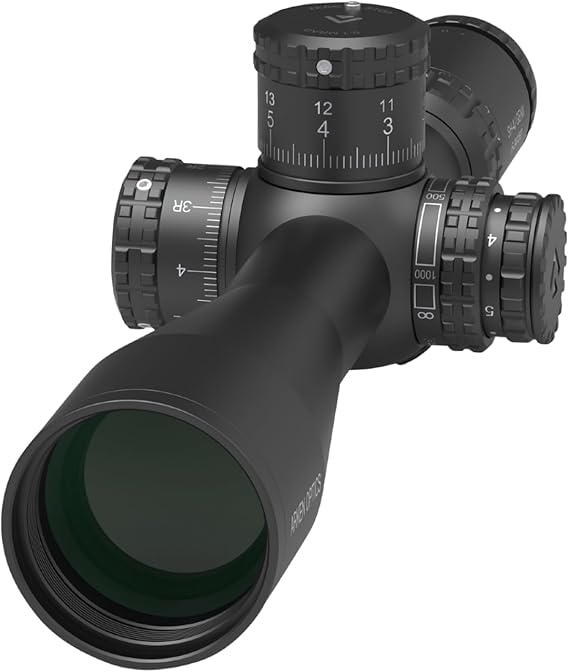
Long-range shooters looking for a reliable and clear first focal plane (FFP) scope will find the Arken Optics SH4J GEN2 6-24×50 suits their needs well. Its standout feature is the Japanese ELD glass, which offers excellent clarity and low-light visibility for precision shooting at extended distances.
Setting up the scope involves mounting on a rail mount easily, with quick parallax adjustment from the side knob, allowing you to fine-tune focus without breaking your shooting position. The zero stop mechanism ensures fast return to your zero setting, cutting down on readjustment time. The magnification range from 6x to 24x covers a wide scope of scenarios, whether target shooting or hunting.
Performance at long range is sharp and consistent thanks to the fully multi-coated lenses, improving light transmission and image brightness. Build quality feels sturdy with a simple but effective zero stop system. Praise often mentions the clarity and reliability, with a common downside noted in the larger objective lens making the scope a bit heavier to handle for some users.
Many appreciate the bright, clear sight picture delivered by the multi-coated lenses and Japanese ELD glass, making distant targets easier to spot even in low light. The durability and simplicity of the zero stop system are often praised. However, some mention the weight added by the 50mm objective lens can feel cumbersome during extended carry.
Shooters who need reliable clarity and quick reticle resets will be happiest with this scope. Those prioritizing lighter setups or requiring illuminated reticles may want to consider other options that better fit those specific needs.
Pros
- Excellent clarity with Japanese ELD glass
- Quick zero stop for fast reticle reset
- Easy parallax adjustment while shooting
- Wide magnification range 6-24x
Cons
- Larger 50mm objective adds noticeable weight
- No reticle illumination options available
| Specification | Details |
|---|---|
| Magnification Maximum | 24 x |
| Objective Lens Diameter | 50 millimeters |
| Magnification Minimum | 6 x |
| Reticle Type | VPR |
| Mounting Type | Rail Mount |
| Field Of View | 20.88 feet |
5. Monstrum G3 6-24×50 FFP Rifle Scope

Designed with long-range shooters in mind, the Monstrum G3 6-24×50 FFP Rifle Scope stands out for its first focal plane MOA reticle. This feature keeps ranging and holdover details accurate at all magnifications, making it ideal for targets beyond 1000 yards. It suits tactical and precision shooters who want quick, reliable adjustments without second-guessing their aiming points.
Setup involves mounting it on a Picatinny rail and adjusting the objective lens to eliminate parallax for clearer target focus. The reticle illumination controlled by an inline dial offers multiple brightness levels, helpful during low light conditions.
Daily handling feels balanced, and the zoom range makes it versatile for mid to long distances without overcomplicating adjustments.
The scope performs well in maintaining clarity and precision across its 6-24x magnification range. Built with a tactical focus, it feels sturdy yet manageable on the rifle.
Praise often goes to the clear reticle visibility and accurate MOA markings, while some users note that the 30 mm objective lens diameter limits light transmission compared to larger lenses.
The clear and constant ranging information on the first focal plane reticle gets praised for fast target acquisition and accurate holdover. Common criticism centers on the relatively small objective lens, which impacts brightness in dim conditions compared to larger scopes.
Those who hunt or shoot at targets beyond 1000 yards will appreciate the precision focus and reticle clarity here. Shooters needing maximum light transmission or a broader field of view might want to look at scopes with larger objective lenses instead.
Pros
- First focal plane MOA reticle stays accurate throughout zoom
- Adjustable objective lens eliminates parallax effectively
- Inline dial illumination with multiple brightness levels
- Wide magnification range suitable for varying distances
Cons
- Smaller 30 mm objective lens limits brightness in low light
- Field of view somewhat narrow at max magnification
| Specification | Details |
|---|---|
| Magnification Minimum | 6 x |
| Magnification Maximum | 24 x |
| Objective Lens Diameter | 30 millimeters |
| Reticle Type | MOA |
| Mounting Type | Picatinny Mount |
| Field Of View | 100 yard |
6. CVLIFE 6-24×50 AO Illuminated Rifle Scope

CVLIFE 6-24×50 AO Illuminated Rifle Scope suits shooters aiming for precision at long distances, standing out with its clear cross reticle and dual-color illumination. Best for those who want adjustable magnification and an easy-to-use scope for rifles and handguns. Its biggest strength lies in the 24x maximum magnification paired with red and green illumination options.
Setting it up is straightforward, thanks to the free mount design and a 1/4-20 UNC thread type. The 50mm objective lens lets in plenty of light, making the view crisp across various lighting conditions.
Adjusting magnification from 6x to 24x feels smooth, while the 1/8 inch click value helps dial in shots carefully. The 9cm eye relief keeps shooting comfortable without feeling cramped during use.
Performance-wise, it delivers solid accuracy through its cross reticle and reliable click adjustment. The build feels sturdy but lightweight. The illumination feature is often praised for low-light visibility, though some mention it could be brighter.
It performs well for most long-range needs, but a couple of users note the eye relief might not suit every shooter’s setup.
Many appreciate the clear cross reticle and versatile magnification for long-range accuracy. Some find the illumination insufficient in very dark conditions. Adjustment clicks allow precise targeting but the eye relief length limits comfort depending on firearm and shooting style.
Those needing a well-rounded scope with adjustable brightness and sharp image will be happy with it. Shooters who require stronger illumination or longer eye relief should consider other options. Fits best for enthusiasts using rifles or handguns wanting clarity within a reasonable budget.
Pros
- Adjustable red and green illumination
- High maximum magnification of 24x
- Detailed 1/8 inch click adjustments
- Compatible with rifles and handguns
Cons
- Illumination could be brighter
- Eye relief not ideal for all setups
| Specification | Details |
|---|---|
| Magnification | 6-24x |
| Objective Lens Diameter | 50 millimeters |
| Field Of View | 28 feet @ 100 yards |
| Click Value | 1/8 inch @ 100 yards |
| Reticle Type | Cross |
| Eye Relief | 9 centimeters |
7. SIG SAUER Tango-SPR 6-24x52mm Rifle Scope

Feeling confident in every shot is easy with this scope. It suits shooters who need reliable precision at long distances, thanks to its clear view and smart design. The biggest strength lies in its fast, no-guess elevation adjustments that keep you on target quickly.
Setting up is straightforward thanks to the exposed zero-stop elevation dial and capped windage turret. Day-to-day use is made simple by the dedicated controls for side focus, elevation, and windage, allowing you to tune your aim just right. The removable magnification throw lever adds convenience, especially when shifting between 6x and 24x zoom during shooting sessions.
Built to last, it handles rough conditions without losing clarity or accuracy. The MOA BDC-1 reticle keeps shots precise even at longer ranges. The main praise centers on the sharp and bright image the scope provides, while occasional users mention it could be a bit bulky for smaller rifles.
Sharp clarity and reliable adjustments make this scope stand out for serious accuracy, while some find the size a bit heavy for smaller rifles. Controls are well designed but might require a learning curve for quick focus.
Shooters prioritizing pinpoint accuracy and rugged build will appreciate this scope, especially for longer distance shots. Those needing a lighter or simpler option might want to consider different models that better fit smaller setups.
Pros
- Clear and bright imaging for long-range precision
- Locking zero-stop for quick, confident elevation adjustments
- Removable magnification throw lever for fast zoom changes
- Durable 30mm maintube construction
Cons
- Can feel bulky on lighter rifles
- Side focus may take time to master
| Specification | Details |
|---|---|
| Magnification Maximum | 24 x |
| Objective Lens Diameter | 5.2 centimeters |
| Magnification Minimum | 6 x |
| Mounting Type | Picatinny Mount |
| Reticle Type | MOA BDC-1 |
8. Monstrum Beast 6-24×50 Rifle Scope

Great for long-range shooting, the Monstrum Beast 6-24×50 Rifle Scope offers impressive magnification and a bright fiber optic reticle that suits shooters looking for precision in varied light conditions. Its standout feature is the daylight-bright center dot, which keeps aiming quick and accurate.
Setting up the scope feels straightforward, thanks to the side focus parallax adjustment dial that sharpens the target image and aids in eliminating parallax errors. The scope covers 6 to 24 times magnification, allowing clear observation of distant targets, while the 50mm objective lens brings in plenty of light and a wide field of view. Fiber optic reticles deliver a clear, illuminated aiming point without extra battery needs.
Performance on long-range shots holds up well, delivering sharp imagery and a reticle that remains visible in daylight. Its build quality supports rugged use with a stable cantilever mount that fits rifles and shotguns securely. The most praised feature is the brightness and clarity of the illuminated dot, while some mention that high magnification settings can require careful adjustment to maintain focus.
The bright fiber optic reticle receives high praise for quick target acquisition in daylight. Users also highlight the parallax adjustment dial’s role in improving target clarity. Common feedback points to the challenge of maintaining sharp focus at the maximum 24x magnification, requiring some patience and fine-tuning.
Shooters needing a versatile scope for long-range precision will appreciate this optic’s light-gathering capability and adjustable reticles. Those prioritizing the easiest possible focus at highest magnifications or needing other mounting styles might want a different model.
Pros
- Bright fiber optic dot visible in daylight
- Wide 50mm objective lens for more light
- Side focus adjustment for parallax elimination
- Multiple reticle options available
Cons
- High magnification requires careful focus adjustment
- Limited to cantilever mounting style
| Specification | Details |
|---|---|
| Magnification Minimum | 6 x |
| Magnification Maximum | 24 x |
| Objective Lens Diameter | 50 millimeters |
| Reticle Type | Dot |
| Mounting Type | Cantilever Mount |
| Thread Type | 1/2″-20 UNC |
9. CVLIFE 3-9×40 R4 Reticle Rifle Scope

Constructed with a solid free mount design, this scope suits shooters looking for versatility between 3 and 9 times magnification. Its biggest strength lies in the R4 crosshair reticle, ideal for long-range targeting with simple adjustments and clear visuals.
Setup involves mounting it easily on most rifles with the standard 1/4-20 UNC threads. Day-to-day use benefits from the 40-millimeter objective lens, providing good light gathering while maintaining a compact length of 12.20 inches.
The field of view covers 300 degrees, helping track moving targets without strain, and the exit pupil of 0.2 keeps the image steady at higher magnifications.
It performs well in delivering sharp and accurate aiming thanks to the R4 reticle and 9x maximum magnification. The scope’s build feels sturdy enough for regular use, though some mention the body could be lighter. Clear optics stand out as a plus, but the lower exit pupil size sometimes causes a slightly dimmer image in low light conditions.
Many appreciate the clear and simple R4 reticle that helps in precise long-range shots, though the slightly small exit pupil can make images less bright in dim conditions. The scope’s weight is a frequent drawback for those who want something lighter for extended use.
Shooter looking for solid magnification control and easy mounting will find this scope suits their needs well. Those who hunt in low light regularly or prefer super lightweight gear might want to consider options with larger exit pupils or lighter materials.
Pros
- Adjustable magnification from 3 to 9 times
- Clear R4 crosshair reticle for targeting
- Wide 300-degree field of view
- Compact 12.20-inch length fits most rifles
Cons
- Exit pupil size 0.2 can limit low light clarity
- Build feels heavier than some expect
| Specification | Details |
|---|---|
| Magnification | 3-9x |
| Objective Lens Diameter | 40 millimeters |
| Length | 12.20 inches |
| Field Of View | 300 degrees |
| Reticle Type | R4 Crosshair |
10. KT12 60x60SAL Long Range Rifle Scope

High magnification stands out immediately, making this scope ideal for those focused on extreme long-range shooting. Suited for rifles that require precision at various distances, it shines with crystal clear optics and adjustable reticle illumination that supports accuracy in different light conditions.
Setting up involves attaching it to a Picatinny Mount, and the side parallax adjustment lets you fine-tune focus from 30 yards out to infinity, which simplifies target acquisition at multiple ranges. The eye relief of 10.9 centimeters keeps shooting comfortable, and the 12-60x magnification range handles anything from mid- to long-range shots.
Red and green illuminated reticle settings with various brightness levels add convenience when shooting in low light.
Performance-wise, the scope delivers sharp images thanks to its large 60mm objective lens allowing excellent light transmission. The glass-etched MIL reticle holds up well and offers precise markings for range estimation and holdover. The construction feels solid and durable, but some mention the heft could be challenging for extended carry.
Most praise its clarity and magnification, while a few note it demands careful handling due to its size and weight.
Crystal clear optics and a bright, adjustable reticle make target acquisition precise and reliable. The scope’s weight and size require patience when carrying or mounting, but its optical quality often outweighs these factors.
Shooting enthusiasts needing high magnification and detailed reticle options will appreciate this scope. Those prioritizing lightweight gear for fast movement might want to consider more compact alternatives.
Pros
- Wide magnification range from 12x to 60x
- Side parallax adjustment for precise focusing
- Illuminated red and green reticle with brightness control
- Durable glass etched MIL reticle
Cons
- Relatively heavy and bulky for some shooters
- Requires careful handling due to size
| Specification | Details |
|---|---|
| Magnification Minimum | 12 x |
| Magnification Maximum | 60 x |
| Objective Lens Diameter | 6 centimeters |
| Eye Relief | 10.9 centimeters |
| Reticle Type | MIL |
| Mounting Type | Picatinny Mount |
11. Vortex Venom First Focal Plane Riflescope

Vortex Venom First Focal Plane Riflescope suits long-range shooting and competition with its wide 5-25x magnification and a 34mm tube. Its biggest strength lies in its extensive turret travel, offering 85 MOA of max elevation and windage adjustment for precise targeting at distance.
Setting up the scope is straightforward thanks to the RevStop Zero System that ensures a reliable and quick return to zero after adjustments. The side knob parallax adjustment is user-friendly, showing range numbers clearly during use. Its wide magnification range and clear sight picture make it easy to adapt to varying distances in real conditions.
Optical clarity is impressive due to the XD Optical System, delivering sharp images edge to edge while reducing chromatic aberration. The build feels solid with fully multi-coated lenses that maintain good light transmission even in low-light settings. A common complaint involves the size and weight, which can be bulky on some rifle setups.
Optical performance stands out with sharp and clear visuals, while the scope’s size and weight tend to be the main drawbacks for those seeking lighter setups. The quick zero return and wide turret range support precision at long distances.
Ideal for shooters who prioritize adjustment range and optical clarity, especially in competition or long-range contexts. Those needing a lighter or more compact scope should consider alternatives better suited to their platform and carry preferences.
Pros
- Wide 5-25x magnification suitable for varied distances
- Large turret travel with 85 MOA max elevation/windage
- Clear edge-to-edge optical sharpness with reduced chromatic aberration
- RevStop Zero System allows fast, reliable zero resets
Cons
- Bulkier size may not suit all rifle platforms
- Side knob parallax might be less intuitive for some users
| Specification | Details |
|---|---|
| Magnification Maximum | 25 x |
| Objective Lens Diameter | 5.6 centimeters |
| Magnification Minimum | 5 x |
| Mounting Type | Cantilever Mount |
| Eye Relief | 9.1 centimeters |
| Reticle Type | EBR-7C |
12. DISCOVERYOPT ED-PRS GEN II 5-25×56 FFP Rifle Scope

Long-range shooting demands precision and clear sighting, especially when light starts to fade. Designed for shooters who want both power and clarity, the DISCOVERYOPT ED-PRS GEN II 5-25×56 FFP Rifle Scope offers a wide range of magnification with exceptional glass quality, making distant targets easier to spot and hit in changing light conditions.
Setting up the scope is straightforward using a Picatinny mount. The 34mm aircraft-grade aluminum tube feels sturdy and adds confidence when carrying and handling the rifle.
Sorting out the reticle, the Christmas Tree style is intuitive for long-range adjustments, and the scope’s maximum 25x magnification delivers a close, sharp view. The size of the objective lens at 5.6 centimeters lets in plenty of light, which really helps in dawn or dusk shooting sessions.
Performance delivers as expected for competition or extreme long-distance work. The 36 MRAD maximum elevation travel gives plenty of adjustment room to dial precise shots well beyond typical ranges.
Optical clarity stays crisp from center to edges thanks to the premium Japanese ED glass, making spotting easier without color distortion. The strongest praise lies in its sharp, bright optics, while the most common gripe is that the scope’s size and weight might be bulky for some setups.
The sharpness and brightness from the fully multi-coated Japanese glass receive strong praise for spotting and target clarity, especially in low light. A common complaint is the overall size and weight, which can feel cumbersome on lighter rifle setups.
Shooters focused on extreme long-range or competition scenarios will appreciate the wide adjustment range and optical quality. Those needing a more compact, lightweight scope for fast handling may want to consider smaller models instead.
Pros
- Clear edge-to-edge optics with Japanese ED glass
- Wide 36 MRAD elevation adjustment range
- The main tube is made from sturdy 34mm aluminum.
- Large 5.6 cm objective lens for low-light use
Cons
- Relatively bulky and heavy for some rifles
- High magnification can reduce field of view
| Specification | Details |
|---|---|
| Magnification Minimum | 5 x |
| Magnification Maximum | 25 x |
| Objective Lens Diameter | 5.6 centimeters |
| Reticle Type | Christmas Tree |
| Mounting Type | Picatinny Mount |
| Field Of View | 24.6 feet |
Best Scope Reticles for Long Range Shooting Comparison
| Product | Magnification Max | Objective Lens Diameter | Reticle Type | Mounting Type |
|---|---|---|---|---|
| Vortex Triumph HD | 9x | 40 mm | Dead-Hold BDC | Ring Mount |
| DISCOVERYOPT HD GEN2 | 30x | 56 mm | Mrad Ffp | Picatinny Mount |
| CVLIFE EagleBlaze | 25x | 34 mm | Christmas-tree | Picatinny Mount |
| Arken Optics SH4J | 24x | 50 mm | VPR | Rail Mount |
| Monstrum G3 | 24x | 30 mm | MOA | Picatinny Mount |
| CVLIFE AO Illuminated | 24x | 50 mm | Cross | Free Mount |
| SIG SAUER Tango-SPR | 24x | 52 mm | MOA BDC-1 | Picatinny Mount |
| Monstrum Beast | 24x | 50 mm | Dot | Cantilever Mount |
| CVLIFE R4 3-9×40 | 9x | 40 mm | R4 Crosshair | Free mount |
| KT12 60x60SAL | 60x | 60 mm | MIL | Picatinny Mount |
| Vortex Venom FFP | 25x | 56 mm | EBR-7C | Cantilever Mount |
| DISCOVERYOPT ED-PRS GEN2 | 25x | 56 mm | Christmas Tree | Picatinny Mount |
- Magnification Max9x
- Objective Lens Diameter40 mm
- Reticle TypeDead-Hold BDC
- Mounting TypeRing Mount
- Magnification Max30x
- Objective Lens Diameter56 mm
- Reticle TypeMrad Ffp
- Mounting TypePicatinny Mount
- Magnification Max25x
- Objective Lens Diameter34 mm
- Reticle TypeChristmas-tree
- Mounting TypePicatinny Mount
- Magnification Max24x
- Objective Lens Diameter50 mm
- Reticle TypeVPR
- Mounting TypeRail Mount
- Magnification Max24x
- Objective Lens Diameter30 mm
- Reticle TypeMOA
- Mounting TypePicatinny Mount
- Magnification Max24x
- Objective Lens Diameter50 mm
- Reticle TypeCross
- Mounting TypeFree Mount
- Magnification Max24x
- Objective Lens Diameter52 mm
- Reticle TypeMOA BDC-1
- Mounting TypePicatinny Mount
- Magnification Max24x
- Objective Lens Diameter50 mm
- Reticle TypeDot
- Mounting TypeCantilever Mount
- Magnification Max9x
- Objective Lens Diameter40 mm
- Reticle TypeR4 Crosshair
- Mounting TypeFree mount
- Magnification Max60x
- Objective Lens Diameter60 mm
- Reticle TypeMIL
- Mounting TypePicatinny Mount
- Magnification Max25x
- Objective Lens Diameter56 mm
- Reticle TypeEBR-7C
- Mounting TypeCantilever Mount
- Magnification Max25x
- Objective Lens Diameter56 mm
- Reticle TypeChristmas Tree
- Mounting TypePicatinny Mount
How to Choose the Right Scope Reticle
Choosing a good scope reticle for long range shooting depends on factors like clarity, precision markings, and ease of use in different light conditions. Picking the right features prevents costly mistakes and ensures accurate targeting, saving time and frustration during actual shooting.
Reticle Type and Design
Choosing between mildot, MOA, BDC, or other reticle styles comes down to your preferred way of estimating range and making quick shots. For someone relying on mil-dots, consistent subtensions let you calculate distance using the known size of an object, which can save time compared to BDC reticles that match bullet drop at specific distances.
More complex reticles with extra markings mean slower target acquisition; a simple duplex or a basic mildot often works better in fast-paced situations.
An illuminated reticle can improve visibility in low light but adds complexity and battery dependence. The brightness levels should be sufficient but not overpowering, avoiding glare. Practically, mildot or MOA styles combined with lightweight illumination offer a balance between precision and usability.
Reticle Subtensions and Adjustments
Reticle subtensions are critical for making precise holdovers and windage corrections without guessing. For example, a reticle with clear 0.1 or 0.2 mil or MOA increments allows you to adjust your aim based on observed data, reducing the chance of off-target shots in the field.
Lack of clear markings or uneven spacing often leads to miscalculations.
Look for reticles where the subtensions match your turret adjustments, so dialed clicks correspond directly to reticle marks. Some reticles even allow quick range estimation by counting hashes, avoiding complex math.
Testing compatibility with your scope’s knobs can save time and frustration during actual shooting situations.
Compatibility with Glass and Magnification
The reticle must remain clear and sharp across your scope’s full magnification range. A reticle designed for high magnification can become too cluttered at low power, while a simple reticle may blur at max zoom. Optics with quality lens coatings improve light transmission, so reticles with clean, non-distorting lines perform best.
It’s important that reticle details do not distort or become pixelated as you zoom. Reticles etched into the glass provide consistent performance, whereas some projected reticles can shift or lose clarity. Checking that your reticle and scope magnification work well together influences target acquisition and shot precision.
Illumination and Battery Life
Adjustable brightness illumination is vital for adapting to changing light. A single illumination level either appears too bright in dark or too dim in twilight. Easy access controls prevent fumbling during a shot, so a tactile dial or button placement matters when you need fast adjustments.
Battery life is often overlooked but crucial. Lithium batteries generally last longer under typical daytime and low-light use.
Reticles with power-saving modes or automatic shutoff help extend operating time, while user-replaceable batteries avoid relying on specific tools or parts.
Durability and Build Quality
Long-range shooting equipment faces repeated recoil and exposure to weather, so reticle durability depends on material and manufacturing quality. Etched reticles tend to outlast digitally projected ones, which might lose alignment or fail after impacts. Metal housings and sealed scopes protect internal parts from moisture and dust.
Reticles resistant to fogging and corrosion ensure performance consistency in cold, humid, or rainy conditions. Pay attention to scope ratings for waterproofing and fog proofing. A rugged design means fewer surprises and better reliability during real-use scenarios outdoors.
Optimizing Reticle Adjustments for Enhanced Accuracy
Having the right reticle adjustment is essential for making precise long-range shots. Most scopes offer windage and elevation knobs that let you zero in on your target by making small, measurable changes. Each click usually corresponds to a fraction of a minute of angle (MOA) or milliradian (mil), so knowing your scope’s increment helps in making exact corrections at various distances.
To optimize accuracy:
- Zero your scope at a specific distance to create a reliable baseline.
- Record how many clicks it takes to adjust for common distances beyond zero.
- Use holdover marks or reticle hash marks calibrated to those increments for follow-up shots without dialing.
Consistent reticle adjustments combined with a reticle designed for clear reference points create predictability in aiming, which is key when shooting at longer ranges.
Common Mistakes to Avoid When Using Long Range Scopes
Many shooters underestimate how environmental factors affect scope performance. One common mistake is neglecting to account for wind speed and direction, which can cause shots to drift significantly over long distances.
Another issue involves improper mounting of the scope. Even slight tilts or loose mounts can cause inconsistent shots and difficulty maintaining zero. Consistent cheek weld on the stock also plays a critical role; inconsistent head positioning changes your eye’s relationship to the reticle and can lead to aiming errors.
Other things often overlooked include:
- Failing to calibrate the reticle for bullet drop and velocity specific to your load.
- Adjusting without returning the turret to zero after corrections, leading to confusion in settings.
- Not confirming parallax adjustment to ensure the target image and reticle are aligned.
Avoiding these mistakes results in more reliable and repeatable long-range shots.
Comparing Reticle Types: Mil-Dot vs. MOA for Precision Shooting
Mil-dot and MOA reticles serve similar purposes but differ in how they quantify adjustments, which affects shooter preference and application. Mil-dot reticles use milliradians (1 mil equals 3.6 inches at 100 yards), making them popular for military and tactical shooters due to their metric system compatibility and ease of use in range estimation.
MOA reticles are based on minutes of angle, where 1 MOA roughly equals 1 inch at 100 yards, favored by hunters and competitors who find this increment intuitive, especially in US customary units. Both provide reference points for holdover and windage corrections, but their scales are not interchangeable, so choosing between them depends on the shooter’s familiarity and the measurement system they prefer.
Practical use shows:
- Mil-dot reticles require quick mental or tool-assisted conversion for precise adjustments.
- MOA reticles offer straightforward numerical adjustments for ranges commonly used in sport shooting.
Understanding these differences helps in selecting the reticle type that suits your shooting style and environment.
People Also Asked
How Do I Properly Care for My Long Range Scope Reticle?
Keep the scope clean and dry, and avoid touching the glass with fingers to prevent smudges. Regularly inspect the reticle for dirt or moisture inside the tube, which may require professional servicing to fix.
What Reticle Size Works Best for Precision Long Range Shooting?
Smaller, thin reticles are better for precision shooting because they don’t block the target. A fine crosshair or a mil-dot reticle helps with accurate holdovers without obscuring details at long distances.
Are There Safety Concerns Using Illuminated Reticles on Scopes?
Using illuminated reticles at high brightness in dark environments can strain your eyes and potentially cause distraction. Lower illumination levels or turning them off in bright daylight prevents unnecessary battery drain and maintains clear target visibility.
How Do I Ensure My Reticle Is Compatible with My Rifle?
Check the reticle’s calibration matches your rifle’s ballistic profile and mounting system. Matching the reticle design, like mil-dots or MOA, with your rifle’s range-finding tools ensures consistent adjustments and accuracy.
What Common Problems Affect the Longevity of Scope Reticles?
Exposure to moisture inside the scope, rough handling, and extreme temperature changes often cause the reticle to shift or become blurry. Protecting the scope with proper storage and avoiding impacts helps keep the reticle intact over time.
Conclusion
Choosing the right scope reticle for long range shooting comes down to clarity, the ability to hold for wind and elevation adjustments, and personal comfort with the reticle’s design. A simple, uncluttered reticle helps you focus on the target without distraction. Having marks that allow quick compensations for distance and wind conditions can make a significant difference in accuracy.
Consider your shooting environment, how frequently you’ll use the scope, and your budget when making a final decision. A reticle that fits your specific needs will serve better than one that looks good on paper but doesn’t match your setup. Review the comparison table and the detailed picks above to find the right balance for your long range shooting style.