Top 12 Best Budget Radios That Will Blow Your Mind!
Buying cheap radios often turns into a disappointment when the sound cuts out or the device stops working after a short time. The best budget radios manage to avoid those common issues by focusing on reliable reception and durable construction.
Radios that sound fuzzy or have inconsistent signal strength usually come from low-quality components that save money but sacrifice performance.
What matters most for best budget radios is solid material quality, speaker efficiency, and battery life. Radios with metal or sturdy plastic cases tend to last longer than flimsy models. A speaker diameter around 3 inches often provides clear audio without distortion, and power consumption should allow at least 6 to 8 hours of continuous use on standard AA batteries.
Portability and simple controls also play a crucial role since these radios are often used outdoors or on the go.
Need a Quick Check?
| Image | Product | Price |
|---|---|---|
Our Top Picks 1  | Generic AM/FM Radio | Check Price |
Our Top Picks 2  | PRUNUS J03 Radio | Check Price |
Our Top Picks 3  | Bluetooth AM/FM Shortwave | Check Price |
Our Selected Top 12 Budget Radios for Every Budget
This list features twelve affordable radios chosen for their reliability and performance across various uses. Each review details how well the radio works, who it is best suited for, and highlights its main advantages and disadvantages to help you make an informed choice.
1. Portable AM/FM Transistor Radio
Portable AM/FM Transistor Radio offers solid signal reception across AM, FM, and shortwave bands, making it ideal for anyone who enjoys listening to music, talk shows, or news on the go without breaking the bank. Its biggest strength lies in its ability to catch a wide range of frequencies clearly thanks to its DSP anti-jamming chip and telescopic antenna.
Setup is straightforward with a rechargeable lithium-ion battery included, powered via USB, so carrying spare batteries isn’t necessary. Day-to-day use involves simply extending the telescopic antenna to improve reception and tuning across FM (88-108 MHz), AM (530-1710 kHz), and shortwave (2.8-22 MHz) bands.
The clear 5W speaker delivers volume and sound quality good enough for casual listening in different environments.
Reception is the defining feature, with the DSP chip reducing interference for clearer audio across all supported bands. The build is compact and portable, though not water-resistant, so care is needed in damp conditions. The clearest praise focuses on strong signal reception and solid audio, while the common complaint involves the lack of water resistance and sometimes limited battery life in extended use.
Radio listens clearly on AM, FM, and shortwave thanks to the DSP chip and antenna. Common drawback is its sensitivity to moisture as it lacks water resistance. Battery power offers convenience but may not last enough for very long sessions without recharging.
Great choice for people wanting broad band coverage and portability without spending much. Avoid if radio use is frequently outdoors in wet or very rugged environments where durability and longer battery life are critical.
Pros
- Catches wide range of frequencies clearly
- Rechargeable lithium-ion battery included
- Clear 5W speaker for good audio quality
- Portable with telescopic antenna for strong signals
Cons
- Not water resistant, needs careful handling
- Battery life can be limited during extended use
| Specification | Details |
|---|---|
| Radio Bands Supported | 4-Band (AM/FM/SW1/SW2) |
| Frequency Range | FM 88-108 MHz, AM 530-1710 kHz, SW 2.8-22 MHz |
| Power Source | Battery Powered (1 Lithium Ion battery included) |
| Speaker Output | Clear 5W Speaker |
| Connectivity | USB |
| Display Type | LED, LCD |
2. PRUNUS J03 AM/FM Portable Radio
Compact and lightweight, this AM/FM radio fits perfectly into daily routines and outdoor moments. Ideal for those who want dependable radio access both at home and on the go, its standout feature is the choice to operate via AC plug or batteries, offering real flexibility.
Setup involves a simple plug-in or inserting 4 AA batteries, not included, making it ready for indoor or outdoor use quickly. The foldable handle feels sturdy, which helps when carrying it to a park or along on a road trip. Connecting headphones is straightforward through the headphone jack, allowing for private listening sessions.
Sound quality covers the essentials with a 5-watt speaker output that’s clear enough for casual listening. The small but solid build feels durable despite not being water resistant.
Most praise focuses on how portable and easy the radio is to handle, while the main downside is that you need to provide your own batteries, which can be inconvenient.
Users often highlight the radio’s portability and flexible power options as major benefits, with some frustration over having to supply their own batteries. The compact size and ease of carrying make it convenient, but it lacks water resistance for risky outdoor conditions.
Those looking for a straightforward, lightweight radio for casual indoor or dry outdoor settings will find this suitable. People needing something durable for wet or rough environments might want to explore waterproof or rugged models instead.
Pros
- Runs on AC power or 4 AA batteries
- Compact size with foldable handle
- Simple headphone connectivity
- Lightweight at just 20.8 oz
Cons
- Batteries not included
- No water resistance
| Specification | Details |
|---|---|
| Power Source | Battery Powered |
| Number of Batteries | 4 AA batteries required |
| Speaker Maximum Output Power | 5 watts |
| Voltage | 110 volts_of_alternating_current |
| Radio Bands Supported | 2-Band |
3. Bluetooth AM/FM Shortwave Radio
Great for budget-minded folks who want more than just basic radio reception, this portable Bluetooth AM/FM Shortwave Radio handles multiple bands well and includes handy NOAA weather alerts. It’s especially useful for those who like to keep updated on weather events while on the go or camping.
Setting it up involves inserting the included LR44 batteries or using the rechargeable option, so you have flexibility. Switching between AM, FM, Shortwave, and Weather Band is straightforward on the digital tuner display.
Bluetooth connectivity makes pairing with headphones or speakers easy, and the built-in flashlight adds a practical touch for nighttime use or emergencies.
Reception is solid across the four bands, catching faint stations that many basic radios miss, thanks to the DSP chip. The device feels fairly sturdy and compact, suited for travel. Users often appreciate the clear NOAA weather alerts, while the most frequent downside mentioned is that the buttons can be a bit small and tricky to press for some fingers.
Clear reception across AM, FM, shortwave, and weather band makes it reliable for receiving distant and local stations, plus NOAA alerts offer practical safety notices. Some find the compact buttons fiddly, which can slow down quick tuning or settings changes during use.
Good fit for travelers, campers, or anyone needing a compact radio with multiple bands and alerts. Not ideal if you require easy button access or prefer radios powered by standard batteries for convenience.
Pros
- Supports 4 radio bands including shortwave and weather band
- Bluetooth lets you connect headphones or external speakers
- NOAA weather alerts keep you informed of emergencies
- Built-in flashlight useful in dark environments
Cons
- Small buttons can be difficult to operate
- Relies on LR44 batteries or recharge, no standard AA/AAA
| Specification | Details |
|---|---|
| Radio Bands Supported | 4-Band (FM87-108MHz, AM520-1710 KHZ, SW 4.75-21.85MHZ, WB162.400-162.550MHZ) |
| Connectivity Technology | Bluetooth |
| Additional Features | NOAA Weather Alert, Rechargeable, Built-In Flashlight, Digital Tuner, Portable |
| Audio Output Mode | Stereo |
| Number of Batteries | 2 LR44 batteries required (included) |
4. XHDATA D220 Portable Shortwave Radio
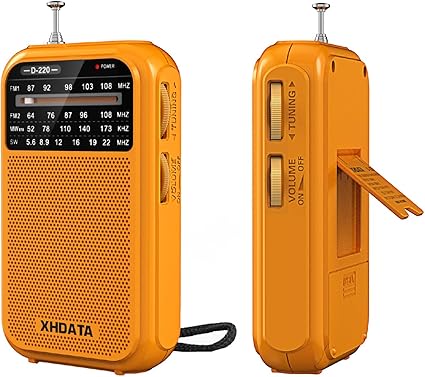
Compact plastic build keeps the radio lightweight and very portable. Great for anyone wanting access to AM, FM, and shortwave bands on the go without carrying a bulky device. Its single biggest strength is how easy it is to carry and use anywhere, fitting right into your pocket or bag.
Setup involves just inserting AA batteries and switching it on using the volume and power button. Tuning is done with a simple knob, and changing bands is a one-button step, making it simple for all ages to operate.
The three control buttons keep things straightforward so you can quickly find your favorite stations without fuss.
Reception covers FM, AM, and SW, offering a good range including two FM bands from 64-108 MHz and AM up to 1730 KHz. Signal quality is dependable for its size, especially on FM.
Construction feels sturdy with shockproof and dust-resistant features, but it isn’t water resistant. Most users praise its portability and clear sound while some note signal struggles on weaker bands.
Users often highlight how easy it is to carry and operate with straightforward buttons, making tuning quick and accessible. However, some experience difficulties with weak signals, especially on certain AM and shortwave bands.
Compact size and simple interface will appeal to those wanting a portable radio for casual listening outdoors or while traveling. Anyone needing stronger signal reception or water resistance might want to explore other options.
Pros
- Lightweight and pocket-sized for easy portability
- Simple controls suited for all ages
- Covers AM, FM, and shortwave frequencies
- Dust-resistant and shockproof build
Cons
- Not water resistant
- Signal reception can be weak on some bands
| Specification | Details |
|---|---|
| Radio Bands Supported | 3-Band, FM, AM, SW |
| Frequency | 108 MHz |
| Power Source | Battery Powered (AA batteries required) |
| Audio Output Mode | Stereo |
| Hardware Interface | 3.5mm Audio |
| Size & Weight | 125*74*30mm, 125g (without batteries) |
5. MOICO 22-Channel FRS Walkie Talkies

Clear communication is what stands out most with these walkie talkies, ideal for outdoor trips or keeping in touch in busy places. Their biggest strength lies in a wide selection of channels and privacy codes, letting you avoid interference and maintain your own conversation space.
Getting started is simple, with 22 FRS channels and plenty of privacy tones to choose from. The VOX hands-free function means you can talk without pressing buttons, handy when your hands are full. A digital display and keypad lock help keep settings steady during use.
They’re lightweight and water-resistant, making them easy to carry and durable against light weather or accidental drops.
Communication works smoothly up to about 3 miles, with clear sound through the UHF frequency range. The casing feels solid and shockproof, good for outdoor environments.
Most enjoy how long the batteries last, roughly 12 hours with 4 AAA batteries. Some mention the range can fall short in more obstructed areas, but the build quality and voice clarity get consistent praise.
Clear voice transmission and an impressive variety of channels with privacy codes are standout features, while range limits in areas with obstacles are frequently mentioned. The 12-hour battery life offers solid usage time, but the need for multiple AAA batteries could be inconvenient for some.
Anyone needing reliable, hands-free communication on outdoor trips or busy settings will find these walkie talkies a good fit. Those requiring longer range or rechargeable power might prefer other options.
Pros
- Plenty of channel and privacy tone options
- Voice-activated communication with adjustable sensitivity
- Lightweight and water-resistant design
- Digital display and keypad lock included
Cons
- Range drops in obstructed environments
- Requires 4 AAA batteries to operate
| Specification | Details |
|---|---|
| Number of Channels | 22 |
| Talking Range Maximum | 3 miles |
| Battery Average Life | 12 hours |
| Power Source | 4 AAA batteries |
| Water Resistance Level | Water Resistant |
| Additional Features | Digital Display, Keypad Lock, Lightweight, Shockproof |
6. PRUNUS J-166 Portable AM/FM Radio

Small size and easy portability are key reasons to go for this radio, great for anyone wanting a simple, compact AM/FM device. Its ability to clip onto clothing or hang from a lanyard makes it an ideal choice for outdoor walks or keeping in an emergency kit.
Setup consists of inserting 2 AA batteries, then tuning in with a mechanical dial. The lightweight unit fits comfortably in one hand and clips securely to a pocket. Listening through headphones or earphones is simple thanks to the 3.5mm audio jack.
Controls are straightforward, making it a no-fuss option for casual use during exercise or downtime.
Sound quality meets basic expectations for portable radios, with stereo output that works well for talk shows or music. Construction feels sturdy enough for everyday carry, featuring dust resistance and shockproof design. Most praise goes to its compact size and convenient clip, while some users note the absence of water resistance as a downside.
Users appreciate the radio’s small, lightweight design with a convenient clip and lanyard for carrying anywhere. The most common drawback is the lack of water resistance, which limits use in wet or damp conditions.
This radio suits those who want a straightforward AM/FM device for outdoor or emergency use with easy one-handed operation. It might not be the best choice for someone needing waterproof features or digital tuning capabilities.
Pros
- Compact size fits easily in hand or pocket
- Back clip and lanyard for easy carrying
- Simple mechanical tuning dial
- Shockproof and dust resistant design
Cons
- Not water resistant
- Requires manual tuning, no digital display
| Specification | Details |
|---|---|
| Weight | 4.2oz (without batteries) |
| Dimensions | 2.7 x 5 x 1.1 inch |
| Radio Bands Supported | AM/FM |
| Power Source | Battery Powered, 2 AA batteries |
| Audio Output Mode | Stereo |
| Hardware Interface | 3.5mm Audio |
7. DreamSky Portable AM/FM Shortwave Radio

Finding a budget radio that delivers clear sound and good reception can be tough, especially when you want more than just AM/FM. Perfect for radio hobbyists and casual listeners alike, this DreamSky model shines with its ability to pull in AM, FM, and shortwave stations clearly, making it a solid choice for those wanting reliable listening without spending much.
Setting it up is straightforward thanks to a large analog dial and a digital LCD with backlight, letting you tune stations easily in different light conditions. The radio can run on batteries or by plugging into a wall, making it flexible for indoor and outdoor use. Switching between high and low tones changes the audio quality noticeably, and plugging in headphones offers private listening without disturbing others.
Reception is strong due to the long range transistor antenna that handles AM, FM, and SW frequencies well, even from weaker or distant stations. The big speaker fills a room with clear, loud sound, although it’s not water resistant or designed for rough outdoors. The build holds up well to daily use with intuitive controls, but some find the analog dial less precise when tuning stations.
The most praised feature is the strong, crisp reception across multiple bands combined with a speaker that fills a room clearly. The main complaint centers on tuning accuracy, as the analog dial may take patience to lock in stations perfectly.
Anyone wanting a budget-friendly multi-band radio with flexible power options and solid sound quality will like this. Those who need precise digital tuning or rugged outdoor gear might want to look elsewhere.
Pros
- Large speaker provides loud, clear audio
- Strong reception across AM, FM, and shortwave bands
- Easy-to-use large analog dial and backlit LCD
- Runs on both batteries and wall power
Cons
- Analog dial can be imprecise when tuning
- Not water resistant or suited for wet conditions
| Specification | Details |
|---|---|
| Connectivity Technology | AM/FM/SW |
| Tuner Type | AM/FM/SW |
| Power Source | Corded Electric & Battery Powered |
| Display Type | LCD |
| Hardware Interface | 3.5mm Audio |
8. Rechargeable Long Range Two-Way Walkie Talkies

A talking range of up to 2 miles stands out for those needing reliable communication without breaking the bank. Ideal for outdoor activities, work sites, or family trips, these rechargeable walkie talkies suit anyone wanting easy, clear UHF communication with solid battery life and customizable channels.
Getting started involves choosing from 16 preset channels using a simple knob, making it quick to find a clear frequency. The VOX voice control allows hands-free chatting, and the night flashlight is handy in low light.
Battery packs recharge easily, and accessories like earpieces and belt clips come included to keep the radios ready and comfortable throughout daily use.
The radio performs well within its 2-mile range, delivering clear audio thanks to noise reduction. Water resistance helps protect it outdoors, while the sturdy plastic build feels decent though not heavy-duty. Most praise focuses on the long battery life and clear transmission.
Some mention that the sound can get faint near the outer range limit, which can be a drawback depending on terrain.
The radios are praised for lasting nearly four days on a single charge, which makes them very dependable for extended outings. Most users note the sound clarity drops as you approach the 2-mile maximum, which makes communication less reliable at full range.
Perfect for casual users who need easy, consistent walkie talkies without spending a lot. Those requiring rugged devices or longer range should look for options built specifically for harsh environments or higher power output.
Pros
- Long battery life of 96 hours
- Includes flashlight for nighttime use
- Multiple programmable audio codes
- Water resistant for outdoor use
Cons
- Sound fades near maximum range
- Build quality not heavy-duty
| Specification | Details |
|---|---|
| Number of Channels | 16 |
| Talking Range Maximum | 2 mile |
| Battery Average Life | 96 hours |
| Voltage | 3.7 volts |
| Water Resistance Level | Water Resistant |
9. Midland WR120B NOAA Weather Radio

People living in tornado or flood-prone areas looking for reliable local alerts will appreciate how this radio filters warnings just for their county. Its biggest strength is the county-level warning filter, which keeps the unit quiet unless a storm affects your immediate area.
Setting up takes less than five minutes with a guided menu in English, Spanish, or French that walks you through county codes and clock settings. Large buttons and a backlit screen are easy to use even in the dark hours. It plugs into a wall outlet daily but switches automatically to six AAA batteries during power outages, ensuring continuous alerts.
It consistently scans seven NOAA public channels, giving clear, timely warnings. The build is rugged and waterproof, meant for emergency use in any weather.
Most praise focuses on the exact county targeting feature, while the main complaint is the need for six AAA batteries, which might be inconvenient to replace often.
The county-level warning filter receives strong praise for delivering precise alerts without unnecessary noise from nearby counties. Many note that the battery backup is vital during outages but can be cumbersome due to the number of AAA cells needed.
Anyone needing focused weather warnings to their specific location and wanting a reliable power switch from outlet to batteries will be satisfied. Those looking for a radio with more features beyond NOAA alerts or fewer battery requirements might want to explore other options.
Pros
- Filters alerts down to your exact county
- Automatic battery backup during power outages
- Menu available in three languages
- Backlit screen visible at night
Cons
- Requires six AAA batteries for backup power
- Only supports FM and NOAA alert channels
| Specification | Details |
|---|---|
| Power Source | Corded Electric, Battery |
| Number of Batteries | 6 AAA batteries required |
| Tuner Type | FM |
| Radio Bands Supported | 1-Band |
| Additional Features | SOS Alarm |
| Display Type | LCD |
10. Portable AM/FM/SW Solar Charging Radio

Small enough to carry everywhere, this radio suits anyone needing dependable AM, FM, and SW bands with solar backup power. Its standout feature is the built-in solar charging alongside USB Type-C charging, making it ready for emergencies or outdoor adventures without worrying about battery life.
Setting up involves just extending the antenna for clearer signal reception, and recharging is flexible with sunlight or a USB cable. The COB LED light makes it handy at night, useful for camping or power outages. Lightweight design means slipping it in a bag is no burden, and it works with headphones for private listening.
The radio catches AM, FM, and SW stations well, delivering clear audio through its tuner. Its build feels solid for a portable device, though the analogue display isn’t as precise as digital ones.
Reviews often praise the reliable solar charging and the brightness of the emergency light. On the downside, some notice limits in reception strength compared to bigger radios.
Many appreciate the dependable solar charging and bright emergency light, making it reliable during outages or outdoor use. Most complaints focus on the weaker reception compared to bigger radios, slightly limiting station options in some areas.
Anyone wanting a compact, solar-powered radio for emergencies or travel will find this practical. People needing stronger radio reception or digital tuning might want to consider other models better suited for those demands.
Pros
- Solar charging and USB Type-C recharging
- Built-in bright COB LED emergency light
- Lightweight and easy to carry
- Supports AM, FM, and SW bands
Cons
- Reception not as strong as larger radios
- Analogue display less precise than digital
| Specification | Details |
|---|---|
| Connectivity Technology | USB |
| Tuner Type | AM/FM/SW |
| Power Source | Battery Powered |
| Radio Bands Supported | 3-Band |
| Display Type | analogue/analog |
11. Portable AM/FM Bluetooth Rechargeable Radio

Portable AM/FM Bluetooth Rechargeable Radio offers great radio reception and Bluetooth connectivity for anyone looking for a compact device to catch AM and FM stations on the go. Its standout feature is the stable and clear signal supported by a retractable antenna and DSP chip, making it a solid pick for both city and countryside listening.
Getting started is straightforward with the included rechargeable battery and lightweight design that makes it easy to carry around. Saving your favorite stations is simple thanks to three one-touch preset buttons and the ability to store up to 50 AM and 50 FM stations.
The LCD display helps stay on track with your selections, while Bluetooth and auxiliary connections open up extra listening options. The included headphone jack means private listening is covered too.
Reception holds steady across the advertised FM and AM ranges, delivering clear sound through the built-in 3-watt speaker. The radio feels solid yet portable, designed for frequent handling.
Most people appreciate its straightforward button controls and signal quality. A common gripe mentioned is that the speaker volume can be quiet in noisy environments, despite the reasonable output. Battery life on the 1100mAh rechargeable pack appears adequate for daily use.
Users often praise the radio’s clear and stable signal reception in both urban and rural areas, aided by the advanced DSP chip. However, some find the built-in speaker volume insufficient when background noise is present, making headphones necessary for better sound clarity.
Ideal for anyone wanting reliable AM/FM radio access with added Bluetooth features without bulk or complexity. Those needing louder sound or longer battery life might want to explore other options. The easy preset buttons and good reception suit seniors and kids well.
Pros
- Clear AM/FM reception with retractable antenna
- Stores up to 100 preset stations total
- Bluetooth and auxiliary connectivity options
- Lightweight and portable for easy use
Cons
- Speaker volume can be low in noisy places
- Uses a nonstandard battery requiring charging
| Specification | Details |
|---|---|
| Radio Bands Supported | AM/FM |
| Frequency | 87.5 MHz |
| Speaker Maximum Output Power | 3 watts |
| Power Source | Battery Powered (1 Nonstandard Battery included) |
| Connectivity Technology | Auxiliary, Bluetooth, USB |
| Additional Features | 1100mAh Rechargeable battery, P1/P2/P3 one-touch preset channels |
12. PRUNUS J03C AM/FM Portable Radio

Easy to carry and simple to use, this AM/FM radio suits anyone needing a reliable, budget-friendly device for everyday listening. Its standout feature is the dual power system that switches effortlessly from rechargeable battery to AA batteries, so it keeps going during power outages or long trips without needing a charge.
Setup involves charging the built-in battery via USB, which lasts up to 9 hours. In daily use, it automatically uses the rechargeable battery first, then switches to AA batteries as backup. Tuning is straightforward with its FM and AM bands, and you can plug in headphones through the 3.5mm jack for private listening.
Its lightweight design makes it easy to carry around for hiking, camping, or a walk.
The radio delivers clear stereo sound with a 5-watt speaker output, matching what you’d expect from a small portable device. The build feels light but durable for its size.
The best feedback notes how reliable and convenient the auto-switching power system is. Some mention the volume level could be higher for noisy outdoor settings.
Most praise highlights the automatic battery switching as a practical and eco-friendly feature that keeps the radio working when power is unavailable. The common complaint involves the speaker volume not being loud enough in loud or windy surroundings.
People needing a simple radio for home or casual outdoor use will appreciate its convenience. Those who want stronger volume or a more rugged design might want to look at other options.
Pros
- Automatic switch from rechargeable to AA batteries
- Lightweight and portable for outdoor use
- Long battery life of up to 9 hours per charge
- Supports both AM and FM radio bands
Cons
- Volume may be too low in noisy environments
- Build feels lightweight, less sturdy for rough use
| Specification | Details |
|---|---|
| Power Source | Rechargeable battery / AA batteries |
| Battery Life | 9 hours on rechargeable battery |
| Radio Bands Supported | FM (87-108 MHz) and AM (520-1710 KHz) |
| Speaker Maximum Output Power | 5 watts |
| Connectivity Technology | USB |
| Audio Output Mode | Stereo |
Best Budget Radios Comparison Table
| Product | Radio Bands | Power Source | Connectivity | Additional Features |
|---|---|---|---|---|
| Generic AM/FM Radio | 4-Band | Battery Powered | USB | Rechargeable |
| PRUNUS J03 Radio | 2-Band | Battery Powered | USB | Lightweight, Portable |
| Bluetooth AM/FM Shortwave | 4-Band | Rechargeable | Bluetooth | NOAA Alert, Flashlight |
| XHDATA D220 Radio | 3-Band | Battery Powered | Auxiliary | Dust Resistant, Shockproof |
| MOICO FRS Walkie Talkies | – | – | – | Long Range, Shockproof |
| PRUNUS J-166 Radio | 2-Band | Battery Powered | Auxiliary | Dust Resistant, Shockproof |
| DreamSky Shortwave Radio | 3-Band | Plug in/Battery | AM/FM/SW | Large Speaker, LCD |
| Rechargeable Long-Range Walkie | – | Rechargeable | – | Emergency Alarm, Water Resistant |
| Midland WR120B Weather Radio | 1-Band | Corded/Battery | AC Adapter | SOS Alarm |
| Solar AM/FM/SW Radio | 3-Band | Battery Powered | USB | Solar, Rechargeable |
| Bluetooth AM/FM Radio | 2-Band | Battery Powered | Auxiliary/Bluetooth/USB | 3W Speaker, Rechargeable |
| PRUNUS J03C Radio | 2-Band | Battery Powered | USB | Lightweight, Rechargeable |
- Radio Bands4-Band
- Power SourceBattery Powered
- ConnectivityUSB
- Additional FeaturesRechargeable
- Radio Bands2-Band
- Power SourceBattery Powered
- ConnectivityUSB
- Additional FeaturesLightweight, Portable
- Radio Bands4-Band
- Power SourceRechargeable
- ConnectivityBluetooth
- Additional FeaturesNOAA Alert, Flashlight
- Radio Bands3-Band
- Power SourceBattery Powered
- ConnectivityAuxiliary
- Additional FeaturesDust Resistant, Shockproof
- Radio Bands–
- Power Source–
- Connectivity–
- Additional FeaturesLong Range, Shockproof
- Radio Bands2-Band
- Power SourceBattery Powered
- ConnectivityAuxiliary
- Additional FeaturesDust Resistant, Shockproof
- Radio Bands3-Band
- Power SourcePlug in/Battery
- ConnectivityAM/FM/SW
- Additional FeaturesLarge Speaker, LCD
- Radio Bands–
- Power SourceRechargeable
- Connectivity–
- Additional FeaturesEmergency Alarm, Water Resistant
- Radio Bands1-Band
- Power SourceCorded/Battery
- ConnectivityAC Adapter
- Additional FeaturesSOS Alarm
- Radio Bands3-Band
- Power SourceBattery Powered
- ConnectivityUSB
- Additional FeaturesSolar, Rechargeable
- Radio Bands2-Band
- Power SourceBattery Powered
- ConnectivityAuxiliary/Bluetooth/USB
- Additional Features3W Speaker, Rechargeable
- Radio Bands2-Band
- Power SourceBattery Powered
- ConnectivityUSB
- Additional FeaturesLightweight, Rechargeable
How to Choose the Right Budget Radio
Choosing a good budget radio involves considering sound quality, durability, and ease of use to ensure reliable performance. Paying attention to battery life and reception helps avoid frequent replacements and frustration, ultimately saving money and ensuring long-term satisfaction with your purchase.
Sound Quality
Many radios struggle to keep the sound clear once the volume increases or in busy areas with overlapping signals. A radio with stable audio clarity cuts down on static and interference, which matters a lot if the environment changes often. The difference shows up during listening: weaker models produce noisy crackles or muffled voices, while better ones keep stations crisp across volume levels.
Watching how bass, treble, and midrange balance out makes a big difference. Radios that favor midrange but lack bass can sound flat, while those with too much treble can get harsh. Radios that allow for some tone adjustment offer more pleasant listening without distortion.
It’s common to find good quality in devices with 2 to 4 watts output and built-in digital noise reduction.
Battery Life and Power Options
Keeping the radio going on a long outing depends on battery life which varies widely. Radios running for less than 10 hours on standard batteries often require frequent replacements that add up fast. Choosing products rated near or above 20 hours on a single charge or set of batteries means less hassle and downtime.
Support for multiple power sources like AC adapters, USB charging, or solar panels adds a lot of flexibility. Some radios include rechargeable Li-ion batteries that recharge via USB, easing costs over time.
Solar charging or crank options help when no electrical outlet is around, but those usually work slower. Having several power options prevents that frustrating dead radio moment.
Build and Portability
Carrying a radio for travel or outdoor use quickly highlights the impact of size and weight. Radios around 1 to 2 pounds with compact footprints fit easily into backpacks or gear bags.
Very heavy or bulky models get left behind despite better sound or features. Weight also relates to materials; plastic with a textured finish often balances durability and lightness.
Durability counts when radios face drops or weather exposure. Radios with sealed controls resist water damage better than those with exposed knobs.
Rubberized corners and reinforced frames reduce damage from impacts. Design conveniences like foldable handles, detachable straps, or built-in loops make carrying easier over rough terrain or long distances.
Tuning and Frequency Range
A radio’s usefulness depends on what bands it can reach. Models supporting AM and FM cover local stations, but getting access to DAB or shortwave widens the range worldwide.
Radios that include shortwave bands particularly benefit those interested in broadcasts from other countries or emergency updates.
Turning the tuning dial or pressing buttons should be straightforward to find stations without overshooting. Digital tuning with a display often works better than analog for precision, allowing exact frequency input.
Presets and memory functions quickly restore favorite channels, saving time especially when moving between locations.
User Interface and Features
Controls that are too complicated or dials with tiny markings slow down the process of changing stations or adjusting volume. Radios that keep buttons clearly labeled and spaced simplify daily use, especially in low light. A clear but not overwhelming display helps to confirm settings at a glance.
Extra features can add value depending on needs. Built-in clocks and alarms turn a radio into a bedside companion. Bluetooth connectivity adds wireless streaming options but often raises cost and battery usage.
Ports for headphones or auxiliary input make listening private or allow connecting with other devices. Radios without marked port access quickly frustrate users trying to plug in gear.
Tips for Maximizing Reception and Signal Clarity on Budget Radios
Positioning the radio plays a big role in improving reception. Placing it near a window or away from electronic devices that cause interference helps bring in clearer signals.
Avoid corners or enclosed spaces which tend to weaken reception.
Adjusting the antenna can make a difference, especially with portable models. Fully extending it or rotating it slowly until the signal is strongest often improves sound quality. Some radios allow swapping between built-in and external antennas for better reception.
Tuning carefully is crucial on budget radios. Using manual tuning to find the midpoint of the signal rather than auto-scan often reduces static and boosts clarity.
- Turn off nearby electronics that emit radio noise while listening.
- Use headphones to sometimes improve reception quality on some radios.
- Clear battery contacts and keep power sources stable to avoid signal fluctuations.
Common Mistakes to Avoid When Using Affordable Radios
Assuming all budget radios perform the same can lead to frustration. Some models have better features like digital tuning or memory presets, so overlooking these can limit your experience.
Reading the manual helps avoid confusion about how these functions work.
Trying to force an extended antenna or replacing parts not designed for the radio may cause damage. Stick to manufacturer recommendations when modifying the device.
Expecting long-range reception from a small budget radio sets unrealistic goals. These radios typically are best for local stations.
- Don’t leave the radio in direct sunlight or damp environments as this can shorten its lifespan.
- Avoid excessive volume or sudden jolts which may affect internal components.
- Using incompatible power adapters may harm some models, so verify voltage and polarity.
Comparing Budget Radios with High-End Models: What You Really Get
Budget radios usually cover basic AM/FM bands and may include limited additional features. High-end radios often have broader frequency ranges, including shortwave or digital broadcasts, alongside more precise tuning systems.
Sound quality on expensive models tends to be clearer with less static. Better speakers and internal components contribute to this difference. Budget radios usually deliver satisfactory sound for casual listening but may lack depth.
Durability varies; pricier radios often use higher-grade materials with weather resistance, useful for outdoor use. Budget options commonly focus on affordability, which can mean compromises in construction quality.
- Advanced features like Bluetooth or app connectivity are usually absent in budget models.
- Battery life can vary, with high-end units often lasting longer on a single charge.
- Maintenance and repair options are more limited for budget radios, affecting long-term usage.
People Also Asked
How Do I Properly Care for My Budget Radio?
Keep your budget radio clean by wiping it with a dry, soft cloth and avoid exposing it to moisture. Store it in a dry area away from extreme temperatures to help maintain the internal components. Regularly check and replace batteries to prevent corrosion inside the battery compartment.
What Size Radio Is Best for Small Spaces?
Compact radios around 5 to 7 inches wide fit well in small spaces like bedside tables or kitchen counters. Their smaller size often means they consume less power and are easier to move around when needed.
Are Budget Radios Safe to Use Around Children?
Budget radios are generally safe around children but keep small parts like detachable knobs out of reach to avoid choking hazards. Using radios with simpler controls can reduce the risk of damage or accidental settings changes by young kids.
How Long Do Budget Radios Typically Last with Regular Use?
Budget radios often last between 2 to 5 years with regular use before performance declines, depending on build quality and care. Replacing batteries promptly and avoiding dropping or hitting the unit can help extend its functional life.
What Are Common Problems with Inexpensive Radios and How to Fix?
Common problems include poor reception and static, often fixed by adjusting the antenna or relocating the radio for better signal. Buttons or dials may become sticky, which usually requires gentle cleaning or careful use to prevent damage.
Conclusion
Choosing a budget radio comes down to sound quality, ease of use, and durability. A clear display and simple controls make daily use more enjoyable.
Battery life also matters, especially if you plan to take it outdoors or use it during power outages.
Consider how much space you have and how often you’ll use the radio before making a decision. Cheaper models might suit occasional use, while more durable ones work better for frequent listeners.
Check the comparison table and the detailed picks above to find a model that fits your needs and budget.