
Top 10 Best Personal Radio That Will Blow Your Mind!
Many people who rely on a personal radio have faced the frustration of poor sound quality, short battery life, or uncomfortable designs that make long use tiring. Selecting the best personal radio matters because a cheap or unsuitable model can leave you cut off during important moments or difficult to carry for extended periods. Radios that lack clear reception or quickly drain power become more of a burden than an aid in daily activities.
Key features that distinguish a good personal radio include durable, lightweight construction to prevent fatigue, battery life of at least 8 to 12 hours for all-day use, and the ease of tuning into various channels without complicated controls. A comfortable fit and simple cleaning options also make a difference, especially for those who wear radios in active or outdoor settings. A radio that balances these aspects offers practical reliability in everyday use.
Need a Quick Check?
| Image | Product | Price |
|---|---|---|
Our Top Picks 1  | Sony Walkman Radio | Check Price |
Our Top Picks 2  | Sangean Bluetooth Radio | Check Price |
Our Top Picks 3  | Panasonic Personal Radio | Check Price |
Our Selected Top 10 Personal Radio Worth Buying
This list features a range of personal radios designed for various needs and environments. Each review covers how well the radio performs, who it is best suited for, and highlights its main advantages and disadvantages to help readers make an informed choice.
1. AM FM Walkman Radio
A sturdy and durable design gives this radio a solid feel that fits comfortably in your hand. Suited for anyone wanting to revisit the simplicity of classic AM FM radio listening with the bonus of modern upgrades and better sound quality.
Its strongest feature is the improved reception thanks to a built-in DSP chip and extended antenna.
Setup involves charging the lithium-ion battery via USB, then tuning through the digital FM band with ease using the LCD display. The fact that it is rechargeable and portable makes it handy for outdoor use or just moving around the house. Earphones can be plugged in using the 3.5mm jack for private listening.
Controls are straightforward, making day-to-day usage smooth and familiar.
Reception stands out for consistency, picking up numerous stations within 108 MHz without much interference. The stereo sound is clear with its 0.5 watts output, creating a surprisingly full audio experience for such a compact unit.
While the build feels tough and enduring, some users wish for higher volume power. The lightweight and simple button layout are praised, but limited audio customization is a noted drawback.
The strongest praise focuses on the reliable and expanded station reception helped by the DSP chip and extended antenna. The most common complaint is the limited volume power, which can be low depending on listening preferences and environments. Users appreciate the nostalgic feel combined with practical upgrades.
The radio will satisfy anyone seeking a portable device for casual AM FM listening with decent stereo sound and solid reception. Those looking for louder sound or more audio features should look elsewhere. It suits everyday use where simplicity and reliability in radio reception are priorities.
Pros
- Sturdy and durable build feels good in hand
- Built-in DSP chip gives excellent reception
- Rechargeable battery adds portability
- Clear stereo sound for a compact radio
Cons
- Volume maxes out at 0.5 watts, may be low for some
- No advanced audio customization options
| Specification | Details |
|---|---|
| Power Source | Battery Powered (1 Lithium Ion battery included) |
| Radio Bands Supported | 2-Band (AM FM) |
| Audio Output Mode | Stereo |
| Connectivity Technology | USB |
| Hardware Interface | 3.5mm Audio, USB |
2. Bluetooth AM FM Shortwave Radio
Reliable reception across four bands stands out with this radio, making it a solid pick for anyone wanting consistent signal quality during travel or emergencies. Its ability to catch faint signals on shortwave and AM really sets it apart from typical portable radios.
Setup is straightforward thanks to the digital tuner and built-in Bluetooth, letting you pair headphones or other devices quickly. It fits in a backpack easily, powered by included LR44 batteries, and the built-in flashlight adds practicality for outdoor use at night or during outages. NOAA Weather alerts come through clearly, providing timely updates without extra devices.
Performance meets expectations on all four bands, AM, FM, SW, and WB, with clear stereo sound. The build feels durable, compact, and comfortable to hold. Most praise highlights its reception quality and weather alerts.
A common downside is the reliance on LR44 batteries, which may need frequent replacement in extended use.
Reception quality across AM, FM, SW, and WB bands stands out as the strongest praise. Users appreciate the NOAA Weather alerts that keep updating in real time. Common complaints focus on the battery type since LR44 cells don’t last very long under continuous use.
Anyone needing reliable reception for various radio bands and emergency alerts will appreciate this device. Those preferring rechargeable batteries rather than button cells or wanting a larger, more visible display might want to consider other options. It suits travelers, emergency prep, and outdoor enthusiasts.
Pros
- Clear reception even on faint stations
- NOAA Weather alerts for real-time updates
- Bluetooth lets you connect headphones easily
- Built-in flashlight for emergency light
Cons
- Uses LR44 batteries that drain fairly quickly
- Some find the digital display a bit small
| Specification | Details |
|---|---|
| Radio Bands Supported | 4-Band |
| Connectivity Technology | Bluetooth |
| Number of Batteries | 2 LR44 batteries required. (included) |
| Audio Output Mode | Stereo |
| Additional Features | NOAA Weather Alert, Rechargeable, Built-In Flashlight, Digital Tuner, Portable |
3. Personal Portable AM FM Radio
Perfect for those wanting reliable AM/FM reception during outdoor activities, this personal radio is compact and stable in signal quality. Its biggest strength comes from excellent DSP digital processing combined with earphones acting as an antenna, which keeps the listening experience steady while on the move.
Setting up involves simply charging via USB and slipping it into your pocket or clipping it on with the removable back clip. The radio stores up to 70 stations so you can easily switch between favorites.
Features like backlight, time display, and timing shutdown make daily use straightforward whether jogging, cycling, or just relaxing outside.
Sound comes through clearly with stereo audio, and the small size means it doesn’t weigh you down at just 1.14oz. The build feels durable for its weight, though a common complaint is that the tiny size makes the buttons a bit fiddly for some.
It does a great job keeping consistent signal reception wherever you go.
The strongest praise comes from the radio’s ability to maintain stable reception even when moving around, thanks to the DSP chip and earphones as an antenna. The most common complaint involves the small size making operation harder, particularly for users with larger fingers trying to press buttons.
People spending lots of time outdoors who want a lightweight radio with solid reception will appreciate this model. Those needing larger controls or more conventional battery types might prefer exploring other options instead.
Pros
- Excellent AM/FM reception with stable signal
- Compact and lightweight with removable clip
- Stores up to 70 radio stations
- Includes rechargeable battery and USB charging
Cons
- Buttons can be difficult to press due to small size
- Uses a nonstandard battery which may limit replacements
| Specification | Details |
|---|---|
| Frequency | FM: 60-108MHz; AM: 520-1710KHz |
| Station Storage | 70 (50 FM, 20 AM) |
| Power Source | 1 Nonstandard Battery (included), rechargeable via USB |
| Dimensions | 3.5 x 1.5 x 0.3 inches |
| Weight | 1.14 oz |
| Additional Features | Backlight, Time display, Detachable belt clip, Earphones, Timing shutdown |
4. Mini Portable AM FM Radio
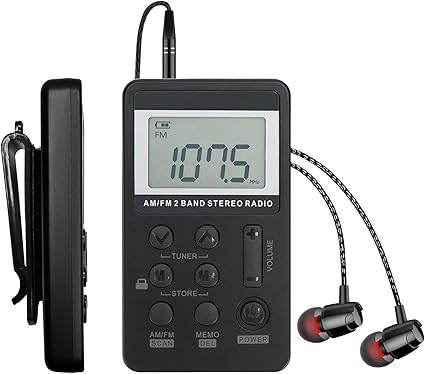
Listening to the radio on walks, runs, or during outdoor activities becomes easy with a tiny device that disappears in your pocket. Perfect for anyone who wants clear AM/FM radio reception without bulk, this mini portable radio’s main strength lies in its excellent signal stability thanks to a smart digital signal processing chip.
Setup involves plugging in any 3.5 mm earphone or headset, which acts as the antenna and boosts reception quality. It’s light, just 1.5 oz, and includes a detachable clip for hands-free carrying on belts or backpacks.
The LCD display makes tuning stations straightforward, and the rechargeable battery means no constant need to swap out power sources. Ideal for day-to-day walks, jogging, or gardening.
Radio reception is solid across both AM and FM bands, covering 520-1710 KHz for AM and 64/87-108 MHz for FM. It delivers stereo sound through earphones, with stable signal thanks to DSP tech. The build is small and durable, about the size of a credit card.
Most praise centers on the clear reception and lightweight design, while the lack of water resistance is a drawback during wet conditions.
Clear radio reception thanks to the DSP chip is the most praised feature, making the radio reliable even where signals are weak. The one complaint that appears often is how fragile it can feel due to its tiny size and lack of water resistance.
Anyone who wants a simple, lightweight radio for dry conditions and outdoor activities will appreciate this device. Those needing a rugged or weatherproof unit should consider other options better suited for harsh environments.
Pros
- Excellent digital signal processing for stable reception
- Ultra-lightweight and pocket-friendly size
- Detachable belt clip included for hands-free use
- Rechargeable battery with USB charging
Cons
- Not water resistant, limits outdoor use in rain
- Requires earphones with 3.5 mm plug as antenna
| Specification | Details |
|---|---|
| Frequency Range | FM: 64/87-108 MHz; AM: 520-1710 KHz |
| Weight | 1.5 oz |
| Power Source | Battery Powered, rechargeable 3.7 volts |
| Connectivity Technology | AM/FM |
| Audio Output Mode | Stereo |
| Display Technology | LCD |
5. Portable AM/FM Transistor Radio

Strong signal reception across AM, FM, and shortwave bands sets this radio apart, making it great for anyone who wants wide coverage on the go. Its DSP anti-jamming chip ensures you get clear audio in places where signals might normally struggle.
Setting it up is straightforward with the included rechargeable lithium-ion battery and a USB charging option. The telescopic antenna extends easily to capture signals, and the LED and LCD help keep track of stations. Switching between AM, FM, and shortwave bands happens smoothly, so tuning in daily is simple and reliable.
The 5W speaker delivers clear sound that works well for music, news, or talk shows. The radio feels solid but not bulky, making it handy to carry around.
Most praise focuses on its clear reception and multi-band support. The main complaint concerns the lack of water resistance, which means extra care is needed outdoors.
Many find that the radio’s strong reception and clear audio meet everyday listening needs effectively, especially with the anti-jamming chip. However, its lack of water resistance means it requires caution when used outside or in damp conditions. Battery life depends on a single lithium-ion cell, so charging regularly is important.
People wanting a multi-band radio with portable convenience and good sound will appreciate this model. Anyone seeking durability in wet or rugged environments might want to look for a water-resistant option instead.
Pros
- Wide frequency range: AM/FM/SW bands
- Rechargeable with USB charging
- Clear sound from 5W speaker
- Compact and portable design
Cons
- Not water resistant
- Single battery limits usage span
| Specification | Details |
|---|---|
| Radio Bands Supported | 4-Band |
| Frequency | 108 MHz |
| Power Source | Battery Powered |
| Number of Batteries | 1 Lithium Ion battery required. (included) |
| Connectivity Technology | USB |
| Display Type | LED or LCD |
6. Personal Portable FM Radio

Great for anyone who likes to listen to FM radio during exercise, this compact radio works best for joggers and walkers. Its biggest strength lies in excellent signal reception thanks to DSP circuitry, which makes music and talk shows clear and enjoyable on the go.
Setup involves simply inserting 2 AAA batteries and plugging in any 3.5 mm earphones since it lacks an internal speaker. Its small size and detachable belt clip make it easy to carry during outdoor workouts or walks. The LCD display shows the frequency, and storing up to 20 stations helps quickly switch between favorites.
Reception quality is impressive with clear sound and stable signal within the 64-108 MHz range, fulfilling its main purpose well. Build feels lightweight and portable but it is not water resistant. Most praise comes for clarity and simple controls, while the main downside is no built-in speaker, so headphones are always required.
Reception is clear and stable on most FM stations, praised for good sound quality. The common complaint is having to use earbuds every time due to the lack of a speaker, which limits hands-free listening.
Great choice for those who listen mostly during exercise and prefer wearing headphones. Anyone wanting to share radio audio without earbuds or needing water resistance should consider other options.
Pros
- Excellent reception with DSP circuitry
- Stores 20 FM stations for quick access
- Compact size with detachable belt clip
- Works with any 3.5 mm earphones
Cons
- No built-in speaker, headphones required
- Not water resistant, careful in rain
| Specification | Details |
|---|---|
| Frequency Range | 64-108 MHz |
| Power Source | 2 x AAA batteries required |
| Connectivity Technology | Auxiliary |
| Display Type | LCD |
| Radio Bands Supported | FM |
| Audio Output Mode | Stereo |
7. DreamSky AM FM Portable Radio

Strong and clear reception from both AM and FM bands makes this portable radio ideal for anyone living in a remote area or just wanting reliable sound at home. Easy analog tuning and loud, crisp sound make it especially friendly for seniors or people who prefer simple gadgets.
Setting up doesn’t take long; it can run on four AA batteries or an AC adapter, so it works well both indoors and outdoors. The large analog dial is straightforward to use and helps you find stations quickly without fuss. Plugging in earphones is easy too, which makes quiet listening an option when needed.
Reception is solid, pulling in broadcasts clearly without static or unwanted noise. The big speaker delivers a loud, clear sound that fills a room nicely. The most common snag is the need for four AA batteries, which can add up over time if you use it often away from power outlets.
The analog tuning feels classic and responsive, but some might find it less precise than digital tuners.
Clear, loud sound and strong reception stand out as the radio’s main strengths, while the biggest drawback is the reliance on four AA batteries that may need frequent replacement. The analog dial is easy to operate but less precise than digital tuners.
People who want a no-fuss, easy-to-use radio with solid reception will appreciate this model. Those looking for a more precise digital tuner or wanting to avoid battery expenses might want to consider other radios.
Pros
- Strong AM/FM signal even in remote areas
- Large, easy-to-use analog tuning dial
- Supports both battery and AC power
- Clear sound with no static or cross-talk
Cons
- Uses 4 AA batteries which can drain quickly
- No digital tuner for exact frequency locking
| Specification | Details |
|---|---|
| Radio Bands Supported | AM/FM |
| Frequency | 108 MHz |
| Power Source | AC Plug & Battery Powered |
| Number of Batteries | 4 AA batteries required |
| Hardware Interface | 3.5mm Audio |
| Voltage | 110 volts |
8. Portable AM FM Battery Operated Radio

Victrola’s Portable AM FM Battery Operated Radio is great for anyone who wants a small, lightweight device to listen to radio stations while moving or jogging. Its biggest strength lies in its compact size combined with surprisingly clear sound quality from the built-in big speaker.
Setup takes just a minute thanks to the quick preset buttons that let you save up to five favorite stations. The retractable antenna extends reception, making it flexible for city or countryside use.
Operating on two AAA batteries keeps it truly portable, and the 3.5mm headphone jack allows private listening when preferred.
The radio picks up AM and FM signals clearly across its wide bands, providing reliable sound wherever you are. Its stereo speaker delivers good volume and clarity for a device this size.
The casing feels light yet sturdy, with the single downside being no water resistance. Some users mention the antenna could be more durable.
Strongest praise goes to its clear sound and good reception regardless of location. The most frequent complaint is about the antenna’s fragility and the lack of water resistance, limiting use in adverse weather. Everyday handling is smooth, especially when jogging or walking around.
People looking for a simple, portable radio for casual listening will find it suitable. Those needing a rugged or waterproof model may want to look at other options that withstand rougher conditions or moisture exposure better.
Pros
- Very lightweight and pocket-sized
- Clear stereo sound from big speaker
- Quick preset buttons for easy station access
- Good reception with retractable antenna
Cons
- No water resistance
- Antenna durability could be better
| Specification | Details |
|---|---|
| Radio Bands Supported | 2-Band |
| Frequency | 108 MHz |
| Power Source | Battery Powered (2 AAA batteries) |
| Audio Output Mode | Stereo |
| Hardware Interface | 3.5mm Audio |
9. AM FM Portable Radio

Easy to carry around and simple to use, this AM FM Portable Radio suits anyone who values solid reception in a compact device. Its strongest feature is the professional aviation DSP chip, which really makes a difference in picking up clear signals, even in areas where radios often struggle.
Setup is straightforward, just pop in 2 AA batteries, extend the antenna, and start scanning. The auto-scan and lock screen features simplify tuning, and the built-in clock and sleep timer bring added convenience for daily listening. A headphone jack lets you enjoy stereo sound without disturbing others, and you can rely on the clear speaker to fill a room in a pinch.
Sound quality punches above its size with a 0.5-watt speaker that delivers clear audio. The stretchable antenna boosts signal strength noticeably, making reception more reliable.
The most common issue is its dependence on two AA batteries, which means you’ll need spares handy. The build is compact and lightweight, although the lack of water resistance means caution around moisture.
Reception is impressively strong thanks to the aviation DSP chip, even in weak signal areas where many radios fail. The main drawback comes from its reliance on AA batteries, which means limited runtime unless spares are nearby. Most users find the sound surprisingly clear for such a small speaker, filling a room without trouble.
This radio fits well with anyone who wants a portable, no-fuss device for everyday AM and FM listening, especially in places with spotty signals. Those needing waterproof or rechargeable features might want to look for another option.
Pros
- Excellent reception with DSP chip
- Compact and lightweight design
- Built-in clock and sleep timer
- Stereo headphone compatibility
Cons
- Requires 2 AA batteries
- Not water resistant
| Specification | Details |
|---|---|
| Tuner Type | AM FM |
| Power Source | Battery Powered (2 AA batteries required) |
| Speaker Maximum Output Power | 0.5 watts |
| Audio Output Mode | Stereo |
| Display Type | LCD |
| Additional Features | Time, Clock, Sleep Time, Auto-Scan, Lock Screen |
10. Portable FM Radio Wireless Headphones

Perfect for anyone who wants a dedicated FM radio with headphones, it stands out for easy tuning and solid reception through its external metal antenna. Ideal for those who prefer digital FM over AM and want quick access to favorite stations stored in memory.
Setup involves simply adjusting the headband for a comfortable fit, which works well for various head sizes. The display makes tuning straightforward, and you can scan stations automatically or manually, depending on what you prefer. Using it as a computer headset is an option, though an AUX cable is needed separately.
Daily use revolves around quick station access and comfortable wear.
Reception quality is reliable thanks to the digital FM tuning and external antenna, helping to pick up signals clearly in most areas. The adjustable headband is durable and fits firmly, offering good comfort for hours.
Most praise focuses on its good reception and comfort, while a common downside is that AM stations are not available, limiting options for some listeners.
The Portable FM Radio Wireless Headphones provide clear FM reception thanks to the external metal antenna and a digital tuning display that is easy to read. Channel memory saves favorite stations for quick access, and the adjustable headband offers a comfortable fit. A common downside is the absence of an AM band, limiting available radio options.
People who listen mainly to FM radio and want a combined headphone and radio device will find this useful. Those needing AM radio or a full range of audio functions might prefer a dedicated radio or more advanced headphones with built-in streaming. Ideal for casual listening rather than professional or high-fidelity use.
Pros
- Clear LCD display for easy tuning
- External metal antenna improves reception
- Comfortable, adjustable headband
- Channel memory saves favorite stations
Cons
- No AM radio support available
- AUX cable sold separately for headset use
| Specification | Details |
|---|---|
| Brand Name | ZOOFEED |
| Model Number | HANW-5627-JKHG |
| FM Radio | Digital FM only, no AM support |
| Channel Memory | Yes, for quick program access |
| Headband Design | Adjustable for various sizes |
| Manufacturer | HANWIS |
Comparison of Top Personal Radios Reviewed
| Product | Connectivity | Radio Bands | Power Source | Additional Features |
|---|---|---|---|---|
| Sony Walkman Radio | USB | 2-Band | Battery Powered | Portable, Rechargeable, Stereo Sound |
| Sangean Bluetooth Radio | Bluetooth | 4-Band | Rechargeable | NOAA Alert, Flashlight, Portable |
| Panasonic Personal Radio | USB | 2-Band | Battery Powered | Backlight, Belt Clip, Rechargeable |
| JBL Mini FM Radio | AM/FM | 2-Band | Battery Powered | Belt Clip, Lanyard, Lightweight |
| Philips Transistor Radio | USB | 4-Band | Battery Powered | Rechargeable, Lithium Ion battery |
| Sony Personal FM Radio | Auxiliary | FM | Battery Powered | Belt Clip, Lightweight, Portable |
| DreamSky AM FM Radio | AM/FM | FM | Battery Powered | Portable, Strong Reception, Analog |
| Panasonic Battery Radio | Auxiliary | 2-Band | Battery Powered | Portable, Stereo, LCD Display |
| Sony AM FM Radio | Auxiliary | AM FM | Battery Powered | Time, Auto-scan, Sleep Timer |
| JBL FM Wireless Radio | – | – | – | Headphone, User Manual, Adult |
- ConnectivityUSB
- Radio Bands2-Band
- Power SourceBattery Powered
- Additional FeaturesPortable, Rechargeable, Stereo Sound
- ConnectivityBluetooth
- Radio Bands4-Band
- Power SourceRechargeable
- Additional FeaturesNOAA Alert, Flashlight, Portable
- ConnectivityUSB
- Radio Bands2-Band
- Power SourceBattery Powered
- Additional FeaturesBacklight, Belt Clip, Rechargeable
- ConnectivityAM/FM
- Radio Bands2-Band
- Power SourceBattery Powered
- Additional FeaturesBelt Clip, Lanyard, Lightweight
- ConnectivityUSB
- Radio Bands4-Band
- Power SourceBattery Powered
- Additional FeaturesRechargeable, Lithium Ion battery
- ConnectivityAuxiliary
- Radio BandsFM
- Power SourceBattery Powered
- Additional FeaturesBelt Clip, Lightweight, Portable
- ConnectivityAM/FM
- Radio BandsFM
- Power SourceBattery Powered
- Additional FeaturesPortable, Strong Reception, Analog
- ConnectivityAuxiliary
- Radio Bands2-Band
- Power SourceBattery Powered
- Additional FeaturesPortable, Stereo, LCD Display
- ConnectivityAuxiliary
- Radio BandsAM FM
- Power SourceBattery Powered
- Additional FeaturesTime, Auto-scan, Sleep Timer
- Connectivity–
- Radio Bands–
- Power Source–
- Additional FeaturesHeadphone, User Manual, Adult
How to Choose the Best Personal Radio
Choosing a good personal radio depends on factors like signal range, battery life, and durability to ensure reliable communication. Prioritizing these features helps avoid frequent replacements or poor performance, ultimately saving money and preventing frustration during use.
Audio Quality and Reception
Static and dropped signals can ruin the experience of tuning into a morning show or catching a live game. Radios that struggle with reception often leave you adjusting the antenna or moving around to find a clear spot. Good models offer consistent signal strength across different environments, maintaining clarity whether indoors or on the go.
The difference is noticeable, especially with digital bands that cut down on background noise compared to traditional AM/FM.
Look for a device that supports multiple frequency bands, including AM, FM, and digital options like DAB or HD radio, to access a wider range of stations. Clear sound comes down to the quality of the speakers and tuners.
A speaker rated around 1-3 watts usually balances portability with clear volume and crisp audio output. Reliable signal reception and broad band compatibility make for less frustration and more listening enjoyment every day.
Portability and Design
Carrying a personal radio around should never feel like a burden. Radios that are too bulky or heavy get left behind quickly. A compact size that fits comfortably into a pocket or small bag makes it much easier to include in daily routines.
Weight under 300 grams is common with portable models designed for convenience.
Controls matter just as much as size. Buttons and dials that are intuitive and easy to reach mean fewer fumbling moments when adjusting volume or switching channels. Durability plays a role for anyone using the radio outdoors.
Weather-resistant housings and impact-resistant materials like ABS plastic or metal frames stand up better to drops and occasional rain, which helps the device last longer without repairs.
Power Source and Battery Life
Keeping a radio powered without constantly hunting for replacements simplifies daily use. Models powered by standard AA or AAA batteries are popular for ease of finding extras on the go.
Rechargeable battery options add convenience, especially with USB charging, eliminating waste and expense of disposable batteries.
Battery life varies widely, but many portable radios offer 15 to 30 hours of playback on a single charge or set of batteries, enough for several days of use. Energy-saving modes that dim displays or reduce power to unused features extend runtime significantly. Battery type and longevity impact how often charging or replacements are needed, an important practical detail for regular users.
Connectivity and Features
Listening privately or connecting to external devices is much easier with multiple connectivity options. Radios including headphone jacks or auxiliary inputs let you plug in earbuds or external speakers without hassle.
Bluetooth adds the modern touch of wireless connection for pairing with headphones or streaming from other devices.
Extra features like alarms and sleep timers turn a simple radio into a more functional companion, especially at home or in the bedroom. The quality of any digital display affects readability in bright or low light.
Simple channel switching and preset buttons on the device let you quickly tune into favorite stations without scrolling through all the available frequencies.
Build Quality and Durability
Repeated drops or exposure to dust and moisture quickly reveal a radio’s build quality. Units made with solid plastic or metal enclosures tend to survive everyday wear better than cheaper alternatives. Some radios include rubberized corners or sealed controls to add extra protection against damp conditions or accidental bumps.
Prices often reflect how rugged a device is, but investing in well-built hardware reduces the chances of malfunctions down the road. A clear warranty and accessible customer support also matter if repairs or replacements become necessary. This combination ensures the radio stays reliable over time even with rough handling.
Maximizing Your Personal Radio’s Battery Life for Extended Use
Battery life is often the deciding factor when choosing or using a personal radio. To get the most out of your device, lowering the volume can make a noticeable difference; high volume levels consume more power. Choosing modes like power-saving or standby can extend use without turning off the device entirely.
Consider using rechargeable batteries designed for long-lasting performance rather than standard alkaline cells, which may drain faster.
Other practical tips include:
- Turning off unnecessary features such as backlit screens or Bluetooth when not in use.
- Keeping your radio at room temperature since extreme cold or heat drains battery faster.
- Charging your radio fully before prolonged use, especially for outdoor activities.
These adjustments can help extend listening time significantly, preventing interruptions when you rely on your personal radio throughout the day.
Essential Maintenance Tips to Keep Your Personal Radio Performing Like New
Personal radios work best with regular care to maintain sound quality and operational consistency. Dust accumulation in speaker grills or control buttons can cause muffled audio or unresponsive controls.
Wiping the device gently with a slightly damp cloth helps keep it clean without risking water damage.
Maintenance practices to follow:
- Check battery contacts periodically and clean any corrosion with a small brush or cloth.
- Store your radio in a dry, dust-free environment when not in use to prevent internal damage.
- Inspect antennas for damage or looseness to ensure clear signal reception.
Simple routine checks like these prevent common issues that degrade performance over time, so the radio continues functioning as intended long after purchase.
Comparing Personal Radios with Other Portable Audio Devices for Different Needs
Personal radios differ significantly from other portable audio devices, such as Bluetooth speakers or MP3 players. Radios offer the unique ability to receive live broadcasts without needing an internet connection, making them reliable in areas with poor mobile coverage.
This is advantageous during travel or outdoor activities.
Comparison points include:
- Connectivity: Radios rely on radio waves, while other devices often depend on Wi-Fi or Bluetooth.
- Content: Radios provide live, real-time content and emergency alerts, not stored music or podcasts.
- Power consumption: Radios generally use less battery when tuned to FM or AM stations compared to streaming devices.
Selecting between these options depends on your needs for live content, offline reception, and battery life during daily use.
People Also Asked
How Do I Properly Care for My Personal Radio Device?
Keep your personal radio dry and clean by wiping it with a soft cloth and avoiding exposure to moisture or extreme temperatures. Store it in a case when not in use to prevent scratches and dust buildup.
What Size Personal Radio Is Ideal for Everyday Use?
A compact, lightweight personal radio fits well in pockets or small bags, making it easier to carry daily. Choose one that balances size with battery life so it can last through your usual routine without frequent recharging.
Are Personal Radios Safe to Use for Children?
Personal radios can be safe for children as long as volume levels are kept moderate to prevent hearing damage. Look for simple models with easy controls and sturdy construction to handle occasional drops.
How Compatible Are Personal Radios with Various Accessories?
Most personal radios support standard accessory connections like earphones and external microphones, especially models with a 3.5mm jack. Check the radio’s specs to confirm compatibility with your preferred accessories before purchasing.
What Common Problems Should I Expect with Personal Radios?
Common issues include battery draining quickly, static interference, and difficulty tuning to certain frequencies. Regularly replacing batteries or recharging, adjusting antenna position, and using the radio in areas with stronger signal can help reduce problems.
Conclusion
Choosing a personal radio comes down to sound quality, ease of use, and battery life. Clear audio lets you enjoy music or talk shows without distortion.
Controls should be straightforward so you can change stations quickly. Long battery life ensures the radio lasts through your day without frequent recharging or battery changes.
Think about where you’ll use the radio and how much you want to spend. Smaller radios work well for travel, while larger ones suit home use.
Check the comparison table and detailed picks above to find the best match based on those needs. That helps narrow down the options to what fits your routine and budget.

