
Top 10 Best QRP Battery Hacks You Can’t Miss Today
A battery failing in the middle of a QRP operation session can turn a smooth day into a frustrating scramble for replacements. A best qrp battery handles low power output devices reliably without sudden drops or overheating, something many cheaper ones struggle with. The wrong battery might weigh more than necessary or not hold charge under continuous use, ruining the experience.
Good qrp batteries balance capacity and weight carefully, often providing around 1000 to 2000 mAh at 3.7 volts while staying compact and light. The chemistry usually is lithium-ion or lithium polymer, which offers a steady power supply and longer cycle life compared to older alkaline options. Fit is critical too, batteries designed specifically for QRP gear ensure secure placement and manageable cable connections, avoiding loose contacts during field use.
Need a Quick Check?
| Image | Product | Price |
|---|---|---|
Our Top Picks 1  | Talentcell 12V Lithium Battery | Check Price |
Our Top Picks 2  | UL Certified 12V LiFePO4 Battery | Check Price |
Our Top Picks 3  | QYT CB-58 Marine Handheld Radio | Check Price |
Our Selected Top 10 Qrp Battery for Every Budget
This list features a variety of compact, reliable batteries suitable for low-power radio use, covering different capacities and durability levels. Each review explains performance details, ideal user scenarios, and highlights advantages and drawbacks to help choose the best match for your needs.
1. Talentcell 12V Rechargeable Lithium Ion Battery Pack
You’ll notice the compact size and double output ports right away, making it a great fit for anyone needing portable 12V power with USB options. Ideal for powering LED lights, cameras, or small gadgets, its biggest strength lies in providing reliable power on the go without bulky packs.
Setting it up is simple thanks to clear polarity on the 12V DC port and a handy USB Type A output for your phone or other devices. Daily use involves just charging it and plugging in compatible 12V or 5V devices.
Its portable size means carrying it around is easy, whether powering a camera or LED strip on the move. You won’t have to worry about cords during use, making it convenient in various settings.
Performance holds up well in everyday scenarios like running cameras or even robotic telescopes, with a capacity of 6000mAh at 11.1V. It’s solidly built for battery-powered use and designed for repeated recharge cycles. The strongest praise highlights how versatile it is, while the most common complaint points to its voltage not being constant but dropping between 12.6V and 9V.
Reliable power delivery and versatility get frequent positive mention, especially the ability to run devices like cameras and small electronics smoothly. The most often noted drawback is the non-constant voltage output, which can be less ideal for devices needing steady power.
This battery suits anyone wanting a lightweight and portable solution for low to moderate power 12V or USB devices. Using it for appliances requiring a stable voltage or higher amperage might call for a different power source.
Pros
- Dual 12V and 5V USB outputs for flexibility
- Compact and easily portable design
- Compatible with a wide range of 12V/5V devices
- Rechargeable lithium-ion battery pack
Cons
- 12V output voltage varies between 12.6V and 9V
- Amperage limited to 1 A may restrict high draw devices
| Specification | Details |
|---|---|
| Battery Capacity | 6000 milliamp_hours |
| Voltage | 12 volts_of_direct_current |
| Connector Type | USB Type A |
| Number of Ports | 2 |
| Amperage | 1 A |
| Power Source | Battery Powered,Corded Electric |
2. 12V 10Ah LiFePO4 Lithium Battery UL Certified
Replacing a standard 12V 7Ah SLA battery with one that fits the same space but weighs half as much is a clear advantage for anyone needing a dependable, lightweight power solution. Ideal for fish finders, ham radios, and small solar setups, it offers higher energy density without the bulk or weight of traditional lead-acid batteries.
Installation is straightforward, given the universal fit and familiar F2 terminal, so it fits right where the older battery lived. Carrying around something just 2.1 lbs makes it much easier when moving gear or swapping batteries in cramped setups.
Daily use benefits from the 10Ah capacity and consistent 12.8 volts, powering devices reliably without frequent recharges.
Performance delivers steady power over long cycles, supported by Grade A cells rated for over 5,000 cycles and a 10-year service life, hinting at a long-term investment. The build is compact and light, with dimensions matching standard lead-acid types, making replacements painless. Most praise highlights the long lifespan, while the common complaint focuses on the upfront cost compared to cheaper lead-acid alternatives.
Long lifespan with over 5,000 cycles stands out as a major plus, promising many years of use. More than one review mentioned the price as a downside, especially when compared to standard lead-acid batteries.
Those prioritizing weight and longevity over initial expense will find this battery solid and reliable. Anyone looking for a larger capacity or lower price might want alternatives better suited to those needs.
Pros
- Same size as standard 12V 7Ah SLA battery
- Half the weight of traditional lead-acid batteries
- Cycle life over 5,000 cycles
- 10-year service life
Cons
- Higher upfront cost compared to lead-acid options
- Capacity limited to 10Ah for larger power needs
| Specification | Details |
|---|---|
| Voltage | 12.8 volts |
| Battery Capacity | 10 amp_hours |
| Terminal Type | F2 Terminal |
| Number Of Cells | 1 |
| Automotive Fit Type | Universal Fit |
| Weight | 2.1 lbs |
3. QYT CB-58 27MHz Marine AM/FM CB Handheld Radio Battery
When you need reliable power for your QYT CB-58 handheld radio out on the water or during outdoor activities, having a battery that lasts without weighing you down makes all the difference. Especially useful for marine and CB radio users, this 12V, 4100mAh battery stands out for its solid capacity, giving enough juice to keep you connected.
Setting it up involves charging the battery fully until the charger shows green, which is a straightforward step after unpacking the factory-sealed brand new battery and belt clip. Day-to-day, it fits perfectly onto the QYT CB-58 radio and stays secure with the belt clip. Carrying it around at just over half a pound doesn’t add much bulk, making it easy to bring along on long trips or shifts.
Performance-wise, the battery delivers consistent power, making it dependable through extended use without sudden drops. Built with quality materials, it feels sturdy rather than flimsy in hand.
Most of the time it meets expectations for run time, but some users find that charging needs attention before first use, which is easy to manage but worth noting. It balances power and weight comfortably.
This battery is praised for delivering reliable, steady power that lasts through long use periods, with the main drawback being the need to fully charge it before first use. It’s sturdy and feels well-made compared to generic alternatives.
Ideal for those using the QYT CB-58 radio extensively outdoors or on water who want a lightweight, powerful replacement battery. It may not suit users with other radio models due to compatibility limits or those looking for pre-charged solutions straight from the box.
Pros
- High-capacity 4100mAh battery life
- Lightweight at just over half a pound
- Comes with a belt clip for easy carrying
- Compatible specifically with QYT CB-58 radios
Cons
- Not charged on arrival, requires initial charging
- Only fits QYT QB-58L model radios
| Specification | Details |
|---|---|
| Capacity | 4100mAh |
| Voltage | 12V |
| Weight | 250g / 8.6oz / 0.53lb |
| Material | High quality battery materials |
| Watt Hours | 49.2Wh |
| Battery Type | Lithium Ion |
4. DCH 4200mAh Battery Replacement for Explorer QRZ-1

4200mAh capacity stands out as the key feature, making it ideal for those needing long-lasting power in their Explorer QRZ-1 two-way radios. It suits professionals or outdoor enthusiasts who rely on clear, continuous communication without frequent recharging interruptions.
Setup is straightforward since the battery is designed specifically for the QRZ-1 model, fitting perfectly without modifications. Daily use means dependable power output at 7.4V, so your radio stays functional during extended shifts or events. Its moderate weight of 260g feels manageable when carried around all day.
Performance delivers steady power without sudden drops, supporting long periods of radio operation. The Li-ion build ensures capable energy density and durability.
Strongest praise focuses on how reliably it keeps devices powered. Some users mention a heavier feel compared to lighter disposable batteries as a downside.
The battery consistently powers radios for long periods, which makes it a reliable choice, but the weight has been noted as somewhat bulky during prolonged carry or use. It fits the Explorer QRZ-1 perfectly, so you don’t have to worry about any fitment issues during use.
Individuals needing a dependable, high-capacity battery for professional communication devices will appreciate its performance. Those looking for lighter options or batteries compatible with multiple radio models may want to consider alternatives instead.
Pros
- High 4200mAh capacity for extended use
- Perfect fit for Explorer QRZ-1 radios
- Stable voltage output of 7.4V
- Durable Li-ion battery type
Cons
- Relatively heavy at 260g
- Only compatible with QRZ-1 model
| Specification | Details |
|---|---|
| Capacity | 4200mAh |
| Voltage | 7.4V |
| Type | Li-ion |
| Weight | 260.0g |
| Model Number | CS-BAF130TW |
5. TalentCell 12V 6Ah LiFePO4 Battery Pack

Anyone needing a reliable 12V power source for portable electronics or hobby projects will find this battery pack a solid choice. Its biggest strength lies in the long cycle life of over 3000 charge cycles, which means it will last a long time without needing a replacement.
Setting up is straightforward thanks to the DC 5521 output port with clear polarity markings. Daily use is simple since it delivers a stable voltage around 12V to 13V for most of the discharge cycle, suitable for devices like digital cameras, fish finders, or 12V pumps. The battery pack is compact and replaces heavier lead-acid batteries without much fuss.
Performance-wise, the battery keeps a consistent voltage output and holds enough charge at 6000mAh to support devices reliably throughout the day. Build quality feels solid, with well-constructed lithium iron phosphate cells inside. Most praise mentions the long lifespan, while common complaints focus on the single output port limiting simultaneous connections.
The battery’s main strength comes from its long cycle life, lasting over 3000 recharge sessions while maintaining consistent voltage near 12V for most of its runtime. A common downside is only having one output port, which can be inconvenient if you want to power multiple devices simultaneously.
Those needing a durable, rechargeable 12V power source for single devices will appreciate this battery pack’s reliability and capacity. People who want to power several gadgets at once or draw more than 5 amps might need to consider other options with multiple ports or higher current limits.
Pros
- High capacity suitable for many 12V devices
- Very long cycle life of 3000+ charges
- Stable voltage output during discharge
- Compact and lighter than lead-acid alternatives
Cons
- Single DC5521 output port limits multiple device use
- Max current 5A may be low for some high-draw devices
| Specification | Details |
|---|---|
| Capacity | 12.8V 6000mAh (76.8Wh) |
| Cycle Life | 3000+ Cycles |
| Output Voltage | 14.6V-9V (Nominal 12.8V) / 5A Max |
| Port Type | DC 5521 Output: Inner Positive(+), Outer Negative(-) |
| Warranty | 1 year manufacturer |
6. Rechargeable 12V 5200mAh Li-Ion Battery Pack

Compact and lightweight, this rechargeable 12V 5200mAh Li-ion battery pack suits anyone needing a reliable power source for small 12V devices. Its biggest strength lies in delivering steady 12V output through a common DC5521 connector, ideal for radios, LED strips, and security cameras without adding bulk.
Setting it up involves matching your device’s DC5521 plug, then connecting through its output port. It comes with a fast 12.6V/2A charger and adapter cables, so recharging is straightforward.
Daily use feels convenient because the battery sustains power for hours while remaining easy to carry or install in tight spaces.
Performance holds up well with a stable 12V output and the capacity to handle up to 3A current, enough for various electronics like routers and LED lights. The build is solid and lightweight, suitable for portable projects.
Most appreciate its dependable power delivery, while some note the need for verifying connector compatibility carefully before purchasing.
Strongest praise revolves around its reliable power supply that works nicely for a variety of small electronics. Common complaint emphasizes careful checking of the DC5521 connector size to avoid compatibility issues.
Those needing a dependable, portable 12V battery for DC5521 devices will appreciate this pack. Users with devices requiring different connector types or higher current should look at other options.
Pros
- Lightweight and compact design
- Fast 12.6V/2A charger included
- Steady 12V output suitable for many devices
- Compatible with common DC5521 connectors
Cons
- Requires exact plug size verification
- Limited to devices under 3A current draw
| Specification | Details |
|---|---|
| Output Voltage | 12 volts |
| Input Voltage | 12.6 volts |
| Current Rating | 2 A |
| Amperage | 3 A |
| Compatibility | DC5521 connector devices |
7. Eveready 6 Volt Spring Lantern Battery

Eveready 6 Volt Spring Lantern Battery suits anyone needing reliable power for low drain devices like lanterns or smoke alarms. Its biggest strength lies in delivering long-lasting and dependable energy without harmful chemicals, making it a straightforward choice for everyday home safety gear.
Setting up the battery in devices is simple thanks to its standard size and spring terminals, fitting well in common lanterns and flashlights. Daily use means stable power for essential devices that don’t demand high output, helping keep safety alarms and portable lights running reliably without frequent changes.
Performance holds steady with consistent power throughout its lifespan, making it trustworthy during use. The build feels solid and designed to avoid leaks, with no added mercury or cadmium to worry about.
Most praise highlights lasting power, while the common complaint involves it being only suitable for low drain gadgets, not devices needing higher voltage or current.
The battery consistently delivers dependable power ideal for devices that don’t require much current. Most people find its mercury- and cadmium-free construction reassuring, while some note it won’t power items with higher energy demands.
Perfect for those needing steady energy in safety and home lighting devices. Anyone requiring batteries for heavy duty or high drain gear should consider alternatives better suited to that purpose.
Pros
- Long-lasting power for low drain devices
- Safe with zero added mercury and cadmium
- Simple spring terminal design for easy installation
- Suitable for home safety tools like smoke alarms
Cons
- Not ideal for high power devices
- Limited to a specific battery size and type
| Specification | Details |
|---|---|
| Voltage | 6 Volt |
| Type | Super Heavy Duty |
| Battery Size | 1 A batteries required (included) |
| Model Number | 30039800011634 |
| Included Components | Battery Pack |
8. HW 9V USB-C Rechargeable Batteries 4 Pack
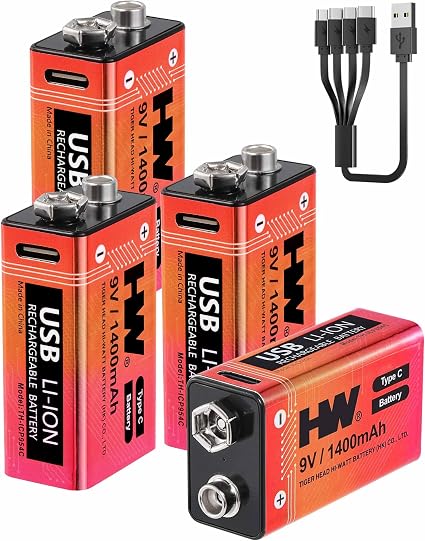
Using rechargeable 9V batteries that actually hold up well over time makes powering devices so much easier. Suited for anyone tired of swapping out alkaline batteries, these offer longer runtimes and simple USB-C charging, which is their standout feature.
Plugging the battery into power is straightforward thanks to the built-in USB-C port and the included 4-in-1 cable. There’s no need to carry around a separate charger, and the LED indicator provides quick info on charging status so you know when it’s ready. Daily use feels convenient, with a steady voltage output that keeps devices running reliably.
The upgraded 1400mAh capacity means these 9V batteries last longer than typical rechargeable or alkaline alternatives. They handle multiple recharge cycles, promising up to 1000 uses, which reduces waste and saves money in the long run.
The batteries are built with safety features like overcharge and short-circuit protection, though some users note that charging speed can be a bit slow.
The most praised aspect is the long runtime and easy USB-C charging that removes the need for an extra charger. The most commonly noted downside is that the charging speed isn’t particularly fast, which might be inconvenient for someone needing quick turnarounds.
Those who prioritize rechargeable convenience and eco-friendliness will find these batteries a great fit. People requiring multiple batteries at once or faster charging might want to look for alternatives that better match those needs.
Pros
- Long-lasting 1400mAh capacity
- Convenient built-in USB-C charging
- Multiple safety protections included
- Can recharge up to 1000 times
Cons
- Charging can feel slow compared to dedicated chargers
- Only comes with 4 batteries, limited if more needed
| Specification | Details |
|---|---|
| Number of Batteries | 4 9V batteries included |
| Capacity | 1400mAh |
| Charging Port | Built-in USB-C |
| Recharge Cycles | Up to 1000 |
| Warranty | 2 Year manufacturer |
9. 12V 10Ah LiFePO4 Lithium Battery for Fish Finders

Great for anyone needing a reliable power source for fish finders or small devices, this 12V 10Ah LiFePO4 battery offers long life and solid performance. Its standout feature is the lifespan, with over 2000 deep cycles far exceeding traditional lead-acid options, saving you frequent replacements.
Setting up the battery is straightforward thanks to its standard 12.8-volt output and F2 terminal, making compatibility with fish finders, small UPS systems, and solar setups simple. It is light enough to handle easily, and daily use shows steady power delivery.
Maintenance is minimal, as the lithium iron phosphate chemistry keeps it stable and reliable over time.
Power output feels consistent, keeping equipment running smoothly without sudden drops. Built with A-grade cells, it supports long-term use with a solid build that handles deep discharging well. The strongest praise highlights its lifespan and energy density, while the common complaint relates to the vehicle-specific fit, requiring confirmation of compatibility before purchase.
The battery consistently delivers steady, reliable power lasting for years with minimal maintenance. Most users appreciate its durability, while some note fitment concerns due to its specific terminal type and size, which means it’s essential to verify compatibility with your device.
This battery suits anyone needing a dependable 12V power source for fish finders or small electronics who values longevity and performance. Those requiring larger capacities or broader compatibility options might want to explore other choices better suited to heavier demands.
Pros
- Long lifespan with over 2000 deep cycles
- Higher energy density than lead-acid batteries
- Stable lithium iron phosphate chemistry
- Fits common 12V power needs
Cons
- Vehicle-specific fit requires careful compatibility check
- Limited to 10Ah capacity for power-hungry devices
| Specification | Details |
|---|---|
| Voltage | 12.8 volts |
| Battery Capacity | 10 amp_hours |
| Terminal | F2 Terminal |
| Number Of Cells | 1 |
| Vehicle Type Compatibility | 12V routers, Fish Finder, RV, Solar Power, ham radios, small UPS |
10. 12V 10Ah LiFePO4 Lithium Battery with BMS

LiFePO4 chemistry powers a compact and sturdy 12V 10Ah battery designed to deliver reliable energy for low-power applications. Suited for solar setups and backup power needs, its biggest strength lies in the built-in 10A Battery Management System that guards against common electrical risks.
Setting up involves connecting a single 12V battery, making installation straightforward. Day-to-day use benefits from the advanced BMS which prevents overcharging, excessive discharge, and overheating.
This makes it safe to use in various small-scale energy systems without constant monitoring. The battery’s deep cycle life adds convenience by reducing the frequency of replacements.
Performance keeps up well with expectations for a 10Ah battery, supporting long use with over 2000 deep discharge cycles. Build quality reflects in the use of Grade A cells and integrated safety features, contributing to a stable and durable unit.
The strongest praise often mentions the long cycle life, while common complaints revolve around the limited 1-year warranty period.
The battery receives regular praise for its long service life, often lasting well beyond traditional alternatives through thousands of cycles. On the downside, a one-year warranty leaves some uncertainty for continued use past that period.
Those needing a dependable 12V source for routine solar or backup setups will find it fitting. Users who want higher capacity or longer coverage might want to explore other options.
Pros
- Strong safety with BMS against common electrical issues
- Long cycle life reduces replacement frequency
- Grade A cells assure consistent performance
- Compact size for easy installation
Cons
- Warranty limited to 1 year
- Capacity may be insufficient for high power users
| Specification | Details |
|---|---|
| Number of Batteries | 1 12V battery required (included) |
| Brand | LKWPOW |
| Model Number | LKW1210 |
| Battery Chemistry | LiFePO4 with BMS |
| Battery Management System | 10A BMS protection |
| Cycle Life | 2000+ deep discharge cycles |
Comparison of Top QRP Batteries Reviewed
| Product | Voltage | Capacity | Compatible Devices | Warranty |
|---|---|---|---|---|
| Talentcell 12V Lithium Battery | 12 volts DC | 6000 mAh | camera, mobile phone | – |
| UL Certified 12V LiFePO4 Battery | 12.8 volts | 10 Ah | Fish Finder, HAM Radio | – |
| QYT CB-58 Marine Handheld Radio | – | – | – | – |
| DCH QRZ-1 Replacement Battery | – | – | – | – |
| TalentCell 12V 6Ah LiFePO4 Battery | 12 volts | 6 Ah | – | 1 year |
| 12V 5200mAh Rechargeable Battery | 12 volts | 5200 mAh | security cameras, walkie-talkies | – |
| Eveready 6V Lantern Battery | 6 volts | – | – | – |
| HW 9V USB-C Rechargeable 4 | 9 volts | – | – | 2 years |
| Fish Finder 12V 10Ah LiFePO4 | 12.8 volts | 10 Ah | Fish Finder, ham radios | – |
| 12V 10Ah LiFePO4 Battery BMS | 12 volts | 10 Ah | – | 1 year |
- Voltage12 volts DC
- Capacity6000 mAh
- Compatible Devicescamera, mobile phone
- Warranty–
- Voltage12.8 volts
- Capacity10 Ah
- Compatible DevicesFish Finder, HAM Radio
- Warranty–
- Voltage–
- Capacity–
- Compatible Devices–
- Warranty–
- Voltage–
- Capacity–
- Compatible Devices–
- Warranty–
- Voltage12 volts
- Capacity6 Ah
- Compatible Devices–
- Warranty1 year
- Voltage12 volts
- Capacity5200 mAh
- Compatible Devicessecurity cameras, walkie-talkies
- Warranty–
- Voltage6 volts
- Capacity–
- Compatible Devices–
- Warranty–
- Voltage9 volts
- Capacity–
- Compatible Devices–
- Warranty2 years
- Voltage12.8 volts
- Capacity10 Ah
- Compatible DevicesFish Finder, ham radios
- Warranty–
- Voltage12 volts
- Capacity10 Ah
- Compatible Devices–
- Warranty1 year
How to Choose the Right QRP Battery
Choosing the right QRP battery involves considering capacity, weight, and compatibility with your equipment to ensure efficient power delivery. Picking the best fit prevents frequent replacements and performance issues, saving both money and hassle during your outdoor or radio activities.
Capacity and Runtime
Running a QRP setup means dealing with limited power budgets, so battery capacity really determines how long a session can last before recharge or replacement. Capacity ratings in milliampere-hours (mAh) or watt-hours (Wh) provide clear clues about runtime, but the real-world duration depends on your device’s power draw. Expect a direct trade-off between the battery’s capacity and its weight; larger capacities give more hours on air but add bulk and weight.
For typical QRP radios drawing anywhere from 300mA to 1A on transmit, batteries rated around 3000-6000mAh strike a balance, usually lasting a few hours of continuous use. Weight is especially critical in field operations where every ounce counts.
A high-capacity battery might seem great on paper but becomes a burden if too heavy to carry comfortably.
Size and Weight
Compact batteries that slide easily into a pack or pocket and fit snugly with your radio ease field setups significantly. Bulky or heavy batteries introduce fatigue quickly, limiting how far or long you can carry your gear. Dimensions should not just be about volume but also fit within the specific battery compartments or attach points of your QRP radio model.
Many standard QRP radios accommodate batteries in ranges roughly around 100-200 cubic centimeters and under 500 grams for easier portability. Anything larger risks protruding or forcing awkward setups.
A compact design that balances weight and capacity supports longer outings without compromising comfort or gear layout.
Voltage and Compatibility
The voltage your QRP radio accepts varies but often falls between 7.2V and 12V. Using a battery mismatched to this can cause poor performance or potential damage. It’s also important that connector types are compatible, common standards like XT60, Deans, or barrel plugs avoid frustrating adapter issues in the field.
Good batteries maintain voltage stability during high demand, supporting several power modes your radio might switch through, such as low power receive or full power transmit. Voltage drops under load lead to signal distortion or unexpected shutdowns.
Picking a battery rated for your device’s nominal voltage and input current range simplifies this.
Durability and Build Quality
Batteries for outdoor radios must endure drops, moisture, dirt, and temperature shifts without failing. Cases made of dense plastics or rubberized coatings provide resistance against impact and environmental debris. Shell integrity translates into fewer worries about shorts or cell damage during active use.
Internal protection circuits that manage voltage, current, and temperature ensure steady power delivery even under tough conditions. A loosely built pack might not just fail but risk damage to your radio or even become a safety hazard. Solid construction pays off with reliable performance in unpredictable settings.
Safety Features
Overcharge, overdischarge, and short circuit protections are crucial, preventing battery damage or fire risks. Thermal management features like vents or heat sinks help avoid overheating during sustained transmissions or charging cycles.
These safety layers protect both your equipment and personal safety.
Look for certifications such as UL or CE marks indicating that the battery passed required tests for safe use. Batteries without these can be unpredictable or poorly regulated, especially when exposed to typical field conditions. Prioritizing safety features avoids nasty surprises during prolonged QRP operations.
Optimizing Battery Life for Extended QRP Operations
Batteries used in QRP (low power) operations need careful management to last through extended sessions. Lowering the transmission power reduces energy consumption significantly, allowing batteries to run longer between charges or replacements.
Using a power meter during setup helps dial in the minimum necessary output, which stretches battery life.
Temperature also affects battery performance. Cold environments decrease capacity, so keeping batteries insulated or close to the body can maintain better voltage output. Checking battery voltage regularly during operation prevents unexpected shutdowns due to depletion.
Practical tips for maximizing battery runtime:
- Choose batteries with a high mAh rating for longer service
- Turn off the radio completely when not transmitting or receiving
- Use low-power modes or settings compatible with the QRP device
- Recharge batteries fully before heading out
Small changes in how the battery is handled and how the QRP transmitter is set up can add several extra hours of operation.
Common Mistakes to Avoid When Using QRP Batteries
One common mistake is leaving QRP radios powered on and idle, which drains battery unnecessarily over time. Even when not transmitting, receivers can consume considerable energy, particularly if backlighting or additional features remain active.
Failing to monitor battery voltage is another issue. Running batteries to complete exhaustion damages their longevity and reliability. It is better to recharge or replace batteries before they drop below recommended limits.
Mixing different types or brands of batteries in the same device can cause inconsistent power delivery and reduced run time. Always use matched batteries or a single battery pack designed for the device.
Other mistakes include:
- Charging batteries incorrectly or with incompatible chargers
- Exposing batteries to extreme temperatures during storage or use
- Ignoring manufacturer guidelines for battery replacement intervals
Addressing these errors improves safety and reliability while minimizing downtime in the field.
Comparing Rechargeable vs. Disposable Batteries for QRP Devices
Rechargeable batteries are common in QRP use since they can be cycled many times, reducing long-term costs. Lithium-ion rechargeable cells typically offer better energy density and maintain stable voltage under load, beneficial for consistent transmission power.
Disposable batteries tend to be lighter initially and can be convenient for short-term or emergency use. Alkaline disposables, while easy to find, lose voltage which may cause the QRP device to shut down prematurely during critical moments.
Key differences to consider:
- Rechargeable: Higher upfront cost but reusable, requires a charger
- Disposable: Single use, no charging needed, but more waste and variable performance
- Weight and size: Rechargeables sometimes heavier depending on chemistry and capacity
- Environmental impact: Rechargeables generate less waste over time
Choosing between the two depends on usage patterns, budget, and access to charging options during field operations.
People Also Asked
How Do I Properly Care for a Qrp Battery?
Store the QRP battery at room temperature and avoid overcharging. Keep it dry and disconnect it from the charger once fully charged to extend its life. Don’t leave it unused for months without checking the charge level.
What Size Qrp Battery Is Compatible with My Device?
Check your device’s manual or specifications for battery size and voltage requirements before buying. Using a battery with the wrong size or voltage can cause damage or poor performance.
Are Qrp Batteries Safe to Use in Handheld Radios?
QRP batteries designed for handheld radios are generally safe if they match the device’s voltage and connector type. Always use the battery recommended or approved by the radio’s manufacturer to avoid overheating or short circuits.
How Long Does a Typical Qrp Battery Last on a Single Charge?
A typical QRP battery lasts between 8 to 12 hours of continuous low power use, though this varies by device and operation mode. Conserving power by lowering transmit time helps maximize its runtime.
What Common Problems Should I Watch for with Qrp Batteries?
Watch for swelling, excessive heat, or quick draining as signs of battery issues. Clean contacts regularly and avoid exposing the battery to extreme temperatures, which can reduce its effectiveness or cause failures.
Conclusion
Capacity, weight, and durability are the key factors to consider when choosing a QRP battery. Capacity determines how long the battery will last on your trips, while weight affects how much gear you carry. Durability ensures the battery can handle outdoor conditions without failing unexpectedly.
Check the voltage and connector compatibility as well to make sure it fits your specific equipment.
Think about where and how often you’ll use the battery to find one that fits your budget and space requirements. Smaller batteries work well for short outings, while larger capacities suit extended trips. Refer back to the comparison table and the picks above to match your needs with the right option.
This will help you avoid carrying unnecessary weight or running out of power unexpectedly.
