Top 10 Best Travel Radio That Will Change Your Journey
Many travelers know the frustration of carrying a radio that is either too bulky or fails to hold a battery charge when they need it most. The best travel radio manages to avoid these issues, offering reliable reception and a compact design that fits easily into a backpack or carry-on.
Radios that don’t meet these standards often become dead weight or useless once you’re away from power sources or areas with good signal.
Two key factors distinguish a good travel radio. First, battery life matters, a typical travel radio should provide at least 12 hours of continuous use on a set of rechargeable batteries or AA cells. Second, size and weight play a major role since too large a device adds unnecessary bulk while too small can compromise durability and signal quality.
A sturdy, weather-resistant casing also makes a difference when using the radio outdoors or on the go.
Need a Quick Check?
| Image | Product | Price |
|---|---|---|
Our Top Picks 1  | Generic AM/FM Transistor | Check Price |
Our Top Picks 2  | PRUNUS J-166 Radio | Check Price |
Our Top Picks 3  | Pocket AM/FM Transistor | Check Price |
Our Selected Top 10 Travel Radio You Can Trust
This list features a range of travel radios designed for different needs and environments. Each review covers performance, ideal users, and key advantages and drawbacks to help you choose the best option for your trips.
1. Portable AM/FM Transistor Radio
Portable AM/FM Transistor Radio fits well for anyone needing a straightforward travel radio that handles multiple bands with strong signal reception. Its biggest strength lies in picking up AM, FM, and shortwave signals clearly even in challenging locations thanks to the DSP anti-jamming chip.
Setting up is simple with the included rechargeable lithium-ion battery and USB charging. The telescopic antenna extends for better reception, making it easy to tune in to your favorite music, news, or traffic channels while on the road.
Adjusting between FM, AM, and shortwave bands happens smoothly with dedicated tuner options visible on the LED and LCD display.
The sound comes through a clear 5W speaker built into the compact body, making the radio easy to carry without sacrificing audio quality. Most reports highlight reliable signal capture and loud, clear output as strong points.
Complaints mainly center on the lack of water resistance, so it needs careful handling around moisture.
Strong radio sensitivity from the DSP chip and clear speaker output are praised often. Users commonly note the need to keep it dry due to no water resistance, which requires extra care during travel.
Great choice for travelers wanting compact, multi-band reception and decent sound. Those needing rugged or waterproof radios might want to consider alternatives better suited to harsh outdoor conditions.
Pros
- Supports wide frequency coverage including shortwave
- Rechargeable battery included for portability
- Clear 5W speaker sound
- The telescopic antenna improves signal strength
Cons
- Not resistant to water or moisture
- Single battery limits long-term use without recharge
| Specification | Details |
|---|---|
| Radio Bands Supported | 4-Band (AM/FM/SW1/SW2) |
| Power Source | Battery Powered with 1 Lithium Ion battery included |
| Speaker Output | 5W |
| Connectivity Technology | USB |
| Display Technology | LED, LCD |
| Frequency Range FM | 88-108 MHz |
2. PRUNUS J-166 Portable AM/FM Radio
Lightweight plastic makes the PRUNUS J-166 Portable AM/FM Radio easy to carry around, ideal for those who want a simple, compact radio for daily use or emergencies. Its small size and clip design stand out as the biggest strengths for convenience and portability.
Setting up involves just popping in two AA batteries and tuning in to your preferred AM or FM station. The back clip and lanyard make it easy to keep with you during a walk or while doing chores.
Using the mechanical LED display is straightforward, and the 3.5mm audio jack lets you plug in headphones or connect to other devices.
The radio performs solidly at picking up bands from 520 to 1730 kHz AM and 87 to 108 MHz FM with built-in AM antenna support. It feels sturdy enough for everyday use and is dust resistant and shockproof. The most praised feature is its portability, while the common drawback is that it isn’t water resistant.
Portability and durability get the most favorable mentions, showing it’s excellent for carrying around daily or in emergency kits. Users find it reliable for tuning AM and FM stations but often point out it cannot handle exposure to water.
Walkers, park-goers, or anyone needing a lightweight everyday radio will like what it offers. Those needing water resistance or an integrated rechargeable battery on the go should look at other models instead.
Pros
- Compact size fits in pocket or emergency kit
- Back clip and lanyard for easy carrying
- Shockproof and dust resistant build
- Simple mechanical LED tuner display
Cons
- Not water resistant at all
- Requires AA batteries, no rechargeable option
| Specification | Details |
|---|---|
| Power Source | 2 AA batteries required |
| Radio Bands Supported | AM/FM |
| Frequency | 108 MHz |
| Audio Output Mode | Stereo |
| Hardware Interface | 3.5mm Audio |
| Dimensions | 2.7*5*1.1 inches |
3. Portable AM/FM Pocket Transistor Radio
Small size and lightweight design make it perfect for carrying everywhere. It suits those who want a simple, portable way to listen to AM/FM radio on the go.
Its best feature is how easily it fits in pockets or bags without weighing you down.
Setup is straightforward since it runs on 2 AA batteries, so no cords or outlets restrict where you can use it. Tuning in is easy with a standard AM/FM dial, and the built-in headphone jack allows private listening without disturbing others.
You can take it gardening, on trips, or just enjoy it in the backyard without hassle.
Reception is decent for a pocket radio, picking up local stations clearly most of the time. The compact plastic build feels solid enough to handle casual outdoor use but isn’t rugged.
Most praise its portability and simple function, while some note the lack of included batteries as a minor downside.
Most people appreciate the radio’s portability and convenience, especially how easy it is to carry and use without cords. A frequent complaint is that batteries need to be purchased separately, which can be inconvenient for some.
This radio suits anyone looking for a lightweight, straightforward device for casual listening on the move. Those needing a more durable or feature-packed radio might want to look at other options.
Pros
- Compact and easy to carry anywhere
- Runs on batteries, no cords needed
- Includes headphone jack for private listening
- Tunes both AM and FM stations
Cons
- Does not come with batteries included
- Build is basic, not very rugged
| Specification | Details |
|---|---|
| Connectivity Technology | Auxiliary |
| Tuner Type | AM/FM |
| Power Source | Battery Powered |
| Radio Bands Supported | 2-Band |
| Number of Batteries | 2 AA batteries required |
| Hardware Interface | Headphone |
4. XHDATA D220 Portable AM/FM/SW Radio
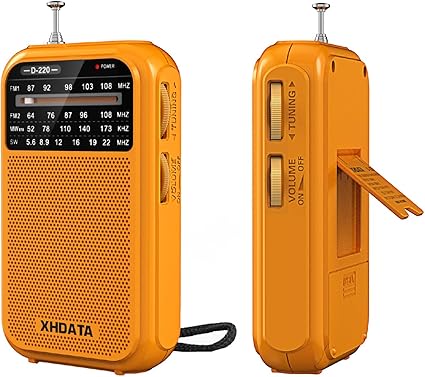
Small size and portability make this radio perfect for anyone needing reliable AM/FM/SW reception on the go. Lightweight and fitting easily into a pocket or handbag, it suits travelers, hobbyists, and those who prefer analog controls over digital fancy features.
Using the radio is straightforward thanks to just three knobs for tuning, band switching, and volume control. It runs on AA batteries, so you don’t need an external power source.
Everyday carry is easy given its minimal weight of 125g without batteries, and the non-digital display keeps things simple and classic.
Reception quality ranges across AM, FM, and shortwave bands with built-in antennas for AM and dust-resistant construction to handle travel bumps. Sound comes through stereo output, though it depends on the battery life. Few users find the lack of water resistance a drawback, but many appreciate how tough and shockproof it is for its size.
Reception across multiple bands works well and the radio is praised for its compactness and simple controls. However, users commonly note that it is not water resistant and that the battery reliance can be a hassle.
Ideal for travelers and casual listeners who want a light and portable radio with manual tuning. Those needing water resistance or USB charging might want to explore other options.
Pros
- Compact size fits into pockets or handbags
- Easy to use with just three control knobs
- Supports AM, FM, and shortwave bands
- Lightweight and shockproof design
Cons
- Not water resistant, careful around moisture
- Requires AA batteries, no recharge option
| Specification | Details |
|---|---|
| Size | 125*74*30mm |
| Weight | 125g (without batteries) |
| Radio Bands Supported | FM, AM, SW |
| Power Source | Battery Powered (AA batteries required) |
| Audio Output Mode | Stereo |
| Hardware Interface | 3.5mm Audio |
5. DreamSky AM/FM Portable Radio

When you need a reliable radio that picks up stations well even in remote areas, this one works great. Perfect for those who want simplicity and clear sound in a portable AM/FM radio, it shines most with its ability to grab signals strongly without the usual static interference.
Setting it up is straightforward since it runs on 4 AA batteries or an AC adapter. The large analog dial is easy to turn, making tuning quick whether you’re after music, news, or sports. The earphone jack lets you listen privately, which is helpful in quiet environments or around others.
Its compact size makes it easy to carry on trips or use around the house without hassle.
Reception is really strong, catching AM and FM stations clearly even far from cities. The built-in speaker delivers crisp and loud audio without cross-talk or static disrupting the sound. The radio feels solid and has simple controls that suit seniors or anyone who prefers a fuss-free radio.
Some mention the analog display can be harder to read in low light, but most praise how easy it is to use.
Many appreciate how well this radio pulls in stations without static, making it reliable during travel or in rural areas. The main downside is the analog dial, which is not very visible in low light, creating a small challenge when tuning.
The radio suits people who want simple, clear AM/FM reception with minimal controls, like seniors or those who travel often. Those needing a backlit display or fewer battery changes might prefer other options.
Pros
- Strong reception with clear sound quality
- Large analog dial easy to tune
- Works on batteries and AC power
- Includes earphone jack for private listening
Cons
- Analog dial can be hard to read in dim light
- Requires 4 AA batteries to operate on the go
| Specification | Details |
|---|---|
| Radio Bands Supported | AM/FM |
| Power Source | AC Plug & Battery Powered |
| Frequency | 108 MHz |
| Number of Batteries | 4 AA batteries required |
| Hardware Interface | 3.5mm Audio |
6. Portable AM/FM/SW Transistor Radio

Compact and easy to carry, this radio covers AM, FM, and shortwave bands, making it a reliable companion for anyone who wants continuous access to broadcasts on the go. Its biggest strength lies in the built-in solar charging, ensuring it stays powered when access to mains electricity is limited.
Setting it up is straightforward with the extendable antenna helping pull in clearer stations. Day-to-day use leans on its USB Type-C charging combined with solar power, so it keeps running through camping trips or emergencies. The bright COB LED light adds practical value beyond radio listening, handy in low-light situations or power outages.
Reception on all three bands is consistent, and the analogue tuner makes scanning through stations simple and satisfying. The radio feels lightweight and compact in the hand, which is great for slipping into a backpack or glove compartment.
Most users appreciate the dual charging options, but some note the analogue display can be harder to read compared to digital alternatives.
The device earns praise for its dependable charging methods, especially solar support that keeps it powered during extended time outdoors or blackouts. The most frequent complaint relates to the analogue tuner dial, which some find tricky to read compared to modern digital displays.
Those seeking a simple, lightweight radio with emergency features will appreciate this model. It suits campers, hikers, and anyone wanting a backup radio with reliable power sources. Users who prefer digital tuning or easier readability should consider alternatives with electronic displays.
Pros
- Solar and USB Type-C charging options
- Bright COB LED emergency light included
- Lightweight and truly portable design
- Covers AM, FM, and SW radio bands
Cons
- Analogue display less clear in low light
- Requires a nonstandard battery
| Specification | Details |
|---|---|
| Connectivity Technology | USB |
| Tuner Type | AM/FM/SW |
| Power Source | Battery Powered |
| Radio Bands Supported | 3-Band |
| Display Type | analogue/analog |
7. XHDATA D228 AM/FM/SW Weather Radio

Great for anyone who likes staying tuned to multiple radio bands on the go, including weather updates. Perfect for travelers, campers, or anyone wanting access to AM, FM, shortwave, and NOAA weather broadcasts. Its biggest strength is its versatility in receiving a wide range of signals, all in one compact, battery-powered device.
Setup is simple, just insert batteries and turn on to scan through AM, FM, shortwave, or NOAA weather channels. Tuning is more stable thanks to the DSP receiver chip, making station selection less fiddly.
A built-in flashlight adds convenience when out at night, and the 3.5mm headphone jack lets you listen privately or connect auxiliary devices.
This radio does a solid job covering four bands, giving clear enough reception to stay informed and entertained. The build feels sturdy for its size, though some mention tuning can take a bit longer on weak signals. Most praise the stable tuning and weather alert function, while common complaints include occasional difficulty locking into some distant stations.
The most praised feature is how stable the tuning is across four radio bands, making it easier to find and stay on stations. The most common issue involves a bit of difficulty when tuning into distant or weaker stations, causing some frustration during use.
Anyone seeking a compact, battery-powered radio with broad band coverage and weather alerts will find this a reliable companion. Those who need very quick tuning or strong reception in remote locations might want to consider other models.
Pros
- Receives AM, FM, shortwave, and NOAA weather signals
- Stable tuning supported by DSP receiver chip
- Built-in flashlight for nighttime use
- headphone jack for private listening
Cons
- Sometimes struggles locking on distant stations
- Tuning can be slow with weaker signals
| Specification | Details |
|---|---|
| Tuner Type | AM/FM/SW/NOAA |
| Radio Bands Supported | AM/FM/SW/NOAA |
| Frequency | 520 KHz |
| Power Source | Battery Powered |
| Hardware Interface | 3.5mm Audio |
| Additional Features | Built-In Flashlight |
8. C. Crane CC Skywave 2 AM/FM/SW Radio

Reliable reception across multiple bands makes the CC Skywave 2 ideal for travelers who want to catch AM, FM, shortwave, and weather alerts all in one compact package. Its ability to tune accurately and store a wide range of stations stands out from typical travel radios.
Setting up involves inserting two AA batteries, which keeps it lightweight and portable. Tuning through AM, FM, and shortwave is simple thanks to fast or fine modes.
Direct frequency entry saves time when searching for specific stations. The LCD screen and multiple bandwidth settings make day-to-day use straightforward whether you’re scanning for local news or catching airband signals on the go.
Reception quality stays sharp across all supported frequencies, and the built-in speaker delivers clear stereo sound. The durable construction feels like it can handle travel with ease.
The best part is scanning and storing up to 400 memories for quick access. Complaints often mention it not being water resistant, so extra care is needed in wet conditions.
Reception and audio clarity receive consistent praise, alongside the ability to store many stations for quick recall. The most frequent drawback mentioned is the lack of any water resistance, requiring caution around moisture or rain.
The radio suits travelers seeking comprehensive band coverage and precise tuning who prioritize portability and strong reception. Those needing a rugged or waterproof option should look for other models better suited to harsh environments.
Pros
- Digitally tuned with fine or fast tuning modes
- Stores up to 400 memories including aviation channels
- Lightweight and easy to carry on trips
- Includes NOAA Weather band and alert
Cons
- Not water resistant
- Requires manual battery replacement
| Specification | Details |
|---|---|
| Power Source | 2 AA batteries required |
| Radio Bands Supported | AM, FM, Shortwave, Weather |
| Frequency | 2300 KHz |
| Display Type | LCD |
| Hardware Interface | USB |
| Audio Output Mode | Stereo |
9. Retekess V112 AM/FM Pocket Radio

Retekess V112 AM/FM Pocket Radio is a compact travel radio that fits perfectly in your pocket while delivering clear stereo sound. It suits those who want easy station access on the go with good volume control and a lightweight design that won’t weigh down your day.
Setting up involves simply turning it on and using the LCD digital display for quick tuning, either automatic or manual. You can save up to 58 stations and easily switch among them.
Volume adjusts in 31 steps, including a low setting that won’t disturb sleep. The built-in lanyard and included stereo headphones make it convenient for walking, bus rides, or hikes.
Performance in picking up AM and FM stations is reliable with clear stereo playback through headphones. The small size and light weight, at just 45 grams, make it easy to carry everywhere.
The main praises note the excellent sound quality for a mini radio and simple controls, while a common complaint is that it automatically shuts off after 90 minutes unless restarted, which can interrupt extended listening.
Strong appreciation comes from the clear stereo sound and easy station storage that makes daily use straightforward. Common feedback points out the automatic protection function that turns the radio off after 90 minutes unless manually restarted, which can be inconvenient on longer outings.
Anyone needing a highly portable travel radio with good sound and simple controls will find it fitting. Those looking for continuous play without interruptions might want to consider other options that do not have the timed auto shutoff.
Pros
- Lightweight and portable with lanyard
- 31-level volume control including very low volume
- 58 preset stations for easy access
- Stereo sound through included headphones
Cons
- Auto shutoff after 90 minutes may disrupt listening
- Requires lithium ion battery replacement eventually
| Specification | Details |
|---|---|
| Tuner Type | AM FM |
| Power Source | DC |
| Number of Batteries | 1 Lithium Ion batteries required. (included) |
| Audio Output Mode | Stereo |
| Display Type | LCD |
| Weight | 45g/0.1lb |
10. Portable AM/FM Transistor Radio

Easy to carry and straightforward to use, this Portable AM/FM Transistor Radio is great for anyone who wants reliable access to local stations without fuss. Its standout feature is the ultra-long telescopic antenna, which significantly improves signal reception for AM and FM bands, making it ideal for travel or outdoor use.
Setting it up is simple, just extend the 16.5-inch antenna and power it with batteries. You can quickly scan through the ultra-wide FM (87-108 MHz) and AM (520-1710 KHz) frequency range. Adjusting the volume and switching between stations feels natural thanks to the physical tuner and high-quality large speakers.
A 3.5mm headphone jack allows private listening when needed.
It handles radio signals well, picking up stations clearly without much interference due to the DSP anti-jamming chip. The large stereo speakers deliver clear sound, although some users note that it isn’t water resistant, so it suits dry environments best. Build quality feels solid for a portable radio, but the one common complaint is the lack of water resistance, limiting outdoor use in damp conditions.
Signal clarity stands out thanks to the DSP anti-jamming chip and the long telescopic antenna. Most users appreciate the sound quality but mention it isn’t water resistant, which limits where it can be used safely. It performs well across wide frequency bands for both AM and FM.
This product will suit travelers or anyone needing dependable radio reception on the go in dry environments. It may not be the best fit for those wanting a weatherproof option or rechargeable power sources.
Pros
- Strong signal reception with 360-degree rotatable antenna
- Clear stereo sound from large speakers
- Supports wide FM and AM frequency bands
- Includes headphone jack for private listening
Cons
- Not water resistant, unsuitable for wet conditions
- Battery powered only, no option for USB charging
| Specification | Details |
|---|---|
| Tuner Type | AM, FM |
| Frequency | 108 MHz |
| Power Source | Battery Powered |
| Hardware Interface | 3.5mm Audio |
| Audio Output Mode | Stereo |
| Radio Bands Supported | AM/FM |
Best Travel Radios Side by Side Comparison
| Product | Portability | Power Source | Bands Supported | Additional Features |
|---|---|---|---|---|
| Generic AM/FM Transistor | Yes | Battery Powered | 4-Band AM/FM/SW1/SW2 | Rechargeable, USB |
| PRUNUS J-166 Radio | Lightweight, Portable | Battery Powered | AM/FM | Built-In AM Antenna, Shockproof |
| Pocket AM/FM Transistor | Portable | Battery Powered | 2-Band AM/FM | Auxiliary, Headphone Compatible |
| XHDATA D220 Radio | Lightweight, Portable | Battery Powered | 3-Band AM/FM/SW | Dust Resistant, Shockproof |
| DreamSky AM/FM Radio | Portable | Battery Powered | AM/FM | Large Analog Dial |
| AM/FM/SW Portable Radio | Lightweight, Portable | Battery Powered | 3-Band AM/FM/SW | Rechargeable, USB |
| XHDATA D228 Weather Radio | – | Battery Powered | AM/FM/SW/NOAA | Built-In Flashlight |
| C. Crane Skywave 2 | Lightweight, Portable | Battery Powered | AM/FM/Shortwave/Weather | Built-In Clock |
| Retekess V112 Pocket | – | DC Powered | AM/FM | Auto Protection Feature |
| Classic AM/FM Transistor | Portable | Battery Powered | AM/FM | LCD or LED Display |
- PortabilityYes
- Power SourceBattery Powered
- Bands Supported4-Band AM/FM/SW1/SW2
- Additional FeaturesRechargeable, USB
- PortabilityLightweight, Portable
- Power SourceBattery Powered
- Bands SupportedAM/FM
- Additional FeaturesBuilt-In AM Antenna, Shockproof
- PortabilityPortable
- Power SourceBattery Powered
- Bands Supported2-Band AM/FM
- Additional FeaturesAuxiliary, Headphone Compatible
- PortabilityLightweight, Portable
- Power SourceBattery Powered
- Bands Supported3-Band AM/FM/SW
- Additional FeaturesDust Resistant, Shockproof
- PortabilityPortable
- Power SourceBattery Powered
- Bands SupportedAM/FM
- Additional FeaturesLarge Analog Dial
- PortabilityLightweight, Portable
- Power SourceBattery Powered
- Bands Supported3-Band AM/FM/SW
- Additional FeaturesRechargeable, USB
- Portability–
- Power SourceBattery Powered
- Bands SupportedAM/FM/SW/NOAA
- Additional FeaturesBuilt-In Flashlight
- PortabilityLightweight, Portable
- Power SourceBattery Powered
- Bands SupportedAM/FM/Shortwave/Weather
- Additional FeaturesBuilt-In Clock
- Portability–
- Power SourceDC Powered
- Bands SupportedAM/FM
- Additional FeaturesAuto Protection Feature
- PortabilityPortable
- Power SourceBattery Powered
- Bands SupportedAM/FM
- Additional FeaturesLCD or LED Display
How to Choose the Right Travel Radio
Choosing a travel radio involves focusing on key features like battery life, durability, and signal reception to ensure reliable use on the go. Prioritizing these factors helps avoid frequent replacements or poor performance, ultimately saving both money and hassle during your travels.
Portability and Size
Cramming gear into a small backpack or tight car trunk makes size and weight more than just preferences, they decide if the radio even fits. Carrying a heavy or bulky unit feels like a burden on long hikes, and fragile antennas can snap if they aren’t foldable or retractable.
Radios designed for travel typically weigh under a pound, with dimensions compact enough to slip into side pockets or glove compartments without fuss.
Design features like foldable antennas or built-in protective casing matter. A foldable antenna avoids damage during transport, while a hard or rubberized case shields the device from bumps. For backpackers, a radio with a slim profile and lightweight body is easier to stash alongside essentials.
In contrast, car trip radios might trade some compactness for stronger antennas that improve reception on the move.
Power Options and Battery Life
Relying on a single power source can turn a trip sour. Radios offering multiple power options, AA or AAA batteries, USB charging, and solar panels, cover more scenarios.
Battery life varies widely, but radios that last 15 to 25 hours on standard batteries keep broadcasts playing across a weekend without hunting for outlets.
Replacing batteries on the road should be straightforward; standard battery types keep costs low and access easy. USB charging adds convenience when power banks or car chargers are available. Radios with integrated solar panels extend runtime outdoors but tend to charge slowly.
Prioritizing models with flexible and long-lasting power setups avoids dead radios at the worst times.
Reception and Tuning Capabilities
Shortwave band support opens up stations well beyond local areas, which comes in handy when traveling abroad. Radios covering AM, FM, and shortwave offer the most options. The quality of the tuner, often defined by its sensitivity and selectivity, determines signal clarity, helping avoid static and fading in weak signal zones.
Features like digital presets store favorite frequencies, preventing tedious manual tuning each time. Autoscan modes scan across bands and stop on active signals automatically, saving time and frustration during spontaneous stops or campouts.
Choosing a radio with at least 10 digital presets and clear tuner indicators simplifies staying connected.
Durability and Build Quality
Travel environments are harsh on gadgets. Drops, moisture, and temperature swings are common challenges. Radios with sturdy plastics or metal bodies stand up better than thin, brittle shells.
Rubberized exteriors or bumpers add protection without much weight increase, absorbing shocks from accidental floor hits or jostling in bags.
Some models offer water resistance, which helps resist light rain or splashes but not full submersion. The balance between durable build and manageable weight is crucial; heavy-duty radios often feel bulky, while lightweight units may sacrifice toughness. A device with a rubber grip and sealed ports proves its worth after a few travel mishaps.
User Interface and Ease of Use
Easy-to-use controls become crucial, especially while on the move or in low light. Radios with large, tactile buttons reduce fumbling, and rotary knobs shouldn’t feel stiff.
Digital displays with adjustable backlighting or high contrast remain readable inside tents during night or in bright sun outside.
Added conveniences improve daily use: built-in speakers avoid carrying extras, headphone jacks enable private listening, and alarms help time travel breaks or wake-ups. Simple menus with clear labels minimize confusion. Radios designed with user-friendliness in mind keep programming quick and listening pleasant under all conditions.
Tips for Maximizing Signal Reception While Traveling
Finding a clear signal can be a challenge, especially if you’re moving through different areas. Use the radio’s telescoping antenna fully extended to get the best reception.
Avoid covering the antenna with your hand, as this can weaken the signal.
Position yourself near a window or away from large metal objects which may interfere with reception. Hearing static or drops?
Try slightly adjusting the radio or antenna angle to improve clarity. Tuning slowly and precisely to the station frequency matters more than rushing through the numbers.
- Keep the device away from other electronics that cause interference, such as mobile phones and laptops.
- Use the device in areas with minimal physical obstructions like tall buildings or hills.
- Some radios come with external antenna jacks, using an external antenna can help in remote locations.
How to Properly Maintain and Care for Your Travel Radio
Regularly cleaning the radio’s exterior with a soft, dry cloth prevents dust buildup that can affect buttons and the screen. Avoid using harsh cleaning agents, as these can damage the surface or seep inside.
Store the device in a cool, dry place when not in use to protect electronic components from moisture and extreme temperatures. Leaving batteries inside during long periods of disuse may cause corrosion; remove them to prolong the radio’s life.
- Check the battery compartment regularly for any signs of leakage or corrosion.
- When the radio has a rechargeable battery, following the manufacturer’s charging instructions helps avoid overcharging.
- Test the radio periodically, even if stored, to ensure it’s operational and ready for use.
Comparing Travel Radios with Other Portable Audio Devices
Travel radios usually focus exclusively on AM and FM reception, sometimes folding in shortwave capabilities. This is distinct from portable audio devices like Bluetooth speakers or MP3 players, which prioritize digital music playback over live broadcasts.
Travel radios often have longer battery life and analog tuning options, which can be beneficial when you need access to local news or emergency alerts without relying on an internet connection. Portable audio devices, however, can provide higher sound quality for stored or streamed music.
- Travel radios operate independently of cellular service and Wi-Fi, offering consistent access to radio signals.
- Other portable devices require paired smartphones or connections to streaming services to function fully.
- Some newer travel radios combine basic media player functions but generally lack the extensive features of dedicated audio devices.
People Also Asked
How Do I Properly Maintain My Travel Radio for Longevity?
Keep your travel radio dry and dust-free to maintain its longevity. Storing it in a protective case when not in use helps prevent damage to buttons and speakers. Regularly check the battery compartment for corrosion or leaks.
What Batteries Are Compatible with Most Portable Travel Radios?
Most portable travel radios use AA or AAA batteries, which are widely available. Some models may also support rechargeable NiMH batteries, which can save money over time if you travel a lot.
Is It Safe to Use Travel Radios on Airplanes or Public Transport?
Travel radios are generally safe to use on airplanes, but you should follow airline rules about electronic devices. On public transport, they can be used but remember to keep the volume low or use headphones to avoid disturbing others.
How Do I Connect My Travel Radio to External Speakers?
Connect external speakers to a travel radio through the headphone jack or an auxiliary output, if available. Using a good quality 3.5mm audio cable ensures clear sound and helps avoid disconnects during movement.
What Common Issues Should I Expect with Travel Radios?
Common issues with travel radios include weak battery life, poor reception in low-signal areas, and buttons becoming sticky or unresponsive. Keeping spare batteries and occasionally cleaning the controls can reduce these problems.
Conclusion
Choosing a travel radio comes down to a few key points. Look for clear sound quality and good reception, since you want to pick up stations easily while on the move.
Battery life is important too, especially on long trips where charging options might be limited. Size and weight matter as well, so it fits comfortably in your bag without adding much bulk.
Consider how often you will use the radio and where you plan to take it. Matching the radio to your usual travel settings and budget helps avoid paying for features you don’t need. Take another look at the comparison table and detailed picks above to find one that fits your exact needs.
That will make your choice easier and more practical.