Top 10 Best Ultralight Radios You Can’t Miss Today
Carrying a heavy or bulky radio on a long hike or a backcountry trip quickly becomes tiresome, and cheap models often fail to deliver a reliable signal when you need it most. The best ultralight radios strike a balance between weight and durability, ensuring communication stays clear without adding unnecessary bulk to your pack.
A radio that feels cumbersome or breaks easily can turn a routine outing into a frustrating experience.
Key factors that define the best ultralight radios include weight, battery life, and durability. Radios under 10 ounces are ideal for keeping packs light, while battery life should exceed 8 hours to last through extended trips.
Durable construction, often with water resistance rated at IPX4 or higher, helps survive rough conditions. Antenna design also matters, a short, flexible antenna tends to work better for mobility without snagging on gear.
Need a Quick Check?
| Image | Product | Price |
|---|---|---|
Our Top Picks 1  | Mountain Radio FRS Walkie Talkies | Check Price |
Our Top Picks 2  | Mini Wearable Walkie Talkies | Check Price |
Our Top Picks 3  | Retevis RT22 4-Pack | Check Price |
Our Selected Top 10 Ultralight Radios You Can Trust
This list features the best ultralight radios known for their portability and ease of use. Each review highlights how well the radio performs, who it is best suited for, and outlines its key strengths and potential drawbacks.
1. Mountain Radio FRS Long Range Walkie Talkie 2 Pack
Mountain Radio FRS Long Range Walkie Talkie 2 Pack offers reliable communication for outdoor enthusiasts looking for long-distance coverage without a license. It suits hikers, climbers, and backcountry adventurers who value battery life and rugged design above all.
Setting up these radios is straightforward thanks to 128 available channels and the standard FRS connectivity. Daily use feels secure with the rechargeable lithium-ion battery delivering over 4 days of power, even in cold weather.
The carabiner and metal leash make attachment to backpacks or harnesses easy, keeping the radios close and accessible during activities.
Performance-wise, the radios reach expected talk ranges of 1 to 5 miles in typical backcountry terrain, with potential for up to 35 miles in ideal conditions. Build quality stands out with shatterproof LED screens and thermoplastic covers, avoiding fragile plastic parts. Reviews praise durability and battery life, while some note the maximum range is rarely achieved in real environments.
The radios receive strong compliments for lasting over four days on a single charge, even in cold conditions, and for having a tough protective design. Many notes highlight that the maximum 35-mile range tends to be more theoretical than practical in rugged terrain, where 1 to 5 miles is more common.
Anyone needing dependable communication on longer backcountry trips will appreciate the battery life and sturdy build. Those requiring full waterproofing or guaranteed maximum range might want to consider other options better suited for extreme conditions.
Pros
- Long battery life over 4 days
- Durable shatterproof LED screen
- Ultra-light climbing rated carabiner included
- Large number of channels (128)
Cons
- Maximum range rarely reached in backcountry
- Water resistance level not fully waterproof
| Specification | Details |
|---|---|
| Number of Channels | 128 |
| Battery Average Life | 4 days |
| Talking Range Maximum | 35 miles |
| Connectivity Protocol | FRS |
| Water Resistance Level | Water Resistant |
2. Mini Wearable Two Way Walkie Talkies with Earpieces
Wearing a radio without noticing it is a big plus for anyone moving around a lot through the day. Perfect for teams that need easy, hands-free communication without bulky gear weighing them down. The ultralight design at just 27g makes it feel like a natural part of your outfit rather than a gadget.
Getting started is simple, clip it on your collar and attach the short earpiece that runs directly from collar to ear, avoiding those annoying tangles. The push-to-talk button is right at your fingertip, speeding up conversations during busy shifts. No need to worry about charging often, thanks to a solid 48-hour standby and 12 hours of talk time.
Communication comes through crisp and clear within its 2-mile range, covering most operational needs. The build holds up well with water resistance (IP54) that handles light splashes and daily wear. Reviews highlight the convenience of using a short earpiece instead of a long cord, though some found the nonstandard batteries slightly inconvenient for replacement.
Clear praise centers on the lightweight design and tangle-free earpiece, making it comfortable for full shifts. Common issues include the nonstandard battery type that can be harder to replace quickly.
Ideal for users needing a compact, easy-to-wear radio with decent battery life and water resistance. Not suited for those requiring longer communication range or easily replaceable standard batteries.
Pros
- Extremely lightweight at just 27g
- Short earpiece avoids tangled cords
- 48-hour standby time, 12-hour talk
- Water-resistant to IP54 standard
Cons
- Uses nonstandard batteries
- Maximum range limited to 2 miles
| Specification | Details |
|---|---|
| Weight | 27g |
| Number of Channels | 16 |
| Talking Range Maximum | 2 mile |
| Water Resistance Level | IP54 Water-Resistant |
| Battery Type | 2 Nonstandard Battery batteries included |
3. Retevis RT22 Compact FRS Walkie Talkies 4 Pack
Small and lightweight, these compact walkie talkies suit family outings or light outdoor use, offering easy handling and safe design. Their biggest strength lies in the convenient size and shortened antenna that reduces snag risks while staying effective for close-range communication.
Setup is straightforward and quick since they come ready to use with included rechargeable batteries. USB-C charging lets you top them up easily anytime, even on the go. The separate belt clip means you can keep them handy without fumbling, and the battery saver mode helps extend the talk time during casual use.
Audio is clear with a decent volume thanks to the built-in 300 mW speaker and squelch function that cuts out background noise. The blunted antenna feels safer in a family setting but does limit range to about 2 miles at best.
The plastic build is light and water resistant, though some mention the clip could be sturdier.
Clear and loud audio with minimal background noise stands out as the most praised feature, while the limited range and somewhat fragile clip appear frequently in feedback. The safety-focused antenna design is appreciated for use around children.
People needing easy-to-carry radios for short-distance family activities will appreciate these walkie talkies. Anyone requiring longer range or a tougher clip should consider other models with extended coverage and stronger hardware.
Pros
- Compact design fits easily in pocket or on belt
- USB-C charging for convenient power-ups
- Clear audio with noise reduction feature
- Blunted antenna improves safety for kids
Cons
- Maximum range limited to 2 miles
- Belt clip feels less durable than expected
| Specification | Details |
|---|---|
| Number of Channels | 16 |
| Battery Average Life | 12 hours |
| Talking Range Maximum | 2 mile |
| Voltage | 3.7 volts_of_direct_current |
| Frequency Range | FRS |
4. Hi-Viz Expedition GMRS Waterproof Radio 2 Pack

Rugged and waterproof, these radios come in a 2-pack designed for outdoor enthusiasts needing long-range communication. Best suited for hiking, camping, or any backcountry adventure, their standout feature is a 5 watt power output that pushes the maximum range up to 35 miles in ideal conditions.
Getting started is straightforward, with a rechargeable 1800 mAH battery that lasts about five days on one charge, even in cold weather. The radios offer 22 channels plus 8 repeater channels to extend your signal, and NOAA weather alerts keep you informed with live updates.
Dual-channel monitoring makes it easy to listen and transmit on two channels without switching manually.
The build quality matches its waterproof IP67 rating, able to withstand submersion up to 1 meter. Communication tends to work well within the typical 2 to 8 mile range in rough terrain. Users praise the long battery life but sometimes mention that heavier antenna options add a bit of bulk.
Setup and pairing with repeaters and antennas are reliable for expanding reach.
Battery life holding steady for five days gets frequent praise among users, providing reliable communication on extended trips. Many find the radios sturdy and waterproof as advertised. The usual drawback comes from range, which in practical backcountry conditions is significantly less than the maximum theoretical 35 miles, often settling between 2 and 8 miles.
Anyone needing dependable long-duration radios in wet or harsh environments will appreciate these. They fit best with outdoor trips where weather alerts are important and moderate range suffices. Those requiring consistent maximum distance or ultra-compact radios might want to look elsewhere.
Pros
- Long battery life lasting up to 5 days
- Waterproof design for rugged outdoor use
- Access to NOAA weather alerts and channels
- Supports repeater channels for extended range
Cons
- Range often limited to 2-8 miles in rough terrain
- Antennas can feel bulky when swapped out
| Specification | Details |
|---|---|
| Number of Channels | 22 |
| Battery Average Life | 5 days |
| Talking Range Maximum | 35 miles |
| Water Resistance Level | Waterproof |
| Connectivity Protocol | GMRS, NOAA |
5. Rechargeable Long Range Two-Way Walkie Talkies 2 Pack

Long battery life stands out right away with these Rechargeable Long Range Two-Way Walkie Talkies, making them a solid choice for anyone needing reliable communication over distances up to 2 miles. They suit outdoor enthusiasts and professionals who want a sturdy, water-resistant radio without extra bulk.
Setting up is straightforward thanks to the rotating knob that switches between 16 preset channels. Everyday use feels practical with voice-activated controls, low battery alerts, and a built-in night flashlight for dim conditions.
The package includes everything you’d want, like earpieces, belt clips, and a charger, so there’s no need to hunt for accessories.
The radios deliver clear sound within their 2-mile range, making conversations easy to follow. The water-resistant build stands up well to outdoor use. Most praise goes to the excellent battery life that lasts up to 96 hours on a charge.
The common drawback mentioned is that the channels sometimes pick up interference, affecting clarity.
These walkie talkies are praised for their exceptional battery life that keeps them going for days without charging. Some users note that the signal can sometimes pick up interference, which may interrupt clear conversations. They balance durability and ease of use.
Ideal for those needing a dependable radio for moderate-range communication outdoors or work sites. Larger or more urban areas requiring stronger signal clarity might want to look at radios with higher range or signal filtering technology.
Pros
- Long-lasting 96-hour battery life
- Includes useful accessories like earpieces and belt clips
- Voice-activated control for hands-free use
- Water-resistant design for outdoor conditions
Cons
- Channel interference can disrupt communication
- Maximum range limited to 2 miles
| Specification | Details |
|---|---|
| Number of Channels | 16 |
| Battery Average Life | 96 hours |
| Talking Range Maximum | 2 mile |
| Voltage | 3.7 volts |
| Water Resistance Level | Water Resistant |
6. Cobra RX680 Walkie Talkies 2 Pack

Great for outdoor adventures, these radios stand out for their rugged, splashproof design and long range. Ideal for hikers, campers, or anyone needing reliable communication in harsh weather, they offer up to 38 miles of clear talk, making them more dependable than many cheaper alternatives.
Setting them up is straightforward with 60 preset channels, including standard FRS and privacy codes, so you don’t have to fiddle around much to find a clear line. The built-in flashlight and voice-operated transmission add convenience to daily use, especially when hands-free communication or low light situations arise.
Performance-wise, the radios deliver solid clarity over long distances, holding up well in rain or rough conditions thanks to their IP54 rating. The structure feels tough and drop-resistant, which is a clear advantage out in the field.
Some users mention the battery life could last longer, but 18 hours is sufficient for most day trips.
These radios are praised for their solid build and reliable communication even in rain, making them a solid choice outdoors. Common complaints focus on the battery life not lasting as long as some users hoped during very extended use.
Adventurers who prioritize durability and weather protection will appreciate this pack, especially for day outings or short trips. Anyone needing longer battery life for multiday excursions might consider radios with larger battery capacity instead.
Pros
- Rugged and splashproof design for tough conditions
- Up to 38-mile communication range
- 60 preset channels with privacy codes
- Integrated flashlight for low-light use
Cons
- Battery life could be longer for extended trips
- Range may vary depending on terrain
| Specification | Details |
|---|---|
| Number of Channels | 60 |
| Talking Range Maximum | 36 mile |
| Water Resistance Level | Water Resistant (IP54) |
| Battery Average Life | 18 hours |
| Voltage | 3.7 volts |
7. Motorola Talkabout T605_H2O Waterproof Two-Way Radios 2 Pack

Keeping in touch while outdoors or on the water can be tricky, but these radios handle the challenge well. Great for anyone who needs waterproof and reliable communication without a license, their waterproof design and floating feature make them ideal for boating, hiking, or beach trips.
Setup is straightforward with easy pairing and a backlit display that makes navigating channels simple even in low light. Charging via USB-C adds convenience, and the radios run on dual power, so you can switch between rechargeable batteries or standard ones. The water-activated flashlight is useful when night falls unexpectedly or hands are full.
Communication stays clear across the 22 channels and 121 privacy codes, meaning interference is rare. The radios perform well up to 35 miles in optimal conditions.
Built tough with IP67 water resistance, they survive drops and submersion. The most appreciated feature is how they float face up, while a few mention the battery life as a limitation during extended use.
Many users appreciate that the radios float face up and remain fully functional even after submersion, making them reliable for water activities. At the same time, the battery life can be a drawback during long outings, as it lasts about 9 hours on average between charges.
The radios suit outdoors enthusiasts looking for waterproof and easy-to-use communication tools. Those needing longer battery duration or a lower power battery option might want to explore other models with extended runtimes or single-battery designs.
Pros
- Floats face up to prevent loss in water
- Water-activated flashlight for emergencies
- Easy pairing with backlit display
- Long talking range up to 35 miles
Cons
- Battery life averages only 9 hours
- Requires two 12V batteries per radio
| Specification | Details |
|---|---|
| Water Resistance Level | Waterproof (IP67) |
| Number of Channels | 22 |
| Talking Range Maximum | 35 mile |
| Battery Average Life | 9 hours |
| Connectivity Protocol | FRS |
| Charging | USB-C |
8. PRUNUS J-166 Portable AM FM Radio

Weighing just 4.2oz and close in size to an iPhone 7, the PRUNUS J-166 Portable AM FM Radio stands out for its ultra-light design. Ideal for carrying during morning exercise or keeping in an emergency kit, its compact size and portability make tuning into radio shows or music convenient anywhere.
Setup is simple, needing just two AA batteries to get started. The back clip and lanyard make it easy to carry or attach to your pocket while moving around. The mechanical display and easy-to-use buttons keep operation straightforward without fuss.
A 3.5mm audio jack lets you connect headphones or compatible devices for private listening during breaks or strolls.
Reception on AM and FM bands is solid for an ultra-light radio, with clear stereo audio output. Constructed to be dust resistant and shockproof, it holds up well against minor bumps. Users praise the convenience of its size and portability most, though some mention it’s not water-resistant, so protection during rain is necessary.
Many users appreciate how the small size and lightweight design make it perfect for outdoor activities and emergency kits. The radio’s dust resistant and shockproof build adds durability, but the lack of water resistance requires caution in wet weather. The mechanical display and simple controls make it approachable though less modern than digital displays.
A great choice for anyone wanting a small, portable AM/FM radio for casual listening on the go. It suits people who like simple devices without complicated setups or screens. Those needing water resistance or advanced display features should look at other models better suited for harsh environments.
Pros
- Compact and lightweight, easy to carry around
- Back clip and lanyard included for convenience
- Supports both AM and FM bands
- Dust resistant and shockproof design
Cons
- Not water resistant, needs care in wet conditions
- Mechanical display less clear than digital types
| Specification | Details |
|---|---|
| Tuner Type | FM: 87-108 MHz, AM: 520-1730 kHz |
| Power Source | 2 AA batteries required |
| Audio Output Mode | Stereo |
| Hardware Interface | 3.5mm Audio |
| Weight | 4.2oz without batteries |
9. Retevis RT22 Rechargeable Walkie Talkies 2 Pack
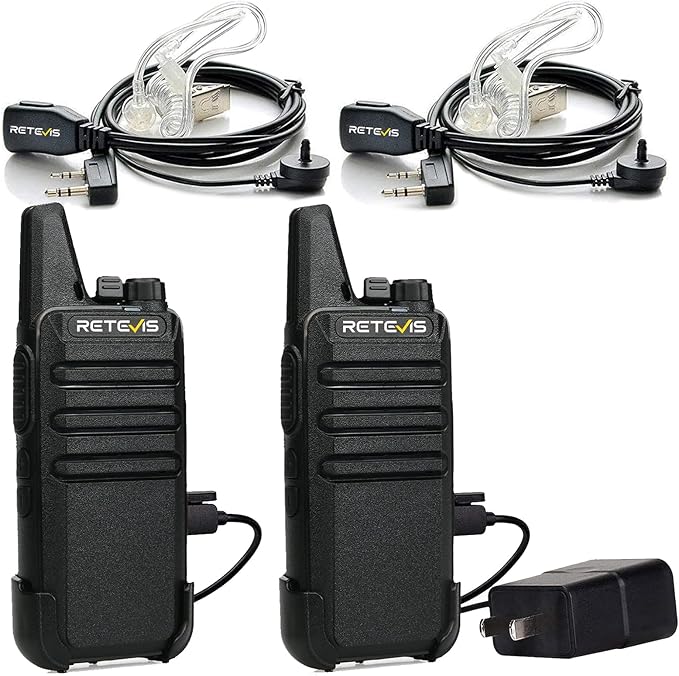
People who need lightweight and easy-to-carry walkie talkies for outdoor activities or loud workplaces will appreciate these small gadgets. Their standout feature is the lightweight, compact design, making communication comfortable over long periods without feeling bulky or tiring to hold.
Setting them up is straightforward with 16 available channels to choose from. Battery life lasts about 12 hours thanks to the 1000mAh Li-ion battery, enough to get through most days without constant recharging. A handy VOX hands-free mode allows talking without pressing buttons, which makes multi-tasking easier.
The detachable belt clip adds portability, fitting well in pockets or clipped to gear.
Sound quality is clear and loud, making messages easily heard even in noisy environments, although range tops out at about 2 miles which is adequate for most personal and work-related uses. The build is water-resistant and lightweight, designed for comfort. A common drawback is the limited range for larger outdoor spaces, but the ease of use and audio clarity often outweigh that.
Clear and loud sound quality stands out in use, making conversations easy even in noisy places. The main limitation is the 2-mile maximum range, which some users find insufficient for larger outdoor areas. The lightweight design receives high marks for comfort and portability.
Ideal for those who want simple, portable communication in small to medium-sized outdoor or work environments. Users needing longer range should consider alternatives better suited for extended distances or rugged conditions.
Pros
- Lightweight and comfortable for all-day wear
- Loud and clear sound quality
- Hands-free VOX function simplifies communication
- Long-lasting 12-hour battery life
Cons
- Maximum 2-mile range can be limiting outdoors
- Requires charging both included batteries
| Specification | Details |
|---|---|
| Number of Channels | 16 |
| Battery Average Life | 12 hours |
| Talking Range Maximum | 2 miles |
| Water Resistance Level | Water Resistant |
| Battery Type | 2 Lithium Ion batteries required |
| Voltage | 3.7 volts |
10. Super Mini Clip-On Two Way Walkie Talkies 2 Pack

Ultra-lightweight and compact, these walkie talkies clip easily to your collar and weigh less than an ounce. Perfect for jobs requiring long hours of communication without the bulk of traditional radios. Their hands-free design shines for busy work environments like restaurants and retail where discreet, clear communication matters most.
Setting them up is pretty straightforward since they’re ready to use with included nonstandard batteries and an earpiece. Wearing one clipped on your collar means you barely notice the weight, and the earpiece makes conversations private and clearer by damping surrounding noise.
It’s ideal for noisy, fast-paced places since you don’t have to shout or awkwardly hold a device.
The radios deliver solid voice clarity over most indoor workspaces and up to a 2 mile range outdoors, making basic communication reliable. They’re built to be water-resistant with IP54 rating and have noise reduction for clearer talks in loud settings.
While praised for their lightness and secure fit, some users mention the battery type isn’t standard, which could make replacements less convenient.
The radios are highly praised for their light, clip-on design and how the earpiece improves clear communication in noisy spaces. The most frequent complaint mentions the use of nonstandard batteries, which may complicate replacements over time.
People needing lightweight, discreet radios for work environments where hands-free communication is essential will appreciate these. Those looking for longer range or standard battery use might want to consider different models better suited for those needs.
Pros
- Extremely lightweight at 0.9 ounces
- Includes earpieces with built-in microphone
- Water-resistant with IP54 rating
- Privacy-enhanced communication with earpiece
Cons
- Uses nonstandard batteries, harder to replace
- Maximum range limited to 2 miles
| Specification | Details |
|---|---|
| Weight | 0.9 ounces |
| Number of Channels | 16 |
| Talking Range Maximum | 2 mile |
| Water Resistance Level | IP54 Water-Resistant |
| Frequency Range | FRS 462 – 467 MHz |
| Number of Batteries | 2 Nonstandard Battery batteries required (included) |
Comparison of Top Ultralight Radios Reviewed
| Product | Channels | Range | Water Resistance | Battery Life |
|---|---|---|---|---|
| Mountain Radio FRS Walkie Talkies | 128 | 35 miles | Water Resistant | 4 days |
| Mini Wearable Walkie Talkies | 16 | 2 mile | Water Resistant | – |
| Retevis RT22 4-Pack | 16 | 2 mile | Water Resistant | – |
| Hi-Viz GMRS Waterproof Radios | 22 | 35 miles | Waterproof | 5 days |
| Rechargeable Long Range Radios | 16 | 2 mile | Water Resistant | – |
| Cobra RX680 Radios | 60 | 36 mile | Water Resistant | – |
| Motorola Talkabout T605_H2O | 22 | 35 mile | Waterproof | – |
| PRUNUS J-166 AM FM Radio | – | – | Dust Resistant | – |
| Retevis RT22 Rechargeable | 16 | 2 mile | Water Resistant | – |
| Super Mini Clip-On Radios | 16 | 2 mile | Water Resistant | – |
- Channels128
- Range35 miles
- Water ResistanceWater Resistant
- Battery Life4 days
- Channels16
- Range2 mile
- Water ResistanceWater Resistant
- Battery Life–
- Channels16
- Range2 mile
- Water ResistanceWater Resistant
- Battery Life–
- Channels22
- Range35 miles
- Water ResistanceWaterproof
- Battery Life5 days
- Channels16
- Range2 mile
- Water ResistanceWater Resistant
- Battery Life–
- Channels60
- Range36 mile
- Water ResistanceWater Resistant
- Battery Life–
- Channels22
- Range35 mile
- Water ResistanceWaterproof
- Battery Life–
- Channels–
- Range–
- Water ResistanceDust Resistant
- Battery Life–
- Channels16
- Range2 mile
- Water ResistanceWater Resistant
- Battery Life–
- Channels16
- Range2 mile
- Water ResistanceWater Resistant
- Battery Life–
How to Choose the Best Ultralight Radio
Key factors to consider include battery life, signal range, and durability, as these affect usability and reliability during outdoor activities. Choosing the right features ensures long-term satisfaction and helps avoid frequent replacements or malfunctions, ultimately saving time and money.
Weight and Portability
Carrying a radio that weighs significantly more than a few ounces can quickly become a burden during long hikes or camping trips. I’ve found radios around 5 to 6 ounces to be manageable for all-day carry. Those with a compact design measuring roughly 4 to 5 inches in length and 2 to 3 inches in width easily slip into pockets or small compartments of backpacks without causing bulk.
Radios designed for portability often include clips or straps that allow attachment to a belt or pack, which keeps your hands free for other gear or activities.
Devices without these features tend to be forgotten or stashed away, making quick access difficult in situations where you need immediate communication. The best models balance weight and size without sacrificing usability.
Adjusting to a radio that fits snug and can be attached securely saves time and improves convenience while outdoors.
Battery Life and Power Options
On many outdoor excursions, running out of battery power is a frequent frustration, especially on multi-day trips. Radios that offer 8 to 12 hours of continuous use on a full charge cover most typical outings. Choosing between rechargeable batteries and disposable AA or AAA options depends on access to electricity and ease of replacement.
Rechargeables save waste but need planning for charging opportunities. Several models accommodate both, giving flexibility in the field.
Alternative charging methods like USB ports or solar panels add valuable options for power replenishment. USB charging lets you tap into power banks or vehicle outlets, while solar charging suits extended stays off the grid.
Radios with multiple charging pathways reduce downtime and help avoid the inconvenience of dead batteries when communication is critical.
Durability and Build Quality
Exposure to rain, dust, or accidental drops is routine in outdoor settings, and radios that can’t handle this often fail early. A solidly built radio with an ingress protection rating of at least IP54 or higher effectively resists dust and water splashes.
Dropping the device on rocks or hard ground is less damaging when the casing uses impact-resistant materials like rugged plastic or rubberized coatings.
Well-designed sealing around buttons and seams prevents moisture and dirt from reaching internal electronics, extending reliability. Radios with poor construction not only risk malfunction but also require more careful handling, which isn’t always practical outdoors. Investing in a model designed for tough conditions pays off through longer service life and less worry during use.
Signal Range and Reception
Communication range varies widely depending on terrain; open fields might allow up to 5 miles, but in dense forests or urban settings, range often drops below a mile. Radios that clearly maintain signal strength up to 3 miles in varied environments provide dependable contact during hikes or camping near trails.
Signal clarity without static or dropouts makes conversations smoother and reduces guessing or repeated calls.
Frequency bands such as FRS and GMRS affect compatibility and range, so selecting a radio that supports commonly used bands helps when coordinating with other devices. Models with adjustable power settings enable you to switch between conserving battery and maximizing reach depending on situation needs, making communication flexible and efficient.
User Interface and Features
Simple controls with intuitive layouts allow quick channel changes or volume adjustments without pulling out instructions. Radios featuring large push buttons and readable backlit displays make operation easier in low light or cold conditions when dexterity suffers. Some radios include built-in alerts for emergencies or weather updates, a useful feature that can provide early notice of changing conditions.
Accessory compatibility such as earpieces or external antennas broadens usability. Earpieces offer privacy and reduce noise disturbance, while external antennas can improve reception in difficult areas.
A straightforward interface combined with practical features keeps the radio functional and accessible in demanding outdoor environments.
Optimizing Battery Life for Ultralight Radios in Outdoor Adventures
Managing battery life is critical when using ultralight radios on extended outdoor trips. These radios rely on compact, lightweight batteries that can run out quickly if not handled carefully.
To extend usage, reduce screen brightness and avoid unnecessary transmissions. Carrying extra batteries or a portable charger designed for your radio model adds a layer of reliability. Using energy-saving modes, commonly found in most ultralight radios, helps conserve power without sacrificing communication quality.
Remember to turn off the radio when it’s not in use instead of leaving it in standby mode. Keeping the radio in moderate temperatures also benefits battery longevity, as extreme cold or heat can drain batteries faster.
- Dim screen or disable screen if possible
- Use power-saving modes
- Carry spare batteries or charger
- Turn off radio completely during inactive periods
- Store radio away from extreme temperatures
These tactics help maintain reliable communication without adding weight or bulk to your pack.
Essential Maintenance Practices to Prolong Your Ultralight Radio’s Performance
Routine maintenance keeps an ultralight radio operating well over time. Regularly cleaning the device, especially the battery contacts and antenna connector, prevents corrosion and signal interruptions.
Check the housing for cracks or damage that might allow moisture inside, as water can quickly degrade internal components. Inspect the battery compartment for corrosion or leaks. Using a soft cloth to wipe down the radio after exposure to dust, dirt, or sweat ensures no buildup interferes with controls.
Avoid dropping the radio or exposing it to harsh impacts since lightweight materials can be more vulnerable. Storing the radio in a padded protective case when not in use adds extra safety, particularly during hiking or travel.
- Clean battery contacts and antenna connections
- Inspect casing for cracks or damage
- Check battery compartment for corrosion
- Wipe off dirt and sweat after use
- Store in a padded case
Proper upkeep lets your ultralight radio perform reliably on every outing.
Comparing Ultralight Radios with Traditional Models: Pros and Cons for Hikers
Ultralight radios are smaller and weigh less than traditional models, making them easier to carry on long hikes. This portability comes with some trade-offs. Their reduced size typically means shorter battery life and fewer features compared to bulkier radios.
Traditional radios often provide clearer reception over long distances and feature tougher durability thanks to their heavier casing. However, ultralight models excel in convenience, fitting comfortably in a pocket or small pouch without noticeable weight impact.
For hikers focused on minimizing pack weight, ultralight radios provide basic communication needs without hassle. Those prioritizing extended use or ruggedness might lean toward traditional radios, accepting extra bulk for longer battery life and advanced functionality.
- Ultralight radios: compact, lightweight, easier to carry
- Traditional radios: longer battery life, more features
- Trade-off between convenience and durability
- Choice depends on balance of weight versus performance
Understanding these differences guides hikers to select the right tool for their specific adventure.
People Also Asked
How Do I Care for My Ultralight Radio Properly?
Store the ultralight radio in a dry place and avoid dropping it to maintain its functionality. Keeping it clean by wiping with a soft cloth can prevent dust and moisture damage over time.
What Are the Compatible Accessories for an Ultralight Radio?
Compatible accessories usually include rechargeable battery packs, belt clips, and external antennas. It’s helpful to check the model specifications to ensure accessories fit properly.
How Long Does the Battery Typically Last on Ultralight Radios?
Battery life often lasts between 8 to 12 hours, depending on usage and signal strength. Carrying a spare rechargeable battery can prevent downtime during long outings.
Are Ultralight Radios Safe to Use During Outdoor Activities?
Ultralight radios are generally safe for outdoor use but should be kept away from water and extreme temperatures. Using a protective case can help prevent damage in rough conditions.
What Common Problems Should I Expect with Ultralight Radios?
Common issues include battery drainage, weak signal, or sticky buttons. Regular maintenance like charging fully and cleaning contacts can reduce these problems.
Conclusion
Choosing the right ultralight radio mainly depends on portability, battery life, and signal reception quality. A compact design makes it easier to carry around, especially for outdoor use.
Long battery life helps avoid frequent recharges, and clear signal reception ensures you catch your favorite stations without interference.
Consider how often you’ll use the radio and where you plan to take it before making a decision. Matching the radio to your typical environment and budget will save you from unnecessary features or size. You can review the comparison table and detailed picks above to find the one that fits your needs best.