
Top 12 Best Airband Scanner That Will Blow Your Mind
Many people who rely on airband scanners know the frustration of missing important transmissions because their device lacks clarity or range. The best airband scanner catches clear signals from various aircraft, avoiding the static and dropouts common with cheaper models. A subpar scanner can also be bulky or difficult to carry, making it less practical for field use or travel.
What really matters in an airband scanner is strong frequency coverage across the 108 to 137 MHz range and good sensitivity to pick up weak signals. Portability is key, a model around 6 to 8 inches with a lightweight design fits easily in a bag or attaches to a belt. Battery life typically ranges from 8 to 12 hours on standard AA batteries, crucial for extended use without recharging.
Controls should be straightforward for quick tuning and volume adjustments, especially in noisy environments.
Need a Quick Check?
| Image | Product | Price |
|---|---|---|
Our Top Picks 1  | Uniden Bearcat BC125AT | Check Price |
Our Top Picks 2  | PJ2+ COM Aviation Radio | Check Price |
Our Top Picks 3  | ZHIWHIS A330 Shortwave | Check Price |
Our Selected Top 12 Airband Scanner Picks for Every Need
This list features a variety of airband scanners designed for aviation enthusiasts and professionals alike. Each review covers how well the scanner performs, who it is best suited for, and highlights its main advantages and disadvantages to help you make an informed choice.
1. Uniden Bearcat BC125AT Analog Handheld Scanner
Ideal for analog scanning enthusiasts, this compact model delivers reliable reception across a wide frequency range. Best suited to those monitoring analog transmissions, its standout feature is Close Call RF capture technology, which quickly picks up nearby signals without delay.
Setting it up is straightforward with a digital display that shows channel information clearly. Storing up to 500 alpha-tagged channels helps keep things organized. Carrying it around is simple due to its light weight and handheld design.
The Do Not Disturb Mode prevents interruptions during active transmissions, making day-to-day listening more pleasant.
Reception quality covers VHF and UHF bands well, providing consistent analog scanning within 50 kilometers. It runs on two included AA batteries, lasting about 10 hours, which suits portable use. The plastic body feels solid but is not water resistant, a common downside.
Close Call technology is praised, while inability to monitor digital systems is the main limitation.
Close Call RF capture technology is highly effective at tuning into nearby analog signals quickly, which helps users stay informed without complex scanning. However, the scanner’s strict analog-only design means it cannot pick up newer digital radio systems, often leaving out important communications in some areas.
People interested primarily in analog transmissions or who live in areas with mostly analog systems will find it quite capable. Those needing to monitor digital or trunked systems would do better to consider a scanner designed for those technologies instead.
Pros
- Quick signal capture with Close Call RF technology
- Compact and lightweight for easy portable use
- Clear digital display with alpha-tagged channels
- Long battery life of approximately 10 hours
Cons
- Not compatible with digital trunked radio systems
- Not water resistant, limiting outdoor use in bad weather
| Specification | Details |
|---|---|
| Number of Channels | 500 |
| Frequency Range | 25-54 MHz, 108-174 MHz, 225-380 MHz, 400-512 MHz (UHF) |
| Talking Range Maximum | 50 kilometer |
| Battery Type | 2 AA batteries required (included) |
| Battery Average Life | 10 hours |
| Voltage | 3 volts |
2. PJ2+ COM Aviation Handheld Radio
Built with a sturdy yet lightweight design, the PJ2+ COM Aviation Handheld Radio fits perfectly for pilots who need straightforward, reliable airband communication. Its biggest strength lies in operating without adapters, thanks to dual PJ headset plugs ready for standard general aviation headsets.
Setup is simple, power it on and dial the frequency you want with the large, backlit keypad, so you can do it easily while flying. The six AA batteries provide long-lasting power, but there’s also a USB-C connection option to tap into the aircraft’s power when needed.
Buttons are big and spaced out, making one-handed operation during flight less distracting.
The radio delivers a clear VHF signal over 760 channels between 118.000 and 136.975 MHz, with a maximum talking range of about 10 miles. It feels solid and dependable, but it’s not water-resistant, which might be a drawback in wet conditions. Users appreciate its straightforward functionality but sometimes mention the lack of advanced menus as a limitation.
The radio is praised for its simple, no-fuss operation that lets you pick frequencies quickly without messing with complicated settings. Most complaints point toward its lack of water resistance, making it less ideal for wet or high-moisture environments.
Pilots who prefer straightforward communication with long battery life will find this radio very suitable. Those looking for advanced features or waterproof options may want to consider other models.
Pros
- No adapters needed for standard PJ headsets
- Simple operation with large, backlit buttons
- Dual power options: batteries or USB-C
- Supports up to 760 channels
Cons
- Not water resistant
- Limited features due to absence of complex menus
| Specification | Details |
|---|---|
| Frequency Range | 118.000-136.975 MHz |
| Number of Channels | 760 |
| Transmission Power | 6 Watts |
| Power Source | 6 AA batteries or USB-C backup power |
| Connectivity | PJ headset jacks and 3.5mm headphone jack |
3. ZHIWHIS A330 SSB Shortwave Radio Receiver
Wide frequency coverage stands out immediately, especially if you want access to everything from FM to airband and shortwave. Perfect for anyone interested in tracking multiple bands, including single-sideband signals. Its biggest strength lies in handling SSB reception with fine BFO adjustment options, making it a solid choice for shortwave enthusiasts.
Setting up involves plugging in the included battery and optionally connecting an external antenna for better reception. You can store up to 200 stations per band, which comes in handy for frequently accessed channels. The numeric keypad speeds up finding exact frequencies, while auto search modes make scanning through bands quick and flexible.
Lightweight design makes carrying it around pretty easy.
It does a great job picking up signals across a wide range, including airband and NOAA weather channels. The build is compact and lightweight but feels sturdy enough for regular use. Positive feedback highlights its clear SSB reception thanks to BFO control, though some note the battery life could be longer.
Sound quality is generally good for a portable unit of this size.
The strongest praise focuses on precise single-sideband reception thanks to the adjustable Beat Frequency Oscillator. Common feedback points to battery life being shorter than desired, especially during extended listening sessions. Its compact size and wide band coverage add flexibility to daily use, although users should plan for battery replacements.
Enthusiasts needing wide frequency options including airband and shortwave with SSB will find it useful. Those wanting longer battery endurance or standard battery types should look for other models. Good for portable scanning with ample memory but best suited to users who can manage the battery requirement.
Pros
- Supports SSB with adjustable BFO for clear reception
- Wide range of frequency bands covered
- Large memory for storing radio stations
- Lightweight and portable for easy transport
Cons
- Battery life could be longer with heavy use
- Nonstandard battery might limit replacements
| Specification | Details |
|---|---|
| Number of Channels | 1400 |
| Frequency Coverage | FM, MW, SW (2.3-30MHz), AIR (118-138MHz), CB, VHF, UHF, WB |
| Battery | 1 Nonstandard Battery (included) |
| SSB Demodulation Modes | AM, LSB, USB with BFO adjustment |
| External Antenna Port | 3.5mm jack |
| Station Memory | 200 per frequency band |
4. Whistler WS1010 Analog Handheld Scanner

Perfect for serious hobbyists or emergency spotters, this scanner stands out with its massive 400 channel memory and specific functions for weather and storm spotter networks. It suits anyone who needs quick access to a broad range of frequencies without fuss.
Setting up involves organizing frequencies into 10 memory banks, which makes daily scanning organized and easy. The built-in Spectrum Sweeper helps find active channels nearby, while the SAME alert system keeps you updated on weather risks by county, crucial during storm seasons.
PC programmability lets you update and back up data as needed.
Performance-wise, it reliably picks up signals from marine, fire, police, aircraft, ham, and weather bands using preprogrammed banks. The handheld unit is compact and lightweight at just 7.7 ounces, making it handy for outdoor use.
Many users praise its clear reception and alert features, though some report the small size can make the buttons a bit fiddly.
Clear reception and effective weather alerting are the strongest aspects users appreciate the most. A common complaint is that the small buttons can be difficult to operate, especially for those with larger fingers or in low-light conditions.
People who want an easy-to-carry, detailed scanning experience with weather alerts will find this very useful. Those preferring larger controls or plug-and-play PC programming without extra accessories might consider other models.
Pros
- Stores up to 400 frequencies in 10 banks
- Immediate storm spotter network access
- Weather alerts by specific counties
- Lightweight and portable design
Cons
- Buttons are small and can be tricky to press
- Requires additional cable and software for PC programming
| Specification | Details |
|---|---|
| Channels | 400 |
| Memory Banks | 10 |
| Dimensions | 1.56 x 2.37 x 5.68 inches |
| Weight | 7.7 ounces |
| Batteries | 4 AA batteries (included) |
5. Uniden Bearcat SR30C Analog Handheld Scanner

Trying to stay updated with local emergency, weather, or radio communications while on the go can be tricky without the right tool. The Uniden Bearcat SR30C is perfect for someone looking for an affordable, pocket-sized scanner that covers a wide variety of frequencies. It shines in giving quick access to many preset channels straight out of the box.
Setting up the scanner feels straightforward, especially since it comes with 10 service banks that include popular searches like police, fire, NOAA weather, and ham radio. Programming more specific channels is easy using a PC with its USB connection.
Running on AA batteries or USB power means it’s flexible for use at home or outdoors without worrying much about power sources.
The scanner handles a large range of frequencies well, covering over 32,000 MHz, so it picks up a broad spectrum of signals clearly. Its compact design fits comfortably in hand or pocket for carrying around. Reviews often praise how many frequencies it covers and the preset banks for various services but mention that being mono audio is a limitation for some users who want stereo sound or better audio quality.
The strong points lie in its broad frequency coverage and ready-to-use preset service banks, making scanning various signals fast and convenient. The mono audio output is a common drawback, with some users wanting richer sound quality for better listening comfort.
Those who want a simple, portable scanner to catch standard analog signals in multiple categories will find this a practical choice. People needing stereo audio or scanning multiple bands concurrently might want to explore other models that fit those needs better.
Pros
- Wide frequency support including 32,000 MHz
- Convenient pre-set channels in ten service banks
- USB and battery power options
- Easy PC programming interface
Cons
- Audio output is mono, not stereo
- Limited to one radio band
| Specification | Details |
|---|---|
| Frequency | 32000 MHz |
| Number of Channels | 500 |
| Power Source | USB, Battery-Powered |
| Connectivity Technology | USB |
| Audio Output Mode | Mono |
| Additional Features | Close Call RF Capture, Turbo Search, PC Programming |
6. Uniden Bearcat BCD160DN Digital Handheld Scanner
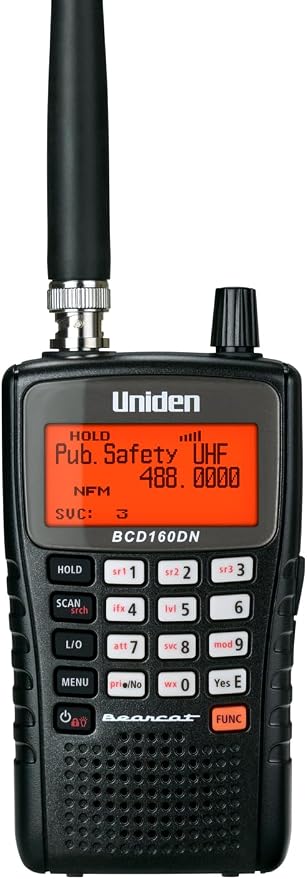
Rapidly detecting CTCSS tones and DCS codes is what sets this scanner apart, making it ideal for enthusiasts who want quick access to system information. It fits best with users who don’t require trunking but need clear decoding of conventional digital signals like DMR and NXDN.
Setting it up involves a straightforward USB connection. Day-to-day use benefits from features like Band Scope Rapid System/Channel Number Tagging, which helps find specific signals faster. Searching is efficient thanks to the complete suite of search options, and narrow-band reception keeps signals clean even in crowded areas.
The scanner handles its main task of decoding conventional digital radio transmissions with reliable accuracy. Build quality feels solid and practical for handheld use.
Most praise goes to its quick code identification and versatile decoding. The most frequent complaint revolves around the lack of trunking support and no handling of encrypted transmissions.
The scanner quickly identifies tones and codes, making signal detection efficient. Most people note its inability to handle trunking systems or encrypted transmissions as a limitation. It performs well for scanning regular digital and analog signals.
This model suits hobbyists focused on straightforward scanning without trunking needs. Anyone requiring trunking or encrypted signal decoding will want to look for a different product offering those capabilities.
Pros
- Instantly detects and displays CTCSS/DCS codes
- Supports DMR and NXDN decoding out of the box
- Comes with multiple search features for faster detection
- USB connection makes setup easy
Cons
- No trunking support for more complex systems
- Cannot decode encrypted signals
| Specification | Details |
|---|---|
| Scanner Type | Radio Scanner |
| Connection Type | USB |
| DCS/CTCSS Rapid Decode | Yes |
| Digital Decoding Support | DMR, NXDN, APCO P25 Phase 1 & 2 (firmware update) |
| Trunking Support | No |
7. Uniden SDS150 Digital Radio Scanner

People who need reliable scanning of digital and analog radio frequencies in the field will appreciate this scanner. It suits hobbyists and professionals looking for good reception and advanced features. Its biggest strength is enhanced sensitivity that picks up faint signals while minimizing interference.
Setting up involves a straightforward control layout and a clear digital display that makes tuning and programming easier than older models. A built-in GPS receiver aids location-specific scanning, and Bluetooth support lets you pair it with a smartphone app for added convenience.
The charge cradle keeps it powered during long hours outside, and the lightweight design makes it comfortable to carry around.
Signal reception and filtering work well for clear audio, even across trunked systems like APCO P25 and Motorola. The sturdy build handles daily use without issues while being water resistant. The clearest positive noted is the enhanced sensitivity and simple interface.
A common complaint is the nonstandard battery, which may limit easy replacements.
Reviews highlight the strong reception and easy interface as the best features. Most users find the enhanced sensitivity helpful for picking up weak signals, but the nonstandard battery type is commonly mentioned as inconvenient for replacing or finding spares.
Anyone needing reliable digital trunked scanning with good portability will find this suitable. Those wanting a scanner with standard batteries or simpler operation might want to look at alternative models.
Pros
- Improved signal reception and interference filtering
- Lightweight yet durable for field use
- Includes built-in GPS for precise scanning
- Bluetooth connectivity to smartphone apps
Cons
- Nonstandard battery may limit quick replacements
- Some complexity in supporting multiple trunking systems
| Specification | Details |
|---|---|
| Connectivity Technology | Bluetooth |
| Power Source | Battery Powered |
| Radio Bands Supported | AM, NFM, FM, WFM, or FMB |
| Tuner Type | TrunkTracker X, APCO P25 Phase I & II, Motorola, EDACS, LTR DMR Tier III* |
| Display Type | digital |
| Additional Features | Weather Alert, Built-in GPS |
8. Uniden BC365CRS 500-Channel Scanner

Offering 500 channels with pre-set searches for police, fire, weather, aircraft, and more, the Uniden BC365CRS suits anyone wanting a reliable desktop airband scanner without complicated setup. Its combination of scanner, FM radio, and alarm clock in one package stands out for convenience and versatility.
Getting started is straightforward since it comes with preset channels covering popular frequencies like emergency services and marine bands. You control it using push buttons, which keeps navigation simple and responsive. The built-in FM radio lets you save up to 30 stations, while the alarm clock functionality adds everyday usefulness to this tabletop device.
The scanner performs well at picking up analog signals quickly and clearly around its 500 available channels. The build feels durable with a solid desktop design but is limited to corded electric power and needs three AA batteries for backup. Strongest praise focuses on easy access to diverse channels, while the most frequent complaint regards its lack of digital frequency support.
Many appreciate its wide range of preset channels that let you tune into emergency, marine, and aircraft bands right away. The main drawback noted is the absence of digital frequency scanning, which limits listening options in some areas.
Anyone wanting a straightforward analog scanner combined with an FM radio and alarm clock will find this device suitable. Those needing digital scanning capabilities or portable operation without cords might want to explore other models.
Pros
- Pre-set searches for quick channel access
- Includes FM radio with 30 station presets
- Alarm clock function adds everyday value
- Push button controls are intuitive
Cons
- Only receives conventional analog signals
- Needs a power cord plus AA batteries
| Specification | Details |
|---|---|
| Power Source | Corded Electric |
| Number of Channels | 500 |
| Control Method | Push Button |
| Battery Description | Alkaline |
| Number of Batteries | 3 AA batteries required |
| Mounting Type | Tabletop Mount |
9. Uniden BC355N Base/Mobile Scanner

Uniden BC355N Base/Mobile Scanner is designed for analog radio users who want reliable signal capture near 800 MHz. Best for those in areas with analog signals, its biggest strength is the Close Call RF Capture Technology that instantly tunes to nearby transmissions, making it easy to catch local chatter quickly.
Setting up takes just a few minutes since it plugs into a power outlet and connects via USB for programming. Daily use revolves around scanning one band effectively, and the LCD display is clear enough to keep track of stations. Close Call helps you discover signals without manual searching, which simplifies tuning and keeps you locked onto active frequencies in your area.
It performs solidly on analog frequencies, catching transmissions without delays. The build feels sturdy and made for consistent use, though it lacks digital system support which limits usability in cities switching to digital trunking. The strongest praise is for quick tuning to analog signals, while the main complaint centers on the absence of digital monitoring capabilities, which means it’s not suited for all emergency scanning today.
Close Call RF Capture makes finding local analog signals fast and straightforward, which reviewers appreciate the most. However, it cannot monitor digital communications, limiting its usefulness in places with modern emergency or public safety radios.
Perfect for anyone relying on analog scanners who mostly want to monitor 800 MHz channels. People needing digital trunking or multi-band scanning should look at other Uniden models designed for newer systems.
Pros
- Instant tuning to nearby signals with Close Call technology
- Clear LCD display for easy station tracking
- Works well on analog 800 MHz band
- Simple USB connectivity for programming
Cons
- Not compatible with digital radio systems
- Supports only one band of frequencies
| Specification | Details |
|---|---|
| Radio Bands Supported | 1-Band |
| Frequency | 800 MHz |
| Power Source | Corded Electric |
| Connectivity Technology | USB |
| Additional Features | Close Call RF Capture Technology, Wide Frequency and Service Bank Support |
| Display Type | LCD |
10. BAOFENG DM32 DMR Dual Band Radio

Carrying a single radio that covers both digital and analog modes feels like owning two devices in one. Ideal for ham radio enthusiasts who want flexibility between DMR and FM communications, it shines with its wide frequency range and AM airband reception, making scanning multiple services convenient.
Setting up the DM32 involves programming channels and zones to fit personal needs, which can be done on compatible radios and repeaters. The built-in GPS and digital APRS add a handy way to track your position during outdoor activities.
USB-C charging is a practical touch for daily use, and noise from digital call recordings keeps important communications stored.
The radio handles VHF, UHF, and AM airband signals clearly, supporting both modes without hassle. Solid build quality is notable, though it lacks water resistance, which matters in wet conditions.
Many users appreciate the vast 4,000 channels, but some find the battery performance and nonstandard battery type slightly inconvenient for longer sessions.
Users appreciate the extensive channel capacity and flexible dual-mode operation that cover various scanning needs in one radio. The main drawback is the lack of water resistance, which means it requires care around moisture and rain during outdoor use.
The radio suits those who want a versatile ham radio combining digital and analog functions with location tracking. Anyone needing a rugged, waterproof radio for harsh environments might look for alternatives better suited to wet conditions.
Pros
- Supports both DMR digital and analog FM modes
- Built-in GPS with digital APRS tracking
- Large memory with 4,000 channels and 250 zones
- Includes NOAA weather and AM airband reception
Cons
- Nonstandard battery can complicate replacements
- No water resistance limits outdoor durability
| Specification | Details |
|---|---|
| Number of Channels | 4000 |
| Frequency Range | VHF 136–174MHz, UHF 400–470MHz, AM 108–136MHz, FM 65–108MHz |
| Talking Range Maximum | 6 km |
| Voltage | 7.4 volts_of_direct_current |
| Charging | USB-C |
| Water Resistance Level | Not Water Resistant |
11. A330 Portable SSB Shortwave Radio

Compact and versatile, the A330 Portable SSB Shortwave Radio suits anyone serious about scanning a wide range of frequencies. Its strongest point lies in the impressive frequency coverage, including airband and shortwave with SSB capability, making it a practical tool for airband scanning fans and radio enthusiasts.
Setup is straightforward with a clear, blue-backlit LCD screen that stays visible outdoors. Daily use benefits from storing up to 1,400 stations, helping you quickly access favorite bands.
Bluetooth 5.2 allows you to stream music from a smartphone, and the TF card slot extends media playback options. Fine-tuning with BFO adjustment helps get clear single sideband signals every time.
The radio excels at picking up multiple bands, from FM and AM shortwave to air, CB, VHF, and UHF frequencies. Its build quality feels solid, even if it’s not water resistant. Many appreciate the deep station memory and fine-tuning feature, although some mention the single nonstandard battery as a minor hassle.
The auto power-off helps conserve energy during longer use.
The radio’s broad frequency range and detailed fine-tuning receive strong praise for aiding clear signal reception, appealing to serious shortwave and airband listeners. The need for a nonstandard battery and lack of water resistance are commonly noted drawbacks affecting convenience and outdoor use.
Listeners wanting extensive band coverage with solid digital features will find it satisfying. Those frequently using the radio in wet or harsh environments, or seeking standard battery compatibility, might want to explore other options better tailored to those needs.
Pros
- Wide band coverage including air and shortwave
- Stores up to 1,400 stations for quick access
- Bluetooth 5.2 supports wireless music playback
- BFO fine-tuning improves single sideband clarity
Cons
- Requires single nonstandard battery, not standard types
- Not water resistant, limits outdoor durability
| Specification | Details |
|---|---|
| Frequency Coverage | FM (64-108MHz), MW (520-1710kHz), SW (2.3-30MHz), AIR (118-138MHz), CB (25-28MHz), VHF (20-250MHz), UHF (250-999MHz), WB (162.4-162.55MHz) |
| Number of Channels | 1400 |
| SSB Demodulation Modes | AM, LSB, USB |
| Bluetooth Version | 5.2 |
| Display | STN LCD blue-backlit, wide viewing angle |
| Power | 1 Nonstandard Battery (included) |
12. Uniden BearTracker BCT15X Scanner

Designed with a durable mobile build, the Uniden BearTracker BCT15X Scanner suits anyone needing a powerful airband and police frequency scanner for vehicle use. Its biggest strength lies in the ability to store up to 9,000 channels, covering wide-ranging communications including local police and highway patrol, making it highly suited for travelers and radio enthusiasts.
Setting up the scanner involves connecting it to power through the vehicle accessory power cord and mounting it securely using the hardware supplied. It automatically selects local channels via the location-based scanning feature when paired with a compatible GPS receiver. Daily use is simplified by the TrunkTracker III technology, which keeps up with Motorola, EDACS, and LTR systems, while individual channel volume offset and alpha tagging make it easier to identify communications.
Performance meets expectations with clear reception and extensive channel memory that handles a dynamic range of signals well. The sturdy build feels solid and dependable in a vehicle environment. Common praise focuses on the vast channel capacity and location-based scanning, while the main complaint involves the complexity of initial programming for some users.
Strong points include the vast channel memory and automatic selection of local frequencies with GPS, making it convenient for frequent travelers. Complexity during the initial setup is frequently noted, especially when programming the scanner for specific needs.
People who travel often or monitor various local and trunked systems will find it very useful. Those who want simple plug-and-play operation or are new to scanner programming might find the learning curve frustrating and should consider simpler alternatives.
Pros
- Supports location-based programmed scanning
- Individual channel volume offset feature
- Compatible with BC-RH96 Remote Head
- Preprogrammed state-by-state police channels
Cons
- Programming can be complicated for beginners
- GPS compatibility required for location-based scan
| Specification | Details |
|---|---|
| Channels Capacity | 9,000 Channels |
| Trunking Technology | TrunkTracker III |
| Included Accessories | AC Adapter, Vehicle Power Cord, Mounting Bracket and Hardware, Antenna, Serial Programming Cable |
| Alpha Tagging | Yes |
| Warranty | 1 year manufacturer |
Best Airband Scanners Comparison Table
| Product | Number of Channels | Frequency Range | Power Source | Water Resistance |
|---|---|---|---|---|
| Uniden Bearcat BC125AT | 500 | 25-54,108-174,225-512 MHz | 2 AA batteries | Not Water Resistant |
| PJ2+ COM Aviation Radio | 760 | 118.000-136.975 MHz | 9 volts | Not Water Resistant |
| ZHIWHIS A330 Shortwave | 1400 | Full-Band | 1 Nonstandard battery | – |
| Whistler WS1010 Scanner | – | – | 4 AA batteries | – |
| Uniden Bearcat SR30C | – | 32000 MHz | USB, Battery | – |
| Uniden BCD160DN Digital | – | – | USB | – |
| Uniden SDS150 Scanner | – | – | Battery Powered | – |
| Uniden BC365CRS Scanner | – | – | 3 AA batteries | – |
| Uniden BC355N Base Scanner | – | 800 MHz | Corded Electric | – |
| BAOFENG DM32 DMR Radio | 4000 | VHF, UHF, AM, FM | USB-C Charging | – |
| A330 Portable Shortwave | 1400 | – | 1 Nonstandard battery | Not Water Resistant |
| Uniden BearTracker BCT15X | – | – | AC Adapter, Vehicle Power | – |
- Number of Channels500
- Frequency Range25-54,108-174,225-512 MHz
- Power Source2 AA batteries
- Water ResistanceNot Water Resistant
- Number of Channels760
- Frequency Range118.000-136.975 MHz
- Power Source9 volts
- Water ResistanceNot Water Resistant
- Number of Channels1400
- Frequency RangeFull-Band
- Power Source1 Nonstandard battery
- Water Resistance–
- Number of Channels–
- Frequency Range–
- Power Source4 AA batteries
- Water Resistance–
- Number of Channels–
- Frequency Range32000 MHz
- Power SourceUSB, Battery
- Water Resistance–
- Number of Channels–
- Frequency Range–
- Power SourceUSB
- Water Resistance–
- Number of Channels–
- Frequency Range–
- Power SourceBattery Powered
- Water Resistance–
- Number of Channels–
- Frequency Range–
- Power Source3 AA batteries
- Water Resistance–
- Number of Channels–
- Frequency Range800 MHz
- Power SourceCorded Electric
- Water Resistance–
- Number of Channels4000
- Frequency RangeVHF, UHF, AM, FM
- Power SourceUSB-C Charging
- Water Resistance–
- Number of Channels1400
- Frequency Range–
- Power Source1 Nonstandard battery
- Water ResistanceNot Water Resistant
- Number of Channels–
- Frequency Range–
- Power SourceAC Adapter, Vehicle Power
- Water Resistance–
How to Choose the Right Airband Scanner
Look for a scanner with clear audio quality, reliable frequency coverage, and easy operation to ensure you can monitor air traffic effectively. Choosing the right features helps avoid frustration and costly upgrades later, making your experience smoother and more enjoyable.
Frequency Coverage
A radio that can’t pick up all relevant aviation frequencies quickly becomes frustrating in practice. Some radios cover only the basic VHF airband channels around 118 to 137 MHz but miss supplemental or nearby frequencies used in certain regions or for specialized services like weather alerts. Missing those means lost information and gaps in tracking flights or communicating with control towers.
A good scanner covers the full VHF airband and includes flexibility for newer or regional channels, often extending slightly beyond 137 MHz up to about 138 MHz or more. Support for a frequency range roughly between 118 to 138 MHz is ideal, allowing you to stay connected as frequency standards evolve or vary by location. Look for models specifying continuous coverage rather than just preset channels for better adaptability.
Audio Quality and Reception
Listening to aviation chatter in a noisy environment gets challenging if audio isn’t clean. Lower-end models struggle with static and interference, which can obscure important calls or weather updates.
Good sensitivity lets radios pick up weaker signals, while selectivity cuts down background noise from nearby transmissions.
Volume control must be precise enough to adjust for quiet spaces or noisy outdoors. Clear, distortion-free sound requires decent speaker quality or an option to plug in headphones.
Radios with a signal meter or noise blanker features generally provide better clarity, important during busy traffic or adverse weather.
Portability and Power Options
Traveling with bulky or heavy equipment gets tiring fast, and frequent users know that compactness makes daily carrying and quick checks easier. A lightweight device around 200 grams or less fits comfortably in a jacket pocket or small bag. Size impacts how easily the radio can be pulled out and operated on the move.
Battery life is a major consideration. Units running on standard AA or AAA batteries are handy since replacements are easy to find, but built-in rechargeable batteries with USB charging add convenience if outlets are available.
Having the option to power the device via USB or external adapters can extend use during extended fieldwork.
User Interface and Features
Constant retuning or fiddling with buttons quickly gets annoying without a practical interface. Radios with dedicated knob tuning or clearly labeled keys let users lock on frequencies fast.
Saving frequently used channels into memory means no repeated manual input after initial setup.
Display clarity improves usability, especially under bright sunlight or at night. Backlit LCDs with adjustable brightness or contrast work better in varied lighting. Additional tools like scanning modes to cycle through channels, signal strength meters, and alert tones help identify and monitor transmissions efficiently without constant surveillance.
Durability and Build Quality
Devices used outside are exposed to drops, dust, and rain, so build quality affects longevity. Radios with rubberized bumpers or reinforced housings withstand everyday knocks better than plastic-only shells. Protection ratings such as IP54 indicate resistance to dust ingress and splashing water, useful for outdoor environments.
Materials matter: metal chassis parts increase durability but can add weight. Ergonomic design including comfortable grip textures and accessible buttons reduces hand fatigue during longer listening sessions. Durability combined with practical design ensures equipment stays functional through rough handling and regular use.
Maximizing Reception: Tips for Optimal Airband Scanner Performance
Good placement of your airband scanner antenna can significantly improve reception quality. Position the antenna outdoors or near a window away from metal objects that can block signals.
Using an external antenna, especially one designed for VHF frequencies, often brings clearer audio and more consistent scanning results.
Adjust the scanner’s frequency step size to match the channel spacing used in aviation bands, commonly 25 kHz or 8.33 kHz, to prevent missing transmissions. Keep the scanner updated if it allows firmware or software upgrades, as these can refine scanning algorithms and support newer frequency standards.
- Use a ground plane or mount antennas higher for better line-of-sight.
- Reduce electrical interference by keeping the scanner away from other electronic devices.
- Regularly scan different frequency ranges to catch variations or updates in local traffic.
Essential Maintenance Practices to Extend the Life of Your Airband Scanner
Cleaning the exterior of the airband scanner with a dry, soft cloth prevents dust buildup that could clog vents or buttons. Avoid using water or solvents that might damage electronic components. Periodic inspection of antenna connectors ensures they are tight and free from corrosion, which can degrade signal quality.
Store the scanner in a dry environment to protect internal circuits from moisture damage. When the battery is removable, take it out during extended storage to prevent leakage. Maintain firmware updates when available, as these typically include bug fixes that can affect device longevity.
- Handle knobs and buttons gently to avoid mechanical wear.
- Check cables regularly for cracks or fraying.
- Keep a backup of important settings if the device supports it.
Comparing Airband Scanners with Alternative Aviation Communication Tools
Airband scanners focus on monitoring communication between pilots and air traffic control, using dedicated aviation frequencies. Compared to general radio scanners, they offer finer frequency resolution suited to VHF airband channels. However, portable transceivers designed for pilots allow both listening and transmitting, which scanners do not.
Software-defined radio (SDR) setups provide a flexible alternative by enabling users to monitor a wide range of frequencies, including aviation bands, with customizable software. These require a computer or compatible device and some technical know-how, unlike standalone airband scanners that work out of the box.
- Dedicated airband scanners typically have simpler interfaces focused on aviation.
- SDRs can cover multiple communication types but may lack immediate ease of use.
- Transceivers allow active communication but tend to be more expensive and complex.
People Also Asked
How Do I Properly Care for My Airband Scanner?
Keep the airband scanner clean and dry to maintain functionality. Avoid dropping it or exposing it to extreme temperatures. Using a protective case can prevent damage during transport.
What Size Antenna Fits Best with an Airband Scanner?
A quarter-wave antenna tuned to the 118-137 MHz range works best. This length offers good reception for airband frequencies without being cumbersome. Some users find flexible whip antennas handy for portability.
Are Airband Scanners Safe to Use Around Electronics?
Airband scanners do not emit strong signals, so they generally do not interfere with electronics. It’s still wise to keep the scanner a few inches away from sensitive devices to avoid any minor signal crossover. Avoid using it near medical equipment without checking guidelines.
How Long Do Airband Scanners Typically Last with Regular Use?
Airband scanners usually last several years with regular use if handled carefully. Battery life depends on the model and usage, so have spare batteries or a charger handy. Regularly updating firmware can also help prolong device life.
What Are Common Problems with Airband Scanners and How to Fix?
Common problems include poor reception and battery drain. Improving antenna placement often fixes reception issues. Using fresh batteries or a reliable power source takes care of power problems. Firmware updates can resolve software glitches.
Conclusion
Choosing a good airband scanner comes down to clear reception, ease of use, and a decent frequency range. You want a model that can pick up the right signals clearly without a complicated setup.
Battery life or power options can also matter depending on where you’ll be using it most.
Think about how often you’ll use the scanner and where. A compact, affordable model might work well for occasional listening near home, while a more advanced unit suits frequent or field use. Review the comparison table and product details above to find one that fits your specific needs and budget.


