Top 12 Best ALE Radios That Will Blow Your Mind Today
Radio communication can be frustrating when a device cuts out at the worst moment or fails to pick up crucial signals. Many who rely on the best ale radios know the pain of a weak battery or poor antenna disrupting their contact during important situations. Cheap radios often struggle with range and clarity, which can lead to serious inconvenience or safety issues, especially outdoors or in rural areas.
The key factors that distinguish good ale radios include battery life, signal range, and build quality. Radios with at least 10 to 15 hours of battery life on a single charge provide reliable performance throughout the day.
Signal range typically falls between 5 to 10 miles, depending on terrain and antenna strength, so a strong antenna and good reception are essential. Durable materials and water resistance ratings also matter since these radios often face rough environments and weather exposure.
Need a Quick Check?
| Image | Product | Price |
|---|---|---|
Our Top Picks 1  | Baofeng UV-5RM Radio | Check Price |
Our Top Picks 2  | Lifetime Free PoC Radios | Check Price |
Our Top Picks 3  | Choyong LC100 Internet Radio | Check Price |
Our Selected Top 12 Ale Radios Worth Considering
This list features a selection of ale radios known for their reliability and sound quality. Each review covers the device’s performance, ideal user scenarios, and highlights both strengths and weaknesses to help you make an informed choice based on your needs.
1. Baofeng UV-5RM Handheld Ham Radio
Communication over long distances can be tricky without the right gear, especially when you need reliable, clear channels in various environments. The Baofeng UV-5RM Handheld Ham Radio fits well for those looking to cover a broad range of frequencies with plenty of memory slots, making it a solid choice for amateur radio enthusiasts focused on flexible, licensed use.
Setting it up is straightforward and runs smoothly thanks to full compatibility with CHIRP programming software. Daily operation feels comfortable due to its ergonomic design, easy color display, and 999 memory channels that help keep your favorite frequencies organized. Battery saver mode extends talk time, while the integrated flashlight and emergency alarm add practical safety features for outdoor or emergency use.
The radio covers a wide frequency range and holds up well for long-range transmissions, reaching up to 8 kilometers. Build quality leans toward lightweight and practical rather than rugged or waterproof, so handling with care is a must. Users praise the extensive channel memory and ease of programming, while the non-water-resistant design comes up most often as a drawback for outdoor use.
Users appreciate how many channels it holds and how smoothly it works with programming software, making frequency management simple. The most common issue noted is the lack of water resistance, which can be a serious limitation for those using it in wet conditions or harsh environments.
This will satisfy anyone looking for a flexible, licensed ham radio with extensive frequency options and memory capacity. People needing a rugged, fully water-resistant device might want to explore other models better suited for tough outdoor adventures.
Pros
- Wide frequency coverage on several bands
- 999 memory channels for easy frequency recall
- Comfortable ergonomic design for extended use
- Battery saver mode and emergency alarm included
Cons
- Not water resistant, needs careful handling outdoors
- Maximum talk range limited to 8 kilometers
| Specification | Details |
|---|---|
| Number of Channels | 999 |
| Frequency Range (Receive) | 108-136MHz,136-174MHz,220-260MHz,350-390MHz,400-520MHz |
| Frequency Range (Transmit) | 144-148MHz,420-450MHz |
| Talking Range Maximum | 8 kilometer |
| Power Source | 7.4 volts rechargeable |
| Charging Type | Type C |
2. Lifetime Free Rapid PoC Two-Way Radios (2-Pack)
Powered by global 4G networks, these radios allow communication across vast distances up to 5,000 miles. Ideal for teams working remotely or in different countries, they remove the usual range limits found in traditional walkie-talkies, making group coordination possible no matter where members are located.
Setup involves downloading the OLA Radio app on your smartphone, where you can manage groups, rename users, and track who’s online in real time. Using the app, you can talk directly to the radios or onboard users, choosing from private calls, group calls, or temporary sessions depending on your needs.
The radios include rechargeable batteries and have a battery saver mode to stretch usage during long days.
Communication is clear with low audible noise levels, relying on LTE connectivity to keep conversations going reliably over long distances. The radios are lightweight but are not water resistant, which means they need protection from wet environments. Users generally praise how they stay connected globally, though some find the lack of waterproofing a downside for outdoor use.
The biggest advantage is the ability to communicate anywhere in the world thanks to 4G connectivity and app integration. The main drawback is the lack of water resistance, limiting use in harsh outdoor conditions. Users appreciate the range and control but should plan for dry environments.
Those who coordinate teams across wide areas or internationally will benefit most from these radios. People needing rugged, waterproof devices for outdoor work in wet conditions might prefer radios designed specifically for those environments instead.
Pros
- Unlimited global communication over 4G networks
- Manage groups and calls easily via mobile app
- Multiple call modes for flexible communication
- Rechargeable with battery saver mode included
Cons
- Not water resistant, needs careful handling outdoors
- Requires smartphone app for full functionality
| Specification | Details |
|---|---|
| Talking Range Maximum | 5000 mile |
| Connectivity Protocol | LTE |
| Battery | 2 12V batteries required (included) |
| Audible Noise | 0.5 db |
| Compatible Devices | Smartphone (via OLA Radio app) |
| Water Resistance Level | Not Water Resistant |
3. CHOYONG LC100 Multi-Band Smart Internet Radio
Anyone who enjoys variety in radio listening will appreciate this multi-band smart internet radio. Perfect for travelers and global audio fans, its biggest strength lies in connecting to over 50,000 stations and millions of podcasts worldwide through multiple network options.
Setup involves connecting via 5G Wi-Fi, eSIM, or a 4G SIM card, which makes accessing global content straightforward. The interface sorts channels by region, city, or genre, so browsing feels intuitive and fast. Bookmarking a favorite station requires just one tap.
Battery power and voice search add portability and convenience, keeping the daily experience flexible.
The sound quality is clear and noise-free, handling FM/LW/MW/SW/SSB analog bands with adjustable bandwidth and signal strength readouts. A strong antenna port supports better reception.
The build combines practical features like treble and bass adjustments and recording capability. Praise centers on global station variety, while some users mention the reliance on one AAA battery as a limitation.
The broad selection of global radio stations and podcasts stands out as the strongest benefit, while having only one AAA battery as a power source is the most noticeable drawback. Browsing by region and genre works well for quick access, but battery life may require frequent changes during heavy use.
Listeners craving worldwide channels and internet streaming will enjoy this set up. Those who need longer battery life or a more compact form may want to explore other options that better suit portable needs or prolonged outdoor use.
Pros
- Access to over 50,000 global stations
- Multiple connectivity options including eSIM and 5G Wi-Fi
- Adjustable bandwidth and signal readouts for clear reception
- One-tap bookmarking for favorites
Cons
- Relies on a single AAA battery
- Physical size and weight not specified for portability
| Specification | Details |
|---|---|
| Global Radio Stations/Podcasts | 50,000+ stations and 40 million podcasts |
| Connectivity Technology | 2.4Wi-Fi, 4G network, 5GWi-Fi, Bluetooth, eSIM |
| Radio Bands Supported | MULTI-BAND (FM/LW/MW/SW/SSB) |
| Power Source | Battery Powered (1 AAA battery included) |
| Audio Output Mode | Stereo |
| Display Type | LCD |
4. Retevis RB58F Bluetooth FRS Walkie Talkie

These walkie talkies are ready to use straight away and are perfect for teams needing simple, license-free communication. What stands out is the ability to control settings directly from a smartphone app, making it ideal for quick setup and streamlined team coordination.
Getting started requires no license or complex setup, just power on and go. The app lets you adjust channels and functions without fiddling with the device itself, which is handy for managing multiple radios in busy environments.
The water resistance means they fit well for outdoor use, while the battery offers a reliable 16 hours between charges, keeping you connected through long shifts or camping trips.
Performance is solid with clear audio on 22 channels over the FRS frequency range. The build feels durable and practical, handling everyday bumps and light rain with ease.
A strong point is the Bluetooth connectivity for app control, though some find having to rely on nonstandard batteries inconvenient. Noise level is reasonably low at 36 db, making communication clear without too much background hiss.
The strongest point is the easy app control that simplifies management across multiple radios, appreciated especially in professional or group settings. The most frequent downside mentioned is the reliance on nonstandard batteries, which can be less convenient to replace or charge.
Ideal for teams needing quick, license-free communication and straightforward device management. Those prioritizing standard battery types or requiring very crisp audio in loud conditions might want to consider an alternative.
Pros
- License-free, no complicated setup
- Channel and function control via app
- Water-resistant for outdoor use
- 16-hour battery life with included batteries
Cons
- Uses nonstandard batteries
- Some complaints about audio clarity in noisy environments
| Specification | Details |
|---|---|
| Number of Channels | 22 |
| Frequency Range | FRS |
| Battery Average Life | 16 hours |
| Water Resistance Level | Water Resistant |
| Connectivity Protocol | Bluetooth |
5. Lifetime Free Rapid Long Range Walkie Talkies

Lifetime Free Rapid Long Range Walkie Talkies excel at reliable communication over vast distances, ideal for outdoor adventures or busy work sites. Their biggest strength lies in offering global connectivity without any subscription fees, making them handy for anyone needing continuous, long-range contact.
Getting started is straightforward, thanks to the built-in lifetime free SIM card that requires no additional fees. Daily use benefits from a simple push-to-talk system and 200 channels, allowing for smooth communication in different settings. Features like the automatic squelch help reduce background noise, and the battery saver mode extends use across trips or work shifts.
Performance on long-range calls is impressive, reaching up to 10,000 miles under LTE networks, covering coast-to-coast communication. The devices handle rough conditions well with water resistance and a durable build. Users appreciate the integrated flashlight for emergencies, though a few mention the single nonstandard battery needing replacement as an occasional annoyance.
The most praised feature is the unlimited range capability combined with no subscription costs, making these walkie talkies reliable for global communication. The main drawback is the need for a less common battery type, which might complicate replacements during long trips.
These walkie talkies suit travelers, outdoor enthusiasts, and workers needing long distance communication without recurring fees. Those looking for simpler battery management might prefer alternatives with standard battery types or rechargeable options.
Pros
- Lifetime free SIM card included, no extra fees
- Long range coverage up to 10,000 miles
- Water resistant for outdoor durability
- Integrated flashlight and emergency alarm
Cons
- Uses nonstandard battery that may be hard to replace
- Batteries require regular charging for extended use
| Specification | Details |
|---|---|
| Talking Range Maximum | 10000 mile |
| Number of Channels | 200 |
| Battery Average Life | 7 days |
| Water Resistance Level | Water Resistant |
| Connectivity Protocol | LTE |
6. Airiton AI-K28 Rapid 4G LTE PoC Walkie Talkies (2-Pack)

Talking across vast distances without worrying about signal drops feels unusually freeing with these walkie talkies. Perfect for anyone needing reliable long-range communication, especially in work or outdoor setups, their strongest point is the coverage, reaching up to 10,000 miles thanks to 4G LTE technology.
Getting started involves popping in the included SIM card, which offers lifetime-free high-speed data without extra costs. Day-to-day, calls connect quickly through 200 available channels with clear one-on-one or group talks that are encrypted.
Powering them up with the two included 9V batteries is straightforward, though always having spares is wise given regular use.
Communication quality holds up well across the advertised long distances with minimal interference, living up to the promise of national coverage without range worries. While the build is solid for stationary or light use, the lack of water resistance may be a drawback outside controlled environments.
Users praise the unlimited range, but note that it doesn’t handle wet or rough conditions well.
Unlimited range across the country and clear encrypted calls stand out as the biggest advantages. The main drawback lies in the absence of water resistance, which limits use in wet or harsh conditions.
People who work or play in dry environments and need extended coverage will appreciate these walkie talkies. Those frequently exposed to moisture or rough weather should consider more rugged alternatives.
Pros
- Unlimited national coverage with 4G LTE
- Lifetime free SIM card with no extra fees
- Supports private and encrypted group calls
- 200 channels for flexible communication
Cons
- Not water resistant, use cautiously outdoors
- Requires 9V batteries, which need replacement
| Specification | Details |
|---|---|
| Talking Range Maximum | 10000 mile |
| Number of Channels | 200 |
| Connectivity Protocol | LTE |
| Number of Batteries | 2 9V batteries required (included) |
| Water Resistance Level | Not Water Resistant |
7. Emergency Crank AM/FM/WB Weather Radio

Hand crank and solar-powered, this emergency radio suits anyone wanting reliable access to weather updates during outages or outdoor adventures. Its biggest strength is the variety of power options ensuring it stays usable when others fail.
Setup is straightforward with a telescoping antenna for tuning into AM, FM, and NOAA weather bands. Daily use involves charging via hand crank, solar panel, or USB-C, so you’re never without power. Built-in flashlight and SOS alarm add useful safety features when light and emergency signals are needed.
It performs solidly at picking up local radio stations and weather broadcasts, keeping you informed during storms or power loss. The lightweight, shockproof design stands up to rough handling well. Most praise highlights its multiple power sources; a common complaint concerns the hand crank demanding significant effort for a full charge.
Charging flexibility is highly appreciated, especially the solar panel and USB options that reduce reliance on the physical crank. The most frequent drawback recorded is that the hand crank demands substantial physical effort to generate enough power for extended use.
Those needing dependable weather and emergency information with versatile charging will find this radio very useful. People looking for a less labor-intensive charging method or stronger signal reception in all conditions might want to explore other models.
Pros
- Multiple power options: crank, solar, USB
- Tunes NOAA weather band for timely alerts
- Includes flashlight and SOS alarm functions
- Lightweight and shockproof for portability
Cons
- Hand crank requires strong effort to charge
- Reception can vary depending on antenna position
| Specification | Details |
|---|---|
| Power Source | Hand Crank Powered、Solar Powered、USB |
| Tuner Type | AM FM WB |
| Radio Bands Supported | 3-Band |
| Connectivity Technology | USB |
| Additional Features | Built-In Flashlight, SOS Alarm, Weather Alert |
8. FPCN30A 5W UHF Two-Way Radios (6 Pack)
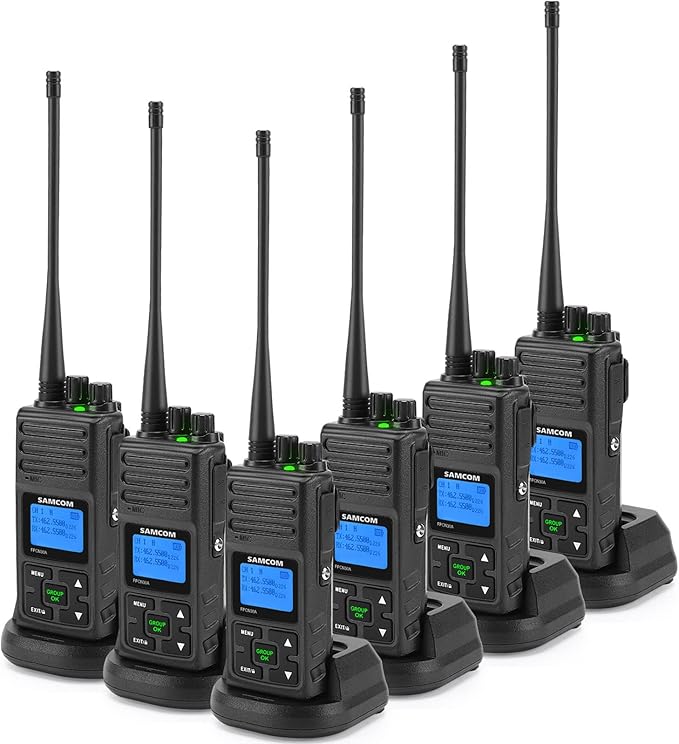
Rugged and designed to withstand tough conditions, these radios are ideal for work teams in construction, warehouse, or security settings. Their strongest feature is the dual PTT buttons that allow quick switching between private and group channels, making team communication smooth and efficient.
Setting them up is fairly straightforward, especially with the option to program channels via PC. Day-to-day use benefits from the clear separation of main and group channels, so you can stay in touch privately or reach everyone with one button.
The 20-channel option gives flexibility, and the large PTT buttons are easy to use even with gloves.
Communication stands out with a maximum range of around 5 miles, although that depends on the environment. The sturdy, drop-proof, and water-resistant shell holds up well in rough conditions. Most reviews say the signal is strong and clear, but some mention that walls or metal structures can cut the range significantly.
Users praise the ability to switch smoothly between private and group channels using the two large push-to-talk buttons, making communication effective on busy job sites. The most common complaint relates to range limitations when used around metal structures or indoors.
Those working outdoors in relatively open areas will appreciate the sturdy build and channel flexibility. Teams in dense or metal-heavy environments might want to consider radios with stronger signals or alternative frequencies to avoid communication issues.
Pros
- Dual PTT buttons for private and group calls
- Durable, drop-proof, and rain-resistant design
- 20 programmable channels via PC
- Included lithium polymer batteries
Cons
- Range affected by terrain and obstructions
- Requires 6 lithium polymer batteries, which may need replacements
| Specification | Details |
|---|---|
| Power Output | 5 Watts |
| Frequency Range | UHF 406.1MHz-470Mz |
| Number of Channels | 20 |
| Talking Range Maximum | 5 miles |
| Water Resistance Level | Water Resistant |
| Voltage | 7.4 volts_of_alternating_current |
9. Mountain Radio FRS Long Range Walkie Talkies (2-Pack)

Long-distance radio communication stands out with a maximum range of over 35 miles, making it a solid option for outdoor enthusiasts who need reliable contact across varied terrain. Its strongest point is powerful transmission without requiring a license, suited for hikers, campers, and climbers.
Setup is straightforward, and everyday use centers on its dependable rechargeable battery that lasts over four days, even in cold weather. The radio’s 128 channels provide plenty of options to avoid interference. Attaching it to a backpack is easy with a metal-reinforced carabiner and leash, keeping it secure during active use.
It lives up to expectations by delivering solid range and clarity within typical backcountry distances of 1 to 5 miles. The shatterproof LED screen and tough thermoplastic covering give it rugged durability without fragile clips to worry about.
Occasional complaints mention the real maximum range being less than 35 miles in hilly areas, which reflects natural limitations more than device faults.
Reliable four-day battery life and rugged build make it durable for outdoor activities, while the actual range often falls between 1 to 5 miles depending on terrain. Ease of attachment with a climbing-rated carabiner adds convenience.
Ideal for users needing solid mid-range communication without a license, especially for hiking or climbing. Those requiring waterproof radios or guaranteed maximum range in highly obstructed areas might want to consider alternatives.
Pros
- Long battery life exceeding four days
- Shatterproof LED screen for durability
- Metal-reinforced carabiner for secure attachment
- Maximum legal transmission power of 2 watts
Cons
- Maximum range reduced in backcountry terrain
- Not fully waterproof, only water resistant
| Specification | Details |
|---|---|
| Number of Channels | 128 |
| Battery Average Life | 4 days |
| Talking Range Maximum | 35 miles |
| Connectivity Protocol | FRS |
| Water Resistance Level | Water Resistant |
10. DreamSky AM FM Portable Radio

DreamSky AM FM Portable Radio stands out by offering strong reception and clear sound even in remote areas. Ideal for seniors or anyone wanting a simple, reliable radio, its biggest strength lies in pulling in AM/FM stations crisply without static.
Setting up involves plugging in or inserting four AA batteries. Tuning is straightforward thanks to the large analog dial that quickly locks onto stations. Daily listening is easy, whether you want music, news, or sports.
The earphone jack makes it convenient to listen privately without disturbing others.
The radio delivers loud, clear audio through a generously sized speaker. It handles both AM and FM bands well across the specified frequency ranges.
The build is straightforward and dependable but mostly plastic. Strong reception and sound clarity stand out, while some found the analog dial less precise than expected.
Users praise how well the radio picks up stations with clear sound and minimal static, even far from cities. A frequent complaint highlights the analog dial’s tuning precision as sometimes tricky to fine-tune exact frequencies.
This radio fits those who want easy operation and reliable reception without extra features. People seeking digital tuning or a more solid build may want to look at other options. It suits seniors and casual listeners who value simplicity.
Pros
- Strong reception even in remote locations
- Clear and loud sound quality
- Large analog dial for simple tuning
- Earphone jack for private listening
Cons
- Analog dial tuning can lack precision
- Mostly plastic construction feels basic
| Specification | Details |
|---|---|
| FM Frequency | 87 -108.00 MHz |
| AM Frequency | 520-1710 KHz |
| Power Source | AC Plug & Battery Powered |
| Number of Batteries | 4 AA batteries required |
| Hardware Interface | 3.5mm Audio |
11. Cobra RX680 IP54 Water Resistant Walkie Talkies (2-Pack)

When you need reliable communication outdoors, especially in tough weather or rough terrain, these walkie talkies come through with durability and range. Designed for hikers, campers, and hunters, their standout feature is lasting water resistance that keeps messages clear even in the rain.
Getting started is straightforward, with 60 preset channels including both FRS and privacy code options that avoid interference from others nearby. The built-in flashlight adds convenience when daylight fades, and voice-operated transmission lets you talk hands-free. Battery life lasts around 18 hours, enough for extended trips without frequent recharging.
These radios deliver on long-distance clarity up to 36 miles under ideal conditions. The rugged shell handles drops and rough handling well, and the IP54 rating means protection against splashes but not full submersion. Many appreciate the NOAA weather alerts to stay informed outdoors, though some mention the well isn’t fully waterproof, so extra care near water matters.
Strong praise centers on the rugged, splashproof build keeping radios working well outdoors, even in bad weather. The most common complaint comes from users wanting full waterproofing, as IP54 rating only guards against splashes and dust, not full immersion.
Ideal for outdoor enthusiasts needing dependable communication during hiking or hunting, especially in variable weather. Those requiring submersion-proof radios or longer battery life might consider other models better suited for those specific needs.
Pros
- Long maximum talking range up to 36 miles
- Water resistant design works in rain and splashes
- 60 preset channels including privacy codes
- Integrated flashlight and voice-activated transmission
Cons
- Not fully waterproof, cautious use near water needed
- Battery life could be longer for very extended trips
| Specification | Details |
|---|---|
| Number of Channels | 60 |
| Talking Range Maximum | 36 mile |
| Battery Average Life | 18 hours |
| Water Resistance Level | Water Resistant (IP54) |
| Voltage | 3.7 volts |
12. PRUNUS J03 Portable AM FM Radio

Running on either 4 AA batteries or an AC plug, this portable AM FM radio fits perfectly for people looking to switch between indoor and outdoor listening with ease. Its compact size and foldable handle make it a solid pick for those wanting something small and easy to carry around.
Power flexibility stands out as its biggest strength.
Setting up involves simply plugging it into a 110 volts power source or popping in four AA batteries (not included) for cordless use. Carrying it around is comfortable thanks to the foldable handle and lightweight build at just 20.8 oz.
Day-to-day use is straightforward with easy FM tuning and compatibility with headphones for personal listening.
Sound output reaches up to 5 watts, providing clear reception on both AM and FM bands within the 108 MHz frequency range. The build reflects portability without water resistance, which means it handles everyday use but needs care around moisture.
Strong praise leans toward its convenience and portability. Common complaints mention lack of included batteries and no water protection.
The radio receives praise for being highly portable and flexible with power options, making it suitable for both indoor and outdoor use. A common frustration is the absence of batteries in the package and its vulnerability to moisture due to lack of water resistance.
People who want a simple, lightweight radio that can run on batteries or plug into AC outlets will be satisfied. Those needing a water-resistant or more rugged option might want to consider other models better suited for harsh outdoor conditions.
Pros
- Runs on AC power or 4 AA batteries
- Compact size with foldable handle
- Supports earphones and headphones
- Lightweight at just 20.8 oz
Cons
- Batteries not included
- Not water resistant
| Specification | Details |
|---|---|
| Power Source | Battery Powered, AC Plug |
| Number of Batteries | 4 AA batteries required |
| Frequency | 108 MHz |
| Speaker Maximum Output Power | 5 watts |
| Voltage | 110 volts_of_alternating_current |
| Connectivity Technology | USB |
Best Ale Radios Comparison Table
| Product | Channels | Range | Water Resistance | Battery Type |
|---|---|---|---|---|
| Baofeng UV-5RM Radio | 999 | Long Range | – | Rechargable, Type C |
| Lifetime Free PoC Radios | – | 5000 mile | Not Water Resistant | 2 12V batteries |
| Choyong LC100 Internet Radio | – | – | – | Battery Powered |
| Retevis RB58F Bluetooth Radio | 22 | – | Water Resistant | 2 Nonstandard batteries |
| Lifetime Free Long Range Radios | 200 | 10000 mile | – | 3.7 volts |
| Airiton AI-K28 4G LTE Radios | 200 | 10000 mile | Not Water Resistant | 2 9V batteries |
| Emergency Crank Weather Radio | – | – | Portable, Rechargeable | Rechargeable |
| FPCN30A 5W UHF Radios | 20 | Long Range | Weather-proof | – |
| Mountain Radio FRS Walkie Talkies | 128 | 35 miles | Water Resistant | Rechargable |
| DreamSky AM FM Radio | – | – | – | Battery Operated |
| Cobra RX680 Waterproof Radios | 60 | 36 mile | Waterproof (IP54) | 3.7 volts |
| Prunus J03 Portable Radio | – | – | Portable | Battery Powered |
- Channels999
- RangeLong Range
- Water Resistance–
- Battery TypeRechargable, Type C
- Channels–
- Range5000 mile
- Water ResistanceNot Water Resistant
- Battery Type2 12V batteries
- Channels–
- Range–
- Water Resistance–
- Battery TypeBattery Powered
- Channels22
- Range–
- Water ResistanceWater Resistant
- Battery Type2 Nonstandard batteries
- Channels200
- Range10000 mile
- Water Resistance–
- Battery Type3.7 volts
- Channels200
- Range10000 mile
- Water ResistanceNot Water Resistant
- Battery Type2 9V batteries
- Channels–
- Range–
- Water ResistancePortable, Rechargeable
- Battery TypeRechargeable
- Channels20
- RangeLong Range
- Water ResistanceWeather-proof
- Battery Type–
- Channels128
- Range35 miles
- Water ResistanceWater Resistant
- Battery TypeRechargable
- Channels–
- Range–
- Water Resistance–
- Battery TypeBattery Operated
- Channels60
- Range36 mile
- Water ResistanceWaterproof (IP54)
- Battery Type3.7 volts
- Channels–
- Range–
- Water ResistancePortable
- Battery TypeBattery Powered
How to Choose the Best ALE Radio
The most important factors to consider are signal quality, durability, and ease of use, as these affect communication reliability and long-term performance. Choosing the right features helps avoid frequent repairs and ensures clear contact, saving money and reducing frustration over time.
Audio Quality
Listening to a radio outdoors or in a noisy workshop often reveals the weaknesses of sound systems that aren’t designed for tough environments. Radios that manage clarity and richness across low, mid, and high frequencies make a big difference in understanding speech and enjoying music without needing to crank up the volume.
Models with noise handling capabilities reduce distortion when background sounds interfere, which is essential if you’re using the device on a busy job site.
Look for radios equipped with equalizers or adjustable stereo settings. These features let you adjust sound output to personal preferences or specific environments, improving usability. A decent radio will balance volume and fidelity without becoming harsh or muffled, even at higher volume levels.
Durability and Build
Workplaces expose radios to dust, moisture, and impacts that can destroy models made from cheap plastic or fragile components. Radios built with thick, reinforced casings tend to last much longer. Some include rubber bumpers or guards that absorb shocks from accidental drops, which are common around construction zones or outdoor setups.
Pay attention to material quality, metal frames or heavy-duty plastic housings make a noticeable difference. Seals and covers over inputs help keep moisture and dirt out, cutting down on service issues. Design aspects like recessed buttons reduce the risk of damage during rough handling.
Power and Battery Life
Many radios show their limits as soon as the battery fades mid-shift or during a long outdoor session. Batteries measuring around 2000 to 4000 mAh commonly provide between 10 to 20 hours of continuous playback, but actual run times vary with volume and usage. Radios with rechargeable batteries and the option to plug into power sources keep you going without interruption.
Energy efficiency also matters. Some models minimize consumption during standby or low-volume listening, extending usability between charges.
Confirm whether the radio can run while charging to avoid downtime, and check the type of charging cable it uses to ensure it matches your other gear.
Portability and Size
Transporting radios between job sites or moving them around a yard is easier if weight and size are reasonable. Heavier radios offer better sound but become burdensome after hours of carrying, especially if the handle or strap is uncomfortable or poorly placed.
Compact radios work better in tight spaces but sometimes sacrifice bass and volume.
Look for well-balanced designs, portable enough to carry yet large enough to produce good audio. Handles should be sturdy, and straps or mounts offer secure attachment options. Simple size measurements and weight listed by manufacturers give a quick sense of how practical the radio is to move daily.
User Interface and Connectivity
Operating a radio should not require navigating complicated menus or fiddling with tiny buttons. Radios with straightforward, tactile controls allow quick adjustments even when wearing gloves or working quickly.
A clear display or LED indicators help confirm current settings without second-guessing.
Connection options like Bluetooth, 3.5mm auxiliary input, and sometimes USB ports offer flexibility for playing audio from different sources. Presets and memory functions save your favorite channels and settings, speeding up use.
Remote controls add convenience but are less crucial if physical controls are well designed and accessible.
Tips for Optimizing Reception and Signal Clarity
The placement of an ALE radio significantly impacts reception quality. Positioning the antenna as high and clear from obstructions like buildings or trees as possible improves signal clarity. Directional antennas require careful aiming towards the expected signal source to reduce interference.
Using high-quality coaxial cables with proper connectors prevents signal loss between the antenna and the radio unit. Keep cable runs as short as practical to limit attenuation.
Grounding the system protects against electrical surges and helps improve signal stability in noisy environments.
Additional tips include:
- Check frequency settings to match your network’s parameters precisely.
- Regularly scan for interference sources such as other radios or electronics nearby.
- Adjust the gain control carefully; boosting too much can create distortion or overload.
Consistent attention to these details helps maintain clear and reliable communication through ALE radios.
Essential Maintenance Practices to Extend the Lifespan of ALE Radios
Routine cleaning around the antenna connections and radio housing prevents build-up of dirt and corrosion that can degrade performance. Use a dry cloth or compressed air to remove dust without introducing moisture.
Inspect cables and connectors periodically. Look for signs of wear like cracks, frays, or corrosion.
Replacing damaged components promptly avoids intermittent signal issues and potential failures.
Store radios in a dry environment when not in use to avoid moisture damage to internal components. For radios used outdoors, ensure that weatherproof seals remain intact to keep water out.
Other maintenance practices include:
- Updating firmware or software as recommended by the manufacturer to keep features current.
- Testing the radio regularly to catch problems early.
- Maintaining a log of maintenance activities can help track when replacements or servicing are due.
These steps extend the usable life of ALE radios and sustain their operational reliability.
Common Mistakes to Avoid When Setting up and Using ALE Radios
Placing the antenna too close to metal objects or electronic devices causes signal reflection and noise that reduces reception quality. Choose locations away from these interference sources for setup.
Ignoring proper grounding can lead to static buildup and possible equipment damage from electrical surges. Always connect ground wires according to the radio’s installation guidelines.
Using incorrect cables or failing to secure connectors tightly invites signal loss and intermittent faults. Match cable types and connector specifications closely with the radio model.
Other errors users commonly make include:
- Setting power levels too high, which can disrupt other communications and damage the transmitter.
- Neglecting routine checks that would identify antenna damage or loose connections.
- Misconfiguring frequency or modulation settings, resulting in failed links and communication problems.
Careful adherence to installation and operational instructions avoids these pitfalls and promotes stable ALE radio performance.
People Also Asked
How Do I Properly Care for an Ale Radio Device?
Clean the unit and speakers regularly to avoid buildup from sweat and dirt. Storing it in a dry place after rides helps prevent corrosion on the contacts and buttons.
What Size Ale Radio Fits Most Motorcycle Helmets?
A medium size usually fits comfortably in most helmets. Picking a model with adjustable mounting options can help achieve a better fit if your helmet is smaller or larger than average.
Are Ale Radios Safe to Use While Riding?
Ale radios are designed to be safe but keep the volume low enough to hear surrounding traffic. Riding with one earbud in or using open-ear speakers increases awareness while still allowing communication.
How Long Does the Battery Last on Average for Ale Radios?
Battery life often ranges between 8 to 12 hours depending on use. Turning off Bluetooth when not in use saves power during longer rides or days off the bike.
What Are Common Problems with Ale Radio Connectivity?
Interference from other devices and weak Bluetooth signals are common causes of dropouts. Keeping the phone and radio close together and ensuring firmware is updated can reduce connectivity issues.
Conclusion
Choosing the best ale radio comes down to sound quality, ease of use, and durability. Clear audio is essential for an enjoyable listening experience. Controls should be straightforward so you can operate the radio without hassle.
A solid build means it will hold up well in different environments, whether indoors or outside.
Consider where you’ll place the radio and how often you’ll use it to find the right size and price. A model that fits your routine and space avoids unnecessary spending. Revisit the comparison table and earlier picks to match these factors with your needs before making your decision.