Top 12 Best Antenna 2m for Ultimate Signal Boost Now!
Trying to get a clear signal with a cheap or poorly designed antenna can be frustrating, especially on the 2-meter band where reception quality matters a lot. The best antenna 2m avoids common issues like weak signal strength, interference, and poor durability that often plague less capable models.
A good antenna makes a noticeable difference in clarity and range during radio communications.
Key factors that set a quality 2m antenna apart include its build material, length, and gain. Most reliable antennas use stainless steel or aluminum for durability and resistance to weather. Length typically corresponds to the wavelength, with about 1 meter being common for a 2m band antenna.
Gain, usually in the 2 to 6 dBi range, indicates how well the antenna directs radio waves, affecting both transmission and reception. Mounting options and ease of installation also impact practical daily use.
Need a Quick Check?
| Image | Product | Price |
|---|---|---|
Our Top Picks 1  | Dualband Mobile VHF/UHF Antenna | Check Price |
Our Top Picks 2  | VHF UHF Base Station Antenna | Check Price |
Our Top Picks 3  | Tram Pre-Tuned Dual-Band Antenna | Check Price |
Our Selected Top 12 Antenna 2m Picks for Every Need
This list features a variety of 2-meter antennas designed for different uses and skill levels. Each review explains how the antenna performs, highlights its advantages and drawbacks, and identifies who will benefit most from using it.
1. Dualband Mobile VHF/UHF Ham Radio Antenna
Quick to set up and tough enough for all-weather mobile use, the Dualband Mobile VHF/UHF Ham Radio Antenna suits anyone needing solid communication on the go. Its strongest point is the magnetic base that sticks firmly to a car roof, even at highway speeds.
Installing the antenna takes just seconds, thanks to the strong 2.95 rare earth magnet base. You can mount it on your vehicle’s roof without tools, and it stays put in high winds hitting 100 kph.
Day-to-day, the 10 ft RG58 cable with PL-259 connector provides decent length to run into your radio setup without hassle. You can adjust the antenna’s position easily for better reception as needed.
Coverage includes VHF and UHF bands between 137-149 and 437-480 MHz. Performance holds steady with a low VSWR less than 1.4 at 145 MHz and less than 1.2 at 455 MHz. Gain is modest at 2dBi/3dBi but enough to hit local repeaters up to 40 miles away.
The stainless steel antenna and rust-resistant magnetic base make it durable under wet and freezing conditions. Common praise highlights its strong hold on cars even in strong winds, while some say gain could be higher.
This antenna holds firmly to metal surfaces, even at 100 kph, and performs reliably across its dual VHF and UHF bands. Most praise centers on its installation ease and durability, while the main complaint is that its gain is somewhat limited for longer-distance transmissions.
People who want a durable, quick-to-install mobile antenna with solid local coverage will find this well-suited. Those needing higher gain or longer cable runs might prefer a different option or external amplifier setup.
Pros
- Strong magnet base holds in high winds
- Waterproof and antifreeze materials
- Dual-band coverage for VHF/UHF
- Includes 10 ft heavy-duty RG58 cable
Cons
- Gain is modest compared to larger antennas
- Limited cable length for some setups
| Specification | Details |
|---|---|
| Frequency Range | 137-149, 437-480 Mhz |
| VSWR | Less 1.4 (145 MHz), Less 1.2 (455 MHz) |
| Gain | 2dBi / 3dBi |
| Magnet Base | 2.95″ Strong Rare Earth |
| Cable Length | 10 Ft RG58 with PL-259 Connector |
| Weight | 0.3 kg |
2. VHF UHF Ham Radio Base Station Antenna
Ideal for anyone needing reliable dual-band communication, this antenna fits well in various settings from homes to vehicles. Its most notable strength is the solid high gain it provides on both 2m and 70cm bands, making it a dependable choice for extended radio use.
Installation is straightforward, with a 1.1-meter length that balances reach and manageability. The UHF female connector matches common setups, and the vertical polarization helps keep signals steady. It suits use on roofs, RVs, or marine vessels, handling daily transmission needs with a good horizontal 360º beam width for wide coverage.
Signal clarity is strong thanks to a gain of 3.5dBi on 144MHz and 5.5dBi on 433MHz. The antenna is built to handle up to 100 watts safely and includes lighting protection through a direct ground connection.
While its design is solid and weather-suitable, some users note its vertical beam width limits elevation angle options.
This antenna delivers reliable high gain across both 2m and 70cm bands, ensuring solid signal transmission in everyday use. The direct ground lightning protection is a notable benefit. The main drawback is the limited vertical beam width that can affect signal angles in some installations.
Ideal for users needing a versatile base station antenna in homes, RVs, or boats. Those looking for a more compact antenna or with special elevation angle needs might prefer a different model.
Pros
- Dual band for 2m and 70cm use
- High gain supports long-distance communication
- Direct ground lightning protection adds safety
- 360º horizontal beam width for broad coverage
Cons
- Vertical beam width limits elevation flexibility
- Length might be bulky for tighter spaces
| Specification | Details |
|---|---|
| Frequency Range | 136-174MHz / 400-470MHz |
| Gain | 3.5dBi at 144MHz, 5.5dBi at 433MHz |
| Connector Type | UHF Female (SO-239 / PL259 Male) |
| Antenna Length | 1.1 Meters |
| Maximum Power Input | 100 Watts |
3. Tram Pre-Tuned Dual-Band VHF/UHF Base Antenna
White fiberglass construction makes it tough enough for outdoor use and resistant to weather. Designed as a single section and standing 43 inches tall, it’s ideal for anyone wanting a dual-band antenna that doesn’t require any tuning.
Its biggest strength lies in being pre-tuned, so performance comes right out of the box.
Installation takes minutes since no tuning is needed before use. It fits masts between 1-13/16 inches and 2-7/16 inches in diameter, which suits most standard setups. Once mounted, the omnidirectional feature means you won’t need to constantly adjust it to keep signals steady.
The UHF female SO-239 connector is common and easy to link up with existing radios.
With an actual gain of 3.5 dBd on VHF and 6 dBd on UHF, it handles both bands well, offering clear reception over a decent range. Build quality feels reliable with the fiberglass staying sturdy over time.
Most users praise its solid performance without tweaking, but a few note that the height might be a bit limited for some long-range needs.
Many users appreciate that the antenna works well straight out of the box without any tuning needed, providing reliable gains on both VHF and UHF bands. The most frequent downside mentioned is the relatively modest height, which can restrict performance for more distant signals.
People who want a straightforward, weather-resistant antenna with easy installation will find it suitable. Those needing extended range or adjustable features should explore taller or more specialized models instead.
Pros
- Pre-tuned for instant use
- Sturdy white fiberglass design
- Fits common mast sizes
- Omnidirectional for simple setup
Cons
- Height may limit long-range reception
- Comes with only 90 days warranty
| Specification | Details |
|---|---|
| Height | 43 in. |
| Material | White fiberglass |
| Gain VHF | 3.5 dBd actual gain |
| Gain UHF | 6 dBd actual gain |
| Connector | UHF female (SO-239) |
| Mast diameter accepted | 1-13/16 in. to 2-7/16 in. |
4. Super Dual Band 2m 70cm Yagi Ham Radio Antenna

High gain and longer range stand out immediately with this 2m 70cm Yagi antenna, ideal for ham radio base stations. It suits anyone wanting clear reception on both VHF and UHF bands, especially with its lower SWR pre-tuning designed to reduce interference.
Its main strength lies in reliable performance across a wide frequency range.
Setup is straightforward since the antenna comes pre-tuned for 136-174 MHz and 400-470 MHz frequencies. It measures 126cm long and has 11 elements, giving you solid directional control.
Day-to-day use is stable thanks to superior waterproofing that keeps the signal consistent even during bad weather, so you won’t worry about the antenna degrading over time.
Performance is dependable with noticeably higher gain right out of the box, resulting in clearer transmissions over greater distances. The tough construction holds up well against the elements, maintaining a stable VSWR. Most praise highlights the superior waterproofing; the one downside mentioned is to always check frequency compatibility before buying since it is pre-tuned and not adjustable.
The most notable strength of this antenna is its waterproof design which ensures stable signal quality in various weather conditions. The top complaint is it must be matched correctly for your frequency range because it’s pre-tuned and cannot be adjusted afterward.
People aiming for a straightforward, weather-resistant base station antenna covering 2m and 70cm will find it suitable. Those needing a broader or differently tuned frequency range might want to explore other options.
Pros
- Low SWR across both VHF and UHF bands
- Durable materials with waterproof construction
- Pre-tuned for easy setup
- Higher gain and longer range
Cons
- Frequency range not adjustable, confirm before purchase
- Length might require larger mounting space
| Specification | Details |
|---|---|
| Frequency Range | 136-174 MHz and 400-470 MHz |
| Length | 126cm |
| Number of Elements | 11 |
| Manufacturer | Lotuskyeserra |
| Brand | Lotuskyeserra |
5. Nagoya NA-320A Tri-Band Antenna

Choosing an antenna that covers three bands makes a big difference for anyone using tri-band radios or dual-band sets wanting extra reach on 2 m and 70 cm. Its biggest draw is the flexible 17.7-inch whip that holds up well outdoors, perfect for camping or trail use while improving signal reception noticeably from stock antennas.
Attaching it to radios like the BF-F8HP PRO or UV-5X3 is straightforward thanks to its SMA-Female base that fits BaoFeng and BTECH handhelds with a center pin. Daily use shows the soft whip handles rough handling without damage and is easy to swing around without worrying about bending it permanently.
It works just as well on dual-band radios but skips the 1.25 m band, which won’t cause problems unless you rely on that frequency.
Signal gain reaches 2.15 dBi on 2 m and 1.25 m, with a stronger 3.5 dBi on 70 cm. It puts in solid performance for its size, noticeably lifting reception above the basic antennas for handheld radios.
The build is lightweight at 40 g yet durable for outdoor activities. Some users mention it could handle more than 10 watts input better and that it isn’t the best choice if you want a larger antenna with higher gain values.
The antenna offers solid gain improvements and durability for its size, making it reliable for outdoor use. A frequent drawback mentioned is its 10 W power limit, which restricts its use on higher-powered radios. Users appreciate the flexible whip that won’t easily break but sometimes wish for higher power handling.
People with tri-band radios or who need handheld performance on 2 m and 70 cm will find this antenna helpful. Those requiring higher power input or exclusively using dual-band radios without 1.25 m functionality might want to consider alternatives offering bigger gains or power tolerance.
Pros
- Flexible whip ideal for outdoor and trail use
- Supports tri-band and works on dual-band radios
- Noticeable gain improvement over stock antennas
- Fits BaoFeng and BTECH handhelds with center pin
Cons
- Limited to 10 W maximum input power
- No coverage on 1.25 m band for dual-band radios
| Specification | Details |
|---|---|
| Gain by band | 2.15 dBi on 2 m (144 MHz), 2.15 dBi on 1.25 m (225 MHz), 3.5 dBi on 70 cm (430 MHz) |
| Maximum input power | 10 W |
| Whip length | 17.7 inches |
| Connector type | SMA-Female (center socket) |
| Item weight | 40 g |
6. UV100 Dual Band Fiberglass Base Antenna

Getting clear range and reliable communication from a ham radio setup in the outdoors or vehicle often depends heavily on the antenna. A 41-inch dual band fiberglass antenna designed for both UHF and VHF frequencies suits anyone looking to extend their radio’s reach without complicated setups. Its standout feature is the good balance between durability and signal gain, helping catch signals further away.
Setting it up involves mounting on a stable point that works with the Ground Plane design to spread the signal at low angles all around. The fiberglass body keeps it lightweight and tough enough for outdoor conditions, whether camping or mobile use.
You won’t need to fuss much with adjustments once it’s secured, making daily use straightforward.
The antenna delivers solid signal improvements with 3.5dB VHF gain and 7dB on UHF, translating to noticeably better communication range. Its fiberglass construction holds up well against weather and rough handling.
Praises note the sturdy build and reliable range, while some mention it could be a bit more compact for vehicle setups.
The antenna stands out by offering strong, reliable gain on both bands along with a tough fiberglass build that handles rough outdoor use well. A frequent downside is that the 41-inch length can feel cumbersome on smaller mobile setups, limiting versatility for some users.
Anyone looking for solid extended VHF/UHF communication with a rugged, straightforward setup will find this antenna fits well. Those needing a more compact solution or longer warranty may want to consider alternatives better suited for tight vehicle spaces or longer-term coverage.
Pros
- Durable fiberglass material for outdoor environments
- High gain on both VHF and UHF bands
- Ground Plane design for 360° low-angle coverage
- Simple installation for mobile or base use
Cons
- Length might be bulky for some vehicle mounts
- Only one-year warranty could be limiting
| Specification | Details |
|---|---|
| Length | 41 inches |
| VHF Gain | 3.5dB |
| UHF Gain | 7dB |
| Design | Ground Plane antenna |
| Material | Fiberglass |
| Warranty | 1 Year |
7. Super-Elastic Dual-Band 2m/70cm Signal Stick Antenna

Rated for operation at 100W with a 50% duty cycle, the Super-Elastic Dual-Band 2m/70cm Signal Stick Antenna suits anyone needing reliable dual-band coverage on both 2m and 70cm frequencies. Its standout feature is its nitinol construction that makes it nearly indestructible and flexible for long-lasting use.
Setup involves choosing the right adapter for your radio, as it supports SMA-F or SMA-M options for non-BNC radios. Day-to-day, the antenna stays resilient thanks to its nickel-titanium alloy, which bends without breaking. It’s lightweight, making it easy to carry or mount without extra strain, and switching antennas during field operations is straightforward with the custom adapter.
Performance is solid across 144-148 MHz and 420-450 MHz bands, handling continuous 50W output reliably. The build quality stands out due to the super-elastic nitinol, which users appreciate for its toughness and flexibility.
A common downside is the need to pick the correct adapter upfront, which can be tricky if you have multiple radios. Still, the lifetime warranty provides confidence in its durability.
The antenna is praised for its nearly indestructible nitinol construction that flexes without damage during normal use. Most users note the challenge of selecting the correct adapter type initially, which could complicate quick swaps between different radios if not planned ahead.
People who want a tough, dual-band antenna capable of handling regular power loads will find it fitting. Those frequently switching between radios with different connectors might want to look for an antenna with more universal compatibility or easier adapter solutions.
Pros
- Flexible nitinol material resists bending and breaking
- Dual-band coverage for 2m and 70cm frequencies
- Supports up to 100W power handling
- Lightweight and easy to mount
Cons
- Requires correct adapter choice for radio compatibility
- Adapter options must be selected at purchase
| Specification | Details |
|---|---|
| Frequency Bands | 144-148 MHz / 420-450 MHz |
| Power Rating | 100W (50% duty cycle) / 50W (continuous) |
| Material | Nickel-titanium alloy (Nitinol) |
| Weight | 26.94 g |
| Adapter Options | SMA-F or SMA-M |
8. Bingfu Dual Band Mobile Ham Radio Antenna

Anyone running a mobile ham radio setup or using a two-way radio in a vehicle will find this antenna a solid choice. It stands out for its magnetic base, making it simple to mount and remove, which works great for those needing quick setups without permanent fixtures.
Setting it up involves just placing the magnetic base on your vehicle’s roof or another metal surface. The 5-meter cable is long enough to reach most radio units inside a standard car or boat.
The dual antennas cover both VHF and UHF bands, making it versatile for various communication needs without changing antennas.
Signal quality is reliable across the 136-174MHz and 400-470MHz ranges, which covers a broad spectrum useful for ham radio and marine communications. The antenna’s build is solid with a 42cm whip and sturdy magnetic mounting.
Many appreciate how secure the base feels, while some mention the cable connector might need a careful hand to avoid wear over time.
The strong magnetic base makes installation quick and secure, and the dual-band design supports a broad frequency range for versatile use. Some find the PL259 connector delicate over time, suggesting a need for gentle handling during setup and takedown.
This antenna suits users needing a flexible, mobile setup on cars or boats who communicate on VHF and UHF bands. Those requiring more rugged or permanent antenna options might want to consider other models with fixed mounts or heavier-duty connectors.
Pros
- Strong magnetic base for easy vehicle mounting
- Covers both VHF and UHF frequency bands well
- 5-meter cable offers flexible radio placement
- Compatible with a wide range of radio brands
Cons
- Connector requires careful handling to avoid wear
- Magnet size differs for each frequency band
| Specification | Details |
|---|---|
| Frequency Range | 136-174MHz and 400-470MHz |
| Antenna Length | 42cm / 16.53 inches |
| Magnetic Base Dimension | 9.5cm (UHF) and 15cm (VHF) |
| Antenna Cable | 5m / 16.4ft RG58/U |
| Cable Connector | UHF PL259 Male |
9. HYS BNC VHF/UHF Handheld Radio Antenna
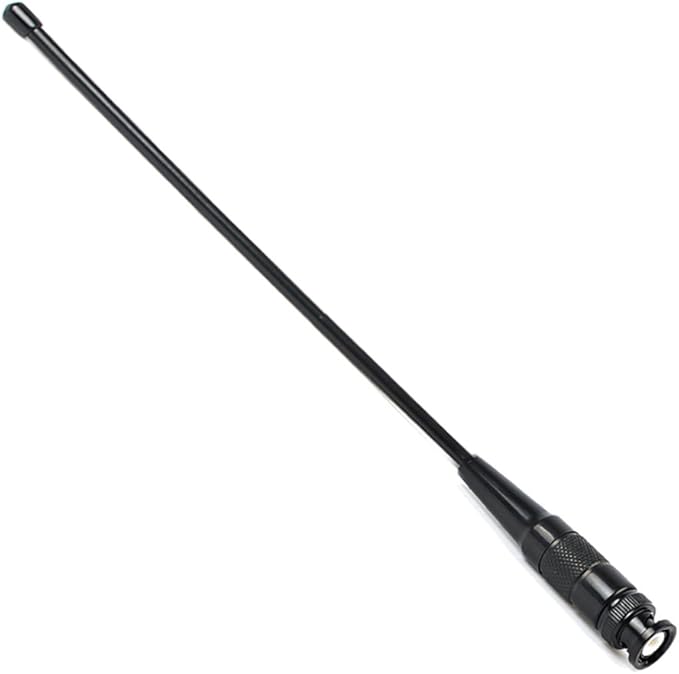
Designed for handheld radios with a BNC connector, this antenna covers both 144 and 430 MHz frequencies, fitting radios like Midland, Yaesu, and Uniden. Its main strength lies in providing solid signal gain on both VHF and UHF bands, making it a practical choice for dual-frequency use without complicated setup.
Installation is straightforward; just screw it onto the BNC port, and it’s ready to go. Its 15.6-inch length is manageable for daily carry without adding much bulk or weight.
The antenna maintains consistent contact, and the 20W maximum power input fits well with most handheld radios used for everyday communication.
Signal gain on 144 MHz (2.15 dBi) and 430 MHz (2.5 dBi) helps improve both transmission and reception quality noticeably. The build is lightweight at 1.76 ounces but sturdy enough for routine use.
Some users appreciate the reliability, while a common downside is its dependence on a BNC connector, limiting compatibility with other connector types.
The antenna is praised for consistent signal improvement on both frequency bands, making it reliable for handheld use. Most users mention its simple screw-on installation and lightweight feel. The common drawback is the exclusive BNC connector, which means it won’t fit radios with TNC or SMA connectors without adapters.
Radio users with BNC ports looking for a straightforward dual-band antenna will find this a practical fit. Those needing compatibility with different connectors or seeking higher signal gains might consider other options better tailored to their gear or requirements.
Pros
- Dual band for both 144 and 430 MHz
- Easy installation with BNC connector
- Lightweight and portable design
- Suitable for up to 20W power output
Cons
- Works only with radios having BNC connectors
- May not match signal quality of larger antennas
| Specification | Details |
|---|---|
| Frequency | 144/430 MHz |
| Gain | 2.15 dBi (144 MHz), 2.5 dBi (430 MHz) |
| Maximum Power Input | 20W |
| Connector Type | BNC |
| Length | 15.6 inches |
| Weight | 1.76 ounces |
10. Yagi Dual Band 2m 70cm VHF/UHF Ham Radio Antenna

HzFitInc’s Yagi Dual Band 2m 70cm VHF/UHF Ham Radio Antenna suits ham radio enthusiasts wanting focused signal gain on both 2m and 70cm bands. Its biggest strength lies in delivering strong dual-band performance with 7dBi gain on VHF and 10.5dBi on UHF frequencies, ideal for directional communication.
Setup involves attaching the included pole mounting bracket and using the 32ft RG-58 cable with a PL-259 connector, which fits standard radio setups. The cable length gives flexibility in positioning the antenna, while the directional design requires aiming for best reception.
Daily use centers on maintaining a stable direction for clear transmission and reception within amateur radio bands.
Performance stands out with a solid gain that improves signal clarity over typical omnidirectional antennas. The build quality feels durable, designed to handle up to 100 watts of power input without issues.
Positive notes highlight strong signal gain and good dual-band coverage. The main complaint tends to involve the need for precise aiming to maximize the directional antenna’s effectiveness.
The antenna offers impressive gain on two ham radio bands, enhancing signal quality significantly when well aligned. The main drawback is the need to spend time precise aiming to get the most out of its directional design, which may be inconvenient for casual or mobile use.
Anyone looking for reliable dual-band performance with strong gain will appreciate this antenna. Those who prefer omnidirectional setups or want simpler installation should consider other options that do not require directional adjustment.
Pros
- Strong dual-band gain on VHF and UHF
- Included 32ft RG-58 cable adds flexibility
- Durable build handles up to 100W power
- Comes with pole mounting bracket for easy setup
Cons
- Requires careful aiming for optimal direction
- SMA adapter may not suit all radio connectors
| Specification | Details |
|---|---|
| Frequency | VHF 2 Meter / UHF 70cm (136-174MHZ/400-470MHz) |
| Gain | 7/10.5dBi |
| Maximum Power Input | 100W |
| Impedance | 50Ω |
| Cable Length | 32 ft |
| Connector | SO-239 / PL-259 |
11. Dual Band 2m 70cm Ham Radio Antenna

Getting clear VHF and UHF signals without fuss makes a huge difference in ham radio use. Fits well for anyone needing solid reception on 2 meters and 70 centimeters bands.
Its real strength lies in balancing good gain with a straightforward setup that works in many environments.
Setting it up typically involves connecting the UHF female connector to your radio, where it handles both handheld and fixed mount setups. The antenna length of 1.1 meters fits nicely on roofs or RVs without being intrusive.
Vertical polarization and direct ground lightning protection make everyday use practical in marine, vehicles, or home settings.
It delivers a gain of 3.5dBi at VHF and 5.5dBi at UHF, which pushes signals clearly around. The VSWR stays below 1.5, ensuring efficiency. Its build feels solid for regular outdoor placement, and many appreciate the wide 360º horizontal beam width.
Some users mention it could be more ruggedly built considering outdoor exposure.
Signal clarity and gain are strong points that show up clearly in daily use with maintained VSWR below 1.5. Many find the antenna’s physical sturdiness less than ideal for harsh weather without extra care.
Those running ham radios from fixed locations or vehicles will find convenience and good performance here. Users requiring a more rugged design or lesser size constraints might want to explore alternative models better suited to tough environments or compact spaces.
Pros
- Supports both 2m and 70cm bands effectively
- Good gain levels for VHF and UHF frequencies
- Direct ground lightning protection included
- Simple vertical polarization works with most radios
Cons
- Build quality could resist weather better
- Length may be cumbersome in tight mounting spots
| Specification | Details |
|---|---|
| Frequency | 144MHz / 433MHz (2m / 70cm) |
| Gain | 3.5dBi at VHF, 5.5dBi at UHF |
| VSWR | Less Than 1.5 |
| Connector | UHF Female (SO-239 /PL259 Male) |
| Maximum Power Input | 100 W |
| Antenna Length | 1.1 Meters |
12. TWAYRDIO Dual Band 2m 70cm Yagi Ham Radio Antenna

A solid choice for ham radio enthusiasts looking for a dual band 2m and 70cm Yagi antenna. Perfect for those wanting reliable directional gain with sturdy construction suited to outdoor use. Its main strength is the high gain it offers on both familiar amateur radio bands.
Assembling the antenna is straightforward thanks to its simple construction and clear design. It comes in three sections with eight elements, making it manageable to handle despite its size. The aluminum alloy finish resists corrosion and holds up well in various weather conditions.
Mounting the unit is stable using the supplied U-Bracket, so you can expect a secure fit even in windy spots.
Signal performance is consistent and strong with gains of 9.5 dBi on 2m and 11.5 dBi on 70cm, aiding in long-distance communication. The build quality stands out with its corrosion-resistant, waterproof body and wind resistance rated up to 60 m/s. Positive feedback highlights stable reception and durability over time; typical complaints involve the size, which might be challenging for smaller setups or limited spaces.
Most positive remarks focus on the antenna’s durable construction and consistent signal strength, helping maintain quality communication in tough outdoor conditions. Common concerns mention the sizable dimensions that demand space and limit portability. Assembly and tuning are generally described as easy tasks.
Those wanting reliable range and gain on common VHF/UHF bands will appreciate this model’s performance and build. It suits installations with enough room for the full antenna size. Smaller setups or users needing longer warranties might consider other options.
Pros
- High gain on dual amateur bands
- Lightweight at just 0.75 Kg
- Resistant to corrosion and weather
- Easy to assemble with three sections
Cons
- Larger size may not suit all locations
- Only 3-month warranty included
| Specification | Details |
|---|---|
| Frequency | 144/430 MHz (136-174 MHz / 400-470 MHz) |
| Gain | 9.5 / 11.5 dBi |
| Power Input | 100 W Maximum |
| VSWR | Less than 1.5 |
| Weight | 0.75 Kg |
| Dimensions | 925×1045×60 mm |
Comparison of Best 2m Antennas Reviewed
| Product | Type | Frequency Bands | Weight | Warranty |
|---|---|---|---|---|
| Dualband Mobile VHF/UHF Antenna | Dualband Mobile | VHF/UHF | 0.3 kg | – |
| VHF UHF Base Station Antenna | Base Station | 2m 70cm | – | – |
| Tram Pre-Tuned Dual-Band Antenna | Two-way Antenna | Dual Band | 0.27 g | 90 days |
| Super Dual Band Yagi Antenna | Yagi Antenna | 2m 70cm | – | – |
| Nagoya NA-320A Tri-Band Antenna | Tri-Band | 2 m/70 cm/1.25 m | 40 g | – |
| UV100 Dual Band Fiberglass Antenna | Fiberglass | Dual Band | – | – |
| Super-Elastic 2m/70cm Stick Antenna | Stick Antenna | 144-148 MHz/420-450 MHz | 26.94 g | Lifetime |
| Bingfu Dual Band Mobile Antenna | Mobile | 136-174 MHz/400-470 MHz | – | – |
| HYS BNC VHF/UHF Handheld Antenna | Signal Stick | 144/430 MHz | – | – |
| Yagi Dual Band 2m/70cm Antenna | Yagi | 2m/70cm | – | 2 Year |
| Dual Band 2m/70cm Antenna | Base Station | 2m 70cm | – | – |
| TWAYRDIO Dual Band Yagi Antenna | Yagi | High Gain 8 Elements | – | – |
- TypeDualband Mobile
- Frequency BandsVHF/UHF
- Weight0.3 kg
- Warranty–
- TypeBase Station
- Frequency Bands2m 70cm
- Weight–
- Warranty–
- TypeTwo-way Antenna
- Frequency BandsDual Band
- Weight0.27 g
- Warranty90 days
- TypeYagi Antenna
- Frequency Bands2m 70cm
- Weight–
- Warranty–
- TypeTri-Band
- Frequency Bands2 m/70 cm/1.25 m
- Weight40 g
- Warranty–
- TypeFiberglass
- Frequency BandsDual Band
- Weight–
- Warranty–
- TypeStick Antenna
- Frequency Bands144-148 MHz/420-450 MHz
- Weight26.94 g
- WarrantyLifetime
- TypeMobile
- Frequency Bands136-174 MHz/400-470 MHz
- Weight–
- Warranty–
- TypeSignal Stick
- Frequency Bands144/430 MHz
- Weight–
- Warranty–
- TypeYagi
- Frequency Bands2m/70cm
- Weight–
- Warranty2 Year
- TypeBase Station
- Frequency Bands2m 70cm
- Weight–
- Warranty–
- TypeYagi
- Frequency BandsHigh Gain 8 Elements
- Weight–
- Warranty–
How to Choose the Best 2m Antenna
Choosing the right 2m antenna depends on factors like gain, durability, and mounting options, which affect signal quality and ease of installation. Prioritizing these features ensures reliable performance, reduces maintenance needs, and prevents unnecessary expenses over time.
Frequency Compatibility
Many amateur radio users quickly realize their antenna doesn’t cover the desired frequency range when signals come in weak or transmissions drop out unexpectedly. The 2 meter band spans 144 to 148 MHz, so an antenna must specifically operate within this range to perform well. Some antennas support multiple bands but can require tuning adjustments to match each one precisely.
Adjustable elements like telescoping rods or rotatable components allow fine calibration, boosting efficiency and reducing interference.
Choosing an antenna designed for 144-148 MHz avoids wasted power and poor reception. Multiband capability benefits operators who use additional frequencies, but tuning options are crucial to prevent signal distortion. Look for antennas with clearly stated frequency ranges and mechanisms to adjust length or loading coils for a perfect match.
This attention keeps daily communication reliable and reduces frustration from out-of-band losses.
Gain and Radiation Pattern
The strength of a radio signal often hinges on the antenna’s gain. Higher gain means signals can travel farther, but antennas with very narrow beamwidths focus energy in tight directions, limiting coverage zones.
For casual or mobile use, omnidirectional antennas spread signals evenly around, simplifying setup and contact with multiple stations. More directional antennas improve range in targeted directions but demand aiming. Beamwidth ratings show how wide or narrow the signal spread is, with larger angles offering broader coverage and smaller ones focusing power.
A mismatch between use and radiation pattern causes dropped contacts or wasted transmission power. Everyday users familiar with both types learn to pick omnidirectional models for general chat or directional ones to reach distant repeaters. Gain numbers often range from 2 to 9 dBi for this band.
Understanding your communication needs helps avoid antenna setups that feel weak or overly complicated.
Build Quality and Materials
Outdoor antennas face rain, wind, sun, and time, making material quality vital. Models made with stainless steel, anodized aluminum, or UV-resistant plastics resist rust and degrade less. Cheaper metals can corrode quickly, causing intermittent failures or signal loss.
Mechanical strength matters too since gusts or storms risk bending or breaking weak structures. Properly designed antennas use sturdy brackets and reinforcements to hold shape under stress.
Connectors often receive less attention but prove critical. Corrosion on connection points or loose fittings produce static and disrupt signals. Look for weathersealed or gold-plated connectors and sturdy mounting hardware to keep the antenna securely in place year after year.
Learning this from experience spares replacing equipment prematurely due to preventable environmental damage.
Installation and Mounting
Space and mounting options vary widely, from rooftops to portable poles. Antenna size and weight influence where it can go and how easily it can be moved.
Large yagi arrays may offer performance but require substantial support structures, while small verticals fit handheld setups or simple roof mounts. Installation steps greatly affect user experience; some antennas snap together, others need tuning by adding or trimming elements during setup.
For portable operation, a light and compact design makes a big difference, avoiding bulky packages that are cumbersome in the field. Rooftop installations call for secure mounts preventing sway or tilt. Assess available mounting locations beforehand and consider how easy the antenna is to assemble and adjust, complex rigs often frustrate users trying to optimize signal quality without specialized tools.
Impedance and Swr Performance
Signal loss often traces back to impedance mismatches. Standard amateur radio gear uses a 50 ohm system, so antennas designed to match this reduce reflections and power waste. The Standing Wave Ratio (SWR) measures how well the antenna’s impedance aligns with the transmitter’s. Values below 1.5:1 indicate efficient transmission; values above 2:1 signal trouble, reducing radiated power and risking equipment damage.
Some antennas include built-in matching devices, simplifying setup by presenting the proper impedance automatically. Others require external tuners or manual adjustment to optimize SWR.
Knowing the antenna’s impedance ratings and SWR data helps avoid trial-and-error frustrations such as weak signals or transmitter protection circuits cutting output unexpectedly. Proper matching is essential for reliable daily use.
Optimizing Antenna Placement for Maximum 2m Signal Reception
Placing a 2m antenna correctly impacts signal strength more than upgrading to a pricier model. Mounting the antenna as high as possible reduces obstacles between your radio and the signal source.
Materials such as metal roofs or walls can block or reflect signals, so avoid mounting the antenna near large metal objects.
Orientation also affects reception. Positioning the antenna vertically typically matches most 2m FM and repeater signals, which are often vertically polarized.
Using a sturdy mast or pole helps maintain a steady position, keeping the antenna from swinging in the wind, which can cause intermittent reception.
- Choose a central location away from tall buildings or trees.
- Use quality coaxial cable to minimize signal loss between antenna and radio.
- Secure all connections and check them periodically for corrosion or loosening.
Proper placement often provides better results than increasing transmitter power or purchasing more complex antennas.
Preventing and Troubleshooting Common 2m Antenna Issues
Common 2m antenna problems usually involve connection issues, damage, or signal interference. Loose or corroded connectors can cause intermittent performance or complete signal loss.
Regular inspections and cleaning of connectors with appropriate contact cleaner help prevent these problems.
Antenna elements bent or broken from weather or accidental impact reduce effectiveness and must be repaired or replaced. In some cases, nearby electronic devices or appliances cause interference, showing up as static or weak signals on the radio.
- Check the coax cable for cracks or cuts, which can allow water intrusion and degrade signal.
- Use a multimeter to verify continuity between the antenna and radio input to rule out cable faults.
- Relocate or turn off nearby electronics that cause noise whenever possible.
Systematic troubleshooting often reveals simple fixes that restore proper reception without costly upgrades.
Comparing Vertical and Horizontal Polarization for 2m Antennas
Vertical and horizontal polarization affect how 2m antennas transmit and receive signals and choosing between them depends on the specific application. Most 2m repeater systems use vertical polarization because handheld radios and mobile units typically have vertically oriented antennas. Matching polarization helps maximize signal strength and clarity.
Horizontal polarization is common in some point-to-point or fixed station setups. It can suffer less from certain types of interference, but if one end of the communication uses vertical polarization, signal loss occurs due to polarization mismatch.
- Vertical polarization suits mobile and handheld use with vertical antennas.
- Horizontal polarization suits fixed stations or directional links where antenna alignment is stable.
- Mixed polarization between transmitter and receiver often reduces signal quality by several decibels.
Checking the polarization used by nearby repeaters or networks ensures you install an antenna that correctly matches the transmission mode, resulting in more reliable communication.
People Also Asked
How Do I Properly Size a 2m Antenna for My Needs?
The right size for a 2m antenna depends on whether it is a half-wave or quarter-wave design, with typical half-wave antennas around 1 meter long. Consider your available space and mounting options before choosing; a shorter antenna might be easier to place but could sacrifice some gain.
What Safety Precautions Should I Take When Installing a 2m Antenna?
Make sure the antenna is mounted securely away from power lines and other metal structures to avoid electrical hazards. Use a grounded mast or lightning arrestor to protect your equipment during storms; always wear gloves and sturdy footwear when climbing or setting up.
How Long Does a Typical 2m Antenna Last with Regular Use?
A 2m antenna can last several years if kept outdoors in good condition. Regularly check for corrosion or loose connections, especially if you live in a coastal or humid area, as exposure to weather can degrade the materials over time.
Are 2m Antennas Compatible with All Types of Ham Radios?
Most 2m antennas work with any ham radio designed for the 2m band, but match the impedance and frequency range to your radio specs. Using the right coax cable and connectors helps maintain signal quality and ensures proper operation.
What Are Common Problems with 2m Antennas and How to Fix?
Common issues include poor SWR caused by loose connections, damaged elements, or bad coax cables. Inspect all parts for wear or corrosion; re-tighten or replace damaged components and use a SWR meter to fine-tune adjustments for optimal performance.
Conclusion
Signal strength, antenna gain, and durability are the key factors for choosing a 2m antenna. A stronger signal and higher gain help with clearer reception, while good build quality ensures it lasts through weather changes.
Also consider how easy it is to install and maintain.
Pick an antenna that suits your available space and how often you plan to use it. A larger, more permanent setup might work well for frequent use, while a compact model fits smaller spots better.
Take a look at the comparison table above to match features and prices before making your decision.