Top 12 Best Avaition Scanner That Will Blow Your Mind!
Anyone who has spent time trying to catch clear aviation transmissions knows how frustrating a poor scanner can be. The best avaition scanner cuts through static and interference that cheap or poorly designed models struggle with, making the difference between missing important updates and staying informed. A substandard scanner often fails in range and clarity, forcing you to constantly adjust or even miss critical communications altogether.
Choosing a good aviation scanner usually comes down to three main factors: frequency range, sensitivity, and durability. Most scanners that cover 30-512 MHz can pick up everything from commercial flights to emergency services.
Sensitivity matters because a stronger receiver catches weaker signals without noise. Durable construction is key as well, especially if the device is used outdoors or carried around; rugged plastic or metal housing helps protect delicate components. Battery life also plays a role, with practical units lasting several hours on rechargeable power.
Need a Quick Check?
| Image | Product | Price |
|---|---|---|
Our Top Picks 1  | Uniden Bearcat BC125AT | Check Price |
Our Top Picks 2  | Uniden Bearcat SR30C | Check Price |
Our Top Picks 3  | PJ2+ Aviation Radio | Check Price |
Our Selected Top 12 Avaition Scanner You Can Trust
This list features carefully chosen aviation scanners designed for various users, from casual listeners to professionals. Each review covers key performance aspects, suitability for different needs, and highlights the strengths and limitations of the scanners to help you make an informed decision.
1. Uniden Bearcat BC125AT Analog Handheld Scanner
Compact and made from durable plastic, the Uniden Bearcat BC125AT suits users who want a straightforward analog handheld scanner. Its single biggest strength is the ability to quickly tune into nearby analog signals with Close Call RF capture technology, all while remaining easy to hold and carry around.
Setup involves inserting the two included AA batteries, and the digital display makes scrolling through the 500 alpha-tagged channels clear and user-friendly. The Do Not Disturb Mode stops interruptions during active transmissions, which keeps listening smooth.
Programming channels can be done via a compatible computer, making it flexible for different scanning needs.
Performance on analog frequency ranges is solid, capturing signals across 25-54 MHz, 108-174 MHz, 225-380 MHz, and 400-512 MHz. The build feels solid for a handheld device, though it’s not water resistant.
The main compliment is the reliable signal capture on analog channels, while the limitation is that it doesn’t support digital radio systems used by some agencies.
The scanner reliably picks up a wide range of analog frequencies and offers a user-friendly interface, but it cannot monitor digital signals, which are crucial for some emergency channels. Users appreciate how simple it is to use and carry, though its lack of water resistance calls for careful handling when outdoors.
This model fits those focused on analog monitoring with basic functionality and portability. People needing digital trunking coverage or harsh environment durability should look toward other options that support digital radio systems and have stronger build protections.
Pros
- 500 alpha-tagged channels for easy identification
- Close Call RF capture for quick tuning
- Includes Do Not Disturb mode during transmissions
- Runs on common AA batteries with 10-hour life
Cons
- Does not support digital radio systems
- Not water resistant
| Specification | Details |
|---|---|
| Number of Channels | 500 |
| Frequency Range | 25-54 MHz, 108-174 MHz, 225-380 MHz, 400-512 MHz (UHF) |
| Power Source | 2 AA batteries (included) |
| Battery Life | 10 hours |
| Digital Display | Yes |
2. Uniden Bearcat SR30C Analog Handheld Radio Scanner
Compact size and easy access to a wide range of frequencies stand out right away. Designed for anyone interested in analog scanning, it covers over 32,000 frequencies, making it great for listening to emergency services, weather, and aircraft traffic.
Its biggest strength is offering many channels in a handheld, affordable package.
Setup involves using the pre-set service banks, which simplifies finding popular channels like police, fire, marine, and aircraft frequencies from the start. Daily use benefits from features like Close Call RF Capture to find nearby signals and Turbo Search for scanning quickly. Programming can also be customized via PC through a USB connection, adding flexibility beyond the presets.
Performance delivers clear analog reception across a broad frequency range supported by a reliable tuner. The build is compact and feels durable for a handheld device powered by AA batteries or USB.
Reviewers often note how well it picks up signals but commonly mention a limited number of channels compared to some higher-end scanners.
Many users appreciate the extensive preset banks and ease of finding channels, plus the option to program via PC adds a user-friendly edge. The frequent complaint centers around the channel limit, which some find restrictive compared to larger, more expensive models.
This scanner suits anyone wanting an entry-level device focused on analog frequencies and diverse public service channels in a portable form. Those needing more channel capacity or digital scanning features would likely want to explore advanced models.
Pros
- Pre-set banks cover popular service categories
- USB programming adds customization options
- Compact and lightweight design for portability
- Works on both battery and USB power
Cons
- Limited to 500 channels only
- Mono audio output might feel basic
| Specification | Details |
|---|---|
| Channels | 500 |
| Frequency Range | 32000 MHz |
| Power Source | USB, Battery-Powered (AA batteries required) |
| Connectivity | USB |
| Additional Features | Close Call RF Capture, Turbo Search, PC Programming |
3. PJ2+ COM Aviation Handheld Radio
Picking a aviation scanner that connects directly to general aviation headsets without needing adapters is a rare convenience. Best suited for pilots who want straightforward communication and a no-nonsense interface, the PJ2+ COM Aviation Handheld Radio stands out for its simple operation and headset compatibility.
Setting it up involves just powering on and entering the frequency you want to communicate on. The large, backlit keypad and big buttons make it easy to operate with one hand even while flying. Power comes from six AA batteries or through a USB-C cable plugged into your aircraft, so battery concerns are minimal during use.
Communication is clear within its 10-mile talking range thanks to 6 watts of transmission power. Built with durable PJ headset jacks and a sturdy feel, the radio avoids complexity in favor of user-friendly control.
Most users appreciate its plug-and-play design, while the lack of water resistance remains a noted limitation.
The radio’s strongest praise comes from its straightforward setup and operation, making switching frequencies quick and straightforward without fiddly menus. Most users mention the lack of water resistance as a downside, which requires handling it carefully around moisture.
This radio works best for pilots wanting simplicity and compatibility with standard aviation headsets straight out of the box. Those needing rugged, weatherproof devices or wider frequency coverage might look for alternatives better suited to those requirements.
Pros
- No adapters needed for standard GA headsets
- Large backlit keypad for easy frequency input
- Dual power options with long-lasting batteries
- One-handed operation with large buttons
Cons
- Not water resistant, so care needed in damp conditions
- Limited to 760 channels within VHF range
| Specification | Details |
|---|---|
| Frequency Range | 118.000-136.975 MHz |
| Transmission Power | 6 Watts |
| Power Source | 6 AA Batteries or USB Type-C |
| Headphone Jacks | Dual PJ Plugs, 3.5mm Aux |
| Talking Range Maximum | 10 miles |
4. Uniden BC355N Base/Mobile Analog Scanner

Picking up local emergency and aviation signals without fuss is much easier with a scanner that reacts quickly to nearby transmitters. Great for folks who want a straightforward analog scanner, this model’s Close Call RF Capture Technology makes spotting active channels simple and fast, ideal for those in areas still relying on analog frequencies.
Setup is straightforward, just plug it into a power source and it’s ready to scan. Day-to-day use involves tuning into the 800 MHz band, and the built-in Close Call technology helps catch signals from nearby transmitters instantly. The single band support means it doesn’t overwhelm with options but keeps things focused.
The LCD screen provides clear information, and USB connectivity is handy for updates or programming.
The analog scanner performs well at picking up local analog transmissions, delivering clear reception as long as you’re in an analog coverage area. Its build is functional with a corded electric power source, making it less portable but steady for home or vehicle base use.
The standout feature is Close Call RF Capture, while the biggest limitation is that it can’t monitor digital systems, which is common in many urban areas now.
Close Call RF Capture Technology reliably picks up nearby analog transmissions, making scanning fast and responsive. The most common complaint is the scanner’s inability to handle digital trunking systems, which are increasingly used by public safety agencies in many larger cities.
Anyone in a mainly analog broadcast area will appreciate the straightforward operation and dependable analog reception. Those needing to monitor digital systems will want to consider a digital-capable scanner instead.
Pros
- Instantly tunes to nearby signals with Close Call technology
- Simple 1-band tuning keeps usage straightforward
- Clear LCD display for easy reading
- USB support for connection and programming
Cons
- Not capable of digital radio system monitoring
- Requires corded electric power, limiting portability
| Specification | Details |
|---|---|
| Connectivity Technology | USB |
| Tuner Type | Radio Frequency |
| Power Source | Corded Electric |
| Radio Bands Supported | 1-Band |
| Frequency | 800 MHz |
| Display Type | LCD |
5. Uniden BC365CRS Scanner with Alarm Clock and Weather Alerts

Offering 500 channels to cover everything from police to aircraft, this scanner suits anyone who wants broad access without breaking the bank. Its strength lies in grouping popular searches by category, making it easier to find what interests you quickly on a tabletop device with an alarm clock and FM radio included.
Setup involves plugging in the corded electric power and optionally inserting 3 AA alkaline batteries. Day-to-day use relies on push-button controls to scan through presets or browse channels manually. The ability to save up to 30 FM radio stations and an audible alarm clock turns it into a versatile part of a daily routine, providing easy access to news and weather.
Performance is solid for analog scanning with clear reception over a broad range of emergency, marine, and amateur frequencies. The build is practical, designed for tabletop use with a straightforward layout. Most praise noted is for its comprehensive channel list, while a common complaint revolves around the reliance on push-button controls, which some find less intuitive.
Offers extensive channel options with helpful presets, making it easy to listen across various bands without complex setup. Some find the push-button interface cumbersome during frequent scanning, which can slow down navigation through channels.
Those wanting an affordable, multi-function scanner with added radio and alarm clock will find this fitting. Users who prefer digital controls or portable battery-only use might look for different models.
Pros
- Pre-sets for popular searches simplify scanning
- Includes alarm clock and FM radio features
- Supports 500 channels including weather and aircraft
- Tabletop design fits easily on desks or counters
Cons
- Push-button controls may feel outdated or slow
- Requires continuous electric power or battery replacement
| Specification | Details |
|---|---|
| Power Source | Corded Electric |
| Number of Channels | 500 |
| Battery Description | Alkaline |
| Number of Batteries | 3 AA batteries required |
| Control Method | Push Button |
| Mounting Type | Tabletop Mount |
6. Whistler WS1010 Analog Handheld Scanner

People interested in tracking aviation frequencies or storm spotter networks will find this scanner helpful. It suits hobbyists who need a compact, portable device with a strong capacity for storing and quickly accessing a wide range of channels.
The biggest strength lies in its ability to manage and quickly scan through many frequencies across different bands.
Setting up requires organizing frequencies into 10 separate memory banks, which gets easier with PC programming through a USB cable and compatible software. Daily use is straightforward thanks to preset service banks for aircraft, marine, and emergency channels. The Spectrum Sweeper feature makes scanning nearby transmissions faster, and the weather alert system ensures you get timely warnings for your area.
Reception quality meets expectations for an analog handheld scanner, picking up transmissions clearly across multiple frequency types. Construction feels lightweight at just 7.7 ounces and compact, but some users note the ergonomics could be better for prolonged handheld use. The preprogrammed service banks receive positive mentions, while battery life from 4 AA batteries is one common complaint.
The scanner is praised for its comprehensive preprogrammed service banks and its fast frequency scanning capability. Most common complaint involves battery life, which often requires frequent replacements during heavy use.
This model will satisfy those wanting a portable, feature-rich analog scanner with weather alerting for casual to moderate use. Users seeking longer battery performance or a more ergonomic design might look at other options.
Pros
- Stores up to 400 frequencies in separate memory banks
- Preprogrammed service banks for quick access
- Includes SAME and weather alerting for safety
- Spectrum Sweeper speeds up frequency scanning
Cons
- Short battery life with included AA batteries
- Handheld grip can feel awkward after extended use
| Specification | Details |
|---|---|
| Item Weight | 7.7 ounces |
| Product Dimensions | 1.56 x 2.37 x 5.68 inches |
| Memory Capacity | 400 Channel Memory |
| Batteries Required | 4 AA batteries (included) |
| Model Number | WS101 |
7. Uniden Bearcat BCD160DN Digital Handheld Scanner
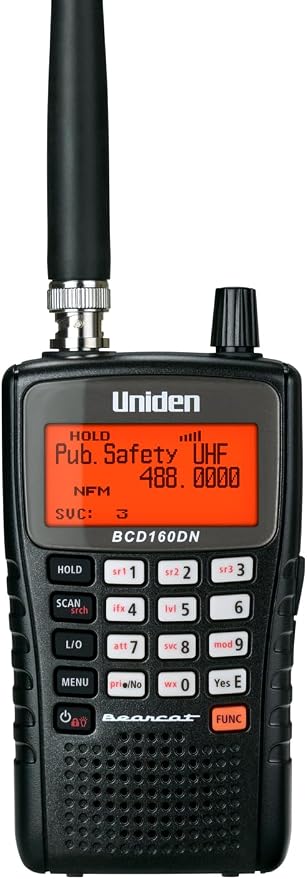
Standing out with its digital decoding right out of the box, this handheld scanner suits aviation enthusiasts and signal hunters who want quick access to a range of digital and analog transmissions. Its biggest strength lies in the fast detection of tones and codes, speeding up the process of locking onto the right frequency.
Setup is straightforward, connecting via USB for programming or updates. Day-to-day use benefits from features like Band Scope Rapid System and Channel Number Tagging, making it easier to find specific signals without scrolling endlessly. The narrow-band reception sharpens focus on the channels you want, helping avoid static and interference.
Performance hits the mark with support for DMR and NXDN digital decoding immediately and an easy firmware upgrade path for APCO P25 systems. Signal clarity and detection speed are well regarded, though the inability to handle trunking systems might limit users seeking that feature.
Solidly built for handheld use, it feels durable but some find the interface a bit complex at first.
Instant detection of CTCSS tones and digital codes is highly appreciated for speeding up signal tracking. A common complaint mentions the lack of trunking support, limiting some communication monitoring options. The build feels sturdy and performs well for conventional analog and digital channels.
Those focusing on conventional digital and analog aviation signals will find this scanner a solid choice. Users needing trunking capabilities or encrypted decoding might want to consider alternatives that cover those requirements better.
Pros
- Instant tone and code detection
- Digital decoding ready without add-ons
- Easy firmware updates via USB
- Narrow-band reception improves signal clarity
Cons
- No trunking system support
- User interface can be tricky initially
| Specification | Details |
|---|---|
| Scanner Type | Radio Scanner |
| Connection Type | USB |
| Digital Decoding Support | DMR, NXDN, APCO P25 (via update) |
| Narrow-band Reception | Yes |
| DCS/CTCSS Rapid Decode | Yes |
8. Uniden Bearcat BCD260DN Base/Mobile Digital Scanner

Uniden Bearcat BCD260DN Base/Mobile Digital Scanner excels at picking up a wide range of signals with impressive speed and precision. Ideal for emergency responders, aviation enthusiasts, and anyone interested in monitoring public safety or weather alerts.
Its ability to cover many service bands makes it particularly strong in versatility.
Setup comes easy since it arrives pre-programmed with key service bands like aviation, marine, railroad, and weather alerts. Daily use involves scanning through thousands of frequencies, including non-digital ambulance, police, and fire emergencies, allowing quick access to relevant channels. The USB connection supports straightforward updates and programming changes.
Features like Band Scope Rapid System and Channel Number Tagging help you detect elusive signals faster during your routine scans.
The scanner performs solidly with sharp digital reception and narrowband support that reduces interference. Built to last, it has a reputation for reliability and durability. Most users appreciate the range and speed of detection, though some note the complexity of the programming menus.
Despite that, it remains practical for users willing to invest time in learning its system.
The scanner receives praise for its extensive band coverage and speed in picking up signals, providing reliable use in various emergency and aviation contexts. The most frequent concern involves the sometimes confusing menu system that requires a learning curve to handle all its features effectively.
People focused on detailed monitoring of public safety and weather alerts will find it suits their needs perfectly. Those seeking a simpler, more intuitive interface or wireless options might want to consider alternatives better suited for casual listening or on-the-go scanning.
Pros
- Pre-programmed with multiple key service bands
- Includes S.A.M.E weather alerts coverage
- Band Scope Rapid System for faster signal detection
- Access to 10,000 frequencies
Cons
- Programming menus can be tricky to figure out.
- No wireless connectivity option
| Specification | Details |
|---|---|
| Scanner Type | Radio Frequency scanner |
| Connection Type | USB |
| Resolution | 300 dpi |
| Pre-programmed Service Bands | Includes Aviation, Marine, Railroad, Emergency services |
9. Uniden SDS200 TrunkTracker X Base/Mobile Digital Scanner

Scanning aviation frequencies feels straightforward and sharp with this unit, making it a solid choice for hobbyists or professionals who want detailed info at their fingertips. Its biggest strength lies in delivering complicated digital broadcasts clearly, even in tricky signal areas.
Getting started involves plugging it in via USB and navigating through a color-coded display that you can customize to highlight exactly what you want to see. The included HomePatrol database sorts through all known aviation and other radio systems in the US and Canada, updating weekly so you stay current without manual programming. Changing what you monitor takes just a few taps on the intuitive screen.
Tracking aircraft and other communications comes through with fine detail thanks to true I/Q technology and software-defined radio. The build is compact and suited for desktop or vehicle use, with a crisp 3.5-inch LED backlit display that remains readable in daylight. People praise its performance with difficult simulcast systems, though some mention the standard sheet capacity and USB connection may feel limiting depending on setup preferences.
Many users appreciate how well it handles tough digital signals with detailed clarity and an easy-to-read customizable display. The most frequent drawback noted is the modest sheet capacity and reliance on USB, which may restrict some users’ setup options.
This unit will suit those wanting comprehensive and current aviation scanning without fuss. People wanting broader connectivity or larger memory may want to look elsewhere for something fitting those needs better.
Pros
- Large 3.5″ customizable color display
- Includes extensive US and Canada radio database
- Performance strong with digital simulcast systems
Cons
- Limited to USB connectivity
- Standard sheet capacity only holds 10
| Specification | Details |
|---|---|
| Scanner Type | Radio Scanner |
| Connection Type | USB |
| Light Source Type | LED |
| Media Type | USB |
| Standard Sheet Capacity | 10 |
10. Uniden SDS100 Digital Handheld Scanner

Hard to beat for anyone wanting a reliable, digital handheld scanner with solid performance. Best for those who need quick access to a wide range of radio systems without complicated setup.
Its strongest point is excellent performance even in weak or tricky signal areas.
Setup is straightforward, just entering your zip code to access the built-in HomePatrol database of US and Canadian radio systems, which updates weekly. The interface is easy to manage thanks to its customizable color display letting you pick what info is showing. The USB connection also makes it simple to update and manage programming through Sentinel software.
It’s built to last as a handheld device and feels well-constructed. The True I/Q receiver handles digital and simulcast signals with strong clarity and minimal dropouts.
The main positive feedback praises how well it picks up signals in tough RF environments. Some users however mention it could be a bit complicated when digging into advanced programming beyond the basics.
Strong reception in challenging radio environments is the standout feature, praised repeatedly. At the same time, users note that fine-tuning or exploring advanced options can be tricky compared to simpler scanners.
Those wanting reliable, straightforward scanning with rich radio coverage will find this a solid choice. People looking for very simple programming or extensive documentation capacity might consider other options better suited to those needs.
Pros
- Easy zip-code-based setup
- Excellent digital performance in weak signals
- Customizable color display
- Includes updatable HomePatrol database
Cons
- Advanced programming can be complex
- Only 1 standard sheet capacity for documentation
| Specification | Details |
|---|---|
| Scanner Type | Digital Handheld Scanner |
| Connection Type | USB |
| Resolution | 24 Bits |
| Color Depth | 24 |
| Media Type | MicroSD Card |
11. Uniden SDS150 Digital Radio Scanner

Built with lightweight durability and designed for professionals, the Uniden SDS150 Digital Radio Scanner suits anyone needing reliable, field-ready scanning. Its standout feature is enhanced sensitivity that picks up signals clearly while cutting down on interference, making it a solid choice for serious users.
Setup is straightforward thanks to the simplified interface and digital display, letting you get started without a steep learning curve. The built-in GPS helps with location tracking, and the included charge cradle keeps power topped up during long sessions.
Bluetooth connectivity pairs smoothly with smartphones, allowing you to tap into the U/AWARE app for extended capabilities on the go.
Signal reception is impressive with the latest TrunkTracker X and APCO P25 Phase I & II technology, ensuring you don’t miss important transmissions. The body is rugged enough for daily professional use while staying light for portability.
The top praise is the scanner’s sharp filtering, but some find the proprietary battery inconvenient compared to standard options.
The scanner is highly praised for its sensitivity and filtering, delivering clear signals with minimal interference. The main drawback noted is the use of a nonstandard battery that some find less convenient than common rechargeable types.
This is a solid choice for those needing a lightweight, durable scanner with advanced digital features and smartphone integration. People who prefer standard battery types or simple setups without complex tuner functions might want to consider other options.
Pros
- Improved signal reception and interference filtering
- Lightweight and rugged enough for daily use
- Bluetooth allows smartphone connectivity
- Extended battery life with optimized power management
Cons
- Uses nonstandard battery that can be inconvenient
- Complex tuner types may require learning curve
| Specification | Details |
|---|---|
| Tuner Type | TrunkTracker X, APCO P25 Phase I & II, Motorola, EDACS, LTR DMR Tier III*, Hytera XPT*, Single-Channel DMR* NXDN 4800/9600*, EDACS ProVoice* |
| Power Source | Battery Powered |
| Connectivity Technology | Bluetooth |
| Additional Features | Weather Alert, Built-in GPS Receiver, Charge Cradle |
| Water Resistance Level | Water Resistant |
12. A330 Portable SSB Shortwave Scanner Receiver

Wide frequency coverage stands out immediately, making it great for anyone needing access across multiple bands. Ideal for aviation enthusiasts, shortwave listeners, and radio hobbyists who want a single device covering FM, MW, SW, AIR, VHF, and UHF with solid SSB capabilities.
Setup is straightforward, powered by a single included battery and offering Bluetooth 5.2 for remote control or music playback via TF card. The large memory holds 1,400 stations, so daily switching between frequencies is smooth. Fine-tuning with BFO adjustment helps sharpen signals on single sideband modes, and the blue-backlit LCD remains visible even outdoors for reliable use during travel or fieldwork.
Reception across all bands is clear when tuned properly, especially on AM, LSB, and USB modes. The build feels solid enough for portable use, though it isn’t water resistant. Frequent praise highlights the wide frequency range and detailed tuning options.
The common complaint is about the nonstandard battery which can be hard to replace and limits convenience during extended outings.
Listeners appreciate the broad frequency range combined with precise tuning for SSB signals, making reception clear and flexible. Many users mention the hassle of sourcing the nonstandard battery, which can interrupt usage during trips.
Aviation and radio enthusiasts needing multiple bands in one device will find it useful. Those prioritizing waterproof features or easy battery swaps may want to explore alternative options better suited for rugged or long-term remote use.
Pros
- Extensive frequency coverage across multiple bands
- Large memory capacity for 1,400 saved stations
- Bluetooth 5.2 for remote control and media playback
- Clear single sideband reception with fine tuning
Cons
- Requires a nonstandard battery that’s hard to replace
- Not water resistant for outdoor use in wet conditions
| Specification | Details |
|---|---|
| Number of Channels | 1400 |
| Frequency Coverage | FM 64-108MHz, MW 520-1710kHz, SW 2.3-30MHz, AIR 118-138MHz, CB 25-28MHz, VHF 20-250MHz, UHF 250-999MHz, WB 162.4-162.55MHz |
| SSB Modes Supported | AM, LSB, USB with BFO fine-tuning |
| Connectivity | Bluetooth 5.2, TF card support |
| Display | STN LCD blue-backlit with wide viewing angle |
Comparison of Top Aviation Scanners Side by Side
| Product | Channels | Frequency Range | Power Source | Additional Features |
|---|---|---|---|---|
| Uniden Bearcat BC125AT | 500 | 25-54,108-174,225-380,400-512 MHz | 2 AA batteries included | Digital Display |
| Uniden Bearcat SR30C | – | 32000 MHz | USB, Battery Powered | Close Call RF Capture |
| PJ2+ Aviation Radio | 760 | 118.000-136.975 MHz | 9 volts | 3.5mm Jack, 6W Power |
| Uniden BC355N Scanner | – | 800 MHz | Corded Electric | Close Call RF Capture |
| Uniden BC365CRS Alarm Scanner | – | – | 3 AA batteries | Ultrasonic Sensor |
| Whistler WS1010 Scanner | – | – | 4 AA batteries included | – |
| Uniden Bearcat BCD160DN | – | – | USB | Radio Scanner |
| Uniden Bearcat BCD260DN | – | – | USB | Radio Frequency Scanner |
| Uniden SDS200 TrunkTracker | – | – | USB | LED Light Source |
| Uniden SDS100 Handheld | – | – | USB | Digital Handheld Scanner |
| Uniden SDS150 Digital Scanner | – | – | Battery Powered | Weather Alert, Bluetooth |
| A330 Shortwave Receiver | 1400 | – | 1 Nonstandard Battery Included | Auto Power Off, Bluetooth |
- Channels500
- Frequency Range25-54,108-174,225-380,400-512 MHz
- Power Source2 AA batteries included
- Additional FeaturesDigital Display
- Channels–
- Frequency Range32000 MHz
- Power SourceUSB, Battery Powered
- Additional FeaturesClose Call RF Capture
- Channels760
- Frequency Range118.000-136.975 MHz
- Power Source9 volts
- Additional Features3.5mm Jack, 6W Power
- Channels–
- Frequency Range800 MHz
- Power SourceCorded Electric
- Additional FeaturesClose Call RF Capture
- Channels–
- Frequency Range–
- Power Source3 AA batteries
- Additional FeaturesUltrasonic Sensor
- Channels–
- Frequency Range–
- Power Source4 AA batteries included
- Additional Features–
- Channels–
- Frequency Range–
- Power SourceUSB
- Additional FeaturesRadio Scanner
- Channels–
- Frequency Range–
- Power SourceUSB
- Additional FeaturesRadio Frequency Scanner
- Channels–
- Frequency Range–
- Power SourceUSB
- Additional FeaturesLED Light Source
- Channels–
- Frequency Range–
- Power SourceUSB
- Additional FeaturesDigital Handheld Scanner
- Channels–
- Frequency Range–
- Power SourceBattery Powered
- Additional FeaturesWeather Alert, Bluetooth
- Channels1400
- Frequency Range–
- Power Source1 Nonstandard Battery Included
- Additional FeaturesAuto Power Off, Bluetooth
How to Choose the Best Aviation Scanner
Choosing the right aviation scanner depends on factors like frequency range, signal clarity, and ease of use, ensuring reliable communication monitoring. Prioritizing these features prevents missed transmissions and costly replacements, making the investment more efficient and trouble-free.
Frequency Coverage
Aviation communications use different frequencies depending on the situation, covering both VHF and UHF bands. Radios lacking coverage of these specific bands can miss important transmissions, such as air traffic control instructions or emergency broadcasts.
Models that include a broad frequency range ensure you catch everything from standard aircraft chatter to weather updates.
Receiving both AM and FM signals matters since most aircraft use AM modulation, but weather and emergency channels might broadcast on FM. A scanner missing AM capability won’t pick up key pilot communications. Look for devices with complete VHF/UHF coverage and support for AM/FM to avoid gaps in monitoring.
Scan Speed and Search Functionality
Running a full frequency scan can take a long time, but fast scan speeds save you from waiting endlessly in active environments like airports. Older or cheaper scanners might lag or freeze, which wastes valuable time. Models with quick scanning not only find active transmissions faster but also let you switch channels smoothly.
Custom search functions let you enter specific frequencies rather than scrolling through long lists, speeding up access to relevant channels. Lockout features that block unwanted frequencies prevent constant interference from nearby signals.
A practical scanner offers manual input, preset memory channels, and frequency lockouts for more control.
Portability and Power Options
A compact, lightweight scanner fits in a pocket or bag, making it simple to carry to an airport or on travel. Bulky units feel inconvenient and often end up unused at home. Portability matters when you want to scan from different locations or on the go.
Power options also affect flexibility. Scanners with multiple sources, rechargeable batteries, standard AA batteries, and AC adapters, work well in various conditions. Battery life plays a big role; short-lasting models require frequent charging or battery swaps that interrupt use.
Aim for at least several hours of continuous operation without a full recharge.
Display and User Interface
Clear screens make a big difference, especially when checking frequency or signal info quickly. A bright, high-contrast display avoids eye strain outdoors or in low light. Some scanners include backlighting or adjustable brightness, which helps in changing lighting environments.
An intuitive interface with straightforward menus and buttons lets you adjust settings fast. Complicated controls slow down users and can lead to mistakes or missed transmissions.
Look for clear labels and logical layouts rather than cluttered screens or too many small buttons.
Audio Quality and Outputs
Accurately hearing pilot communications depends on good audio quality. A scanner with poor sound reproduction can make transmissions hard to understand, especially in noisy areas. Volume control helps balance loudness without distortion, while squelch settings eliminate static and background noise.
Headphone jacks provide privacy and clarity when listening in busy environments, and external speaker outputs allow connection to larger speakers for group monitoring. Having both options adds convenience depending on where and how you plan to use the device.
Tips for Maximizing the Effectiveness of Your Aviation Scanner
Aircraft communication frequencies can vary depending on the region, so programming your aviation scanner with local frequencies is essential. Keeping the scanner’s firmware updated ensures compatibility with newer signals and protocols. Placement matters; positioning the scanner near a window or higher location reduces interference and improves reception quality.
Scanners with built-in digital signal processing (DSP) often filter out noise better, making conversations clearer. Using a dedicated external antenna instead of the one that comes with the scanner can significantly increase range and clarity.
Battery life can limit usage time, so having spare batteries or a power bank handy is practical for extended listening sessions. Regularly reviewing and clearing unnecessary channels helps keep your scanner focused on relevant traffic, speeding up scans and improving user experience.
Handling the device carefully to avoid scratches on the screen and buttons also preserves functionality over time.
Common Mistakes to Avoid When Using Aviation Scanners
Tuning into the wrong frequency bands wastes time and drains batteries quickly on tourism scanners. Many users leave the default factory scan lists unchanged, missing out on local active frequencies. Overloading the scanner’s memory with too many channels can slow down performance and cause lag in switching frequencies.
Ignoring scanner updates or neglecting to check for them reduces the scanner’s effectiveness as aviation frequencies and codes evolve. Another common error is placing the scanner inside a building surrounded by metal or thick walls, which significantly blocks signal reception.
Setting the squelch too high often cuts out weak but important signals, while setting it too low causes constant static. Some users overcomplicate settings, making operation less intuitive and reducing listening enjoyment.
Lastly, using cheap, incompatible antennas can limit range despite a good scanner.
Comparing Aviation Scanners with Alternative Air Traffic Monitoring Tools
Aviation scanners capture real-time radio transmissions directly from aircraft and ground stations, providing immediate audio communication. In contrast, many air traffic monitoring apps rely on data feeds like ADS-B or radar tracking, offering visual displays rather than raw audio. These apps provide broader coverage and traffic patterns but depend on internet connectivity.
Scanners require no internet, which is advantageous in remote locations with poor signal. However, scanning is limited to local range, usually a few dozen miles.
Flight tracking websites and apps can show historical and future estimated flight paths and additional details like aircraft type. Scanners reveal the sometimes-informal chatter and instructions between pilots and controllers, offering insights not found on apps.
Each tool suits different purposes: scanners for listening to live radio traffic and apps for an overview of air traffic movements.
People Also Asked
How Do I Properly Care for an Aviation Scanner?
Keeping an aviation scanner clean and dry is essential to its care. Avoid exposure to extreme temperatures and moisture as these can damage internal components. Periodically wiping the device with a soft cloth keeps the controls and display clear.
What Size Aviation Scanner Is Suitable for Airplane Cabins?
A compact aviation scanner around 6 to 7 inches is best suited for use inside airplane cabins. This size fits comfortably on small tray tables and can be handled easily without getting in the way of seat space.
Are Aviation Scanners Safe to Use During Flights?
Aviation scanners generally do not interfere with airplane systems when used as directed, but following flight crew instructions about electronics use is important. Turning them off during takeoff and landing helps avoid any potential issues.
How Long Does an Aviation Scanner Typically Last with Regular Use?
An aviation scanner worn regularly typically lasts several years before hardware or battery degradation occurs. Replacing batteries and storing the device in protective cases can extend its service life.
What Are Common Problems Users Face with Aviation Scanners?
Common problems include poor signal reception in certain areas and difficulty tuning into specific frequencies. Users sometimes find the buttons or dials tricky to adjust quickly, especially under flight conditions.
Conclusion
Choosing the right aviation scanner depends mainly on its frequency range, ease of use, and reception quality. A wide frequency range lets you pick up various signals, while simple controls help with quick tuning and operation. Good reception ensures clear audio, even in areas with weak signals.
These three factors usually determine whether the scanner will meet your needs.
Think about where and how often you will use the scanner to decide on the right model within your budget. Some scanners work better in urban areas, others excel in rural settings. Check the comparison table and detailed reviews above to find the scanner that fits your requirements and space best.