
Top 12 Best Field Spotting Scope You Can’t Miss Today!
Trying to spot wildlife or identify distant landmarks with a cheap or poorly designed scope often leads to frustration. A blurry image, awkward handling, or weak durability can ruin the experience.
Finding the best field spotting scope means avoiding these common pitfalls to get clear, stable views without constantly readjusting or worrying about damage outdoors.
The most important factors in a good field spotting scope are optical quality, build durability, and portability. Lenses with fully multi-coated glass provide brighter, sharper images and reduce glare. A waterproof and fog-proof body ensures it holds up to weather changes, while a compact size under 15 inches is easier to carry during long outings.
Magnification typically ranges between 20x and 60x; anything more can make the view shaky unless paired with a sturdy tripod socket.
Need a Quick Check?
| Image | Product | Price |
|---|---|---|
Our Top Picks 1  | SVBONY SV28 | Check Price |
Our Top Picks 2  | Athlon Argos HD | Check Price |
Our Top Picks 3  | Vortex Viper HD | Check Price |
Our Selected Top 12 Field Spotting Scope You Can Trust
This list features carefully chosen field spotting scopes designed for various outdoor uses, from birdwatching to hunting. Each review covers performance, ideal users, and key advantages and drawbacks to help readers find the best fit for their specific needs and preferences.
1. SVBONY SV28 Spotting Scope
Durable waterproof construction and a non-slip finish make the SVBONY SV28 Spotting Scope a reliable choice for beginners and novices who want clear views of wildlife and landscapes. Its standout feature is a 25-75x zoom that’s simple to adjust, allowing you to focus easily on distant targets without fuss.
Setting up involves mounting the scope on a tripod and manually adjusting the focus and zoom eyepiece. The 70mm large objective lens gathers plenty of light, helping maintain a bright image even in less-than-ideal conditions. The extendable sunshade reduces glare, improving visibility during sunny outings.
Its manual focus method may take a moment to get used to but offers precise control once set.
Performance delivers sharp, bright images across a wide zoom range, with the 380mm focal length helping you spot details far away. Built to handle the outdoors, it’s waterproof and has a textured, non-slip body that feels secure in hand, even when wet. A common downside is that manual focusing requires steady hands and patience to quickly nail the image.
Most users find its optical quality and practicality solid for the price.
The SVBONY SV28 offers crisp, well-lit images throughout its zoom range, praised often for its bright 70mm lens and weather-resistant build. The most frequent complaint revolves around the manual focus, which can be a bit slow to dial in sharpness, requiring patience during quick spotting moments.
Birdwatchers and nature observers new to spotting scopes will find the SV28 practical and straightforward. Those needing rapid focus adjustments or a more standard mounting system might want to explore other models better suited to advanced fieldwork or specialized use.
Pros
- Easy zoom changes between 25-75x magnification
- Waterproof design withstands sudden weather changes
- Large 70mm lens delivers bright, clear views
- Non-slip material feels secure in wet conditions
Cons
- Manual focus can be tricky to adjust quickly
- Equatorial mount less common, may limit tripod options
| Specification | Details |
|---|---|
| Zoom Ratio | 3:1 |
| Objective Lens Diameter | 70mm |
| Focal Length | 380 millimeters |
| Field of View | 64 feet |
| Mount | Equatorial Mount |
| Coating | FMC |
2. Athlon Optics Argos HD Spotting Scope
Bright and sharp viewing stands out immediately with the Athlon Optics Argos HD Spotting Scope, ideal for bird watching, target shooting, and hunting. Its biggest strength lies in delivering clear images up to 60x magnification, making distant details easy to see.
Setup is straightforward thanks to the rotating tripod ring and the angled eyepiece, which makes long stretches of observing comfortable. The zoom range from 20x to 60x helps you switch between wide views and detailed close-ups without moving the scope. A rubber-armored, lightweight body adds durability while the included soft case makes transport easy.
It performs well in various light conditions supported by advanced HD glass and fully multi-coated lenses that maintain true color and sharpness. The scope’s waterproof, fogproof, and argon-purged sealing keeps moisture and fog from affecting the view.
Most praise centers on image clarity and durability, while some note the zoom can require frequent adjustment for focus.
Image clarity is consistently praised for its sharpness and true colors, supported by quality glass and coatings. The waterproof and fogproof features help maintain clear viewing despite weather conditions. Users often find refocusing necessary when adjusting the zoom, which can interrupt quick spotting sessions.
The scope suits those wanting detailed, sharp images and durability for outdoor use in various weather. People who prioritize a rugged hard case or quicker zoom adjustments might want to explore different models.
Pros
- Bright images even in low light
- Waterproof, fogproof, and argon-purged
- Comfortable angled eyepiece design
- Lightweight yet durable rubber-armored body
Cons
- Zoom requires frequent refocusing
- Soft case offers limited protection
| Specification | Details |
|---|---|
| Zoom Ratio | 20–60x |
| Objective Lens | 85mm |
| Eye Piece Lens Description | Plössl |
| Field Of View | 45 degrees |
| Mount | Altazimuth Mount |
| Focal Length Description | 4.25mm to 1.42mm |
3. Vortex Viper HD Spotting Scope
Premium optical clarity and flexible viewing positions make it a strong choice for serious outdoor observers. Suited for those who want sharp, vivid images when scanning distant targets in variable light conditions, its biggest draw is the HD optical system delivering clear, detailed views.
Setting up involves adjusting the multi-position eyecup for comfortable eye relief, then rotating the scope with the locking collar to get the best angle. The smooth helical focus lets you sharpen the view quickly without bulk, while the built-in sunshade comes in handy on bright days. Its waterproof and fog proof design means no worries about weather during long outings.
Its main job of crisp image delivery works very well thanks to premium glass and XR anti-reflective coatings, supporting low-light use. The build feels solid with waterproofing and fog proofing adding durability. The most praised feature is the bright, high-definition optics; the only consistent complaint relates to weight, which can be a factor when hiking long distances.
The optical clarity and brightness stand out in various light conditions, making distant details easy to see. Its waterproof and fog proof body holds up well outdoors, though some find the scope’s weight noticeable during extended carry. The locking collar adds convenience but may need adjustment after repeated use.
People looking for top-quality viewing and durability will appreciate its features, especially those prioritizing image sharpness in tough light. Users seeking a lightweight or ultra-portable option may want to consider alternatives better suited for long treks or minimal gear loads.
Pros
- Vivid high-definition images with premium glass
- Multi-position eyecup for comfortable viewing
- Built-in sunshade reduces glare effectively
- Waterproof and fog proof for outdoor reliability
Cons
- Weight can be cumbersome for long hikes
- Rotating collar may require occasional tightening
| Specification | Details |
|---|---|
| Magnification Maximum | 60 x |
| Objective Lens Diameter | 8.5 centimeters |
| Focus Type | Helical Focus |
| Coating | Multiple anti-reflective coatings on all air-to-glass surfaces |
| Water Resistance Level | Waterproof |
| Fog Proof | Yes |
4. Maven CS.1 15-45x65mm Spotting Scope

Spotting distant wildlife or game takes patience and clear vision, which the Maven CS.1 15-45x65mm handles well. It fits anyone needing detailed views from long distances, shining brightest in delivering crisp images thanks to its premium optic setup.
Getting set up on a tripod is straightforward, with center focus making quick adjustments easy while scanning or zooming in on a target. The reflex finderscope helps locate subjects fast, while the lightweight design means carrying it around doesn’t tire you out. It holds up fine in wet weather thanks to its waterproof build, making it a solid choice for outdoor adventures.
Its main function of delivering sharp, high-definition visuals comes through clearly, with premium ED glass cutting down color fringing and boosting contrast. The build feels durable yet light, balancing ruggedness with comfort.
Strongest praise centers on its crystal-clear detail, while some note the zoom range demands steady hands or a tripod for best use.
Clear imagery stands out as the biggest strength, owed to the extra-low dispersion glass reducing color distortion. Some users find the highest zoom settings tricky without support, highlighting the need for a steady mount. The waterproof feature and reflex finderscope add to practical daily use.
Anyone focused on sharp detail in varied outdoor conditions will appreciate this scope’s capabilities. People wanting a highly portable, easy one-hand zoom might lean toward lighter or fixed magnification alternatives instead.
Pros
- Crystal-clear images across magnification range
- Waterproof and lightweight for outdoor use
- Quick zoom from wide to detailed views
- Center focus allows smooth adjustments
Cons
- Requires tripod for stable long-distance viewing
- Zoom range can be sensitive to hand shake
| Specification | Details |
|---|---|
| Magnification Range | 15-45x |
| Objective Lens Diameter | 65mm |
| Focus Type | Center Focus |
| Field of View | 64.5 degrees |
| Coating | Fully Multi-Coated |
| Power Source | User-powered |
5. HD 20-60×80 Spotting Scope

Offering a powerful 20-60x magnification with an 80mm lens, this spotting scope suits outdoor enthusiasts who want detailed views of distant birds and landscapes. Its smooth dual focusing system is the biggest strength, letting you quickly sharpen images with precision.
Setting it up is straightforward since it includes a tripod and carrying case. The dual focus knobs make day-to-day observations easy, whether in wetlands or on mountain hikes. The aluminum body keeps weight manageable at 1.18 kg, making it comfortable to carry during extended outdoor use.
The phone adapter adds convenience for capturing what you see.
Clarity and zoom performance meet expectations for detailed viewing over long distances, with focusing range from 48.2 to 86.4 feet per 1000 yards. The build quality feels solid thanks to its aluminum frame and well-designed optics.
The most common appreciation is for the clear zoom range, while some mention the green color blend could be more subtle for camouflage.
Clear optics and smooth zoom adjustments make detailed bird and nature watching enjoyable with this scope. The green finish stands out more than expected, which some find less ideal for stealth in natural surroundings.
Anyone looking for a versatile, lightweight scope with strong zoom and included accessories will appreciate it. Those seeking a fully camouflaged body might prefer alternative color options.
Pros
- Strong 20-60x zoom for detailed observation
- Dual focus knobs for quick and accurate focusing
- Includes tripod and phone adapter for versatility
- Lightweight aluminum construction
Cons
- Green color may not blend well in all environments
- Package weight heavier than the scope itself
| Specification | Details |
|---|---|
| Magnification | 20-60x |
| Objective Lens Diameter | 80mm |
| Weight | 1.18 kg |
| Package Weight | 2.1 kg |
| Included Components | Spotting Scope, carrying case, tripod, phone adapter |
6. 25-75×80 Spotting Scope

Bird watchers, hikers, and target shooters will appreciate this spotting scope designed for close-up views from a distance. Its main strength lies in the wide 25x to 75x magnification range, letting you zoom in on details that matter most, making it easier to observe wildlife and targets clearly.
Setup is straightforward thanks to the adjustable tripod that moves from 18.3 inches to nearly five feet tall, allowing comfortable viewing in different positions. It comes with a phone adapter, which means capturing photos and videos of what you see through the lens is simple. The included carrying bag and protective lens covers help keep it ready for any outdoor adventure.
The zoom and focus system works well for locking in on objects, providing sharp details during use. It has solid build quality with useful extras like cleaning cloths and lens covers for protection.
The most praised feature is the powerful magnification, while the weight at nearly 9 pounds can be a drawback for long hikes or quick trips.
Strong magnification and clear focus are standout advantages, allowing detailed observations from far away. However, the scope’s weight makes it less convenient for those wanting a lightweight option for lengthy hikes.
Anyone seeking powerful zoom and stable viewing with photo abilities will be happy here. Users needing a compact, lightweight scope for fast movement might want to explore smaller alternatives.
Pros
- Broad zoom range for detailed viewing
- Adjustable tripod fits various viewing positions
- Universal phone adapter included for photos
- Protective covers keep lenses safe
Cons
- Almost 9 pounds can feel heavy to carry
- Large size not ideal for quick, mobile use
| Specification | Details |
|---|---|
| Magnification | 25X-75X |
| Tripod Height Adjustment | 18.3″ – 59.3″ |
| Item Weight | 8.98 pounds |
| Package Dimensions | 24 x 9 x 8 inches |
| Manufacturer | GUANIEE |
7. Flagship 20-60×80 Spotting Scope

Ideal for birdwatching, archery, and scenic spotting, it offers a wide 20x to 60x zoom range unmatched by many in its class. Its biggest strength lies in the bright, crisp images delivered even at high magnifications thanks to premium optics.
Setting up involves attaching the altazimuth mount and adjusting the manual focus with a smooth-turning mechanism. The reflex finderscope helps in quickly locating subjects. A smartphone adapter lets you capture what you see through the lens.
The water-resistant body means it can handle damp or foggy conditions without worrying about fogging inside.
Producing clear images, the 80mm fully multi-coated green film objective lens combined with the BAK4 Porro prism lets you see more detail with less glare. Construction feels solid and sturdy, fitting well on tripods.
The smooth focus control receives high marks. Some mention that the manual focusing requires a steady hand for the best results at 60x zoom.
Many users praise the brightness and clarity of the images, especially when zoomed in, which makes spotting detailed targets or wildlife much easier. The most common complaint points to the manual focus needing careful adjustment to keep images sharp at maximum zoom.
Those seeking detailed, long-range viewing will find this versatile scope fulfilling with options for smartphone use. People prioritizing lightweight gear might prefer something smaller, as this unit leans toward a heavier, tripod-friendly setup.
Pros
- Wide 20x to 60x magnification range
- Bright, sharp images from BAK4 Porro prism
- Water resistant and fog proof design
- Compatible with smartphone adapters
Cons
- Manual focus can feel sensitive at highest zoom
- Somewhat bulky due to 80mm lens size
| Specification | Details |
|---|---|
| Zoom Ratio | 60 multiplier x |
| Field Of View | 82.9 feet |
| Eye Piece Lens Description | Prism |
| Focus Type | Manual Focus |
| Mount | Altazimuth Mount |
| Coating | Fully Multi-Coated |
8. Athlon Optics Forerunner 20-60×80 Spotting Scope

Athlon Optics Forerunner 20-60×80 Spotting Scope offers powerful magnification ideal for birdwatchers, hunters, and anyone needing long-range clarity. Its biggest strength lies in its 20x to 60x zoom coupled with a bright 80mm objective lens, delivering striking image detail and true color accuracy.
Setting it up takes minimal effort thanks to the included tripod. The dual focus system stands out in day-to-day use, allowing precise and quick adjustments for sharp images. The scope feels solid in hand with its aluminum body and manageable weight of 2.47 kg.
Weatherproof features bring reliability on damp days or foggy mornings, so it performs without fuss wherever you take it.
Performance in spotting distant objects is clear and stable, with the fully multi-coated lenses improving brightness and color. The build feels sturdy and well-crafted.
Most praise highlights its sharp image quality and dependable weatherproofing. The most common complaint relates to its weight, which might feel a bit heavy for long carries without support.
Many users appreciate the crisp image quality and reliable weatherproof construction that holds up well under different conditions. The heft of the scope is frequently mentioned as a drawback, especially when carrying it around without the tripod.
Ideal for those who prioritize clear, long-distance viewing and don’t mind the extra weight with support gear. Not the best pick for anyone seeking a lightweight or extremely portable option for quick trips.
Pros
- Zoom range from 20x to 60x for precise viewing
- Fully multi-coated lenses for clear, bright images
- Waterproof, fog-proof, and argon-purged design
- Dual focus knobs for quick and accurate adjustments
Cons
- Relatively heavy at 2.47 kg for handheld use
- Size may be bulky for compact packing trips
| Specification | Details |
|---|---|
| Magnification | 20x to 60x |
| Objective Lens Diameter | 80mm |
| Weight | 2.47 kg |
| Dimensions (L x W x H) | 19.9 x 8 x 4.6 inches |
| Material | Aluminum |
9. Vortex Diamondback Spotting Scope
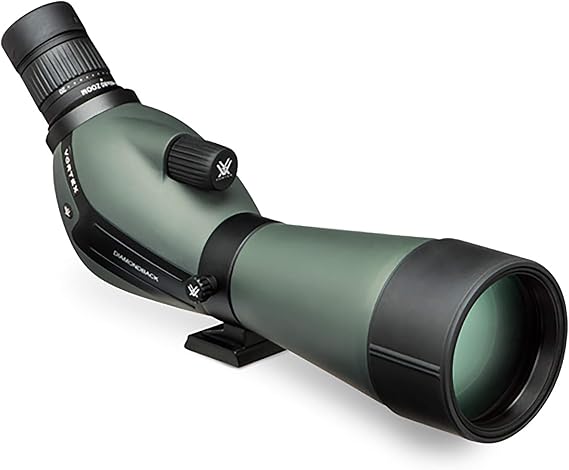
Comfort and clarity come together in a compact and lightweight design that fits nicely into a backpack or a day’s gear. Perfect for birdwatchers or outdoor enthusiasts who want a reliable scope without carrying heavy equipment.
The biggest strength lies in its bright image quality, even in low light.
Setup is straightforward thanks to the twist-and-lock collar that holds the scope steady in any position. The retractable sunshade helps cut glare when working in bright conditions. Adjusting focus is smooth with the easy-turn wheel, and the twist-up eyecup keeps viewing comfortable.
Its compact size makes it simple to handle during long sessions outdoors.
Images remain crisp from 20 to 60 times magnification, with fully multi-coated lenses ensuring good light transmission. The scope feels solid and waterproof, with nitrogen purging preventing fog buildup inside.
Most users praise the clear visuals and solid build, while some mention the manual focus takes getting used to in fast-changing scenes.
Bright, sharp images with solid construction stand out as the main positive, while the manual focus sometimes challenges quick adjustments in dynamic outdoor settings. The scope’s fogproof and waterproof features support reliable use no matter the weather.
Those who enjoy detailed glassing on hikes or birdwatching in varying light will appreciate this scope’s balance of power and portability. People needing quick auto-focus or longer eye relief should look at different models better suited for rapid action.
Pros
- Clear image with excellent light transmission
- Compact, lightweight design for easy transport
- Waterproof and fogproof for all weather use
- Comfortable twist-up eyecup for long viewing
Cons
- Manual focus can be tricky in fast scenes
- Limited eye relief at higher magnifications
| Specification | Details |
|---|---|
| Objective Lens Diameter | 80 mm |
| Magnification Maximum | 60x |
| Eye Relief | 20 millimeters |
| Focus Type | manual focus |
| Coating | Fully Multi-Coated |
10. Celestron C90 Maksutov Spotting Scope

Compact and versatile, the Celestron C90 Maksutov Spotting Scope is great for bird watching, nature observation, and even digiscoping. Its main strength lies in its small size paired with strong magnification, making it easy to carry without giving up viewing power.
Setting it up is straightforward thanks to the manual focus and included equatorial mount. The 8×21 erect image finderscope helps in targeting subjects quickly. Multi-coated lenses offer bright and clear images in daylight and low light.
Turning it into a telephoto lens for a smartphone camera is possible, adding to daily usefulness.
Clarity at long distances is impressive with the 1250mm focal length and 39x zoom. Build quality feels solid and the compact Maksutov-Cassegrain design fits well into a backpack. Bright and sharp views stand out as the biggest plus.
A common issue is the manual focus, which can take some patience to get just right.
Bright, sharp views and compact portability are frequently praised. The manual focus, while precise, is often noted to take practice and can slow down quick viewing. Users value the scope’s ability to deliver clear images over long distances without the bulk.
Anyone wanting a lightweight, powerful scope that doubles as a telephoto lens will appreciate its design. Those needing rapid focus adjustments or wider fields should look at larger or different style spotting scopes.
Pros
- Compact size with powerful magnification
- Multi-coated lenses for bright images
- Equatorial mount allows stable tracking
- Camera adaptable for digiscoping
Cons
- Manual focus requires steady hands and patience
- Smaller field of view compared to larger scopes
| Specification | Details |
|---|---|
| Objective Lens Diameter | 90MM |
| Focal Length | 1250 millimeters |
| Zoom Ratio | 39 multiplier x |
| Finderscope | 8×21 Erect Image Finderscope |
| Mount Type | Equatorial Mount |
| Coating | Multi-Coated |
11. SIG SAUER OSCAR6 HDX PRO 16-32×60 Spotting Scope

Built rugged with a straight eyepiece and a 16-32x magnification range, the SIG SAUER OSCAR6 HDX PRO spotting scope suits hunters and precision shooters who need clear sight of distant targets. Its biggest strength lies in the OmniScan Optical Image Stabilization technology, keeping images sharp despite shaky conditions.
Setting up takes just mounting it on any tripod with an ARCA-SWISS compatible head. Day-to-day use benefits from the smooth zoom between 16x and 32x, while the included 2 AA batteries power the image stabilization, making long viewing sessions comfortable. The IPX7 waterproof and fogproof rating means it handles wet or foggy weather without issue.
Performance delivers crisp, stable images even when holding the scope by hand or facing environmental challenges. The reinforced coatings on the lenses reduce glare and protect against scratches. While many note the clear image quality and solid build, some mention the need to replace batteries regularly as a minor inconvenience.
Image stabilization is highly praised for maintaining sharp visuals in shaky situations, while battery life and replacement frequency come up as the most mentioned drawback. Strong coatings and weather resistance add to its reliability outdoors.
Hunters and long-range shooters will find this scope fits their needs well, especially in challenging environments. Those looking for a simple handheld unit without stabilization might prefer lighter, less power-dependent scopes.
Pros
- Effective optical image stabilization technology
- IPX7 waterproof and fogproof for toughness
- Wide zoom range from 16x to 32x
- Durable lens coatings for clear optics
Cons
- Batteries need regular replacement
- Requires tripod with ARCA-SWISS compatible mount
| Specification | Details |
|---|---|
| Objective Lens Diameter | 6 centimeters |
| Magnification Maximum | 32 x |
| Lowest Useful Magnification | 16 x |
| Field Of View | 3.4 |
| Coating | SpectraCoat, LensArmor, HDX PRO |
| Number of Batteries | 2 AA batteries required (included) |
12. Athlon Optics Talos 20-60×80 Spotting Scope

Bright images and a high zoom range stand out immediately, making it ideal for hunters and outdoor enthusiasts who want a clear view from a distance. Its biggest strength lies in the brightness delivered by the K9 glass prisms with silver coating, which reflects a great amount of light directly to your eyes.
Setup is straightforward with manual focus and a rotating ring to adjust the viewing angle for comfort. The waterproof and nitrogen-purged build means it stays clear and stable even in wet or foggy conditions. Cleaning is simple with the included cloth, keeping the fully multi-coated lenses free from smudges for consistent clarity during long days in the field.
Performance shines through at all zoom levels, especially in low-light situations thanks to the fully multi-coated lenses. Construction feels solid with attention to weather sealing and thermal stability.
The main praise comes from its bright and clear image quality. Most complaints revolve around the relatively narrow field of view at 0.13 degrees, which can feel restrictive during wider scans.
The bright and sharp image quality stands out as the product’s biggest advantage, especially during low-light situations. The common downside is the narrow field of view, which can make scanning wider landscapes cumbersome. The manual focus also demands a bit more attention while tracking moving subjects.
Hunters or sports watchers who prioritize brightness and clarity will appreciate this scope’s features. Those needing a broader view or quicker focusing might want to consider alternative models better suited for wide-field observation or rapid target acquisition.
Pros
- Bright, clear images with silver-coated K9 glass prisms
- Waterproof and fog proof for tough conditions
- Rotating ring for comfortable angle adjustment
- Fully multi-coated lenses improve light transmission
Cons
- Manual focus requires constant adjustment
- Field of view is quite narrow at 0.13 degrees
| Specification | Details |
|---|---|
| Magnification Maximum | 60 x |
| Objective Lens Diameter | 8 centimeters |
| Focus Type | manual |
| Field of View | 0.13 degrees |
| Water Resistance Level | Waterproof |
| Prism Type | Porro Prism |
Best Field Spotting Scopes Comparison Table
| Product | Magnification | Objective Lens Diameter | Coating | Mount |
|---|---|---|---|---|
| SVBONY SV28 | 3:1 Zoom | – | FMC | Equatorial Mount |
| Athlon Argos HD | 20–60x | – | – | Altazimuth Mount |
| Vortex Viper HD | 60x | 8.5 cm | Proprietary coatings | Roof Prism |
| Maven CS.1 15-45×65 | 15-45x | 6.5 cm | Fully Multi-Coated | Tripod Mount |
| HD 20-60×80 Scope | 20-60x | 8 cm | – | – |
| 25-75×80 Scope | 25-75x | – | – | – |
| Flagship 20-60×80 | 60x | 8 cm | Fully Multi-Coated | Altazimuth Mount |
| Athlon Forerunner 20-60 | 20-60x | 8 cm | – | – |
| Vortex Diamondback | 20-60x | 1 cm | Fully Multi-Coated | – |
| Celestron C90 Maksutov | 39x | – | Multi-Coated | Equatorial Mount |
| SIG SAUER OSCAR6 HDX | 16-32x | 6 cm | SpectraCoat, LensArmor | Tripod with ARCA-SWISS |
| Athlon Talos 20-60 | 60x | 8 cm | Fully Multi-Coated | Tripod Mount |
- Magnification3:1 Zoom
- Objective Lens Diameter–
- CoatingFMC
- MountEquatorial Mount
- Magnification20–60x
- Objective Lens Diameter–
- Coating–
- MountAltazimuth Mount
- Magnification60x
- Objective Lens Diameter8.5 cm
- CoatingProprietary coatings
- MountRoof Prism
- Magnification15-45x
- Objective Lens Diameter6.5 cm
- CoatingFully Multi-Coated
- MountTripod Mount
- Magnification20-60x
- Objective Lens Diameter8 cm
- Coating–
- Mount–
- Magnification25-75x
- Objective Lens Diameter–
- Coating–
- Mount–
- Magnification60x
- Objective Lens Diameter8 cm
- CoatingFully Multi-Coated
- MountAltazimuth Mount
- Magnification20-60x
- Objective Lens Diameter8 cm
- Coating–
- Mount–
- Magnification20-60x
- Objective Lens Diameter1 cm
- CoatingFully Multi-Coated
- Mount–
- Magnification39x
- Objective Lens Diameter–
- CoatingMulti-Coated
- MountEquatorial Mount
- Magnification16-32x
- Objective Lens Diameter6 cm
- CoatingSpectraCoat, LensArmor
- MountTripod with ARCA-SWISS
- Magnification60x
- Objective Lens Diameter8 cm
- CoatingFully Multi-Coated
- MountTripod Mount
How to Choose the Right Field Spotting Scope
Choosing the right field spotting scope depends on factors like magnification, lens quality, and portability, which affect clarity and ease of use. Selecting the right balance between these features ensures better viewing without unnecessary expense or hassle during outdoor activities.
Optical Quality
One of the first things you notice using a spotting instrument is how clear and sharp the image remains at different zoom levels. A lens with a good magnification range typically goes from 15x to about 60x; lower magnification offers a wider view, while higher magnification brings distant details closer but can reduce image brightness and sharpness. Clarity also depends heavily on lens coatings.
Multi-coated lenses help in reducing glare and improving light transmission, which in turn preserves true colors and crispness throughout the image.
Lens quality varies a lot with price, but for daily use, look for at least fully multi-coated lenses. Field of view matters too, as a wider view makes it easier to locate fast-moving targets or scan larger areas. Depending on magnification, expect a field of view ranging from about 100 to 60 feet at 1000 yards.
Spotters with sharp images at both close and long distances make a big difference during long observation sessions.
Durability and Weather Resistance
Spending hours outside means the optical device is exposed to dust, moisture, and occasional knocks. The best ones offer waterproof and fogproof design that keeps internal lenses clear and dry, even in rain or heavy dew.
Look for models with nitrogen or argon purging to prevent fogging on the inside, which can ruin a day in the field.
Build quality shows in the materials used; aircraft-grade aluminum bodies are common for their strength without excessive weight. Rubber armor coatings protect against drops and give a better grip, which helps when handling in slippery conditions. Protective lens covers are essential and should be easy to remove but secure enough not to fall off during transport.
Portability and Size
Carries weight quickly becomes evident once out in the field for hours. Devices weighing around 2 to 3 pounds strike a good balance between stability and portability. Compact size helps if you need to stash it in a backpack or carry without extra hassle.
Some designs shape the body for a comfortable grip, preventing hand fatigue during extended handheld use.
Practical design often includes a tripod-ready base without adding bulk. A hard carrying case or padded pouch makes storing and transporting the unit easier and safer.
Without proper protection, scratches or bumps can degrade performance over time, so consider what fits your travel routine best.
Focusing Mechanism
Adjusting focus quickly matters, especially when tracking moving birds or game. Smooth, well-damped focus knobs or rings provide precise control without jerking the image. Some slower or cheaper mechanisms can be stiff or too loose, making it hard to lock in a crisp picture.
The position of the focus control affects usability; centrally located knobs near the eyepiece are easiest to reach. Being able to fine-tune focus rapidly without changing your viewing posture keeps the experience comfortable and reduces missed moments. Precision focusing controls make a clear difference after several hours in the field.
Mounting Compatibility
Tripod mounting is vital if you plan long viewing sessions or want steady images at high magnifications. Most spotting scopes use a standard 1/4-20 threaded socket, allowing them to fit common tripod heads. Stability depends on both the tripod quality and how securely the unit attaches.
Adapters or quick-release systems speed up setup and breakdown, useful if you switch locations often. A solid mount reduces shaking from even the slightest touch or wind gusts.
Before buying, check compatibility with your current equipment or plan to get a matching tripod or plate for best results.
Maximizing Performance: Tips for Effective Field Use of Spotting Scopes
Choosing the right location plays a crucial role in spotting scope performance. Setting up on stable, level ground reduces image shake and makes viewing easier.
Use a sturdy tripod specifically designed for spotting scopes because regular camera tripods might not support the weight or offer the steady base needed. Adjust the eyepiece for your eyesight rather than relying only on the focusing knob; this reduces eye strain over long observation sessions.
Additional tips:
- Allow the scope to acclimate to outdoor temperatures for clearer images, especially when moving from indoors.
- Use a lens cover when not observing to protect against dust and scratches.
- Refine focusing by starting at low magnification and then increasing as needed.
These steps help achieve sharper and more stable observations, essential for spotting small or distant subjects effectively.
Proper Cleaning and Maintenance Techniques for Longevity
Regular cleaning of lenses and body maintains image clarity and extends the life of spotting scopes. Use a soft brush or air blower to remove dust particles before wiping the lenses. A microfiber cloth with a small amount of lens cleaning solution gently removes smudges without scratching the glass.
Avoid household cleaners or paper towels, as they can damage coatings.
Maintenance advice:
- Store the scope in a padded case to prevent impacts and exposure to moisture.
- Check and tighten any loose screws or mounting components periodically.
- Keep lens caps on when the scope is not in use to keep dirt and debris away.
Proper care routines protect internal optics and mechanical parts, ensuring consistent performance over time.
Common Mistakes to Avoid When Using a Field Spotting Scope
Troubles often arise from improper setup and handling of spotting scopes. Not securing the tripod or overextending tripod legs causes instability, resulting in shaky images. Applying too much pressure when focusing can damage internal parts and reduces smooth adjustment.
Common pitfalls include:
- Overlooking the importance of letting the scope reach ambient temperature, which leads to foggy or blurry views.
- Direct exposure to rain or extreme dust without protective covers.
- Using high magnification immediately without establishing a clear low-power image first.
Observing these mistakes and correcting them improves both the experience and the lifespan of the field spotting scope.
People Also Asked
How Do I Properly Clean and Maintain a Field Spotting Scope?
Use a soft brush or air blower to remove dust, then clean the lenses gently with a microfiber cloth and lens cleaner. Avoid using household cleaners or paper towels since they can scratch the glass. Store the scope in a protective case when not in use to prevent damage and dust buildup.
What Size Spotting Scope Is Ideal for Bird Watching?
An 8x or 10x magnification with a 42mm to 50mm objective lens works well for bird watching. This size balances detail and field of view, making it easier to locate and follow moving birds without excessive weight. Some scopes in this range also come with adjustable zoom for versatility.
Are Field Spotting Scopes Compatible with Smartphone Adapters?
Many field spotting scopes support smartphone adapters, allowing photos or videos through the lens. Match the adapter securely to the eyepiece to prevent wobble and ensure the phone’s camera lines up correctly. Certain models fit better than others, so check compatibility before buying an adapter.
How Long Do Field Spotting Scopes Typically Last with Regular Use?
A good quality spotting scope can last 10 years or more with proper care. Keeping it clean, avoiding moisture inside the lenses, and protecting it during transport are key for longevity. Regular inspection for any loose parts or lens fogging helps maintain performance over time.
What Common Issues Should I Watch for in a New Spotting Scope?
Check for smooth focusing and a clear, bright image free of distortions or color fringing. Test the mechanical parts for stability and the durability of the tripod mount. Some scopes may have loose eyepieces or poor waterproofing; these issues can affect use in outdoor conditions.
Conclusion
Choosing a field spotting scope really comes down to three things: clear optics for good image quality, a sturdy build that can handle outdoor use, and a size that works for your typical field conditions. Paying attention to the lens and eyepiece quality will save frustration when trying to spot details at a distance.
Consider how often you’ll use the scope and where you plan to carry it. A heavier model might be fine for car trips but less useful for long hikes.
Take another look at the comparison table and the detailed sections above to find an option that matches your needs and fits your budget.