
Top 12 Best Ham Scanner You Can’t Miss Today!
People who rely on a best ham scanner know how frustrating it is when a cheap model fails to catch crucial signals or has inconsistent frequency coverage. Dropped connections or unclear readings often come from devices that don’t handle the necessary frequency bands well or lack enough power to penetrate interference.
This makes using radio communication unreliable, especially in emergency or outdoor situations where ham scanners are essential tools.
The key features that separate a good ham scanner from a poor one include frequency range, scanning speed, and audio clarity. A reliable scanner typically covers at least 25 to 1300 MHz to reach common amateur radio bands, with fast scanning cycles under one second per channel to avoid missing transmissions. Clear audio without distortion, alongside a well-designed speaker or headphone output, helps distinguish weak signals.
Ease of use, such as simple channel programming and a sturdy build to withstand regular handling, rounds out what matters most.
Need a Quick Check?
| Image | Product | Price |
|---|---|---|
Our Top Picks 1  | Uniden Bearcat BC125AT | Check Price |
Our Top Picks 2  | ZHIWHIS A330 Receiver | Check Price |
Our Top Picks 3  | Whistler WS1010 Scanner | Check Price |
Our Selected Top 12 Ham Scanner Worth Buying
This list features a variety of ham scanners designed for different needs and experience levels. Each review covers key performance aspects, suitability for users, and highlights the strengths and limitations to help you make an informed choice.
1. Uniden Bearcat BC125AT Analog Handheld Scanner
Compact and loaded with features, this analog scanner suits anyone who needs quick access to radio frequencies without digital complexity. Its standout feature is the Close Call RF capture technology, which automatically picks up nearby signals for easy and efficient monitoring.
Setup is straightforward, requiring just two AA batteries and no special programming. The digital display lets you easily scan through 500 alpha-tagged channels. Daily use benefits from the Do Not Disturb mode that prevents interruptions while you’re listening to an active transmission.
Its compatibility with personal computers adds some convenience for managing channels.
Performance in picking up analog signals is solid across its wide frequency range of 25-54 MHz and 108-174 MHz, up to 400-512 MHz in UHF bands. The build feels practical though it’s not water resistant and designed for handheld use. Praise often goes to the Close Call RF capture for catching transmissions quickly, while the inability to handle digital signals is a common drawback mentioned.
Many appreciate how the Close Call RF capture quickly locks onto nearby transmissions, making scanning more intuitive and less time-consuming. At the same time, users often point out its lack of digital system support as a limitation, especially in areas moving toward digital trunking radios.
People interested primarily in analog scanning and straightforward operation will find this scanner reliable and easy to handle. Those needing to track digital police or emergency channels should consider models that support digital trunking systems for better coverage.
Pros
- Close Call RF capture instantly detects nearby transmissions
- 500 alpha-tagged channels for organized scanning
- Digital display for easy reading and navigation
- Includes batteries for immediate use
Cons
- Cannot monitor digital radio systems
- Not water resistant, limiting outdoor use
| Specification | Details |
|---|---|
| Number of Channels | 500 |
| Frequency Range | 25-54 MHz, 108-174 MHz, 225-380 MHz, 400-512 MHz (UHF) |
| Battery Type | 2 AA batteries required (included) |
| Battery Average Life | 10 hours |
| Tuner Type | UHF |
| Voltage | 3 volts |
2. ZHIWHIS A330 SSB Shortwave Radio Receiver
ZHIWHIS A330 SSB Shortwave Radio Receiver covers a wide range of frequencies, making it ideal for ham radio enthusiasts and shortwave listeners wanting versatile scanning. Its standout feature is the precise shortwave single-sideband reception with adjustable BFO, which really sharpens signal clarity on SSB modes.
Setting it up involves just inserting the included battery and attaching an antenna, with options for a 3.5mm external antenna to boost reception. Navigating through bands is simple via the numeric keypad or automatic search modes, storing up to 200 stations on each frequency band.
The lightweight and portable design means it fits easily into daily routines, whether at home or on the go.
Performance-wise, it handles FM, MW, SW, AIR, CB, VHF, UHF, and weather bands reliably with adjustable sensitivity to tune in weak signals better. The build feels solid and compact, though some reviews mention the nonstandard battery as an inconvenience due to availability issues.
The strong SSB demodulation capabilities stand out during listening sessions.
The precise shortwave single-sideband reception with adjustable BFO is a clear highlight, helping users find clear signals on SSB. At the same time, the nonstandard battery requirement is a frequent drawback for those who want easy battery swaps.
Ideal for users who want extensive frequency options and strong SSB reception in a compact package. Those looking for a standard battery or premium build may prefer another radio option.
Pros
- Wide frequency coverage including SSB modes
- Stores up to 200 stations per band
- External antenna port improves reception when needed
- Lightweight and easy to carry around
Cons
- Nonstandard battery can be hard to replace
- Somewhat basic build quality compared to pricier models
| Specification | Details |
|---|---|
| Frequency Coverage | FM, MW, SW (2.3-30MHz), AIR (118-138MHz), CB, VHF, UHF, WB bands |
| Channels | 1400 |
| Station Memory | 200 stations per frequency band |
| Battery Type | 1 Nonstandard Battery (included) |
| Connectivity | Bluetooth, Earphone, PC, Smartphone |
3. Whistler WS1010 Analog Handheld Scanner
Feels sturdy in hand and easy to carry around, making it a solid choice for ham radio enthusiasts wanting reliable analog scanning. Suited for those who want a straightforward scanner with plenty of memory and quick access to emergency weather updates. Its main strength lies in the ability to store many frequencies and quickly scan for nearby transmissions.
Setting up involves programming frequencies either directly or through a PC, which helps keep things organized in the 10 memory banks. Day-to-day use benefits from the preprogrammed service banks for marine, fire, police, aircraft, and ham bands, so you get quick access to important channels. Weather alerts are clear and county-specific, adding valuable safety info without extra fuss.
The build is compact and lightweight at just 7.7 ounces, fitting comfortably in the hand or pocket. Scanning runs smoothly through up to 400 stored frequencies, and the Spectrum Sweeper feature speeds up searches for active signals nearby.
A common positive note is the clarity of alerts, while a frequent complaint points to the need for a third-party PC cable and software to update databases, which can complicate programming.
Reviews highlight that weather alerting and quick scanning make this scanner reliable in active situations, while difficulties with PC programming and needing additional accessories stand out as the main drawbacks. The device performs well as an analog scanner but demands some patience when updating frequency lists.
This scanner suits someone who values handheld portability, multiple memory banks, and weather alert features. People wanting easy updating or plug-and-play programming may prefer simpler models or those that include PC software support.
Pros
- Stores up to 400 frequencies
- Instant access to storm spotter frequencies
- County-specific weather alerts with sound
- Lightweight and compact design
Cons
- PC programming requires separate cable and software
- Programming can be complicated for beginners
| Specification | Details |
|---|---|
| Dimensions | 1.56 x 2.37 x 5.68 inches |
| Weight | 7.7 ounces |
| Memory Capacity | 400 channels in 10 memory banks |
| Batteries | 4 AA batteries required (included) |
| Model Number | WS101 |
4. PNI HAM 27 Multiband Portable Radio Scanner

Ideal for radio enthusiasts looking for wide frequency coverage, the PNI HAM 27 Multiband Portable Radio Scanner covers an impressive 0.153 – 1160 MHz range and supports up to 999 channels. Its biggest strength lies in handling lots of channels for flexible reception and long listening sessions without constant recharging.
Setting up involves charging a 7.4V 2500mAh Li-Ion battery with a desktop charger or wall adapter, making it easy to keep powered up. Day-to-day use includes scanning through hundreds of channels quickly and listening via a 2-pin PNI-K headphone jack, offering clear sound with low distortion. The integrated flashlight comes in handy for night use or emergencies.
Scanning performance is notably sensitive with -21 dBm FM and -100 dBm AM levels, capturing weak signals with clarity. The audio power puts out a decent 1W, keeping reception clear at moderate volumes.
It handles lots of channels smoothly, but lacks water resistance, meaning some care is needed outdoors. The sturdy build feels solid but is not designed for wet environments.
The strongest praise centers on its wide frequency range and large channel capacity while the most common complaint is the lack of water resistance, limiting outdoor durability. It handles channel scanning and reception with good sensitivity and clear sound quality, but caution is needed around moisture.
Anyone needing extensive multiband coverage and many preset channels will benefit, especially those primarily using indoors or in dry conditions. Those requiring rugged, weatherproof equipment should explore more durable alternatives tailored for outdoor use.
Pros
- Extensive 0.153 – 1160 MHz frequency range
- Supports up to 999 channels
- Long battery life with easy charging options
- Clear audio with low distortion
Cons
- Not water resistant, unsuitable for wet conditions
- Uses one nonstandard battery type
| Specification | Details |
|---|---|
| Frequency Range | 0.153 – 1160 MHz |
| Number of Channels | 999 |
| Battery | 7.4V 2500mAh Li-Ion |
| Audio Power | 1W |
| Connectivity | 2-pin PNI-K headphone connector |
| Voltage | 12 volts_of_direct_current |
5. Ham Radio Frequency Chart Quick Reference Cards

Water-resistant PVC construction makes these cards durable and perfect for outdoor use. Ideal for any ham operator wanting quick access to key frequency and code information without the need for a device or large book.
The strongest point is having all essential data organized in a compact, easy-to-carry format.
Carrying the four cards linked on a steel wire ring means you can keep them in your go bag or scrub pocket without losing anything. Each card covers a specific topic like band frequencies, Q codes, or antenna formulas, so you can grab exactly what you need fast during a QSO.
The portable station checklist is a handy touch for preparing setups on the fly.
These cards deliver quick reference capability without flipping pages or scrolling screens, which shines during active communication. The PVC material feels solid and resists dust and water, practical for fieldwork.
People appreciate the organized layout but some find the small font challenging in low light. Weight and waterproof qualities score high.
Many enjoy the convenience of having all essential frequency info and codes at hand in a durable, weather-resistant format. Challenges with small print affect users during dim conditions, highlighting a trade-off between compactness and readability. Carrying four cards on a ring reduces the risk of losing pages, adding reliability for portable operations.
People frequently on outdoor or portable stations benefit most from this practical reference chart that doesn’t rely on electronics. Those needing larger text or more comprehensive explanations might prefer a handbook or digital app. The set works well for quick lookup but isn’t a replacement for in-depth study resources.
Pros
- Compact design fits easily in pockets or bags
- Clear organization by topic speeds up reference
- Durable waterproof and dust-proof PVC material
- Includes antenna formulas and station checklist
Cons
- Font size can be hard to read in poor lighting
- Limited space restricts amount of detailed info
| Specification | Details |
|---|---|
| Material | Waterproof PVC |
| Pages | 8 pages on 4 cards |
| Connectivity | Steel wire ring |
| Water Resistance Level | Water Resistant |
| Additional Features | Dust Proof |
6. Uniden SDS150 Digital Radio Scanner

Known for its clear digital display and portable design, the Uniden SDS150 Digital Radio Scanner fits anyone wanting advanced scanning in the field. Its strongest feature is the enhanced sensitivity, which helps catch signals others might miss, making it ideal for serious scanning enthusiasts.
Setup is straightforward, with a simple interface that doesn’t overwhelm. The built-in GPS receiver pairs nicely with the U/AWARE app, so tracking signals is smoother than before. Battery life holds up well during long sessions, and the charge cradle makes recharging convenient.
Bluetooth connectivity allows easy smartphone integration, expanding how you use the scanner when on the move.
Signal reception is excellent thanks to the advanced filtering that cuts down interference significantly. The rugged, water-resistant build holds up in daily use without feeling bulky. High marks go to signal clarity and portability.
The main drawback people mention is the use of a nonstandard battery, which could complicate replacements or spares.
Strong praise centers on its clear signal reception and rugged design that performs well in the field. Common complaints focus on the nonstandard battery, which can be inconvenient to replace and limits spare availability for daily use.
Anyone needing reliable trunk tracking and digital scanning in a portable unit will find it a solid choice. Those looking for a simpler or battery-standard device might want to explore other scanners with easier battery options or fewer advanced trunking features.
Pros
- Enhanced sensitivity for better signal reception
- Lightweight and water-resistant design
- Integrated GPS and Bluetooth connectivity
- Long battery life with included charger cradle
Cons
- Uses a nonstandard battery that’s harder to replace
- Somewhat complex trunking support may overwhelm beginners
| Specification | Details |
|---|---|
| Connectivity Technology | Bluetooth |
| Power Source | Battery Powered |
| Tuner Type | TrunkTracker X, APCO P25 Phase I & II, Motorola, EDACS, LTR DMR Tier III* |
| Radio Bands Supported | AM, NFM, FM, WFM, or FMB |
| Display Type | digital |
7. Uniden Bearcat BCD160DN Handheld Digital Scanner
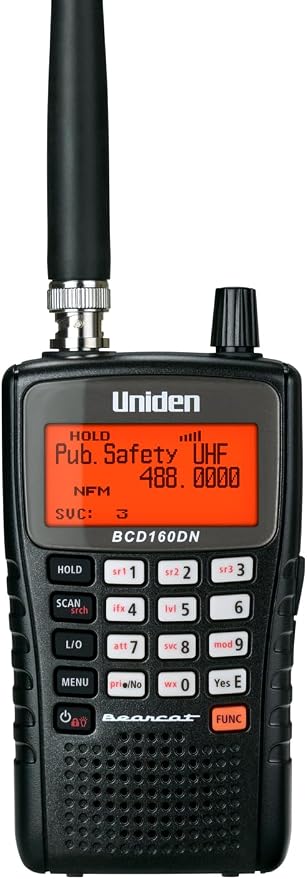
Perfect for serious scanning enthusiasts, the Uniden Bearcat BCD160DN stands out by offering instant decoding of digital signals like DMR and NXDN, along with a comprehensive suite of search features. Its main strength lies in quickly identifying elusive transmissions, making it ideal for those who want fast, reliable signal detection beyond basic analog scanning.
Setting up involves connecting via USB for easy power and updates. Day-to-day operation revolves around features like the Band Scope Rapid System/Channel Number Tagging, which helps organize channels efficiently.
The instant detection of CTCSS tones and DCS codes lets you identify frequency details instantly without fiddling around, making scanning straightforward and intuitive.
Performance-wise, it excels at decoding conventional digital signals right out of the box and extends its capabilities through firmware updates. The build feels solid and durable, suitable for frequent handheld use. Praise often centers on its quick code detection and broad digital compatibility.
Complaints usually focus on the lack of trunking support and inability to decode encrypted transmissions, which limits use in some advanced setups.
The scanner is praised for its instant tone and code recognition, speeding up the scanning process significantly. A common limitation is the absence of trunking support, which restricts signal access in some user cases. The sturdy build and comprehensive digital decoding cover many scanning needs well.
Those needing quick detection of conventional digital and analog signals will find this scanner very satisfying. Individuals requiring trunking or encrypted signal decoding will need to look for other options better suited to those demands.
Pros
- Instant CTCSS and DCS code detection
- Supports multiple digital protocols out of the box
- Easy channel organization with system tagging
- Durable handheld design
Cons
- Does not support trunking systems
- Cannot decode encrypted signals
| Specification | Details |
|---|---|
| Scanner Type | Radio Scanner |
| Connection Type | USB |
| Digital Decoding | DMR, NXDN (APCO P25 Phase 1 & 2 via firmware update) |
| Trunking Support | Not supported |
| Exclusive Features | Band Scope Rapid System/Channel Tagging |
8. KSUN HF123D Dual Band Handheld Ham Radio

Finding a reliable dual band ham radio that also functions as a wideband scanner can be a real challenge. Perfect for amateur radio enthusiasts who want versatility, this handheld device offers strong transmission power and a wide range of frequencies.
Its biggest strength is the ability to both transmit on VHF and UHF bands and receive signals across multiple other bands.
Setting it up is straightforward thanks to Bluetooth compatibility with smartphones, making frequency management easier on the go. Day-to-day use benefits from adjustable power levels, high, medium, and low, to suit different communication needs. Being able to scan LW, MW, CB radio, FM, and NOAA weather channels adds extra value, making it useful beyond just ham radio conversations.
Signal quality is clear with 10W power, covering both VHF (136~174MHz) and UHF (400~520MHz) reliably. The built-in spectrum analyzer lets you get a quick sense of band activity with a simple key press. Build-wise, it feels solid but keep in mind it isn’t water resistant, which requires some care in damp environments.
The noise level at 0.5 sones is pleasantly low.
Signal clarity and the spectrum analyzer feature are often highlighted as strong advantages, making frequency monitoring convenient. The lack of water resistance is a frequent drawback, meaning it needs cautious handling in wet conditions.
Anyone looking for a solid dual band handheld with wide scanning capabilities will find this radio well-suited. Those who require waterproofing or transmission beyond VHF/UHF should consider alternative options.
Pros
- True 10W high power output
- Wideband receiver for multiple signal types
- Built-in professional spectrum analyzer
- Bluetooth connectivity with smartphones
Cons
- Not water resistant
- Only VHF/UHF support transmission
| Specification | Details |
|---|---|
| Number of Channels | 960 |
| Frequency Range | UHF/VHF |
| Power Output | 10W |
| Voltage | 7.4 volts_of_direct_current |
| Connectivity Protocol | Bluetooth |
9. Uniden SDS200 TrunkTracker X Digital Scanner

Providing a large 3.5 fully customizable color display, this scanner suits anyone looking for clear visuals and easy navigation. Its digital technology handles even the most challenging systems with ease, making it powerful for serious radio watchers wanting detailed information at a glance.
Setup involves plugging into a USB connection and updating the HomePatrol database, which covers all known US and Canadian radio systems. Daily use benefits from a color-customizable screen that lets you choose how much information to see, while the user-friendly interface keeps operation straightforward without constant adjustments.
Performance stands out as a strong point, especially in decoding digital simulcast systems accurately. The build feels solid with LED light source support, though some might find the complexity of features a bit daunting at first.
Most praise appreciates its reliable signal handling, while occasional critiques focus on the learning curve of the software updates.
The scanner receives frequent praise for handling tough digital systems reliably and offering a sharp, customizable display. The most common complaint centers on the time needed to learn and keep up with software updates to maintain database accuracy.
Anyone wanting a detailed digital scanner with up-to-date system info will find this useful. Those looking for a simpler or more basic scanner might prefer models with fewer features and less frequent update needs.
Pros
- Large 3.5″ customizable color display
- Includes updatable database for US and Canada
- Effective on digital simulcast systems
- User-friendly HomePatrol interface
Cons
- Learning curve with frequent software updates
- Some may find interface complexity challenging
| Specification | Details |
|---|---|
| Scanner Type | Radio Scanner |
| Connection Type | USB |
| Resolution | scanner |
| Standard Sheet Capacity | 10 |
| Light Source Type | LED |
| Media Type | USB |
10. Uniden Bearcat BCD260DN Base/Mobile Digital Scanner

Radio hobbyists and emergency radio watchers will find the Uniden Bearcat BCD260DN perfect for tracking a wide range of signals in real time. Its biggest strength is scanning across multiple public safety and service bands with great speed and accuracy, thanks to features like Band Scope Rapid System and Channel Number Tagging.
Setup is straightforward since it comes pre-programmed with key emergency and service bands including S.A.M.E weather alerts, Aviation, and Marine. Daily use involves connecting via USB and easily tuning into frequencies stored on the device or searching new ones quickly using its suite of scan functions. Direct access to 10,000 frequencies gives flexibility for varied interests without constant reprogramming.
Performance stands out with sharp reception that includes narrowband capability for picking up clearer signals on congested frequencies. The build feels solid for both base and mobile use.
The most common praise highlights its speed in finding elusive transmissions, while a frequent complaint involves occasional complexity in menu navigation for newcomers.
The Uniden Bearcat BCD260DN is praised for its extensive band coverage and fast signal detection. It includes pre-programmed service bands for emergency alert channels, aviation, marine, and railroad frequencies. Rapid system and channel tagging are useful for organizing channels quickly. A common complaint is the complexity of the menu system, which can take time to learn and might slow down.
People interested in emergency scanning, weather alerts, or multi-environment listening will appreciate the BCD260DN’s wide coverage and features. Those looking for a simpler, more straightforward scanner for casual listening may want to consider more user-friendly models. This scanner is better suited for those who want detailed control and are comfortable navigating complex settings.
Pros
- Pre-programmed for key emergency and service bands
- Band Scope Rapid System helps detect signals quickly
- Narrowband reception improves clarity on busy channels
- Supports both base and mobile use with USB connection
Cons
- Menu navigation can be complicated for first-time users
- Limited touchscreen or modern interface options
| Specification | Details |
|---|---|
| Scanner Type | Radio Frequency scanner |
| Connection Type | USB |
| Resolution | 300 dpi |
| Pre-programmed Bands | Emergency services, Aviation, Marine, Railroad, NASCAR |
| Frequency Access | Direct access to 10,000 frequencies |
11. Yaesu FT-65R Dual-Band Handheld Transceiver

VHF/UHF Dual Band handheld radios with commercial-grade durability don’t come much tougher than this. Compact yet powerful, it suits anyone needing a reliable walkie-talkie for active outdoor use or daily communication.
Its standout feature is rugged construction that keeps it working through dust and water exposure.
Setting it up is straightforward with 200 available channels and adjustable transmission power levels for flexible range and battery use. The big front speaker delivers clear sound, making conversations easy even in noisy environments. Operating time goes beyond nine hours on a standard battery, with the option to swap for a high-capacity pack if longer use is needed.
The main task of consistent, clear communication is handled well through strong 5-watt RF power and a 1-watt audio output. Built to meet IP54 dust and water resistance standards, plus MIL-810-C, D, and E military durability tests, this radio stands up to rough conditions.
Most users appreciate its ruggedness while some note the maximum range of about 65 feet can feel limiting outdoors.
Clear, strong audio and solid build quality earn praise for keeping communication reliable even outdoors. Most complaints revolve around its relatively short maximum talking range compared to other handheld radios.
Those prioritizing a rugged, compact radio for close-range use and extended battery life will appreciate this model. Users needing longer range coverage may want to look at radios designed specifically for extended distances.
Pros
- Compact and easy to carry daily
- Water and dust resistant per IP54 rating
- Clear, loud audio from front speaker
- Long battery life with optional high-capacity pack
Cons
- Maximum talking range only 65 feet
- Single battery type limits quick swaps
| Specification | Details |
|---|---|
| Number of Channels | 200 |
| TX Power Settings | 5 W (High)/2.5 W (Middle)/0.5 W (Low) |
| Operating Time | Over 9 hours (standard battery) |
| Size (W x H x D) | 2.1” x 4.1” x 1.2” (52.5 x 104.5 x 31 mm) |
| Water Resistance | IP54 Rating |
| Battery Type | 1 Lithium Ion (7.4 volts) |
12. Yaesu FT-70DR Digital/Analog Handheld Transceiver

Yaesu FT-70DR Digital/Analog Handheld Transceiver offers dual-band communication with great dust and water protection. Best for ham radio enthusiasts who value a mix of digital and analog modes alongside versatile scanning options. Its standout feature is the combination of a durable design and easy programming via USB.
Setting up the radio involves plugging in the USB cable for programming or updates, which makes channel management simple. Day-to-day use benefits from the Programmable VFO Scan and Priority Channel Scan, helping you stay tuned to important frequencies.
The external DC jack lets you power the unit while charging the battery, making continuous use easier in the field.
Performance-wise, it covers frequencies from 144 to 148 MHz with wide band receive from 108 to 579.995 MHz, delivering clear audio at 50 dB noise. Built with an IP54 rating, it resists dust and water, offering reliability outdoors. The strongest praise centers on its durable construction and scanning flexibility, while a common complaint involves the limited 40-channel memory for heavy users.
The radio’s rugged IP54 construction and flexible scanning options receive frequent praise for outdoor versatility and ease of use. However, the 40-channel memory restriction shows up often as a downside for users needing to store more frequencies.
Those looking for a durable, well-rounded dual-band radio with digital features will find it suitable. People requiring extensive channel memory or longer talking range may want to explore other options.
Pros
- Dual-band digital and analog operation
- Wide band receive scanning feature
- Dust and water protection (IP54 rating)
- USB programming and software updates
Cons
- Limited to 40 memory channels
- Maximum talking range about 5 miles
| Specification | Details |
|---|---|
| Frequency Range | 144 – 148 MHz |
| Number of Channels | 40 |
| Water Resistance Level | Water Resistant (IP54) |
| Wide Band Receive Coverage | 108 – 579.995 MHz |
| Battery | 7.4V 1800 mAh Li-Ion |
Best Ham Scanners Comparison Table
| Product | Channels | Frequency Range | Battery Type | Water Resistance |
|---|---|---|---|---|
| Uniden Bearcat BC125AT | 500 | 25-54,108-174,225-380,400-512 MHz | 2 AA batteries | Not Water Resistant |
| ZHIWHIS A330 Receiver | 1400 | – | 1 Nonstandard battery | – |
| Whistler WS1010 Scanner | – | – | 4 AA batteries | – |
| PNI HAM 27 Scanner | 999 | 0.153-1160 MHz | 12 volts DC | Not Water Resistant |
| Ham Radio Frequency Cards | – | – | – | Water Resistant |
| Uniden SDS150 Scanner | – | – | Battery Powered | – |
| Uniden Bearcat BCD160DN | – | – | – | – |
| KSUN HF123D Radio | 960 | UHF/VHF | 7.4 volts DC rechargeable | Not Water Resistant |
| Uniden SDS200 TrunkTracker | – | – | – | – |
| Uniden Bearcat BCD260DN | – | – | – | – |
| Yaesu FT-65R Transceiver | 200 | UHF, VHF | 1 Lithium Ion battery | Water Resistant |
| Yaesu FT-70DR Transceiver | 40 | 144-148 MHz | – | Dust/Water Protection (IP54) |
- Channels500
- Frequency Range25-54,108-174,225-380,400-512 MHz
- Battery Type2 AA batteries
- Water ResistanceNot Water Resistant
- Channels1400
- Frequency Range–
- Battery Type1 Nonstandard battery
- Water Resistance–
- Channels–
- Frequency Range–
- Battery Type4 AA batteries
- Water Resistance–
- Channels999
- Frequency Range0.153-1160 MHz
- Battery Type12 volts DC
- Water ResistanceNot Water Resistant
- Channels–
- Frequency Range–
- Battery Type–
- Water ResistanceWater Resistant
- Channels–
- Frequency Range–
- Battery TypeBattery Powered
- Water Resistance–
- Channels–
- Frequency Range–
- Battery Type–
- Water Resistance–
- Channels960
- Frequency RangeUHF/VHF
- Battery Type7.4 volts DC rechargeable
- Water ResistanceNot Water Resistant
- Channels–
- Frequency Range–
- Battery Type–
- Water Resistance–
- Channels–
- Frequency Range–
- Battery Type–
- Water Resistance–
- Channels200
- Frequency RangeUHF, VHF
- Battery Type1 Lithium Ion battery
- Water ResistanceWater Resistant
- Channels40
- Frequency Range144-148 MHz
- Battery Type–
- Water ResistanceDust/Water Protection (IP54)
How to Choose the Best Ham Scanner
Choosing the right ham scanner depends on factors like frequency coverage, scanning speed, and ease of use, ensuring reliable reception and quick access to channels. Prioritizing these features helps avoid frustration and additional costs from buying multiple devices or accessories later.
Frequency Range and Coverage
The range of frequencies a scanner can cover has a direct impact on its usefulness for ham radio users. Many devices struggle with limited bands, resulting in missed transmissions or incomplete scanning sessions.
A good model covers both VHF (30-300 MHz) and UHF (300-3000 MHz) bands, as these encompass a majority of ham operations. Coverage beyond these bands, such as shortwave or aircraft frequencies, can be an added benefit, allowing users to catch diverse signals.
It’s important to choose a scanner with clearly defined frequency ranges that match your local ham bands. Units that support programmable frequencies let users tailor the setup based on their interests or regional practices. Typical ham frequencies span from about 144 MHz to 148 MHz on VHF and 420 MHz to 450 MHz on UHF, so make sure these fall within the device’s ability to scan.
Broad frequency coverage eliminates the hassle of switching devices to monitor different ham signals.
Scanning Speed and Sensitivity
The speed at which a scanner cycles channels makes a difference in staying on top of active communications. Slower models miss parts of conversations or force longer waits before a frequency is rechecked.
A scanner with a fast scanning rate helps catch transmissions without delays. Sensitivity is equally crucial; weak or distant signals can be barely audible on less sensitive devices, but a sensitive scanner picks them up clearly, improving reception quality.
Look for scanners known for precise frequency locking, which prevents jitter or drifting off channel during reception. Practical scanners usually handle around 10 to 100 channels per second, with higher sensitivity measured in microvolts. This means more reliable detection of faint signals or those broadcast in noisy urban environments, enhancing the daily listening experience.
User Interface and Display
Clear visibility of information on the display affects how quickly you switch channels and adjust settings, especially in changing light conditions outdoors or at night. Screens that are dim, reflective, or have poor contrast can cause eye strain and slow down operation. Backlit LCD or OLED displays tend to offer better clarity for reading frequency, signal strength, and menu options under sunlight or low light.
Menu structure should be straightforward, with easily accessible buttons or dials to program channels without frequent reference to manuals. Customizable scan options and audible alerts for specific frequencies allow users to focus on what matters without guessing. Simple, logical UI design prevents frustration during setup or quick scanning sessions.
Portability and Power Options
Portability affects whether the device can keep up during field work or casual handheld use. Bulky or heavy models become cumbersome, limiting how long users can comfortably carry or operate them away from home.
A compact size with a weight under a few hundred grams makes a scanner easier to hold for long periods or fit in a backpack.
Battery life also plays a big role in usability. Rechargeable lithium-ion batteries are more practical for extended use since they can be topped off repeatedly and generally last several hours per charge.
Devices accepting common disposable batteries like AA provide convenience in remote areas without charging facilities. External power or USB charging options add flexibility for longer outings.
Connectivity and Expandability
Compatibility with external antennas can drastically improve reception, especially in locations where built-in antennas fall short due to obstructions or distance. Being able to attach different antenna types or amplifiers lets users tailor reception quality to their environment. Firmware update options keep the device current with new features or corrected bugs, extending its lifespan.
Importing frequency databases or connecting to a computer or smartphone provides more precise control over scanning profiles and channel management. Some scanners allow remote operation and logging through apps, which can be helpful for managing extensive frequency lists or monitoring multiple channels simultaneously.
Practical integration features make daily use more efficient and adaptable to individual needs.
Tips for Optimizing Your Ham Scanner’s Performance
Keeping the lens and scanning window clean makes a big difference in how well a ham scanner works. Dust, grease, or fingerprints can interfere with the light sensor and cause poor reads.
Wipe these parts gently with a microfiber cloth after each use.
Using the scanner with a stable power source prevents glitches and sudden shutdowns. Unstable batteries or loose USB connections can lead to inconsistent scanning.
It’s best to keep spare batteries on hand if the model is battery-powered.
Position the ham correctly under the scanner’s reading area. Aligning the scanner carefully to cover the entire surface helps capture accurate information, especially for cured or marinated meats where texture varies.
- Calibrate the scanner regularly if the model includes this feature to maintain precision.
- Avoid scanning in direct sunlight or overly bright artificial light, which can cause interference.
Common Mistakes to Avoid When Using a Ham Scanner
One common mistake is moving the ham scanner too quickly across the surface. A slow, steady pass allows the sensor to pick up consistent data. Speeding up scanning often yields incomplete or inaccurate results.
Ignoring the device’s specific guidelines on surface compatibility also causes trouble. Some ham scanners work best on flat, unwrapped meats, while others handle plastic-wrapped slices better. Using the wrong type of scanner on a given product leads to errors.
Trying to scan irregularly shaped ham pieces by tilting the scanner or scanning at an angle can skew readings. Holding the device flat and steady against the meat produces more reliable outputs.
Lastly, neglecting routine maintenance like cleaning or battery replacement reduces device lifespan and effectiveness over time.
Comparing Ham Scanners with Alternative Meat Slicers
Compared to traditional manual meat slicers, ham scanners are designed not to cut but to analyze meat for factors like freshness, chemical composition, or quality grading. They provide information that slicers do not offer.
Manual slicers allow you to cut ham into various thicknesses and shapes, which ham scanners cannot do. The two tools serve different roles in food preparation and quality control.
Electric meat slicers speed up slicing large quantities but do not provide data on the meat itself. Ham scanners, on the other hand, focus on scanning and diagnosis rather than portioning.
- Ham scanners are better for chefs or butchers who need to check quality before slicing.
- Meat slicers are essential where physical cutting with precision is the priority.
People Also Asked
How Do I Properly Care for My Ham Scanner?
Regularly wipe the scanner’s surface with a soft cloth and avoid exposing it to moisture. Keeping the lens clean without using harsh chemicals ensures clear scanning results over time. Store it in a dry, dust-free place when not in use.
What Size Ham Scanner Works Best for Home Use?
A compact ham scanner around 4 to 6 inches works well for home use, providing good portability and ease of handling. It fits comfortably in one hand and scans typical ham sizes without needing a larger device.
Are Ham Scanners Safe to Operate Around Food?
Most ham scanners designed for food scanning operate safely if cleaned properly before and after use. Using food-safe cleaning wipes and avoiding contact with liquids helps maintain hygiene and prevents contamination.
How Long Does a Typical Ham Scanner Last on Average?
A typical ham scanner can last several years with normal use. Regular maintenance, such as replacing batteries and cleaning the scanner window, extends its lifespan, preventing device malfunctions.
What Are Common Problems with Ham Scanners and How to Fix?
Common issues include poor scan accuracy and slow response time, often caused by dirty lenses or low battery. Cleaning the scanner lens carefully and replacing batteries usually resolves these problems quickly.
Conclusion
Choosing a ham scanner comes down to key factors like frequency of use, scanning range, and compatibility with your existing equipment. Accuracy and ease of reading signals are also important to make sure you can quickly tune into the right frequencies without constant adjustments.
Consider the size of your setup and how often you plan to scan before making a choice. This helps avoid buying something too complex or bulky for occasional use.
Take another look at the comparison table and the detailed picks above to find the scanner that fits your specific needs and budget.


