
Top 12 Best Long Range Scopes with Ranging You Need Now
Spotting a target clearly at long distances often turns frustrating with scopes that lack accurate ranging, especially when the reticle or adjustment dials are hard to read. The best long range scopes with ranging help avoid missed shots by accurately measuring distance and adjusting for bullet drop and windage. Using a poor scope can leave shooters guessing and waste valuable ammunition during crucial moments.
What sets a reliable long range scope apart usually includes precise and repeatable adjustments, often marked in MOA or MILs, allowing shooters to dial in exact corrections. Optical clarity is essential, achieved through high-quality glass with coatings that cut glare and boost light transmission, keeping clarity loss under 1 MOA.
Durable construction, like aircraft-grade aluminum bodies sealed against dust and moisture, ensures the scope holds zero and lasts through rough handling. A good fit on the rifle also prevents shifting that compromises accuracy.
Need a Quick Check?
| Image | Product | Price |
|---|---|---|
Our Top Picks 1  | Garmin Xero X1i Scope | Check Price |
Our Top Picks 2  | Burris Eliminator 6×52 | Check Price |
Our Top Picks 3  | M1200 Art 6-24×50 | Check Price |
Our Selected Top 12 Long Range Scopes with Ranging Worth Your Money
This list features carefully chosen long range scopes equipped with ranging capabilities, providing clear insights into their performance and usability. Each review highlights the strengths and weaknesses of the scopes and identifies the type of user they are best suited for.
1. Garmin Xero X1i Crossbow Scope
Auto-ranging scopes designed specifically for crossbows simplify long-range shots by combining laser ranging with an illuminated aiming point. The Garmin Xero X1i fits hunters seeking precise distance measurement up to several hundred yards straight through their scope, making it easier to line up challenging shots without extra gadgets.
Setting it up requires mounting on a crossbow and connecting the wired trigger or using the range button to activate ranging smoothly with minimal movement. It maintains a consistent 3.5X magnification, so no zoom adjustments distract during the hunt. The brightness of the aim point automatically shifts based on the ambient light, keeping visibility in check at varying dawn or dusk conditions.
You can customize bolt profiles to match your crossbow setup, which makes a significant difference for accuracy.
It performs its main job well by ranging up to 250 yards on game targets and even farther on reflective ones. The scope feels solid and mounts securely with Picatinny threading.
Bright aim points help with precise shots, while the Laser Locate waypoint projection feature links with compatible Garmin GPS devices to mark spots precisely. Strong praise often highlights accurate ranging and ease of use, with occasional complaints about brightness adjustment delays or limits on black target range.
Accurate ranging and easy activation through the wired trigger or button are often praised, providing dependable shot placement. A typical drawback relates to slower changes in the brightness of the illuminated aim point, which can affect quick target acquisition in rapidly changing light.
Hunters wanting precise distance measurement on game within 250 yards and a solid mounting option benefit most from this scope. Those needing longer black target range or faster brightness shifts might explore alternative models better suited for those specific demands.
Pros
- Auto-ranges with minimal movement needed
- Bright aim points auto-adjust for light conditions
- Custom bolt profiles improve shot precision
- Range up to 250 yards on game targets
Cons
- Range limited to 125 yards on black targets
- Some report slow aim point brightness adjustments
| Specification | Details |
|---|---|
| Magnification Maximum | 3.5 |
| Magnification Minimum | 3.5 x |
| Compatible Devices | Cross Bow |
| Mounting Type | Bow Mount |
| Thread Type | Picatinny |
| Reticle Type | Open Reticle |
2. Burris Eliminator 6 4-20x52mm
Burris Eliminator 6 4-20x52mm works best as a long-range rifle scope with an integrated rangefinder. Suited for shooters who want precise aiming at extended distances without fumbling for external tools, it combines magnification and technology for quick distance measurement and aiming corrections right in the optic.
Setting up involves pairing the scope with the Burris Connect app via Bluetooth to upload custom ballistic profiles and adjust features. Day-to-day use benefits from the built-in heads-up display that shows data points you can toggle on or off depending on your preference. The included Bluetooth remote adds convenience, letting you control ranging functions without moving your hand far.
The rangefinder accurately measures reflective targets up to 2,000 yards, which satisfies most long-range needs. It performs well across magnifications from 4x to 20x with a clear 52mm objective lens providing a good field of view at 30.5 feet. The design includes an integral mount that fits various rifles securely.
Most praise highlights the quick data display in the heads-up display, while some mention the need for careful alignment to avoid slight aiming errors.
Users appreciate the quick and clear data display on the heads-up display, which keeps range and wind hold info visible without breaking focus. The most frequent issue is the need to ensure the scope is accurately aligned to avoid slight aiming errors, especially at extended distances.
Great for anyone needing reliable long-range ranging combined with ballistic adjustments in one device. Those who want a simple, traditional scope without digital features might prefer a more straightforward option.
Pros
- Accurate ranging up to 2,000 yards
- Custom ballistic profiles via Burris Connect app
- Heads-up display customizable through app settings
- Included Bluetooth remote for easy control
Cons
- Requires careful alignment for precise aiming
- Blu-ray heads-up display can be busy at times
| Specification | Details |
|---|---|
| Magnification Minimum | 4 x |
| Magnification Maximum | 20 |
| Objective Lens Diameter | 5.2 centimeters |
| Field Of View | 30.5 feet |
| Reticle Type | X177 |
| Mounting Type | Integral Mount or Dovetail Mount or Weaver Mount |
3. M1200 Art 6-24×50 Scope
M1200 Art 6-24×50 Scope offers a smooth long-range shooting experience, perfect for users needing precise distance compensation. Ideal for shooters engaging targets between 300m and 1200m, its standout feature is the Automatic Ranging Trajectory system, which adjusts the optic elevation in one easy motion.
Setting it up is straightforward thanks to its integrated mount and external windage adjustment that lets you fine-tune your aim without fuss. The wide 6 to 24x zoom range makes changing focus simple for different distances, while the XLR milliradian reticle helps judge range using known target dimensions.
Day-to-day, the ranging system works quickly and keeps your shots on target without extra calculations.
It performs reliably over its full range and feels solidly built with attention to detail like the integrated mount and UNC threading. The best praise calls out the precise automatic ranging adjustment, which saves time during shooting sessions.
Common criticism notes that the windage adjustment can require patience to get perfectly dialed in due to its external placement.
Automatic elevation adjustment receives high marks for speeding up target acquisition, cutting down the guesswork in bullet drop compensation. The external windage control works well but can be a bit tedious to adjust precisely, especially for those unfamiliar with external turret controls.
Shooters focusing on medium to long-range precision with known target sizes will appreciate the features here. Less experienced users or those needing quick windage changes might prefer scopes with internal adjustments or simpler reticles.
Pros
- Automatic elevation adjustment from 300m to 1200m
- Wide 6–24x magnification range for versatile target distances
- External windage adjustment built into the mount
- XLR reticle aids precise stadiametric ranging
Cons
- External windage adjustment can be slow to fine-tune
- Reticle complexity may require learning for new users
| Specification | Details |
|---|---|
| Magnification Maximum | 24 x |
| Objective Lens Diameter | 50 millimeters |
| Magnification Minimum | 6 x |
| Mounting Type | Integrated Mount |
| Reticle Type | XLR |
4. RIX Storm S6 R 12um 640 Thermal Scope
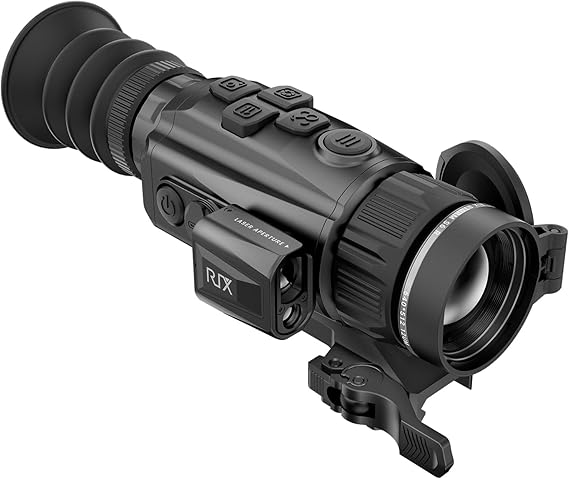
Great for long-distance spotting, the RIX Storm S6 R 12um 640 Thermal Scope delivers clear thermal images and precise ranging. Ideal for hunters and shooters requiring detailed visuals and reliable distance measurements in various conditions, its standout feature is the built-in laser rangefinder paired with a ballistic calculator that improves accuracy.
Setting up involves attaching the compact scope with the quick detach mount, taking no time thanks to its lightweight design. Daily use is straightforward, aided by the clear duplex reticle and a maximum 10x magnification that helps identify targets well beyond typical ranges.
The thermal sensor keeps details sharp even in humid weather, making image noise minimal and consistent during use.
Image quality stands out with reduced noise thanks to the <20 mK NETD rating and high-resolution thermal sensor. The rangefinder achieves precise distances up to 1,312 yards with an accuracy down to ±1.09 yards, supporting confident shots at long stretch. Well-built for regular rifle mounting, it balances functionality without weighing down the setup.
Some users find the 35 mm objective lens a bit limiting for low-light magnification needs.
The sharp thermal imaging combined with a high-precision rangefinder is its strongest advantage, delivering confidence when identifying and measuring distant targets. Meanwhile, some have noted the limited lens size can affect image brightness in certain conditions, slightly impacting the view quality at maximum zoom.
Those needing reliable, detailed thermal imaging with integrated ranging for rifles will find solid value here. Buyers prioritizing extremely high magnification or larger objective lenses for ultra-low light might want to explore alternative models better suited to those specific needs.
Pros
- Crisp thermal imaging even in humid conditions
- Compact laser rangefinder with long detection range
- Accurate ranging within ±1.09 yards
- Quick detach mount for easy setup
Cons
- Objective lens diameter may limit low-light performance
- Magnification capped at 10x might feel low for some scenarios
| Specification | Details |
|---|---|
| Magnification Maximum | 10 x |
| Objective Lens Diameter | 35 millimeters |
| Compatible Devices | Rifle |
| Mounting Type | Quick Detach Mount |
| Reticle Type | Duplex |
5. Leupold RX-1400I TBR/W Gen 2 Rangefinder

Crafted with a focus on durability and precision, the Leupold RX-1400I TBR/W Gen 2 is designed for serious hunters and shooters seeking dependable long-range ranging with ballistic calculations. Its biggest strength lies in delivering calculated, angle-compensated ranges to improve shot accuracy over varying distances.
Setup is straightforward, with selectable displays and adjustable brightness making it comfortable to use in changing light. Daily operation benefits from true ballistic range and wind technology, which provides hold points even in moderate crosswinds out to 800 yards.
The bow mode is a handy feature for archers, visualizing obstructions and adjusting for angles accurately.
Performance is notable thanks to its 1,400-yard max range on reflective targets and 1,200 yards on trees, covering most hunting scenarios. The build feels solid, reinforced for outdoor use, and features a TOLED display that ensures clear readings. Most praise revolves around its reliable ballistic data, while some mention the size as slightly bulky for all-day handheld use.
Precision in ballistic calculation stands out as the strongest praise while the unit’s bulkiness during longer handheld use is the most common complaint. Its ability to factor in wind and angles significantly aids shot accuracy across long distances.
Hunters and archers who rely on detailed ballistic data and need versatile ranging options will appreciate its features. Those prioritizing a compact, lightweight rangefinder for all-day carry may want to consider smaller alternatives.
Pros
- Accurate ballistic ranging with wind compensation
- Long range up to 1,400 yards on reflective targets
- Adjustable bright TOLED display for varying light
- Bow mode useful for archery angle adjustments
Cons
- Can feel bulky for extended handheld use
- Wind compensation limited to 10-mph at 90 degrees
| Specification | Details |
|---|---|
| Model Number | 183727 |
| Sport Type | Hunting |
| Ranging Distance | 1,400 yards on reflective objects, 1,200 yards on trees |
| Display | Selectable TOLED with adjustable brightness |
| Special Features | True Ballistic Range / Wind technology, Bow mode with Flightpath |
6. Vortex Venom First Focal Plane Riflescope

Sharpness and clarity stand out immediately on this scope, designed for serious long-range shooters and competition use. Its 5-25x magnification range packed into a 34mm tube means plenty of adjustment room, making it ideal for shots that demand precision and range estimation.
Setting up involves mounting via the cantilever style, which feels solid and secure. Daily handling benefits from the side knob parallax adjustment, easy to reach and read while aiming at varying distances.
The RevStop Zero System makes it fast to set zero and return to it reliably, which simplifies handling when changing targets or adjusting for wind shifts.
Optically, the XD system delivers impressive edge-to-edge sharpness and reduces chromatic aberration, so targets stay clear without color fringing. The scope offers a max elevation and windage of 85 MOA, plenty for long shots. The largest praise lies in its optical clarity and reliable zero return, while some note its size can feel a bit bulky on smaller rifles.
Reports consistently emphasize the superb optical clarity and fast zero reset as major advantages, making precise long-range shots more manageable. However, some find the scope’s size on smaller rifles less comfortable, and the eye relief requires steady positioning.
Those frequently shooting at extended ranges with competition or precision in mind will appreciate this scope’s features. Shooters with smaller rifles or who want a more compact setup might prefer something lighter or with shorter eye relief.
Pros
- Crystal-clear optics with reduced chromatic aberration
- Large 85 MOA turret travel for big adjustments
- Easy parallax adjustment with visible range numbers
- Reliable and quick return-to-zero system
Cons
- May feel bulky on smaller rifle setups
- Eye relief of 9.1 cm needs consistent cheek weld
| Specification | Details |
|---|---|
| Magnification Minimum | 5 x |
| Magnification Maximum | 25 x |
| Objective Lens Diameter | 5.6 centimeters |
| Eye Relief | 9.1 centimeters |
| Reticle Type | EBR-7C |
| Mounting Type | Cantilever Mount |
7. CVLIFE EagleBlaze 5-25×56 FFP Rifle Scope

Ideal for long-range hunting and competition, the CVLIFE EagleBlaze 5-25×56 FFP rifle scope stands out for its clear optics and precise ranging capabilities. It suits shooters who need accurate holdovers with variable magnification and reliable turret adjustments in varying light conditions.
Setting up on a Picatinny mount takes just minutes, and adjusting magnification from 5x to 25x is smooth and responsive. The Christmas-tree MOA reticle with six illumination levels makes spotting targets quick in daylight or low light.
Zero-stop and locking turrets deliver tactile clicks for consistent zero after each shot, making daily use straightforward and dependable.
Optical performance is sharp thanks to fully multi-coated Japanese ED glass, offering high light transmittance and minimal distortion across all zoom levels. The build feels sturdy and solid, with turrets that lock to prevent accidental shifts during recoil.
Most praise centers on clear sighting even at max zoom; common complaints mention the objective lens diameter being somewhat smaller than expected.
The scope’s clarity and precise holdovers get solid praise, especially under low-light conditions thanks to the illuminated reticle. Common concerns point to the relatively small objective lens which could limit light gathering in very dim environments.
Shooters needing dependable long-range accuracy and consistent zero retention will find it fitting. Those who value larger objective lenses for maximum brightness or a lighter total weight might want to explore other options.
Pros
- Clear optics with extra-low dispersion glass
- Illuminated reticle with 6 brightness levels
- Resettable locking turrets hold zero reliably
- Wide zoom range from 5x to 25x
Cons
- Objective lens only 34 millimeters in diameter
- May feel bulky for lighter rifles
| Specification | Details |
|---|---|
| Magnification Minimum | 5 x |
| Magnification Maximum | 25 x |
| Objective Lens Diameter | 34 millimeters |
| Reticle Type | Christmas-tree |
| Mounting Type | Picatinny Mount |
| Field Of View | 26.2 feet |
8. DISCOVERYOPT HD 5-30×56 GEN2 FFP Rifle Scope

Long-range shooting demands both clarity and precision in range and windage adjustments, especially for difficult shots. Perfect for shooters focused on extreme distances, the DISCOVERYOPT HD 5-30×56 GEN2 FFP Rifle Scope shines with its high magnification and reliable zero-stop turret system, making complex aiming simple and reliable.
Mounting on a Picatinny rail is straightforward with the solid 34mm main tube, which also allows for generous elevation and windage travel. Daily use benefits from the fully multi-coated lenses that provide excellent light transmission and clear, sharp images across all zoom levels from 5x to 30x. Adjustments come in precise 0.1 MRAD clicks, and the first focal plane reticle means ranging remains accurate at any magnification.
The scope performs well under demanding conditions, offering top-tier optical clarity and trustworthy turrets that reset to zero without confusion. Its durable build matches the needs of rugged long-range shooting. The best feedback highlights the crisp imaging and solid adjustment feel, while some mention the scope’s size and weight as a trade-off for its features.
The scope receives strong praise for delivering clear, sharp images that remain consistent at all magnifications. Its zero stop turrets provide confidence in long-range shots by enabling quick and reliable recalibration. Some users find the overall size and weight cumbersome during extended use, especially in mobile setups.
Shooters focused on precision long-range shooting who prioritize optical clarity and reliable adjustments will appreciate this scope. Those looking for a lighter, more compact scope for fast or close-range scenarios might want to explore alternatives with smaller tubes and less weight.
Pros
- Clear optics with edge-to-edge sharpness
- Precise 0.1 MRAD click turret adjustments
- Zero stop mechanism for quick return to zero
- Wide zoom range suitable for varied distances
Cons
- Scope size and weight can feel bulky
- Field of view narrows at highest magnification
| Specification | Details |
|---|---|
| Magnification Range | 5 x to 30 x |
| Objective Lens Diameter | 5.6 centimeters |
| Main Tube Diameter | 34 mm |
| Mounting Type | Picatinny Mount |
| Reticle Type | Mrad Ffp (first Focal Plane) |
9. AGM Global Vision Rattler V2 Thermal Scope

Detecting heat signatures up to 1,250 yards gives serious long-range hunters a powerful advantage. Designed for those who need clear thermal imaging at extended distances, this scope suits anyone ready for tracking at dawn, dusk, or night.
Its wide range and thermal clarity stand out as its biggest strengths.
Setting up is straightforward with a Picatinny mount, and the removable power system makes longer outings manageable. Two rechargeable batteries provide a combined runtime of up to 11.5 hours, so running out of power during important moments is less likely. Multiple reticle options and digital zoom let you tailor it quickly to your preference and conditions.
It performs solidly over wide distances thanks to the 25mm Germanium lens paired with magnifications from 3.5x up to 28x max. The stadiametric rangefinder built in helps you estimate distances quickly for more accurate shots.
The construction feels durable and purpose-built, capable of handling tough hunting environments. Most find the battery system convenient, but some users mention the overall weight could be lighter.
Many appreciate the long battery life and clear thermal imaging for extended hunts. On the downside, the scope’s weight can make it less comfortable to carry on long stalks. The removable power system and quick distance estimation tools consistently receive praise.
Hunters needing extended runtime and long-range heat detection will find this scope reliable. Those prioritizing lighter gear might prefer looking at other options with slimmer profiles and lower weight.
Pros
- Detects heat signatures up to 1,250 yards
- Two rechargeable batteries for 11.5 hours runtime
- Multiple reticle options for precision aiming
- Includes built-in stadiametric rangefinder
Cons
- The weight is heavier compared to some competitors
- May require adjustment to find ideal reticle quickly
| Specification | Details |
|---|---|
| Magnification Minimum | 3.5 x |
| Magnification Maximum | 28 x |
| Objective Lens Diameter | 25 millimeters |
| Field Of View | 37 |
| Mounting Type | Picatinny Mount |
10. Bushnell Match Pro Riflescope

Long-range shooters aiming for precise adjustments at extreme distances will appreciate the Bushnell Match Pro Riflescope. Its standout feature is the wide 5-30x magnification range combined with a 34mm maintube offering a vast 100 MOA elevation adjustment, ideal for reaching distant targets accurately.
Setting up the scope is straightforward with mounting designed for rifles and a wall mount option. The 56mm objective lens provides plenty of light, ensuring a clear sight picture during various lighting conditions. Its Deploy MOA 2 reticle with 11 brightness settings, including 2 for night vision, improves aiming clarity.
Battery saver automatically powers down after 6 hours, reducing the chance of dead batteries in the field. Eye relief at 3.8 feels comfortable for extended use.
The 34mm main tube’s generous windage and elevation adjustments make fine-tuning at long range practical. Construction feels solid and built to handle outdoor conditions. The clearest positive is the crisp reticle illumination and expansive magnification.
Most common drawbacks include the dial travel limits and weight, which some find slightly bulky for extended carry.
Reticle illumination and magnification range receive strong praise for clarity and flexibility under different conditions. Dial travel limits and weight are the main concerns, potentially impacting easy adjustments and portability.
Shooters who prioritize detailed long-distance aiming with clear optics will find it suits well. Those needing lighter gear for mobile situations might consider more compact options instead.
Pros
- Wide 5-30x magnification range
- Large 56mm objective lens gathers light well
- Deploy MOA 2 reticle with multiple brightness levels
- 100 MOA elevation and 50 MOA windage adjustment
Cons
- Dial travel limit can be restrictive
- Somewhat bulky for long carries
| Specification | Details |
|---|---|
| Magnification Minimum | 5 |
| Magnification Maximum | 30 |
| Objective Lens Diameter | 5.6 centimeters |
| Eye Relief | 3.8 |
| Reticle Type | Deploy MOA 2 |
| Elevation Adjustment Range | 100 MOA |
11. Vortex Triumph HD 3-9×40 SFP Riflescope

Ideal for hunters who want straightforward quality without complexity, the Vortex Triumph HD 3-9×40 SFP riflescope stands out with its sharp, clear HD glass that reduces color distortion. It’s designed to make ranging easier while staying user-friendly, especially for those upgrading their gear without needing complicated features.
Setting it up is simple thanks to the included 1 Hunter Rings with low height, making mounting quick and stable. It’s light enough to carry comfortably all day, and the neoprene case helps protect it when moving between spots.
The zoom range from 3x to 9x covers most typical hunting distances, while the Dead-Hold BDC reticle assists with bullet drop compensation, which feels practical right from the start.
The HD optical system delivers bright, crisp images edge to edge, even in low light conditions. The fully multi-coated lenses improve clarity significantly. The build quality feels solid, though some users note it’s not the most rugged scope for extreme rough handling.
It’s praised for excellent resolution and sharpness but can feel a bit basic compared to higher-end scopes in terms of advanced ranging capabilities.
The strongest point of this riflescope lies in its clear, bright view and consistent sharpness across the lens, making sighting easier in different light conditions. Common comments highlight a sturdy feel, though some find it less suited for extremely harsh environments or heavy use.
Hunters wanting a simple, reliable scope that improves accuracy at typical distances will appreciate it. Those needing advanced electronic ranging tools or rugged build for extreme conditions might want to explore other options better suited to specialized challenges.
Pros
- Clear HD optics with edge-to-edge sharpness
- Easy setup with included low-height rings
- Good low-light performance with anti-reflective coatings
- Protective neoprene case included
Cons
- Less durable under very rough handling
- Basic ranging features compared to premium models
| Specification | Details |
|---|---|
| Magnification Minimum | 3 x |
| Magnification Maximum | 9 x |
| Objective Lens Diameter | 40 millimeters |
| Mounting Type | Ring Mount |
| Reticle Type | Dead-Hold BDC |
12. M1000-PRO 2-10×42 Rifle Scope

Vortex M1000-PRO 2-10×42 Rifle Scope stands out with its Automatic Ranging Trajectory (ART) system that automatically adjusts elevation based on distance. Ideal for hunters and tactical shooters, it simplifies long-range shooting by removing guesswork during engagements from 200 to 1000 yards.
Setting up the scope is straightforward thanks to its integral mount and compatibility with most rifles. The 2-10x magnification offers flexibility for seeing targets clearly at both close and longer distances. The HR1 MOA reticle helps with quick range estimation and holdover, making daily shooting sessions more precise with less fiddling on the fly.
Performance is reliable as the ART system delivers accurate bullet drop compensation without manual inputs, which is a notable highlight. The scope feels solid and well-made, built for durability with useful magnification range and a clear 42mm objective lens. Most praise the accuracy the system provides, while some mention the weight could be a bit lighter for longer carry.
The ART system receives significant praise for delivering accurate bullet drop compensation automatically, which reduces the need for manual adjustments. Common feedback points to the scope’s weight as a drawback, particularly for extended use in the field.
Those focused on precise long-range shooting up to 1000 yards will find this scope helpful and reliable. Shooters seeking lighter options or magnifications beyond 10x might want to consider different models better suited for those needs.
Pros
- Automatic elevation adjustments from 200 to 1000 yards
- Clear 2-10x magnification range
- Intuitive HR1 MOA reticle for quick holdover
- Integral mount simplifies setup
Cons
- Heavier than some lightweight alternatives
- Limited to maximum 10x magnification
| Specification | Details |
|---|---|
| Magnification Minimum | 2 x |
| Magnification Maximum | 10 x |
| Objective Lens Diameter | 42 millimeters |
| Reticle Type | HR1 MOA |
| Mounting Type | Integral Mount |
| Compatible Devices | Rifle |
Best Long Range Scopes with Ranging Comparison Table
| Product | Magnification Range | Objective Lens Diameter | Compatible Devices | Mounting Type |
|---|---|---|---|---|
| Garmin Xero X1i Scope | 3.5x only | – | Cross Bow | Bow Mount |
| Burris Eliminator 6×52 | 4x-20x | 5.2 cm | Rifle | Integral/Dovetail/Weaver Mount |
| M1200 Art 6-24×50 | 6x-24x | 50 mm | Rifle | Integrated Mount |
| RIX Storm S6 Thermal | Up to 10x | 35 mm | Rifle | Quick Detach Mount |
| Leupold RX-1400I Rangefinder | – | – | Rangefinder | – |
| Vortex Venom FFP Scope | 5x-1x? | 5.6 cm | Rifle | Cantilever Mount |
| CVLIFE EagleBlaze 5-25×56 | 5x-25x | 34 mm | Rifle | Picatinny Mount |
| DiscoveryOpt HD Gen2 | 5x-30x | 5.6 cm | Rifle | Picatinny Mount |
| AGM Rattler V2 Thermal | 3.5x-28x | 25 mm | Rifle | Picatinny Mount |
| Bushnell Match Pro | 5x-30x | 5.6 cm | Rifle | Wall Mount |
| Vortex Triumph HD 3-9×40 | 3x-9x | 40 mm | Rifle | Ring Mount |
| M1000-PRO 2-10×42 | 2x-10x | 42 mm | Rifle | Integral Mount |
- Magnification Range3.5x only
- Objective Lens Diameter–
- Compatible DevicesCross Bow
- Mounting TypeBow Mount
- Magnification Range4x-20x
- Objective Lens Diameter5.2 cm
- Compatible DevicesRifle
- Mounting TypeIntegral/Dovetail/Weaver Mount
- Magnification Range6x-24x
- Objective Lens Diameter50 mm
- Compatible DevicesRifle
- Mounting TypeIntegrated Mount
- Magnification RangeUp to 10x
- Objective Lens Diameter35 mm
- Compatible DevicesRifle
- Mounting TypeQuick Detach Mount
- Magnification Range–
- Objective Lens Diameter–
- Compatible DevicesRangefinder
- Mounting Type–
- Magnification Range5x-1x?
- Objective Lens Diameter5.6 cm
- Compatible DevicesRifle
- Mounting TypeCantilever Mount
- Magnification Range5x-25x
- Objective Lens Diameter34 mm
- Compatible DevicesRifle
- Mounting TypePicatinny Mount
- Magnification Range5x-30x
- Objective Lens Diameter5.6 cm
- Compatible DevicesRifle
- Mounting TypePicatinny Mount
- Magnification Range3.5x-28x
- Objective Lens Diameter25 mm
- Compatible DevicesRifle
- Mounting TypePicatinny Mount
- Magnification Range5x-30x
- Objective Lens Diameter5.6 cm
- Compatible DevicesRifle
- Mounting TypeWall Mount
- Magnification Range3x-9x
- Objective Lens Diameter40 mm
- Compatible DevicesRifle
- Mounting TypeRing Mount
- Magnification Range2x-10x
- Objective Lens Diameter42 mm
- Compatible DevicesRifle
- Mounting TypeIntegral Mount
How to Choose the Right Long Range Scope
Choosing the right long range scope depends on clarity, accurate ranging capabilities, and durability to suit your shooting environment. Prioritizing these features ensures reliable performance, preventing costly mistakes and frustration during use. Selecting quality optics saves money and effort over time.
Optical Clarity and Magnification
Clear images at long distances depend heavily on the quality of the lenses and coatings. Scopes with well-made, multi-coated lenses reduce glare and improve light transmission, making the image brighter and sharper even in low-light conditions. A scope with poor coatings or cheap glass often leaves you struggling to see details or the reticle clearly.
Adjustable magnification is essential; typical ranges might span from 5x to 25x, letting you zoom in enough for precise shots without losing your field of view.
Field of view (FOV) matters more than many expect. A wider FOV helps track moving targets and speeds up target acquisition. Eye relief (distance eye can be from the scope and still get a full sight picture) of around 3 to 4 inches is common and crucial to avoid injury and maintain comfort during extended use.
Poor eye relief can cause difficulty aligning your eye to the scope or even bruising from recoil.
Rangefinding Accuracy and Features
Built-in rangefinders vary widely in accuracy and dependability. A precise rangefinder can distinguish yards or meters clearly at long distances, which is vital for making an accurate shot. Cheaper models often provide inconsistent readings or take longer to lock onto a target.
Some scopes add ballistic calculators or drop compensation to factor in bullet drop based on distance, making adjustments easier without manual calculations.
Switching between ranging modes or reading different data types should be quick and straightforward. Complex menus or small buttons can slow down the process when time is crucial. Look for scopes that let you toggle information displays or ranging modes with a couple of clicks and provide clear readouts, so you spend less time guessing and more time shooting.
Durability and Weather Resistance
Scopes used outdoors face rough handling and weather exposure. Durable materials like aircraft-grade aluminum help prevent dents or damage from falls and recoil. Water resistance is essential; IPX7 or IPX8 ratings mean the scope can handle rain and even immersion.
Fogproof scopes have nitrogen or argon purging to stop internal fogging when temperatures change quickly, which is common in cold or humid conditions.
Shockproof rating is crucial to ensure the scope holds zero and function after each shot, especially for powerful rifles. Extra features such as sunshades protect lenses from glare, and turret covers keep adjustment knobs free from dirt and accidental changes. These small protections make the difference over time when moving through brush or hunting in bad weather.
Power Source and Battery Life
Battery type affects how long the electronic features last in the field. Commonly used are CR2032 button cells or AA batteries. CR2032s tend to be compact but offer shorter runtimes, while AAs usually last longer and are easier to find in remote areas.
Battery life can run from 8 to 20+ hours depending on use and brightness settings of illuminated reticles or displays.
Replacing batteries quickly is important, and scopes with easy access compartments save time and frustration. Some models support USB recharging, which is handy if you carry external power banks, but this adds weight and complexity. Assess how long you’ll be using the scope without recharging options or replacements nearby and choose accordingly.
Mounting Compatibility and Adjustments
Compatibility with common mounting rails like Picatinny or Weaver is essential for fitting the scope to your rifle. Scopes that only fit proprietary mounts limit your options.
Precision turrets that click firmly on increments help dial corrections confidently, and repeatability ensures your adjustments stay consistent shot after shot.
Zeroing the scope should be straightforward, with turrets that allow resetting the zero without removing the scope. A scope that holds zero well under recoil saves you from repeated adjustments in the field. Loose or flimsy mounts or turrets cause frustration and missed shots due to shifting settings.
Understanding Ballistic Reticles for Enhanced Long-Range Accuracy
Ballistic reticles provide specific holdover points etched or illuminated into the scope’s lens, allowing shooters to compensate for bullet drop and wind drift without adjusting the turrets. These reticles are designed with calibrated hash marks or dots that correspond to various distances. Using them requires understanding the bullet trajectory for your specific load and rifle.
Once zeroed at a known range, you can use these reference points to aim accurately at targets beyond your zero distance.
Advantages of ballistic reticles include:
- Quick target engagement at multiple distances without adjusting the scope knobs.
- Ability to estimate range if the reticle is scaled for size references.
- Reduced time spent on calculations during critical shots.
Using a ballistic reticle effectively involves matching it to your ammunition’s ballistics. This makes them particularly useful in hunting and tactical shooting where timing and precision are crucial over long distances.
Proper Maintenance and Care Tips for Longevity of Long Range Scopes
Regular cleaning of lenses is essential to maintain clear sight pictures. Use a soft brush or air blower to remove dust before wiping with a microfiber cloth.
Avoid household cleaners as they can damage lens coatings.
Other key maintenance tips include:
- Check and tighten mounting screws periodically to maintain zero.
- Store the scope in a dry place to prevent moisture buildup inside lenses.
- Inspect the turrets and reticle for any signs of damage after rough use or transport.
Protective lens caps help prevent scratches during transport. For scopes with ranging abilities, ensure the ranging mechanism is kept free from dirt and debris to avoid errors in measurement.
Simple, regular upkeep can extend the functional life of a scope significantly.
Common Mistakes to Avoid When Using Scopes with Ranging Capabilities
Common mistakes include relying solely on ranging features without confirming zero or environmental factors. A ranging reticle can estimate distance, but it is not a substitute for actual distance measurements when possible.
Other frequent errors:
- Failing to account for wind, target movement, and temperature changes when calculating holdover adjustments.
- Not calibrating the ranging reticle for the specific ammunition used.
- Ignoring scope mounting alignment, which affects point of impact.
Assuming one setting fits all scenarios can lead to missed shots. Take time to practice with the scope in varied conditions and document the impact of different distances and environmental factors on accuracy.
People Also Asked
How Do I Properly Care for a Long Range Scope?
Clean the lenses carefully with a microfiber cloth and avoid touching them with fingers, which can leave oils behind. Store the scope in a dry place with caps on to protect it from dust and moisture. Regularly check the mounts to keep the scope secure and properly aligned.
What Size Scope Is Ideal for Long Range Shooting?
A scope with 10x to 15x magnification usually works well for long range shooting to balance clarity and field of view. Consider the objective lens size around 40mm to 50mm for enough light gathering without excessive weight. Choose a scope with turrets for precise adjustment.
Are Long Range Scopes Safe to Use in Wet Conditions?
Most good long range scopes have O-ring seals and nitrogen or argon purging to keep out moisture, making them safe for rainy or foggy conditions. Still, drying the scope after exposure prevents long-term damage. Use lens covers when not shooting to protect the glass.
How Compatible Are Long Range Scopes with Different Rifle Models?
Long range scopes with standard mount sizes like 30mm or 1 inch tube diameters fit most rifles but verifying compatibility before buying avoids issues. Some rifles, particularly certain bolt-actions or tactical styles, may require specific mounting systems. Using quality rings prevents wobble and keeps zero.
What Common Problems Should I Expect with Long Range Scopes?
Fogging inside the scope, loss of zero due to rough handling, and scratched lenses are typical problems. Regularly checking for moisture and ensuring mounts are tight can prevent larger issues. Avoid overtightening rings to not damage the scope tube.
Conclusion
The key things to focus on are the clarity of the optics, how accurate and easy the ranging feature is to use, and the durability of the scope under field conditions. Good build quality ensures the scope holds zero, while clear lenses help spot targets at long distances.
A reliable ranging system saves time and improves shot placement.
Choose a scope that fits your typical shooting environment and budget since features you won’t use often can add unnecessary cost. Check the comparison table above to weigh prices and features side by side, then review the picks for scopes matching your specific needs and preferences.