Top 12 Best Mobile Radio You Can’t Afford to Miss!
Running into communication issues during a long drive or emergency situation is all too common with cheap or poorly chosen radios. A best mobile radio can make those problems disappear, providing clear, reliable voice transmission even in areas with weak signal coverage.
Struggling with static, dropped calls, or limited range wastes time and could be dangerous, so picking the right device matters more than most people realize.
The most important factors for a good mobile radio include sufficient power output, solid build quality, and user-friendly controls. Radios with 25 watts or more typically offer a better range, especially when paired with a proper antenna. Durable materials and a weather-resistant design protect the unit inside a vehicle exposed to sun, dust, or moisture.
Easy-to-use buttons and a clear display make channel changes quick and reduce distractions while driving.
Need a Quick Check?
| Image | Product | Price |
|---|---|---|
Our Top Picks 1  | Retevis RT95 Mobile Radio | Check Price |
Our Top Picks 2  | ABBREE AR-8118 GMRS Radio | Check Price |
Our Top Picks 3  | Retevis RA86 GMRS Radio | Check Price |
Our Selected Top 12 Mobile Radio Worth Considering
This selection features a variety of mobile radios designed for different uses and preferences. Each product is assessed for performance, suitability, and key advantages and disadvantages, helping readers understand which options might best meet their communication needs.
1. Retevis RT95 Dual Band Mobile Radio
Feels compact and practical for vehicles like trucks or RVs, making communication straightforward on the move. Great for anyone needing reliable dual-band coverage with the option to set it up as a base station at home or the office.
The biggest strength lies in its clear sound delivery and strong signal reach over long distances.
Setup is simple enough, especially with vehicle power supplies and external antennas fitting right in. Adjusting the microphone gain helps keep conversations clear without static, while dual speakers deliver crisp audio. The RCA output allows connection to car audio systems, which gives a better listening experience around the vehicle.
Switching between two frequency bands is smooth, making daily communication convenient on different channels.
Performance does a solid job maintaining communication over distances up to 5 kilometers, which suits most outdoor or mobile uses. The compact size makes installation easy without taking up much space.
Build quality is adequate for vehicle use but it’s not water-resistant, so care is needed outdoors. Positive feedback highlights excellent sound clarity and long-range capability, while the most frequent issue is lack of water resistance, limiting rugged outdoor use.
Clear sound quality through dual speakers receives strong praise, making conversations easy to hear even in noisy vehicle environments. Common complaint centers on the lack of water resistance, which means extra caution is needed if used outdoors in bad weather.
People looking for a reliable, easy-to-use dual band radio for vehicle or base station will find it fitting well. Those needing waterproof radios or longer range might want to consider other options that match those specific needs better.
Pros
- Clear audio with built-in dual speakers
- Compact and easy to install in vehicles
- Supports 200 channels for versatile communication
- RCA output for in-car audio connection
Cons
- Not suitable for wet or rainy environments
- Limited to 5 kilometer maximum talking range
| Specification | Details |
|---|---|
| Frequency Range | 144-148Mhz/420-450Mhz |
| Number of Channels | 200 |
| Talking Range Maximum | 5 kilometer |
| Voltage | 13.8 volts |
| Water Resistance Level | Not Water Resistant |
| Connectivity Protocol | VHF, UHF |
2. ABBREE AR-8118 GMRS Mobile Radio
High power and wide channel range make it a solid choice for off-roading or farm communication. The ABBREE AR-8118 suits those needing reliable long-distance voice clarity without complicated setup. Its standout feature is strong clear transmission over 10 to 30 km depending on terrain and antenna.
Installation takes little time thanks to its compact design that fits well in vehicles. Using 200 different channels helps avoid interference when coordinating groups in logistics or rescue scenarios.
The built-in dual speaker with noise reduction keeps voices clear even in noisy environments. VOX hands-free feature adds convenience during tasks where hands are busy.
Up to 25W output ensures strong transmission across different landscapes, showing reliable performance in real-world use. Solid construction feels sturdy but it lacks water resistance, meaning extra care is needed in wet conditions. The main praise centers on crisp HD voice quality, while a recurring complaint mentions the need for an external antenna for best range.
The radio delivers sharp, understandable voice transmissions up to 30 km when paired with a good antenna setup. However, its lack of water resistance requires careful handling in damp or rainy conditions to avoid damage. This balance of strong audio and vulnerability points defines everyday use.
Anyone needing reliable, long-range mobile communication for outdoor or work-related use will find it meets expectations well. Those seeking a waterproof or fully weatherproof unit should look for alternatives better suited for harsh environments.
Pros
- Clear HD voice with noise reduction
- Wide 200 channel options
- Compact design ideal for vehicle use
- VOX hands-free communication
Cons
- Not water resistant
- External antenna often needed for max range
| Specification | Details |
|---|---|
| Max Power | 25W |
| Number of Channels | 200 |
| Frequency Range | 462MHZ-467MHZ |
| Water Resistance Level | Not Water Resistant |
| Connectivity Protocol | GMRS |
3. Retevis RA86 GMRS Mobile Radio
Retevis RA86 GMRS mobile radio features a durable, shockproof design meant for mounting under a seat or console. Best for outdoor enthusiasts like campers, hunters, or off-roaders who need reliable communication over longer distances using GMRS channels and repeaters.
Setup involves connecting the included USB cable to a PC to configure channels quickly with CHIRP software. The microphone controls all functions, so no need to reach for the main unit while driving. Buttons are large and easy to press, and the LCD has adjustable backlighting and brightness to suit different lighting conditions.
Voice Operated Transmission and weather alerts add convenience in daily use.
Communication stays clear over distances up to 5 miles, with access to 22 GMRS and 8 repeater channels helping extend reach. The build holds up well under rough conditions, thanks to its shockproof nature. The most praised aspect is the long-range clarity, while some users mention that the radio is not water resistant as a drawback.
Clear communication across a 5-mile range and easy channel setup via PC stand out as its biggest strengths. The lack of water resistance often comes up as a downside when used in wet environments.
The radio fits well for those needing dependable long-distance GMRS communication in dry conditions and quick configuration options. It may not be ideal for users requiring waterproof gear or those without a 13.8V DC power supply.
Pros
- Supports CHIRP for easy channel management
- Integrated control microphone for convenient use
- Shockproof construction suits rugged environments
- Multiple backlight and brightness settings on the display
Cons
- Not water resistant, limits outdoor exposure
- Requires external power source at 13.8 volts DC
| Specification | Details |
|---|---|
| Number of Channels | 30 |
| Talking Range Maximum | 5 mile |
| Voltage | 13.8 volts of direct current |
| Audible Noise | 45 db |
| Frequency Range | 462.5625MHz-462.725MHz, 467.5625MHz-467.725MHz |
4. Radioddity UB15-G GMRS Mobile Radio

Compact design with a full control microphone stands out immediately, suited for drivers who want easy access to controls without clutter. Its biggest strength lies in putting all settings within reach on the mic, which frees up space for mounting the main radio unit discreetly in a vehicle.
Setup involves mounting the compact radio body where it won’t get in the way, while the mic handles volume, channel selection, and menu controls. The numeric keypad and LCD sit right on the mic, making scanning and monitoring channels straightforward. It runs off 13.8 volts DC, typical in vehicles, and integrates noise reduction features that prove useful during daily communication.
Clear voice transmission shines thanks to transmit-side ANC, which cuts down background noise around the mic. Receive-side NRC also helps reduce incoming non-voice noise.
The radio does its job well over distances up to 15 miles. Its build emphasizes functionality over ruggedness, but note it’s not water resistant. Most applaud the mic control setup; some find the lack of water resistance a downside.
The full-control mic receives strong praise for letting users keep the compact radio unit out of the way while still having direct access to all important functions. The most often mentioned drawback is the lack of water resistance, which may limit use in harsher environments.
This radio suits people wanting clear communications and easy controls in a vehicle environment, especially those who value a small footprint. Anyone expecting rugged, weatherproof features should look at other options better suited for outdoor or rough conditions.
Pros
- Full control microphone for easy access
- Noise reduction on both transmit and receive
- Compact body fits neatly in vehicles
- Wide range of 80 channels available
Cons
- Not water resistant
- Limited to 13.8 volts DC operation
| Specification | Details |
|---|---|
| Number of Channels | 80 |
| Frequency Range | GMRS (TX & RX), UHF (RX) |
| Talking Range Maximum | 15 mile |
| Voltage | 13.8 volts_of_direct_current |
| Water Resistance Level | Not Water Resistant |
5. Radioddity DB20-G GMRS Mobile Radio

Great for anyone needing a reliable and long-range communication setup, this GMRS mobile radio connects easily across different brands and repeaters. Its biggest strength lies in user-friendly controls designed to be handled safely while driving, making it perfect for outdoor adventures or work on the road.
Setting it up is straightforward, just plug in and you’re ready to chat. The microphone combines all the control buttons, letting you adjust channels or volume with one hand.
The screen shows channel names, numbers, and frequencies, keeping everything visible without distraction. You can switch between GMRS, UHF, VHF, and NOAA with ease, which is handy throughout the day.
It does well in delivering clear voice communication over distances up to 20 miles in open air and about 10 miles in mountainous terrain. Built to handle water exposure, it holds up to outdoor conditions. Positive notes include its lightweight design and noise reduction feature.
The main complaint points to occasional complexity navigating all 500 channels, which can slow down choosing right away.
The easiest praised feature is the single-hand control microphone that helps drivers keep focus while adjusting channels. The most frequent complaint comes from dealing with so many channels, making quick changes slower than expected. Despite that, it remains effective for clear long-distance communication outdoors.
Anyone wanting a versatile radio for camping, offroading, or work will find this radio a solid choice. People needing a simpler interface or who cannot use a 13.8 volts power system should consider alternative models.
Pros
- Driver-friendly microphone with integrated controls
- Sync display with channel name and frequency
- Lightweight and water resistant design
- Supports GMRS, UHF, VHF, and NOAA bands
Cons
- Complexity in navigating 500 channels
- Limited to 13.8 volts power source
| Specification | Details |
|---|---|
| Number of Channels | 500 |
| Frequency Range | GMRS, UHF, VHF |
| Talking Range Maximum | 20 mile |
| Voltage | 13.8 volts_of_direct_current |
| Water Resistance Level | Water Resistant |
6. Midland MXT275 GMRS Two-Way Radio

Staying connected during outdoor adventures or long trips calls for a reliable mobile radio that can handle long distances. Suited for those who need clear communication over wide areas, this radio stands out for its impressive 50-mile maximum talking range, making it handy for off-road excursions or group travels.
Setup involves plugging into a 12-volt power source, common in vehicles, which means no frequent battery changes. It picks up 15 channels, allowing flexibility in crowded areas. Weather alerts keep you updated on conditions, useful when you’re out in nature.
Pairing with Midland FRS and GMRS radios makes coordinating with friends or family pretty straightforward.
Communication comes through clearly thanks to the UHF tuner and GMRS connectivity, making it suitable for various terrains. The design targets vehicle use, but it isn’t water resistant, so keeping it dry is crucial.
Based on reviews, the long range gets consistent praise, while the lack of water resistance is a frequent downside mentioned.
The standout feature is the extensive range of up to 50 miles, making it dependable for keeping in touch over large outdoor areas. However, its lack of water resistance means it needs to be protected from wet conditions to avoid damage.
Ideal for people who use a mobile radio primarily in vehicles where a 12-volt power source is available and who need reliable long-distance communication. Those who require a rugged, water-resistant radio for harsh environments might want to consider other models.
Pros
- Long 50-mile maximum communication range
- Works with Midland FRS and GMRS walkie-talkies
- Includes weather alert feature for safety
- Easy vehicle installation with 12-volt power supply
Cons
- Not water resistant, requires careful handling
- Uses nonstandard batteries, less convenient availability
| Specification | Details |
|---|---|
| Number of Channels | 15 |
| Talking Range Maximum | 50 miles |
| Voltage | 12 volts |
| Connectivity Protocol | GMRS |
| Tuner Type | UHF |
7. BTECH GMRS-50V2 GMRS Mobile Radio

50 watts of true GMRS power makes this radio a solid choice for anyone needing strong mobile coverage. Perfect for licensed GMRS users who want more range and more channels to organize their communications exactly how they like.
The ability to customize 256 channels is what stands out the most here.
Setup takes some time, especially with the software available online, but once configured, it fits neatly in a vehicle and runs on 13.8 volts. Quad Watch lets you keep track of four channels at once, so missing a call becomes less likely.
Handling NOAA weather alerts alongside your main communication channels keeps you prepared in any situation.
The radio performs well on GMRS, FRS, VHF, and UHF bands, with good water resistance for outdoor use. It’s built rugged enough for vehicle use, and users appreciate the repeater compatibility.
The most common complaint is the learning curve required to fully program and utilize all customization options.
Many users say the repeater-ready design and strong power output deliver dependable communication over long distances. The main difficulty lies in mastering the channel customization and software setup, which can be time-consuming and complex at first.
This radio suits people who need a powerful, flexible mobile unit for vehicle or property communication and are comfortable with technical setup. Those wanting straightforward plug-and-play operation might prefer simpler handheld radios without extensive channel programming.
Pros
- 256 fully customizable channels
- Quad Watch monitoring of four channels
- True 50W power for long range
- Water resistant for outdoor use
Cons
- Steep learning curve for programming
- Requires external power source (13.8 volts)
| Specification | Details |
|---|---|
| Number of Channels | 256 |
| Talking Range Maximum | 100 mile |
| Voltage | 13.8 volts |
| Power Output | 50W |
| Frequency Range | FM, UHF, VHF, NOAA, GMRS |
| Water Resistance Level | Water Resistant |
8. BTECH GMRS-50PRO GMRS Mobile Radio

Anyone with an FCC GMRS license looking for a radio to use in their vehicle or at a base station will find this model ideal. It handles up to 50 watts of power and focuses on quick mic control, making it easy to operate while on the move or when parked.
Installation involves wiring the radio directly to a vehicle’s 12 V power system using the included fused DC cable, without relying on a cigarette lighter plug. Day-to-day use is straightforward thanks to the mic-first interface and selectable power levels of 5, 25, or 50 watts, allowing for flexibility depending on the range needed.
It only transmits on GMRS channels and includes features like noise reduction and weather alerts, which are useful for various outdoor or travel scenarios.
Transmission quality on GMRS channels is clear and powerful within the allowed frequencies, especially on channels 15 through 30, including repeaters. Build quality feels solid and weather resistant, suitable for rougher environments. Users appreciate the long range capacity but often note the lack of an included antenna and no AC adapter, limiting immediate out-of-the-box use.
The interface’s focus on mic operation speeds up controlling the radio but may take some getting used to.
The radio stands out for its powerful GMRS transmission and easy mic control during use, which helps in staying connected on the go. A frequent downside is having to buy an antenna separately and the lack of an AC adapter, requiring additional setup for base use.
People who need a dedicated GMRS radio with high power for vehicle or base installation will like it. Those wanting a multi-band or plug-and-play option might look elsewhere, as it only works on GMRS and requires some extra gear to start operating.
Pros
- Strong transmission power up to 50W
- Mic-first operation for quick control
- Includes weather alerts for outdoor use
- Water resistant for durability
Cons
- Does not include an antenna or AC adapter
- Only transmits on GMRS channels
| Specification | Details |
|---|---|
| Number of Channels | 180 |
| Power Output | Selectable 5/25/50W |
| Voltage | 13.8 volts |
| Water Resistance | Water Resistant |
| Connectivity Protocol | Bluetooth, GMRS, GPS |
9. AT-778UVII Dual Band Mobile Radio

Known for its dual-band capability and adjustable power output, this model fits well for amateur radio operators who need flexible frequency ranges and decent power levels. Its biggest strength is the balance between multiple channels and clear communication control through mic gain settings.
Setup involves connecting to a 13.8-volt power source and familiarizing yourself with the distributed buttons that make operation straightforward. Day-to-day use benefits from 200 channel storage, letting you switch between frequencies without fuss. The VOX function helps with hands-free talk, and the mic gain adjustment allows you to dial in clarity depending on your environment.
Performance is solid with 25W output at maximum power, enough to communicate clearly within its 20-kilometer range. The unit is compact but not water resistant, so it needs some protection from elements.
Clear sound quality depends on setting mic gain correctly, with higher levels creating more noise. Users appreciate the signal options like CTCSS/DCS and DTMF but notice it lacks environmental durability.
The unit delivers strong sound with decent range when mic gain is set carefully, but raising mic gain too high introduces noticeable noise. Control layout supports quick channel changes and clear signaling through CTCSS/DCS and DTMF, making it sound-wise a useful tool for local contacts.
It suits hobbyists or those operating mobile radios in controlled environments, particularly where dual-band flexibility matters. People requiring waterproof devices or those who want perfectly noise-free voice at all times might want to consider alternatives with better environmental protection or built-in noise reduction.
Pros
- Dual-band coverage suits varied needs
- Adjustable mic gain for sound clarity
- Stores up to 200 channels
- VOX function enables hands-free communication
Cons
- Not water resistant, needs dry conditions
- Higher mic gain increases background noise
| Specification | Details |
|---|---|
| Frequency Range | 144-148MHz/420-450MHz |
| Output Power | 25W/15W/5W |
| Number of Channels | 200 |
| Voltage | 13.8 |
| Talking Range Maximum | 20 kilometer |
10. Radioddity DB40-G GMRS Mobile Radio
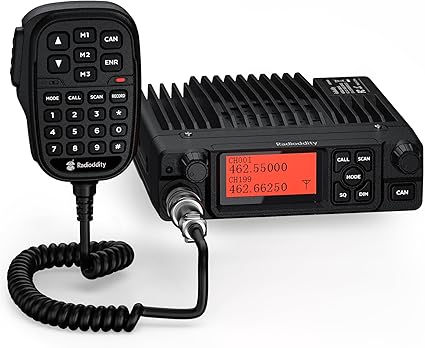
Radioddity DB40-G GMRS Mobile Radio delivers strong radio communication with up to 40 watts of power, making it ideal for off-roading and long-distance driving. Its biggest strength lies in maintaining clear connections up to 40 miles, even in remote locations where signal is usually weak.
Setting it up involves customizing up to 169 channels, so you can tailor it exactly to your communication needs. The digital display makes channel changes and adjustments straightforward during drives.
It supports GMRS repeater channels and has a DIY repeater option, which helps in adjusting connections on the go. Water resistance adds reliability in outdoor or wet conditions.
Performance-wise, the radio handles long-range communication well, providing consistent clarity in varied environments. It’s compact and holds up against the elements, though some find the volume controls a bit sensitive.
Power delivery matches the stated 40W, and it’s compatible with any GMRS or UHF device. The common praise highlights its effective range, while the typical complaint involves minor difficulties with tuning precision.
Most users appreciate the long communication range and clarity that holds up on remote trips. On the downside, some experience minor issues with tuning accuracy and sensitive volume adjustments. These quirks don’t affect overall usability but can take some getting used to.
This radio suits drivers and outdoor enthusiasts who need reliable, long-distance communication. Those needing ultra-precise tuning or simpler volume controls might want to look at different options. Its customizable channels and repeater support appeal to those looking for flexible use in varied conditions.
Pros
- Up to 40 watts output power for long range
- 169 fully customizable channels
- Supports GMRS repeater and DIY repeater channels
- Water resistant for outdoor use
Cons
- Volume controls can be too sensitive
- Tuning precision may require extra attention
| Specification | Details |
|---|---|
| Number of Channels | 199 |
| Output Power | Up to 40W |
| Talking Range Maximum | 40 mile |
| Frequency Range | GMRS (TX & RX) + UHF (RX Only) |
| Voltage | 13.8 volts |
| Water Resistance Level | Water Resistant |
11. Midland MXT500 GMRS Two-Way Radio

Using a Midland MXT500 GMRS Two-Way Radio feels like having a powerful communication tool at your fingertips, ideal for anyone needing reliable long-range contact. Its standout feature is the 50-watt power output that pushes communication farther than typical handheld radios, making it a solid choice for outdoor enthusiasts or business uses covering wide areas.
Setup is straightforward since it’s designed for in-vehicle use, requiring a 12-volt power source. The radio offers 99 channels, including 15 high-power GMRS frequencies that extend range significantly.
Features like weather alerts and 142 privacy codes help maintain clear conversations without interruption. Daily operation includes easy channel tuning, and the repeater capability boosts coverage where repeaters are available.
Performance-wise, it lives up to the expectation with a range that can reach up to 100 miles under ideal conditions, although actual distance varies with terrain and weather. Built to handle rugged use, it is waterproof and compatible with other Midland MXT series radios, supporting a versatile communication setup. The strongest praise highlights its power and range, while some users note the need for nonstandard batteries can be inconvenient.
Strong communication range stands out as the main appeal of this radio, able to cover distances up to 100 miles when conditions allow. The need for nonstandard batteries creates a common inconvenience during use, requiring extra attention to power sources.
Those needing solid, long-distance communication for outdoor or business settings will appreciate this radio’s power and features. Users looking for a simpler, more portable option might want to consider a lower-powered handheld model instead.
Pros
- 50-watt power for extended communication range
- Waterproof design provides weather durability
- 142 privacy codes reduce channel interference
- Compatible with multiple Midland radios
Cons
- Requires nonstandard batteries for operation
- Range depends heavily on environmental conditions
| Specification | Details |
|---|---|
| Number of Channels | 99 |
| Talking Range Maximum | 100 mile |
| Voltage | 12 volts |
| Water Resistance Level | Waterproof |
| Additional Features | Weather Alert, Repeater Capable, 142 Privacy Codes |
12. Retevis RA87 GMRS Mobile Radio

Great for anyone needing reliable long-range communication, this GMRS mobile radio is especially suited to off roaders, farmers, and outdoor lovers. Its strongest feature lies in extending communication with connectable relay stations and handling up to 200 memory channels for large groups.
Setting it up is straightforward with its digital display and dual-standby function, so you can keep an eye on two channels at once like convoy and emergency lines. The smart mic with noise suppression keeps things clear, even when things get loud.
Managing channels is simple, thanks to built-in support for Chirp programming which helps customize frequencies efficiently.
Performance-wise, the radio delivers a solid talking range of up to 10 miles on GMRS frequencies, maintaining audio clarity with voice companding technology. It handles heat well due to its aluminum substrate, making it stable during extended use. The typical praise revolves around clear sound quality, while some find the water resistance level could be better for tougher weather conditions.
Communication stays clear with professional voice companding and mic gain noise suppression, even in noisy environments. The water resistance helps but can limit use in heavy rain or full submersion. Users commonly praise the clear sound and dual channel monitoring while wishing for stronger water protection.
Ideal for outdoor enthusiasts looking for solid range and channel management in good weather. Those needing waterproof radios or longer range beyond 10 miles in tough environments should consider other options.
Pros
- Can connect to 8 relay stations for longer range
- Dual-display lets you monitor two channels simultaneously
- Noise-suppressing mic for clear audio in noisy places
- Supports up to 200 memory channels
Cons
- Water resistant but not fully waterproof
- Maximum 10-mile range may fall short in obstructed areas
| Specification | Details |
|---|---|
| Number of Channels | 30 |
| Talking Range Maximum | 10 mile |
| Voltage | 13.8 volts_of_direct_current |
| Water Resistance Level | Water Resistant |
| Temperature Range | -20℃~+60℃ °C |
Comparison of Top Mobile Radios Reviewed
| Product | Channels | Range | Water Resistance | Voltage |
|---|---|---|---|---|
| Retevis RT95 Mobile Radio | 200 | 5 km | Not Water Resistant | 13.8 V |
| ABBREE AR-8118 GMRS Radio | 200 | – | Not Water Resistant | – |
| Retevis RA86 GMRS Radio | 30 | 5 mile | Not Water Resistant | 13.8 V |
| Radioddity UB15-G GMRS Radio | 80 | 15 mile | Not Water Resistant | 13.8 V |
| Radioddity DB20-G GMRS Radio | 500 | 20 mile | Water Resistant | 13.8 V |
| Midland MXT275 GMRS Radio | 15 | 50 miles | Not Water Resistant | 12 V |
| BTECH GMRS-50V2 Mobile Radio | 256 | 100 mile | – | 13.8 V |
| BTECH GMRS-50PRO Mobile Radio | 180 | – | Water Resistant | 13.8 V |
| Baofeng AT-778UVII Radio | 200 | 20 km | Not Water Resistant | 13.8 V |
| Radioddity DB40-G GMRS Radio | 199 | 40 mile | Water Resistant | 13.8 V |
| Midland MXT500 GMRS Radio | 99 | 100 mile | Waterproof | 12 V |
| Retevis RA87 GMRS Radio | 30 | 10 mile | Water Resistant | 13.8 V |
- Channels200
- Range5 km
- Water ResistanceNot Water Resistant
- Voltage13.8 V
- Channels200
- Range–
- Water ResistanceNot Water Resistant
- Voltage–
- Channels30
- Range5 mile
- Water ResistanceNot Water Resistant
- Voltage13.8 V
- Channels80
- Range15 mile
- Water ResistanceNot Water Resistant
- Voltage13.8 V
- Channels500
- Range20 mile
- Water ResistanceWater Resistant
- Voltage13.8 V
- Channels15
- Range50 miles
- Water ResistanceNot Water Resistant
- Voltage12 V
- Channels256
- Range100 mile
- Water Resistance–
- Voltage13.8 V
- Channels180
- Range–
- Water ResistanceWater Resistant
- Voltage13.8 V
- Channels200
- Range20 km
- Water ResistanceNot Water Resistant
- Voltage13.8 V
- Channels199
- Range40 mile
- Water ResistanceWater Resistant
- Voltage13.8 V
- Channels99
- Range100 mile
- Water ResistanceWaterproof
- Voltage12 V
- Channels30
- Range10 mile
- Water ResistanceWater Resistant
- Voltage13.8 V
How to Choose the Best Mobile Radio
Choosing the right mobile radio means focusing on range, durability, and ease of use to ensure reliable communication in various conditions. Paying attention to compatibility and power options helps avoid costly upgrades and maintenance, saving both money and frustration over time.
Transmission Power and Range
Strong transmission power is crucial when communicating across long distances or through obstacles such as hills or buildings. Radios with low maximum output can result in weak or unclear signals, causing dropped messages or static interference. Having a unit that offers around 25 to 50 watts of power typically covers most mobile needs, but the actual range varies widely based on terrain and environmental factors like dense forests or urban structures.
Adjustable power levels make a big difference day to day. Lower settings conserve battery life during short-range use, while higher power ensures your signal gets through in challenging conditions. This flexibility helps balance energy consumption and communication reliability, beneficial for users who switch between local area communication and wider coverage.
Frequency Compatibility
Communicating effectively depends on matching the radio to the frequency bands used by your group or network. Some radios only cover VHF or UHF bands, which limits their compatibility. A device supporting both bands allows smooth interaction with a larger variety of radios and systems.
Multiband capability extends usefulness in mixed environments, such as switching from rural areas (often VHF) to urban zones where UHF performs better. Checking the exact supported frequencies ensures your radio won’t be isolated from others.
This is particularly important for emergency situations or coordinated activities requiring different channels.
User Interface and Controls
Radios with simple, well-arranged controls are easier to use during movement or under pressure. Buttons that are too small or poorly spaced cause fumbling, especially when wearing gloves or driving. Clear labeling and tactile feedback in controls improve quick operation without looking.
Readable displays in bright sunlight or dim conditions are vital for checking channels and settings reliably. Programmable buttons and presets streamline frequent channel switching, saving time and minimizing distraction by allowing one-touch access to commonly used functions.
Durability and Build Quality
Devices designed with durable materials resist common hazards like shocks, drops, and constant vibration in vehicles. A radio rated IP67 or similar ensures protection from dust and water, preventing failures during outdoor or harsh-condition use.
Metals or reinforced plastics in the casing improve long-term resilience. Radios lacking sufficient build quality often develop loose buttons, cracked screens, or internal damage, leading to costly repairs or replacements. Choosing a sturdy model improves reliability across years of daily operation.
Power Source and Battery Life
Battery life directly impacts how long you can stay connected without interruption. Units with around 2000 to 3000 mAh batteries often provide several hours of continuous use, but this varies based on transmit power and screen usage.
Knowing your average daily usage guides proper battery capacity choice.
Having easy access to spare batteries or fast charging options helps maintain operations during extended outings. Integration with vehicle power sources or external adapters prevents downtime when stationary. Portable radios without these options require cautious management of battery levels to avoid unexpected loss of communication.
Optimizing Mobile Radio Performance in Different Environments
Signal strength depends heavily on the surroundings where the mobile radio is being used. Urban areas with tall buildings can cause signal reflection and interference, which might reduce communication clarity. On the other hand, open rural areas typically offer better reception but may suffer from dead spots due to long distances from repeater stations.
Consider mounting location when installing the radio and antenna for optimal performance. A higher, unobstructed placement usually improves both transmission and reception.
Using a quality antenna suited to the radio frequency also makes a considerable difference.
- Test various mounting spots to identify the clearest reception area.
- Keep antenna cabling as short as possible to minimize signal loss.
- Use shielded cables or connectors to prevent external interference.
Adjusting power output can be helpful in overcoming interference, but higher power settings might lead to quicker battery drain.
Essential Maintenance Practices to Extend Your Mobile Radio’s Lifespan
Dust and moisture are common threats to mobile radios, especially for those used outdoors or in vehicles. Regularly cleaning the exterior and connection points prevents corrosion and maintains signal integrity.
Inspect the microphone, speaker, and control knobs frequently to catch any wear or damage early. Loose connections or damaged cables often cause poor audio or intermittent operation.
- Remove dirt and grime with a soft, dry cloth; avoid harsh chemicals.
- Check and tighten mounting brackets and screws to prevent vibration damage.
- Store the radio in a dry place when not in use to avoid moisture buildup.
Periodic software or firmware updates from the manufacturer may fix bugs and improve compatibility. Follow recommended calibration schedules if available to keep the radio functioning accurately over time.
Comparing Mobile Radios with Alternative Communication Devices
Mobile radios differ from other communication tools like smartphones or satellite phones in their reliability and network independence. They work well in areas without cellular coverage because they use dedicated radio frequencies and repeaters.
Two-way radios provide instant communication without dialing, which is crucial for quick exchanges in emergencies or group operations. Battery life often surpasses that of smartphones since radios are designed to handle long talk and standby times.
- Smartphones depend on cell towers and can lose service in remote locations.
- Satellite phones offer global coverage but tend to be more expensive and bulkier.
- Mobile radios are usually more durable and resistant to rough handling.
For teams working together on-site or in environments with unreliable cellular networks, mobile radios offer a dependable and straightforward communication method.
People Also Asked
How Do I Choose the Right Size Mobile Radio for My Vehicle?
Choose a mobile radio that fits the available dashboard or mounting space in your vehicle. Measure the area to avoid buying a unit too tall or wide. Also, consider the control head’s ease of reach while driving for safe operation.
What Safety Features Should I Look for in a Mobile Radio?
Look for radios with emergency alert buttons and built-in noise reduction. These features improve communication clarity during critical moments. A model with a VOX function can allow hands-free use, which helps maintain attention on the road.
How Long Do Mobile Radios Typically Last with Regular Use?
Mobile radios generally last between 5 to 10 years with regular use. Proper installation and avoiding moisture exposure can extend the radio’s life. Regularly checking connections helps prevent signal issues over time.
Are Mobile Radios Compatible with All Types of Antennas and Vehicles?
Most mobile radios are compatible with standard antennas and vehicles but check the connector type and power requirements. A high-quality antenna matched to the radio’s frequency band improves reception significantly. Different vehicles may require different mounting kits.
What Are Common Problems to Watch Out for in Mobile Radios?
Common problems include poor reception due to antenna issues and interference from other electronics. Loose wiring or damaged connectors can cause dropped signals. Installing a good antenna and securing all connections often prevents these issues.
Conclusion
Range, durability, and ease of use stand out as the key factors when choosing a mobile radio. The unit needs to cover the distances you expect to communicate across without dropping signal. It also has to handle the environment where it will be used, from a vehicle interior to rough outdoor settings.
Simple controls and a clear display can make a big difference, especially if you are operating the radio while driving or in a busy situation.
Select a radio that fits comfortably in your vehicle or space and matches your budget. Think about how often you plan to use it and choose accordingly to avoid spending on features you won’t need.
The comparison table and detailed descriptions earlier will help you see which options meet these practical needs without excess. Take a look back there before making your choice.