
Top 10 Best Monocular Range You Can’t Miss Today
Getting a clear, steady view far away can be frustrating when using a cheap or poorly designed monocular. Many struggle with blurry images, short viewing distances, or uncomfortable grips. The best monocular range solves these problems by offering crisp images even at long distances, usually between 6 to 12 times magnification, without making the device bulky or hard to hold.
Key factors that separate the best monocular range from mediocre ones include lens quality, size and weight, and waterproofing. High-quality glass with multi-coated optics improves clarity and brightness while keeping the device compact.
A monocular around 4 to 7 ounces balances portability with durability. Weatherproof seals or waterproofing ensure it can handle outdoor conditions without fogging or damage, which is essential for reliable use in the field.
Need a Quick Check?
| Image | Product | Price |
|---|---|---|
Our Top Picks 1  | TOPDON TS004 Thermal | Check Price |
Our Top Picks 2  | SVBONY SV28 Spotting Scope | Check Price |
Our Top Picks 3  | Bushnell Legend 10×42 | Check Price |
Our Selected Top 12 Monocular Range Worth Buying
This selection features a variety of monocular ranges designed for different uses and skill levels. Each review covers performance, ideal users, and key advantages and disadvantages to help readers choose the best option based on their specific needs and preferences.
1. TOPDON TS004 Thermal Imaging Monocular
Built with a monocentric lens and manual focus, the device suits outdoor enthusiasts needing clear thermal imaging for spotting targets in the dark. Its biggest strength lies in delivering vivid images with a high IR resolution of 256×192, helping you see precise thermal details even in challenging conditions.
Setup is straightforward since it runs on a single lithium-ion battery included in the package. Day-to-day use benefits from an 11-hour battery life, so you don’t have to keep recharging during long excursions.
Pairing it with your smartphone is simple through the TopInfrared App, letting you view live thermal images directly on your phone screen for easier monitoring.
The 13-millimeter lens combined with 8x zoom captures detailed thermal visuals reliably. The 50Hz refresh rate keeps the images smooth and responsive. While the build feels solid and durable, one common drawback mentioned is the manual focus, which may slow quick adjustments.
The standout feature is its ability to deliver sharp, clear thermal pictures consistently.
The thermal images are sharp and vivid thanks to the high IR resolution, making spotting targets straightforward. Users frequently note the manual focusing slows down changes, which can be inconvenient in fast-moving scenarios. Battery life supports long sessions without worry, adding to the device’s strength.
Anyone exploring or tracking in low light who values image clarity and long operation time will appreciate this monocular. Those needing faster autofocus or a wider field of view might want to look at other options to meet different needs.
Pros
- Clear thermal images with 256×192 IR resolution
- Long 11-hour battery life for extended use
- Easy wireless connection to smartphone app
- Compact and solid build suitable for outdoors
Cons
- Manual focus can be slow for quick adjustments
- Field of view limited to 13.5 degrees
| Specification | Details |
|---|---|
| Eye Piece Lens Description | Monocentric |
| Focus Type | Manual Focus |
| Power Source | Battery Powered |
| Number of Batteries | 1 Lithium Ion batteries required. (included) |
| Zoom Ratio | 8x |
| Field Of View | 13.5 degrees |
2. SVBONY SV28 Spotting Scope 25-75×70
What stands out immediately on the SVBONY SV28 Spotting Scope is the flexible 25-75x zoom, which suits anyone starting out with birdwatching or scenic observation. Its simple focus and magnification adjustments make it ideal for users needing clear views without the fuss.
Setting up requires a tripod or another mount, as the equatorial mount helps keep the scope steady. The manual focus is straightforward to adjust, and the zoom eyepiece lets you smoothly switch between wide views and detailed close-ups. The built-in sunshade keeps glare manageable on sunny days, while the non-slip finish holds well even when your hands are wet.
With its 70mm objective lens, the scope brings in plenty of light for bright images. The FMC coating improves clarity, and waterproofing means it resists sudden weather changes.
Most praise highlights its easy-to-use zoom and solid image quality. Some note the manual focus takes some getting used to and wish for a bit more stability without a tripod.
The scope receives praise for its strong zoom range and clear viewing thanks to the 70mm lens and FMC coating. Reviewers commonly mention that manual focusing requires patience and control to nail sharp images, especially at higher magnifications.
Those seeking a beginner-friendly scope for birding or scenery will find satisfaction here. However, anyone wanting quick autofocus or a built-in tripod should consider alternatives that offer those features out of the box.
Pros
- Easy zoom from 25x to 75x magnification
- Waterproof design for outdoor use
- Non-slip finish for secure grip
- Built-in sunshade reduces glare
Cons
- Manual focus can feel tricky at times
- Needs tripod for best stability
| Specification | Details |
|---|---|
| Zoom Ratio | 3:1 |
| Focal Length | 380 millimeters |
| Field of View | 64 feet |
| Objective Lens Diameter | 70mm |
| Mount Type | Equatorial Mount |
| Coating | FMC |
3. Bushnell Legend 10×42 Tactical Monocular
Perfect for outdoor enthusiasts and tactical users, this monocular stands out with its MIL-HASH reticle that makes range estimation and wind adjustment straightforward. Compact but powerful, it offers a clear edge when precision is a priority in varying light conditions.
Setting up involves just adjusting the twist-up eyecup and manually focusing, which is straightforward during quick scans in the field. Its rubber armor assures a firm grip even when moving around, while the flat dark earth color helps it blend into tactical environments. Carrying it around feels natural thanks to its lightweight and compact size.
Clarity remains strong in low light thanks to the ED Prime Glass and multi-coated lenses, supporting accurate observation and targeting. The rugged construction holds up well against rough handling and weather, being both waterproof and fog proof.
Some mention the manual focus requires a steady hand for fast adjustments, but most agree it performs reliably under different conditions.
Many find the optical clarity and tactical reticle outstanding for estimating distances and aiming. The most frequent drawback mentioned is needing patience when adjusting focus manually, which can slow down fast-paced use.
Those needing detailed, steady observation and some mounting options will appreciate this monocular’s design and optics. Users looking for quicker autofocus might want to explore other options better suited to rapid target acquisition.
Pros
- MIL-HASH reticle for precise targeting and range estimations
- Waterproof and fog proof in various weather conditions
- Lightweight design with secure rubber grip
- Bright, high-clarity optics with multi-coated lenses
Cons
- Manual focus can be slow for quick target changes
- Requires tripod for stable long-range viewing
| Specification | Details |
|---|---|
| Zoom Ratio | 10 multiplier_x |
| Eye Piece Lens Description | Twist-up eyecup design |
| Field Of View | 340 feet |
| Mount | Tripod Mount |
| Coating | Fully Multi-coated |
| Focus Type | Manual Focus |
4. RIX Titan-T6 Thermal Monocular LRF 35mm

Tracking wildlife or pinpointing targets on variable terrain calls for a sturdy, reliable device that combines thermal sighting with precise distance measuring. The RIX Titan-T6 Thermal Monocular LRF suits outdoorsmen and tactical users needing clear thermal images plus distance data, its biggest strength lying in the integrated ballistic calculator and laser rangefinding up to 1312 yards.
Setting it up is simple since the monocular uses manual focus and mounts on an altazimuth stand. Day-to-day use takes advantage of its 35mm lens paired with image stabilization and retained image technology, helping you get clear details in different environments. The built-in laser rangefinder and ballistic calculator make measuring distance and adjusting shots straightforward without extra gadgets.
Performance-wise, the Titan-T6 provides a sharp 1920×1080 OLED display that is 2.5 times sharper than standard models, improving visibility for long-range spotting. The 640×480 resolution sensor with a 12μm pixel pitch detects heat signatures up to 1818 yards away.
Reviews note the clear imaging and useful ballistic data, though some find manual focus tricky under fast-moving situations. The build stands up well to rough conditions but requires care with lens cleaning.
The most praised features include the sharp OLED display combined with ballistic calculation, which provides critical distance and targeting info all in one device. The common drawback centers on the manual focus, which some find tricky when needing quick adjustments on moving targets.
Anyone who prioritizes long-range accuracy and detailed thermal imaging will find this a powerful tool. It may not suit users looking for fully automatic focusing or extremely rapid target acquisition in dynamic conditions. Those users might consider models with autofocus for easier handling.
Pros
- Integrated ballistic calculator for precise shooting
- High resolution 1920×1080 OLED display
- Laser rangefinder detects distances up to 1312 yards
- Advanced electronic image stabilization included
Cons
- Manual focus can be challenging during fast action
- Requires careful lens cleaning to maintain clarity
| Specification | Details |
|---|---|
| Objective Lens | 35mm |
| Resolution | 640×480 |
| Display | 1920×1080 0.49-inch OLED |
| Laser Rangefinder Distance | Up to 1312 yards |
| Detector Pixel Pitch | 12μm |
| Mount | Altazimuth Mount |
5. High Power 8×42 Monocular Telescope
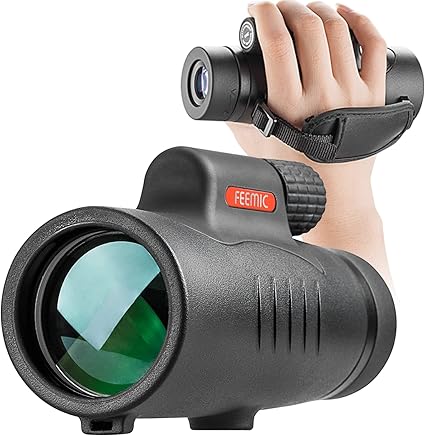
8X magnification with a 42mm wide lens delivers clear views up to 360ft at 1000 yards, perfect for anyone who needs a reliable and sharp monocular outdoors. Its standout feature is the large field of view combined with HD clarity, making spotting distant objects easier and more enjoyable during hikes or birdwatching.
Manual focus lets you quickly sharpen your view, and the built-in lens dust cover keeps the optics clean while out in the elements. Setup is straightforward with no batteries needed.
The rubber finish adds grip and shock resistance, so carrying it or handling it in rough conditions feels secure. Its compact size fits well in hand or backpack without extra fuss.
The monocular delivers crisp images thanks to fully multi-coated BAK-4 prisms and precise glass optics. The build is solid with waterproof, fogproof, dustproof, and shockproof protection, making it durable for outdoor use.
Most users praise its brightness and clarity, while some mention manual focusing requires a bit of patience to get perfect sharpness.
Many find the optics impressively sharp and bright with natural colors, ideal for outdoor activities. The main frustration experienced is the manual focus, which takes patience especially when trying to lock onto fast or distant targets quickly.
This monocular suits people who want a sturdy, clear viewing device for hiking, birdwatching, or casual spotting. Those needing fast autofocus or variable zoom might want to look elsewhere.
Pros
- Wide and clear 360ft field of view
- All-glass optics with BAK-4 prism
- Waterproof, fogproof, dustproof, shockproof
- Rubber finish for secure grip
Cons
- Manual focus can be slow for moving subjects
- No built-in zoom adjustment beyond 8X
| Specification | Details |
|---|---|
| Magnification | 8X |
| Objective Diameter | 42mm |
| Field Of View | 360 degrees |
| Focus Type | Manual Focus |
| Coating | Fully Multi-Coated |
6. Vortex Solo 10×36 Monocular

People who want a compact and reliable monocular for outdoor adventures like hiking or birdwatching will appreciate its sharp 10x magnification paired with a 36mm lens. Its best feature is the clear and crisp image quality made possible by fully multi-coated lenses, which really helps when viewing distant objects.
Setup is straightforward since the monocular has manual focus and an adjustable eyecup that feels comfortable whether or not you wear glasses. The small size and lightweight design make it easy to carry around all day.
The rubber armor offers a secure grip and durability, while a multi-position utility clip allows attaching it quickly to your clothing or gear.
Viewing through this monocular delivers bright, detailed images thanks to increased light transmission from multiple anti-reflective coatings. It performs well even in damp or foggy conditions because it is nitrogen purged and o-ring sealed for waterproof and fogproof protection.
The most common praise highlights its clear visuals and tough build. Some users note the focus adjustment requires patience to get just right for distant objects.
Highly praised for its bright, crisp visuals in varying light thanks to multi-coated lenses and waterproof design. Some find the manual focus needs careful adjustment, which can slow down spotting quickly moving subjects.
Great for those needing a small, sturdy monocular that holds up in challenging weather and offers strong magnification. Users seeking faster focus or a wider field of view might look at other models.
Pros
- Clear images from multi-coated lenses
- Durable rubber armor for grip and protection
- Lightweight and compact for easy carrying
- Adjustable eyecup comfortable with or without glasses
Cons
- Manual focus takes time to fine-tune
- Field of view narrower than some competitors
| Specification | Details |
|---|---|
| Magnification | 10x |
| Objective Lens | 36mm |
| Field Of View | 6.2 degrees |
| Focus Type | manual focus |
| Waterproof/Fogproof | Yes, nitrogen purged and o-ring sealed |
7. RIX Pocket K2 Thermal Monocular

Lightweight and highly portable, the RIX Pocket K2 Thermal Monocular fits comfortably in a pocket, making it perfect for quick outdoor use. It stands out for its impressive thermal sensor resolution that detects subtle temperature changes, ideal for hikers, hunters, or explorers needing reliable night vision on the go.
Setting up involves simply inserting the included lithium-ion battery and powering on. The focus is fixed, so you won’t need to constantly adjust while using.
Its pocket-sized design weighs less than most smartphones, so carrying it throughout the day feels natural. The OLED display offers sharp contrast and clear details, even in fast-moving scenes, supported by electronic image stabilization to keep the view steady.
Performance delivers clear thermal imaging thanks to the 256×192 sensor and high refresh rate of 50Hz, enabling crisp visuals in various weather conditions. The fully multi-coated lens and IP67 waterproof rating ensure solid durability outdoors.
Most praise centers on its light weight and clear image quality, while some mention the fixed focus limits sharpness beyond a certain range.
The monocular delivers impressive thermal image clarity with a sharp and bright OLED display, praised for detecting slight temperature variations easily. Some find the fixed focus design restricts detail when viewing objects far away, which can affect continuous use in dynamic environments.
Those seeking a compact, pocket-friendly thermal device for outdoor activities will appreciate this model’s weight and waterproof design. Users needing adjustable focus for varying distances might want to consider other options with manual focusing capabilities.
Pros
- Very lightweight, lighter than a smartphone
- High-contrast 800×600 OLED display
- IP67 waterproof for rugged use
- Electronic Image Stabilization included
Cons
- Fixed focus limits sharpness at varying distances
- Single battery operation may limit usage time
| Specification | Details |
|---|---|
| Resolution | 256×192 |
| Display | 800×600 OLED |
| Sensor Size | 12μm |
| Focus Type | Fixed Focus |
| Field of View | 19.4 degrees |
| Power Source | 1 Lithium Ion Batteries (included) |
8. 12×50 High Power Monocular with Phone Adapter
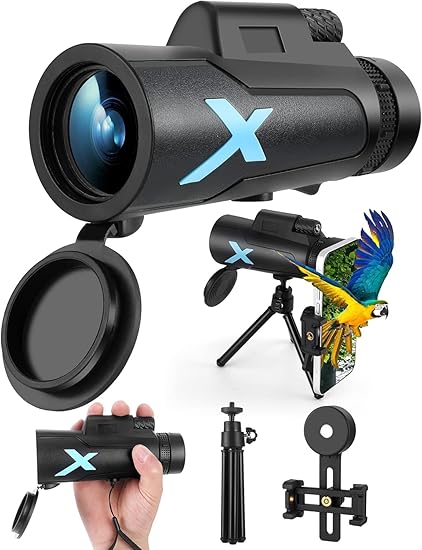
12×50 High Power Monocular with Phone Adapter offers impressive 12x magnification and a wide 6.5° field of view, ideal for anyone who enjoys outdoor activities like bird watching or travel. Its biggest strength lies in its bright, clear images thanks to the large 53mm objective lens and advanced coatings.
Setting up is straightforward since it comes handheld but also works with a tripod thanks to a standard 1/4-inch thread. Manual focusing lets you quickly lock onto subjects, and the adjustable eye relief means you can use it comfortably with or without glasses. The included phone adapter makes snapping distant photos easier, making it practical every day whether hiking or at a concert.
Image quality stands out due to the Fully Multi-Coated green film optics combined with the BAK4 prism lens, providing high contrast and color accuracy. The build feels solid yet lightweight enough to carry for hours without strain.
Most praise notes excellent clarity and comfort for prolonged use, though some mention the manual focus might require practice for fast adjustments.
Praise centers on the sharp, high-contrast images delivered by the BAK4 prism and multi-coated optics, making extended viewing comfortable without dizziness. Some find the manual focus takes getting used to when wanting quick adjustments during active use.
Those seeking a clear, bright image for outdoor activities will appreciate this monocular, especially with its phone adapter and tripod compatibility. Users who demand rapid focus changes might want to consider alternatives with autofocus or faster adjustment mechanisms.
Pros
- Bright and clear images with large 53mm lens
- Comfortable to use with adjustable eye relief
- Phone adapter included for easy photography
- Tripod mount option adds stability
Cons
- Manual focus can be slow to adjust
- May require steady hands without tripod
| Specification | Details |
|---|---|
| Magnification | 12x |
| Objective Lens Diameter | 53mm |
| Field of View | 6.5 degrees |
| Focus Type | Manual Focus |
| Coating | Fully Multi-coated (fmc) Green Film Optical Lens |
| Mount Compatibility | Handheld, Tripod-adaptable (1/4-inch Thread) |
9. RIX Titan-T3 Thermal Monocular LRF 25mm

Using the RIX Titan-T3 feels like having a high-tech spotting scope in a compact monocular form. Perfect for outdoor enthusiasts needing both thermal imaging and distance measurement, its standout strength is the built-in laser rangefinder combined with a ballistic calculator that takes serious guesswork out of long-range viewing.
Setting it up is pretty straightforward with manual focus and a single lithium-ion battery. The 25mm lens and 10-degree field of view make scanning surroundings comfortable in day-to-day use.
Features like smart image stabilization and one-hand operation keep the experience smooth when tracking moving targets or checking distances without fumbling through complicated controls.
The olive display with 1920×1080 resolution really sharpens up the thermal images compared to other monoculars. Detection reaches out to 1421 yards, which suits extended outdoor use.
Its solid build resists rough handling well, though some users mention the manual focusing can be a bit fiddly when moving fast. The integrated laser rangefinder and ballistic calculator bring powerful tools typically reserved for larger setups into a handheld device.
High resolution and integrated ballistic calculator earn strong praise for serious spotting needs. The manual focus, however, is frequently mentioned as tricky when quick adjustments are necessary.
Those focused on precision spotting and rangefinding will appreciate the powerful features here. Users needing faster autofocus or more ergonomic comfort over long sessions might want to consider other monoculars.
Pros
- 1920×1080 OLED display with sharp images
- Integrated ballistic calculator for precise targeting
- Long detection range up to 1421 yards
- One-hand operation with smart stabilization
Cons
- Manual focus requires careful adjustment
- Compact size may reduce comfort for extended viewing
| Specification | Details |
|---|---|
| Objective Lens | 25mm |
| Display | 1920×1080 0.49-inch OLED |
| Resolution | 384×288 |
| Rangefinder Distance | Up to 1312 yards |
| Field Of View | 10 degrees |
| Battery Type | 1 Lithium Ion (included) |
10. Pulsar Telos LRF Thermal Monocular

Perfect for serious hunters, the Pulsar Telos LRF Thermal Monocular delivers sharp thermal imaging with a built-in rangefinder, making it easier to spot targets in low light or darkness. Its main strength lies in offering clear images combined with precise distance measurement, ideal for outdoor use in challenging environments.
Setup is straightforward, powered by a single included battery that keeps the unit running throughout excursions. Manual focus allows precise adjustment, while the nonslip rubber grip feels comfortable and secure in hand, no matter which hand holds it.
The ability to connect with a smartphone adds convenience for sharing or analyzing visuals.
Performance is solid thanks to Pulsar’s advanced Image Boost Technology, which improves clarity and detail under tough conditions. The design is rugged and ergonomic, built to handle rough handling and extreme weather. The most frequent praise highlights image clarity and rangefinding accuracy, while some reviews note occasional difficulty fine-tuning the manual focus quickly.
Image clarity and accurate distance measurement receive high praise for helping hunters track targets better at night or in poor visibility. Common complaints mention the manual focus taking time to dial in, which can slow down fast-paced use.
Hunters wanting clear thermal imaging combined with reliable rangefinding will appreciate this device’s performance. Those seeking quick autofocus or extended battery options may want to explore other monoculars better suited to those needs.
Pros
- Clear thermal images with advanced image boost technology
- Built-in rangefinder for precise distance measurement
- Ergonomic, nonslip rubber housing feels secure
- Compatible with smartphones for added convenience
Cons
- Manual focus can be tricky to adjust quickly
- Battery relies on a single specific product-specific cell
| Specification | Details |
|---|---|
| Focus Type | Manual Focus |
| Power Source | Battery Powered |
| Number of Batteries | 1 Product Specific battery (included) |
| Zoom Ratio | 3-12x |
| Additional Features | Built-In Rangefinder, Portable, Thermal Imaging |
11. AGM Fuzion Thermal Imaging Monocular

Built with a focus on durability and precision, the AGM Fuzion Thermal Imaging Monocular suits night hunters and outdoor enthusiasts who need accurate distance measurement in the dark. Its laser rangefinder combined with dual-spectrum imaging is its biggest strength, offering reliable target detection in multiple conditions.
Setting up involves inserting the included lithium-ion battery and pairing with Wi-Fi enabled devices or mounting on a standard tripod. The wide-field eyepiece and fixed focus design make day-to-day viewing comfortable without frequent adjustments.
Switching between thermal, visible light, and fusion modes lets you adapt to different lighting and weather situations easily.
Performance is solid thanks to the 12m high-sensitivity thermal detector, delivering clear images at night. Its durable waterproof construction stands up well to outdoor use. Praise concentrates on the sharpness and accuracy of the OLED display and laser rangefinder, while some mention the fixed focus can limit close-up clarity.
The OLED display and laser rangefinder deliver sharp, precise images and measurements, making it excellent for night tracking. A common complaint is the fixed focus, which can reduce clarity when observing objects too close to the device. Still, it performs well under varied outdoor conditions.
Those requiring reliable thermal imaging with a dependable rangefinder for night hunting will appreciate this monocular. People needing adjustable focus or greater zoom for very distant targets should consider other options that better fit those specific needs.
Pros
- Accurate laser rangefinder for night distance measurement
- Clear 1024 x 768 OLED display with wide FOV eyepiece
- Multiple imaging modes for different environmental conditions
- Waterproof design with long battery life
Cons
- Fixed focus limits sharpness at very close range
- Zoom only up to 8x might not suit distant target needs
| Specification | Details |
|---|---|
| Eye Piece Lens Description | wide-field |
| Focus Type | Fixed Focus |
| Zoom Ratio | 1x-8x |
| Number of Batteries | 1 Lithium Ion battery required (included) |
| Mount | Altazimuth Mount |
| Focal Length Description | 25 millimeters |
12. ATN BlazeHunter Pro Thermal Monocular

Sharp thermal imaging stands out immediately, making it ideal for hunters and outdoor enthusiasts who need clear detection in any light. Its biggest strength lies in the pro-grade vanadium oxide sensor that captures tiny temperature differences, offering exceptional image clarity.
Setting up takes just a moment thanks to the fixed focus at 35 millimeters and a straightforward interface. Day-to-day use benefits from the bright 0.41-inch OLED display that shows detailed images in full color at 1440×1080 resolution. The built-in rangefinder and 8x zoom make spotting and tracking easier on the go, while the lightweight, compact design fits comfortably in a pocket or pack.
Performance is impressive with crystal-clear thermal views picked up by the low NETD <18mK sensor. The build feels solid yet portable, which is handy when moving through tough terrain.
Most praise centers on image detail and recording features, while some users mention the limited 10-degree field of view as a potential drawback during wide-area scanning.
The crisp image detail and video recording stand out as major positives, making it great for detailed scouting. However, many users find the limited field of view less ideal for quickly scanning large areas.
This device suits those who prioritize image sharpness and portability over wide viewing angles. People needing broader landscapes covered might want to explore other options.
Pros
- Exceptional thermal clarity with NETD <18mK
- High-resolution 1440×1080 OLED display
- Video recording of thermal observations
- Lightweight and easy to carry
Cons
- Narrow 10-degree field of view
- Fixed focus limits manual adjustment
| Specification | Details |
|---|---|
| Focus Type | Fixed Focus |
| Focal Length Description | 35 millimeters |
| Field Of View | 10 degrees |
| Zoom Ratio | 8 |
| Additional Features | Built-In Rangefinder, Compact Design, Lightweight, Portable |
Best Monocular Range Comparison Table
| Product | Power Source | Focus Type | Compatible Devices | Additional Features |
|---|---|---|---|---|
| TOPDON TS004 Thermal | Battery Powered | Manual Focus | Smartphone | – |
| SVBONY SV28 Spotting Scope | – | Manual | Camera, Tripod | Waterproof |
| Bushnell Legend 10×42 | AC/DC | Manual Focus | Monopods, Tripods | Fully Multi-coated |
| RIX Titan-T6 Thermal LRF | – | Manual Focus | – | Laser Rangefinder & Ballistic |
| High Power 8×42 Monocular | Manual Power | Manual Focus | Camera, Smartphone | Fully Multi-Coated |
| Vortex Solo 10×36 | Battery Powered | Manual Focus | Clothing, Equipment | Anti-reflective coatings |
| RIX Pocket K2 Thermal | Battery Powered | Fixed Focus | Smartphone | Fully Multi-Coated |
| High Power 12×50 Phone Adapter | No Battery | Manual Focus | – | Adjustable Eye Relief |
| RIX Titan-T3 Thermal LRF | Battery Powered | Manual Focus | – | OLED Display |
| Pulsar Telos LRF Thermal | Battery Powered | Manual Focus | Smartphone | Built-In Rangefinder |
| AGM Fuzion Thermal Monocular | Battery Powered | Fixed Focus | Wi-Fi Devices, Tripod | Zoom Ratio 1x-8x |
| ATN BlazeHunter Pro Thermal | – | Fixed Focus | Smartphone, Tablet | Built-In Rangefinder |
- Power SourceBattery Powered
- Focus TypeManual Focus
- Compatible DevicesSmartphone
- Additional Features–
- Power Source–
- Focus TypeManual
- Compatible DevicesCamera, Tripod
- Additional FeaturesWaterproof
- Power SourceAC/DC
- Focus TypeManual Focus
- Compatible DevicesMonopods, Tripods
- Additional FeaturesFully Multi-coated
- Power Source–
- Focus TypeManual Focus
- Compatible Devices–
- Additional FeaturesLaser Rangefinder & Ballistic
- Power SourceManual Power
- Focus TypeManual Focus
- Compatible DevicesCamera, Smartphone
- Additional FeaturesFully Multi-Coated
- Power SourceBattery Powered
- Focus TypeManual Focus
- Compatible DevicesClothing, Equipment
- Additional FeaturesAnti-reflective coatings
- Power SourceBattery Powered
- Focus TypeFixed Focus
- Compatible DevicesSmartphone
- Additional FeaturesFully Multi-Coated
- Power SourceNo Battery
- Focus TypeManual Focus
- Compatible Devices–
- Additional FeaturesAdjustable Eye Relief
- Power SourceBattery Powered
- Focus TypeManual Focus
- Compatible Devices–
- Additional FeaturesOLED Display
- Power SourceBattery Powered
- Focus TypeManual Focus
- Compatible DevicesSmartphone
- Additional FeaturesBuilt-In Rangefinder
- Power SourceBattery Powered
- Focus TypeFixed Focus
- Compatible DevicesWi-Fi Devices, Tripod
- Additional FeaturesZoom Ratio 1x-8x
- Power Source–
- Focus TypeFixed Focus
- Compatible DevicesSmartphone, Tablet
- Additional FeaturesBuilt-In Rangefinder
How to Choose the Right Monocular Range
Focus on factors like magnification, lens quality, and durability, as these determine clarity and ease of use in different conditions. Choosing the right specifications ensures reliable performance, preventing costly replacements and frustration from unsuitable features.
Optical Quality and Coatings
A monocular with poorly coated lenses can produce distracting glare, making it difficult to focus on distant objects clearly. Lens coatings play a crucial role in reducing reflections and improving light transmission, which directly affects the accuracy of colors and overall image clarity. Without proper coatings, images often appear washed out or suffer from reduced contrast.
The quality of the optical glass itself largely determines how sharp and detailed the view will be. Low-grade glass introduces distortions and softens edges, which is noticeable during activities like birdwatching or target spotting.
Monoculars that use roof prisms with fully multi-coated lenses tend to provide the best sharpness and resolution. Look for terms like “low-dispersion glass” or “ED glass” that indicate better control over color fringing and image fidelity.
Build and Durability
Sturdy construction using materials such as aluminum or magnesium alloy helps withstand impacts without adding excessive weight. Plastic housings might save money but often sacrifice durability, especially in rugged outdoor use. Besides hardness, a good build will include rubber armor or textured surfaces to improve grip and protect from bumps.
Waterproofing and fog proofing are essential when using the device outdoors in varying weather. Sealed O-rings and nitrogen or argon purging prevent internal moisture buildup, maintaining clear internal optics regardless of rain or humidity.
Comfort during extended use depends on good ergonomics, monoculars that fit well in the hand, offer easy adjustment rings, and maintain balance reduce fatigue when holding steadily for long periods.
Rangefinding Capability and Accuracy
Distance measurement accuracy can vary widely between models. A reliable rangefinder quickly locks onto targets, providing exact readings within a few meters over its full range.
Any lag or inconsistent measurements become frustrating during activities like hunting or golfing, where timing and precision matter.
Rangefinders typically offer minimum effective distances around 5 to 10 meters and maximum capabilities from 500 up to 1200 meters depending on the device. The ideal choice depends on the typical target size and environment.
For small or camouflaged objects, a finer resolution in rangefinding is important, while general spotting requires less precision but longer maximum distance.
Ease of Use and Controls
Controls that are responsive and straightforward make operation easier, especially outdoors when quick adjustments are necessary. Buttons should be tactile and spaced enough to handle without looking, even when wearing gloves.
Confusing menus or poorly labeled buttons slow down use and lead to errors.
The display visibility is critical in different lighting conditions. Bright, high-contrast screens or simple readouts help maintain quick readability under direct sunlight or low light. Portability depends on the weight and size; a compact model weighing around 200 to 300 grams fits well in a pocket or camera bag, yet still feels stable in hand.
Bulky or heavy units may offer features but at the cost of comfort during prolonged use.
Maximizing Accuracy: Tips for Using Monoculars in Varied Environments
Monoculars deliver the best performance when held steadily and aimed carefully. Stability is crucial since even small hand movements can blur the view, especially at higher magnifications.
Using a tripod or resting your arm on a solid surface can reduce shaking and improve clarity.
Environmental conditions affect image quality. Haze, fog, rain, and bright sunlight can all reduce contrast and visibility.
Adjust the focus slowly and carefully to compensate for different lighting and distances. In low light, choosing a monocular with a larger objective lens allows more light to enter, improving image brightness.
For different terrains and uses, keep these practical tips in mind:
- In wooded areas, scan slowly and focus on moving subjects at mid-range distances.
- Open fields favor longer ranges but require good atmospheric conditions for clear images.
- Urban settings may involve closer distances where a wide field of view helps.
Adjusting your technique based on environment can make a significant difference in spotting accuracy.
Comparing Monoculars to Binoculars: When to Choose Each for Optimal Viewing
Monoculars and binoculars offer different advantages depending on the viewing situation. Monoculars are compact and lightweight, making them easier to carry on long hikes or when packing light is necessary.
They are also quicker to bring to the eye for a fast glance.
Binoculars provide better depth perception and a wider field of view because you use both eyes. This makes them preferable for prolonged observation sessions or when scanning wide areas, such as birdwatching from a fixed location.
Choosing between the two depends on:
- Portability: Monoculars are advantageous if space and weight are limited.
- Comfort: Binoculars reduce eye strain during extended use by balancing the weight between both eyes.
- Viewing needs: For detailed close-up viewing, binoculars often perform better.
Both serve well for long-range spotting, but the decision rests on how and where you plan to use them.
Proper Cleaning and Maintenance Techniques to Extend Monocular Lifespan
Maintaining a monocular properly extends its usability and keeps images clear. Use a soft lens cloth or lens cleaning tissue to remove dust and smudges, avoiding excessive pressure that could damage coatings.
Compressed air can blow grit off lenses without touching them, which helps prevent scratches. Avoid touching the lens surface with fingers as oils can degrade optics over time. When cleaning the body, a damp cloth is usually sufficient; harsh chemicals can damage finishes and seals.
Regular upkeep also involves:
- Storing it in a dry place to prevent internal fogging and mold growth.
- Keeping the monocular in a protective case during transport.
- Checking moving parts like the focus wheel for debris and smooth operation.
Routine care ensures the monocular remains reliable, producing sharp images for years.
People Also Asked
How Do I Properly Clean and Care for My Monocular?
Use a soft microfiber cloth to clean the lenses and avoid touching them with fingers. Regularly check for dust and moisture, and store the monocular in a case to prevent scratches when not in use. Avoid using harsh chemicals or paper towels as they can damage the lens coating.
What Size Monocular Is Best for Easy Outdoor Use?
A monocular around 6 to 8 inches long strikes a good balance between portability and image clarity. Smaller ones fit easily in pockets but may offer less comfort during extended use. Choose one with a grip or textured surface to help hold it steady outdoors.
Are Monoculars Safe to Use in Bright Sunlight?
Monoculars are safe for regular viewing even in bright sunlight but never look directly at the sun through the lens. Doing so can cause serious eye damage. Use a sunshade or angle the monocular to avoid glare for better image quality.
How Long Does a Typical Monocular Last with Regular Use?
A well-made monocular can last several years under normal outdoor use without issues. Regularly clean the lenses and avoid dropping it to extend its lifespan. Water-resistant or waterproof models tend to hold up better in rough conditions.
What Are Common Problems When Using a Monocular Rangefinder?
Common problems include difficulty focusing on distant objects and shakiness that makes images blurry. Lack of proper eye relief for eyeglass wearers can cause discomfort. Using a tripod or stabilizer can improve stability, and adjusting the focus slowly helps get a clear image.
Conclusion
Choosing a monocular range mainly comes down to accuracy, ease of use, and durability. A device that provides clear readings quickly will save time and reduce frustration.
Also consider how it feels in your hand and if it holds up well outdoors; these factors affect how often you’ll want to use it.
Think about where you’ll use the monocular and how much you’re willing to spend. Matching the device to your specific needs ensures better satisfaction.
Revisit the comparison table and earlier picks to find a balance between features and price that fits your situation.


