Top 10 Best MW Radios You Can’t Miss Buying Today
Cheap or poorly made MW radios often struggle with weak signals and noisy reception, especially in areas with lots of interference or distant stations. The slow tuning response and short antenna length can make it frustrating to lock onto the right frequency.
For anyone who regularly uses radios to catch news, weather updates, or talk shows, these common issues turn what should be a simple listening experience into a constant hassle. Finding the best MW radios means avoiding that interference and getting clear, stable sound without fuss.
One key factor in a good MW radio is the antenna size and design; an effective ferrite rod antenna around 6 to 8 inches long significantly improves signal reception. Power source options matter too, radios powered by reliable DC adapters or long-lasting batteries avoid downtime during outages.
Finally, a radio that tunes easily and accurately with a smooth dial or digital tuner makes changing stations faster and less frustrating. These details combine to make a radio practical for everyday use, not just for casual listening but for dependable reception in any situation.
Need a Quick Check?
| Image | Product | Price |
|---|---|---|
Our Top Picks 1  | CHOYONG LC100 Radio | Check Price |
Our Top Picks 2  | SANGEAN ATS-909X2 Radio | Check Price |
Our Top Picks 3  | UV-98PLUS Ham Radio | Check Price |
Our Selected Top 10 Mw Radios Worth Buying
This list features reliable medium wave radios that vary in features and design to meet different needs. Each review covers how well the radio performs, its ideal users, and highlights both strengths and potential drawbacks to help you make an informed choice.
1. CHOYONG LC100 Multi-Band Smart Internet Radio
CHOYONG LC100 Multi-Band Smart Internet Radio offers an impressive mix of traditional and modern radio features. Ideal for listeners who want access to both local AM/FM and thousands of global internet stations.
Its single biggest strength is the ability to stream over 5G Wi-Fi, eSIM, or 4G SIM, giving you access to over 50,000 radio stations and 40 million podcasts anywhere.
Setting it up is straightforward, especially with built-in voice search for stations and podcasts. The LCD display makes navigating through radio bands and internet stations easy. Daily use involves switching between FM, LW, MW, SW, and SSB analog radio and internet streaming without hassle.
Sound settings like treble and bass adjustments let you tailor audio to your liking. Bookmarking favorites is just one tap away, making repeated listening simple.
The radio performs well for both analog and internet reception, giving clear, noise-free audio thanks to a high-performance chip and adjustable bandwidth. Its solid build includes an external antenna port to improve signal strength. Strong praise focuses on the wide selection of stations and reliability of connections.
Some notes mention the dependence on a single AAA battery that might require frequent replacement.
Many praise the extensive range of global stations and stable streaming through different wireless networks. A common downside is the reliance on a single AAA battery, which can lead to frequent replacements during active use.
Those who want a combination of internet radio and traditional multi-band analog radio will find this radio a versatile companion. Users looking for a simpler, less feature-heavy device or longer battery life might want to consider alternative options.
Pros
- Access to 50,000+ global radio stations and podcasts
- Adjustable bandwidth and signal readout for analog bands
- Supports multiple connectivity options including 5G Wi-Fi
- Voice search simplifies finding stations and podcasts
Cons
- Uses a single AAA battery that may drain quickly
- Complexity of features might overwhelm some users
| Specification | Details |
|---|---|
| Radio Bands Supported | MULTI-BAND |
| Connectivity Technology | 2.4Wi-Fi, 4G network, 5GWi-Fi, Bluetooth, eSIM |
| Power Source | Battery Powered (1 AAA included) |
| Audio Output Mode | Stereo |
| Additional Features | Recording, Treble and Bass Adjustment, Voice search |
| Display Type | LCD |
2. SANGEAN ATS-909X2 Multi-Band Radio
Radio listening becomes a detailed and organized experience with the SANGEAN ATS-909X2, ideal for those wanting access to a wide range of frequencies. Its biggest strength is the vast station presets and memory banks that let you store many favorites across multiple bands with ease.
Setting up involves straightforward tuning options including direct frequency input and manual or automatic scanning. Daily use benefits from memory recall and fine tuning that make switching stations easy.
The built-in rechargeable option means it can be portable, while an LCD helps with clarity. Modifying settings for different time zones and DST keeps it accurate for frequent travelers or those monitoring world broadcasts.
Reception across AM/FM/SW/LW/AIR bands is precise thanks to the dual conversion and DSP tuner. The plastic build feels sturdy and the controls are tactile without being fragile. Praise often goes to the multitude of tuning methods and extensive presets.
A noted downside relates to the weight and size, making it less pocket-friendly than smaller radios.
Many find the wide frequency range and detailed tuning options outstanding for serious radio listening. Most common complaints mention the weight and size making it less convenient for casual portability. The vast presets and precise reception appeal to those spending time monitoring multiple bands regularly.
Anyone wanting a feature-rich multi-band radio with memory and tuning flexibility will appreciate this model. Those needing a compact, lightweight radio for casual or outdoor use might want to look at smaller, water-resistant options.
Pros
- Extensive presets with 3 memory banks
- Multiple tuning methods including fine and quick shift
- Supports five radio bands including Air Band
- Rechargeable and portable with built-in AM antenna
Cons
- Relatively bulky and heavier than typical portable radios
- Not water resistant, limiting outdoor use in wet conditions
| Specification | Details |
|---|---|
| Radio Bands Supported | AM/FM/SW/LW/AIR |
| Frequency Range | Up to 137 MHz (Air Band Mode) |
| Power Source | Corded Electric/Battery (4 AA batteries) |
| Audio Output Mode | Stereo |
| Display Type | LCD |
| Connectivity Technology | Auxiliary |
3. UV-98PLUS GPS APRS 10W Ham Radio Walkie Talkie
Great for outdoor enthusiasts and ham radio users, this walkie talkie shines in GPS tracking. Its standout strength is the accurate GPS positioning with APRS, helping keep track of locations and coordinate easily on the go. Perfect for camping or group activities needing reliable location updates.
Setup is straightforward, requiring a single 9V battery included in the box. Daily use focuses on GPS features and simple one-touch operation to record your route manually or on a timer. The cross-band repeater allows smooth communication across UHF and VHF bands, which comes in handy when in areas with varied signals.
It stores 1024 channels, giving plenty of options for tuning in.
Performance meets expectations with a solid 10 km range and dependable water repellency to handle outdoor conditions. The build feels durable but is lightweight enough for carrying over long periods.
Most praise goes to the accuracy and usefulness of GPS and APRS tracking features. The most common complaint touches on the power source relying on a single 9V battery, which might limit operation time compared to rechargeable models.
Accurate GPS positioning with APRS integration is the most praised feature, enhancing navigation and team coordination. Common complaints highlight the limited operation time due to reliance on a single 9V battery, which may need frequent battery changes during heavy use.
Ideal choice for users needing precise outdoor navigation and communication through multiple frequency bands. Those looking for longer battery endurance or fully waterproof options might want to explore alternatives better suited to extended or rougher use.
Pros
- Accurate GPS and APRS tracking
- Cross-band repeater for UHF and VHF
- 1024 available channels
- Water-repellent for outdoor use
Cons
- Uses single 9V battery limiting battery life
- Water resistance not full waterproof
| Specification | Details |
|---|---|
| Number of Channels | 1024 |
| Talking Range Maximum | 10 km |
| Voltage | 9 volts |
| Water Resistance Level | Water Repellent |
| Number of Batteries | 1 9V batteries required. (included) |
4. Raddy RF780 Portable Shortwave Radio
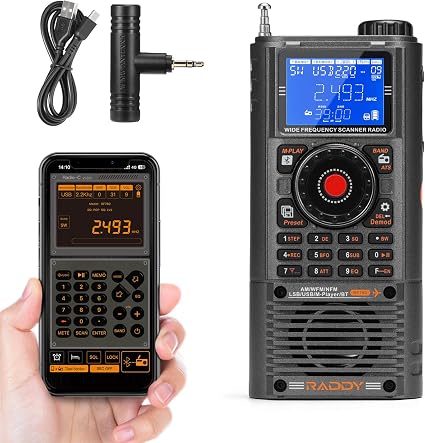
Compact and lightweight, the Raddy RF780 Portable Shortwave Radio is designed for those who want a broad range of bands in one handy device. Its biggest strength lies in the full numeric keypad with shuttle tuning, making frequency changes fast and accurate without hunting through presets.
Setting up requires minimal effort since the rechargeable battery is included and the lightweight body makes it easy to carry around. Day-to-day use benefits from the direct frequency input and smooth micro-step tuning, perfect for quickly locating stations across eight bands. The pluggable ferrite bar antenna helps with indoor MW reception, and Bluetooth connectivity lets you pair it with smartphones for added convenience.
Performance shines in clarity across FM, MW, SW, and even single sideband modes thanks to fine BFO tuning. The build feels sturdy for a portable radio, though some users find the display less bright in strong light. Most praise the range of bands and tuning precision, while the common drawback is the occasional difficulty reading the STN display outdoors.
Most find the tuning options and band coverage excellent for a portable radio, letting them pick up distant shortwave stations with clarity. Complaints focus on the STN display brightness, which sometimes makes it difficult to see the screen outdoors or in bright rooms.
People looking for a versatile shortwave radio with easy frequency control will appreciate this model. Those who need a brighter display for outdoor use or extended battery life might want to consider other options.
Pros
- Direct numeric keypad for quick frequency entry
- Supports single sideband with fine BFO tuning
- Pluggable ferrite bar antenna improves indoor MW reception
- Includes rechargeable lithium ion battery
Cons
- STN display can be hard to read in bright light
- Single battery limiting longer use without recharge
| Specification | Details |
|---|---|
| Radio Bands Supported | 8-Band |
| Power Source | Battery Powered |
| Number of Batteries | 1 Lithium Ion battery required. (included) |
| Connectivity Technology | Bluetooth |
| Audio Output Mode | Stereo |
| Additional Features | Built-In Clock, Lightweight, Portable, Rechargeable |
5. XHDATA D808 Portable Multi-Band Shortwave Radio

Compact size and multi-band reception stand out, perfect for anyone wanting a versatile radio covering AM, FM, Shortwave, Longwave, and Air bands. Ideal for those interested in airband communication or radio amateurs looking for Single Side Band capabilities without carrying bulky gear.
Day-to-day use involves straightforward setup with an easy-to-read LCD display that shows time and temperature. The 360° DSP antenna picks up stations consistently, making tuning quick and reliable.
You can set alarms to catch favorite shows, and a signal-to-noise ratio indicator helps find the best position for clear listening. Charging through USB Type C keeps it simple.
Reception across FM/AM/SW/LW/Air bands comes through clearly, thanks to the DSP chip, while the portable design feels solid and lightweight in hand. The built-in lithium-ion battery lasts well enough for hours out and about.
The main praise points revolve around excellent sensitivity for its size, though some mention the lack of water resistance as a drawback, limiting outdoor use in wet conditions.
The radio delivers exceptional reception across all its supported bands and is praised for easy station finding using the DSP chip and 360° antenna. Common complaints focus on the lack of water resistance which restricts outdoor use during rain or damp conditions. The battery life is decent but depends on one lithium-ion cell, so usage time varies.
People looking for a portable, multi-band radio with strong reception and airband features will appreciate this radio. Those needing rugged or weatherproof options may want to consider models with water resistance or longer battery endurance. It suits enthusiasts who value clarity and varied frequency access in a compact format.
Pros
- Receives multiple bands including air and SSB
- Large LCD with time and temperature display
- Built-in alarm clock function
- Rechargeable battery with USB Type C charging
Cons
- Not water resistant
- Single lithium-ion battery limits continuous use time
| Specification | Details |
|---|---|
| Radio Bands Supported | 5-Band, AM/FM/SW/LW/Air |
| Power Source | Battery Powered (1 Lithium Ion included) |
| Frequency | FM 64-108MHz, AM 520-1710KHz, LW 153-513KHz, SW 1711-29999KHz, Air band 118-137MHz |
| Connectivity Technology | USB Type C |
| Display Type | LCD |
6. ZHIWHIS A330 Portable SSB Shortwave Radio Receiver

Radio enthusiasts looking for a versatile portable receiver with SSB capability will find the ZHIWHIS A330 a solid choice. The standout feature is its wide frequency coverage from FM to UHF, allowing access to many bands beyond standard MW radios, especially for shortwave single-sideband listening.
Getting started is straightforward, as it stores up to 200 stations per frequency band, and offers manual, automatic, and full auto search modes for tuning. The numeric keypad makes entering exact frequencies quick.
Carrying it around is easy due to its lightweight and compact design. You can also plug in an external antenna via the 3.5mm port for better reception when needed.
Reception quality is generally very good, particularly on shortwave thanks to the adjustable BFO for AM, LSB, and USB demodulation. The build feels solid enough for portable use. Many appreciate the large number of channels and selectable tuning modes.
A few users mention that the single included nonstandard battery and Bluetooth connectivity might be limiting for some setups.
Many find the SSB reception with adjustable BFO excellent for shortwave listening, helping to catch precise signals. The unit’s portability and broad scanning options are also praised, though some find the battery type inconvenient to source and replacement a concern.
This receiver suits those who want versatility across numerous bands combined with SSB capability. It may disappoint users stuck on standard battery types or those relying heavily on Bluetooth for connectivity. Perfect for hobbyists with external antenna access and an interest in shortwave signals.
Pros
- Wide frequency coverage including shortwave and AIR
- Large station memory with multiple tuning modes
- External antenna port for improved reception
- Lightweight and portable design
Cons
- Uses a nonstandard battery that may be hard to replace
- Bluetooth connectivity may have limited practical use
| Specification | Details |
|---|---|
| Frequency Coverage | FM, MW, SW (2.3-30MHz), AIR (118-138MHz), CB, VHF, UHF, WB |
| Number of Channels | 1400 |
| Station Memory | Up to 200 stations per band |
| SSB Modes | AM, LSB, USB with BFO adjustment |
| Battery Type | 1 Nonstandard Battery (included) |
7. Tecsun PL330 Digital Worldband Radio

Finding clear radio reception while traveling or at home can be tricky, but this digital worldband radio covers a wide range of frequencies including AM, FM, longwave, shortwave, and single side band. It’s a solid choice for someone needing reliable reception with a good speaker quality for private or shared listening.
Setup is straightforward with a digital LCD display that makes tuning through various bands easier than on analog radios. It runs on a single lithium-ion battery and offers a micro USB port for charging. The included stereo earphones plug into a 3.5 mm jack, perfect for quiet environments.
The built-in alarm clock adds convenience for daily routines.
Reception sensitivity feels impressive across all supported bands thanks to digital demodulation and synchronized detection technology, cutting down on interference and static. The speaker delivers crisp, distortion-free sound at 0.2 watts, which is clear but not very loud in large spaces.
The unit feels durable and water resistant, although some find the audio output power a bit low for filling a room.
Reception clarity and digital tuning are praised for reducing static and interference, making it reliable for various bands. The most common complaint is that the audio output power at 0.2 watts sometimes feels too low for louder listening environments. The radio handles daily use well with its built-in alarm and convenient earphone jack.
People looking for a versatile, portable receiver with strong signal control and private listening options will appreciate this model. Those needing louder sound or longer battery life might consider radios with higher speaker wattage or multiple battery options instead.
Pros
- Wide frequency coverage including single side band
- Crisp, distortion-free stereo sound
- Water resistant design
- Includes stereo earphones and alarm clock
Cons
- Speaker volume may not fill large rooms
- Single battery limits usage time before recharge
| Specification | Details |
|---|---|
| Radio Bands Supported | AM/FM |
| Power Source | Battery Powered |
| Speaker Maximum Output Power | 0.2 watts |
| Display Technology | LCD |
| Hardware Interface | Micro USB Type A |
| Audio Output Mode | Stereo |
8. Radtel RT-880 10W Ham Radio Walkie Talkie

10 watts of power make this radio a solid choice for anyone needing dependable communication over distances up to 10 kilometers. It’s ideal for those who need flexibility across multiple frequency bands and want a device that covers everything from MW to UHF without fuss. Its standout feature is the cross-band repeater function that bridges UHF and VHF signals effectively.
Setup is straightforward with one 9V battery included, and it comes with a shortwave antenna to boost reception immediately. Switching between AM, FM, USB, or other supported modes happens without delay, offering good control over various frequencies. The compatibility with standard two-way radio accessories via a 3.5mm jack adds convenience to daily use.
The unit performs well, delivering solid communication clarity within the stated range. Although not water-resistant, it has a sturdy feel and handles different bands consistently.
Reviews often praise its wide frequency support and power, but the lack of waterproofing and bulkiness come up as typical downsides.
Strong reception across various frequencies and the cross-band repeater function are highlights, praised for covering different communications easily. Common complaints mention its lack of water resistance and the weight being noticeable during prolonged use.
Anyone needing a versatile radio for both commercial and recreational use across multiple frequency bands will find this useful. People who want a rugged, weatherproof device might need to look elsewhere due to the limited water resistance.
Pros
- Cross-band repeater works smoothly
- Includes shortwave antenna for better reception
- Supports many frequency modes and bands
- Compatible with standard accessories
Cons
- Not water resistant
- Requires 9V battery, which may limit runtime
| Specification | Details |
|---|---|
| Power Output | 10w |
| Frequency Range | 144-148Mhz / 420-450Mhz |
| Number of Channels | 1024 |
| Voltage | 7.38 volts |
| Battery Type | 1 9V battery (included) |
9. DP-666 Full Band DSP Radio Receiver

Anyone serious about monitoring a wide range of radio bands will find this portable receiver fitting. It stands out for its reliable signal reception across AM, FM, LW, MW, and Shortwave, making it a solid pick for both local and distant stations. Great for those who want a device that’s versatile and stable in various environments.
Starting up is straightforward, with the included lithium-ion batteries ready to go and easy recharging through USB Type C. Navigating frequencies feels tactile whether using the responsive 2.8-inch touchscreen, stylus, or numeric keypad. On a daily basis, the real-time display of signal strength and battery voltage helps keep track of performance without guessing, plus Bluetooth connectivity allows convenient listening with headphones or MP3 players.
Signal clarity is impressive thanks to the NXP TEF6686 chip and DSP technology, giving dependable reception even on weak or far-off stations. The solid plastic build feels rugged yet light enough to carry around comfortably. Praise constantly highlights how stable and sensitive it is for a portable unit.
On the downside, the touchscreen can be a bit small for detailed work, which some users find limiting at times.
Signal reception quality is praised for its stability and sensitivity due to the specialized chip and DSP tech. The most frequent complaint is about the touchscreen being smaller than ideal, which can slow frequency entry for some. Battery replacement needs planning given it requires two lithium-ion cells.
People wanting a versatile and portable radio receiver happy with plenty of features will appreciate its capabilities. Those needing a bigger display or avoiding battery replacements might look elsewhere for simpler or larger models.
Pros
- Strong sensitivity across multiple bands
- Compact and portable design with battery power
- Clear real-time signal and battery info on touchscreen
- Bluetooth support for wireless listening
Cons
- Touchscreen size too small for some users
- Requires two lithium-ion batteries for operation
| Specification | Details |
|---|---|
| Connectivity Technology | Bluetooth |
| Tuner Type | AM/FM/WB/SW |
| Power Source | Battery Powered |
| Radio Bands Supported | 5-Band |
| Number of Batteries | 2 Lithium Ion batteries required (included) |
| Hardware Interface | USB Type C |
10. Tecsun S-2200 AM/FM/LW Shortwave World Band Radio

Covering a wide frequency range including AM, FM, LW, and Shortwave bands, this radio suits anyone serious about scanning both local and international broadcasts. Its standout feature is the single sideband reception, ideal for hobbyists who want precise control over ham and two-way communications.
Setup involves inserting four D batteries, making it fully portable without needing a power outlet. The digital tuner with dual controls lets you zero in on stations easily, while the built-in AM antenna strengthens local signal pickup. The airband option offers access to local aviation monitoring, adding another layer for users interested in diverse broadcasts.
Reception quality is strong thanks to advanced digital signal processing that cuts down interference and boosts sensitivity. The build feels solid with a clear LCD and stereo audio output, offering good sound for a compact radio. Praise often highlights the effective DSP and tuning options, while some find the need for four large batteries a bit cumbersome during long listening sessions.
Strong DSP performance and sideband functionality allow sharp and clear reception across many bands, often praised in reviews. The main drawback mentioned is the reliance on four D batteries, which can be bulky for extended portable use.
Radio enthusiasts who value broad frequency options and detailed tuning will appreciate this unit. Those seeking lighter or mains-powered radios might want to consider alternatives due to its battery size and power limitations.
Pros
- Single Sideband (SSB) capability for detailed signal tuning
- Extensive frequency coverage including airband monitoring
- Advanced DSP reduces interference effectively
- Portable battery operation with digital tuner
Cons
- Requires four large D batteries, which add weight
- Speaker output limited to 2 watts, softer volume
| Specification | Details |
|---|---|
| Tuner Type | Digital |
| Radio Bands Supported | AM FM, Air Band, Shortwave Longwave |
| Power Source | Battery Powered (4 D batteries) |
| Speaker Maximum Output Power | 2 watts |
| Audio Output Mode | Stereo |
Comparison of Top MW Radios Reviewed
| Product | Power Source | Tuner Type | Radio Bands Supported | Connectivity Technology |
|---|---|---|---|---|
| CHOYONG LC100 Radio | Battery Powered | AM/FM | Global Radio Stations | Wi-Fi, 4G, 5G, Bluetooth, eSIM |
| SANGEAN ATS-909X2 Radio | Corded Electric/Battery | AM/FM/SW/LW/AIR | AM/FM/SW/LW/AIR | Auxiliary |
| UV-98PLUS Ham Radio | 1 9V Battery | – | – | – |
| Raddy RF780 Radio | Battery Powered | AM/FM/WB/SW | 8-Band | Bluetooth |
| XHDATA D808 Radio | Battery Powered | AM/FM | 5-Band | USB |
| ZHIWHIS A330 Receiver | 1 Nonstandard Battery | – | Full-Band | Bluetooth |
| Tecsun PL330 Radio | Battery Powered | AM/FM | AM/FM | USB |
| Radtel RT-880 Ham Radio | 7.38 volts | AM USB LSB CB LW MW SW SSB | – | – |
| DP-666 Radio Receiver | Battery Powered | AM/FM/WB/SW | 5-Band | Bluetooth |
| Tecsun S-2200 Radio | Battery Powered | Digital | AM FM Air SW LW | Auxiliary |
- Power SourceBattery Powered
- Tuner TypeAM/FM
- Radio Bands SupportedGlobal Radio Stations
- Connectivity TechnologyWi-Fi, 4G, 5G, Bluetooth, eSIM
- Power SourceCorded Electric/Battery
- Tuner TypeAM/FM/SW/LW/AIR
- Radio Bands SupportedAM/FM/SW/LW/AIR
- Connectivity TechnologyAuxiliary
- Power Source1 9V Battery
- Tuner Type–
- Radio Bands Supported–
- Connectivity Technology–
- Power SourceBattery Powered
- Tuner TypeAM/FM/WB/SW
- Radio Bands Supported8-Band
- Connectivity TechnologyBluetooth
- Power SourceBattery Powered
- Tuner TypeAM/FM
- Radio Bands Supported5-Band
- Connectivity TechnologyUSB
- Power Source1 Nonstandard Battery
- Tuner Type–
- Radio Bands SupportedFull-Band
- Connectivity TechnologyBluetooth
- Power SourceBattery Powered
- Tuner TypeAM/FM
- Radio Bands SupportedAM/FM
- Connectivity TechnologyUSB
- Power Source7.38 volts
- Tuner TypeAM USB LSB CB LW MW SW SSB
- Radio Bands Supported–
- Connectivity Technology–
- Power SourceBattery Powered
- Tuner TypeAM/FM/WB/SW
- Radio Bands Supported5-Band
- Connectivity TechnologyBluetooth
- Power SourceBattery Powered
- Tuner TypeDigital
- Radio Bands SupportedAM FM Air SW LW
- Connectivity TechnologyAuxiliary
How to Choose the Right MW Radio
Choosing the right MW radio depends on factors like signal reception, durability, and ease of use, ensuring reliable performance and long-lasting use. Prioritizing these features helps avoid frequent replacements and frustration, saving money and hassle over time.
Reception Quality
Picking up weak MW signals can be tricky; radios with poor sensitivity often struggle, leaving you with constant static or losing the station altogether when moving between frequencies. Less sensitive models require you to tweak the antenna or reposition the radio frequently, which can be frustrating during use.
A set with strong signal sensitivity handles weak stations cleanly and reduces interference from nearby electronics.
Consistent clarity across the dial means fewer dead spots and less background noise. Look for units with good signal-to-noise ratios and designs that include filtering circuits. In daily listening, this translates to steady audio quality without buzzing or dropouts even on the less powerful stations.
Power Source and Battery Life
Many radios run off both AC power and batteries, but battery life can vary widely. Some models use common AA or AAA batteries that are easy to replace on the go, while others require proprietary or rechargeable packs that may not be as convenient. Battery operation is essential if you want to use the radio outdoors or during power outages.
Expect typical battery life between 10 to 40 hours depending on the battery type and volume level. Radios drawing too much power may run out quickly, so efficient circuitry helps extend usage time.
An accessible battery compartment without screws is a practical feature that makes swapping batteries faster.
Portability and Design
Carrying a radio around is much easier when it’s compact and light. Radios weighing under a pound with slim profiles slip easily into bags or pockets.
Heavy or bulky models quickly become a nuisance during travel or outdoor use. Durable plastic or metal shells stand up better to drops and knocks in everyday life.
Controls placed close together and shaped for finger grip let you tune or switch stations using one hand, which is handy when multitasking or holding something else. Avoid radios with tiny buttons that require a fingernail or fiddly knobs that don’t click firmly, as they add frustration.
Sound Quality
Volume control should cover a wide range, from quiet background listening to loud environments without distortion. Radios with poor speakers sound tinny or distorted at higher volumes, reducing enjoyment and clarity.
A good speaker size around 1.5 to 3 inches can deliver clear and balanced sound for typical radio programs.
Some models include tone controls like bass and treble adjustment or basic equalizers, which can help tailor the sound to your room or preference. Options for external audio output allow connection to headphones or external speakers, useful if you want better sound or private listening.
Additional Features and Usability
Features such as tuning indicators help you lock onto the correct frequency more accurately, which is a benefit on crowded or close stations. Presets let you quickly jump to favorite stations without searching every time.
Simple mechanical or digital tuning methods affect how smoothly you can scan through frequencies.
Compatibility with an external antenna can boost reception in weak signal areas, so check if the radio has an antenna jack. Accessories like carrying cases or clocks add convenience but aren’t always necessary. Practical usability depends on having straightforward controls and clear displays that make operation quick and intuitive.
Optimizing MW Radio Reception in Different Environments
Medium Wave (MW) radio signals vary in strength depending on surroundings. Buildings, metal structures, and electrical devices can interfere with reception.
Positioning the radio near a window often improves signal clarity. Avoid placing MW radios too close to computers, televisions, or kitchen appliances as they generate interference.
Here are a few practical steps to optimize reception:
- Use the antenna fully extended for best signal capture, if the radio has a telescopic or wire antenna.
- Change the orientation of the antenna by rotating or angling it to reduce static and find clearer signals.
- Place the radio higher up, such as on a shelf, to reduce obstructions from furniture or walls.
- In rural areas with weaker signals, try tuning in during nighttime when MW waves travel farther.
Testing different spots within a room and avoiding electronic interference usually leads to better MW reception.
Essential Maintenance Tips to Prolong MW Radio Lifespan
Regular upkeep can keep MW radios working well beyond their expected life. Dust and dirt may accumulate inside and affect internal components, so occasional cleaning is important.
Here’s how to maintain an MW radio:
- Wipe the exterior with a dry or slightly damp cloth to remove dust. Avoid getting moisture inside.
- Remove batteries when not using the radio for long periods to prevent leakage.
- Check battery contacts for corrosion and clean gently with a cotton swab if necessary.
- Do not expose the radio to extreme temperatures or high humidity to avoid damaging electronic parts.
- Ensure the antenna moves freely and is not bent or broken.
Simple maintenance steps like these can prevent common issues and extend the functional life of your MW radio.
Comparing MW Radios with Shortwave and FM Alternatives
MW radios offer local and regional broadcast access but differ from shortwave and FM radios in several ways. MW broadcasting typically covers medium distances and is more prone to interference at night.
Comparing key points:
- Shortwave radios receive signals from much farther away, often international stations, making them suitable for long-distance listening.
- FM radios provide higher sound quality with stereo audio but usually cover only local or city-wide areas due to line-of-sight transmission.
- MW radios excel at picking up talk shows, news, and sports on local stations but can sometimes have static and weaker audio fidelity compared to FM.
- Shortwave radios require larger antennas and can be bulkier, while FM and MW radios often come in portable sizes suitable for everyday use.
Choosing between these depends on listening preferences and the type of broadcasts desired.
People Also Asked
How Long Do MW Radios Typically Last with Regular Use?
MW radios can last several years with regular use. Keeping the radio away from moisture and dust helps maintain its function over time.
Are MW Radios Safe to Use Around Other Electronics?
MW radios generally do not interfere with other electronics. Placing the radio a few feet away from devices with strong signals helps avoid minor static or interference.
What Size MW Radio Is Best for Home Listening?
A medium-sized MW radio works well for home listening. It provides good reception without taking up too much space on a desk or shelf.
How Do I Properly Care for and Clean My MW Radio?
Use a soft, dry cloth to clean the radio’s exterior and avoid chemical cleaners that may damage the casing. Dusting regularly helps prevent buildup that can affect the speaker.
What Are Common Problems with MW Radios and How to Fix Them?
Common issues include poor reception and volume problems. Checking and repositioning the antenna or replacing batteries are simple ways to fix these problems.
Conclusion
Good MW radios should have clear reception, easy tuning, and a durable build. Battery life and portability also matter if you use it away from home. These features help you catch stations without fuss and keep the radio working for a long time.
Think about where you’ll use the radio most and how much you want to spend. A simple model might be enough for occasional use, while daily listeners might want more features.
Check the comparison table and earlier reviews to find the right fit for your needs and space.