
Top 12 Best Shortwave UV Flashlight You Can’t Miss Now
Many people relying on a shortwave UV flashlight know the frustration of using a low-quality model that fails to emit the right wavelength or loses power quickly. The best shortwave UV flashlight consistently produces UV light within the 100 to 280 nm range, targeting the intended shortwave spectrum effectively.
Cheap versions often cut corners with filters or bulbs, resulting in weak or inaccurate UV output that makes it hard to detect stains, minerals, or security features properly.
A good shortwave UV flashlight needs a durable body usually made of aircraft-grade aluminum to withstand regular use. The light source should offer at least 2,000 microwatts per square centimeter at a six-inch distance to be effective.
Battery life and ease of changing batteries matter since higher-powered UV LEDs consume more energy. Safety features like a protective lens and a snug cap help prevent accidental UV exposure, which is critical for regular users.
Need a Quick Check?
| Image | Product | Price |
|---|---|---|
Our Top Picks 1  | Shortwave 254nm UV Light | Check Price |
Our Top Picks 2  | Max10 254nm UVC LED | Check Price |
Our Top Picks 3  | Triple-Core UV Flashlight | Check Price |
Our Selected Top 12 Shortwave Uv Flashlight You Can Trust
This list features carefully chosen shortwave UV flashlights known for reliability and effectiveness in various uses. Each review highlights performance details, suitable user types, and both advantages and limitations to help you make an informed decision based on your specific needs.
1. Shortwave 254nm UV Flashlight
Shortwave 254nm UV Flashlight delivers a focused 254nm ultraviolet light designed specifically for spotting fluorescent minerals. Perfect for geology enthusiasts and rock collectors, it stands out by highlighting rock specimens that are hard to identify under normal conditions.
Charging happens through a USB-C port, making it easy to power up anywhere without swapping batteries often. The flashlight feels sturdy in hand thanks to its textured, anti-slip grip on the aluminum alloy body.
Carrying it around during outdoor mineral hunting sessions proves convenient because it’s both waterproof and compact.
Performance meets expectations with strong fluorescence detection under the 254nm UV light, revealing features ordinary light can’t. The construction uses durable aviation-grade aluminum that handles regular wear without trouble. The brightest point often praised is its consistent 500 lumens output, while the main drawback comes from the single battery setup limiting extended use time.
The flashlight is praised for offering a powerful 254nm UV light that distinctly highlights minerals difficult to spot under regular lighting. Many find its sturdy aluminum build reliable in rough outdoor conditions, although the battery life can fall short during long prospecting days without access to charging.
People active in mineral hunting or geology hobbies will appreciate how well it detects fluorescent specimens. Those needing longer continuous use or lighter equipment might consider alternatives with extended battery capacity or smaller form factors.
Pros
- Precise 254nm wavelength for clear mineral fluorescence
- Durable aviation aluminum alloy body
- USB-C rechargeable for easy power on the go
- Waterproof design for outdoor use
Cons
- Single battery limits usage duration
- May feel bulky during extended handheld sessions
| Specification | Details |
|---|---|
| Light Output Maximum | 500 lumens |
| Power Source | USB-C Rechargeable Battery |
| Light Source Type | LED |
| Battery Type | Lithium-Ion Polymer |
| Voltage | 3.7 volts |
| Water Resistance Level | Waterproof |
2. Max10 254nm UVC LED Flashlight
Bright enough to reveal details that usually go unnoticed, this shortwave UV flashlight suits anyone needing powerful, precise illumination for mineral spotting or forensic work. Its strongest feature is the intense 254nm UVC LED that hits the right wavelength with impressive power output.
Setup is straightforward since it runs on rechargeable batteries, allowing you to avoid constantly buying replacements. Holding it feels solid thanks to the aluminum alloy body.
The ZWB3 filter helps keep the light focused and sharp, while low voltage and temperature protection add reliability during extended use. It’s handheld without extra mounting fuss, making it convenient on the move.
The light delivers up to 220mW/cm² of power, enough to highlight subtle fluorescence and details for lab research or forensic investigation. The build quality stands out for durability, with an IP5 rating protecting against dust and rough handling.
The most frequent drawback mentioned is the lack of water resistance, which limits outdoor or damp environment use.
The flashlight’s main strength lies in the powerful 254nm UVC LED that effectively highlights fine details during scientific and forensic tasks. However, its lack of water resistance has been a common limitation, especially for users expecting to operate it in moist or unpredictable environments.
Ideal for users who prioritize strong UV output and durable build in controlled indoor settings like labs or crime scenes. Those needing a more weatherproof tool may want to consider other options with better water resistance features.
Pros
- High intensity with 220mW/cm² output
- Durable aluminum alloy construction
- Rechargeable lithium polymer battery
- Includes optical ZWB3 filter for precision
Cons
- Not water resistant, limits outdoor use
- Requires two C batteries, somewhat bulky
| Specification | Details |
|---|---|
| Light Source Type | UV |
| Light Source Wattage | 10 watts |
| Power Source | Battery Powered |
| Battery Description | Lithium-Ion Polymer |
| Additional Features | Rechargeable, Low Voltage and Temperature Protection |
| Water Resistance Level | Not Water Resistant |
3. Triple-Core UV Flashlight 254nm/365nm/395nm
Ideal for anyone needing detailed UV light inspection, this Triple-Core flashlight shines with its dual-wave capability covering 254nm, 365nm, and 395nm wavelengths. Its strongest feature is the ability to switch between UV-C and dual UV-A wavelengths quickly, making it handy for various inspection tasks.
Setup is straightforward, powered by a built-in rechargeable lithium-ion polymer battery with included A batteries for backup. The handheld design feels light and comfortable, making it easy to carry during detailed checks of gemstones or documents.
A quartz UV filter keeps the violet beam focused, reducing outside light interference for clearer inspection results.
The flashlight performs well across different UV ranges, delivering 1600 lumens with a 10-watt fluorescent light source. The waterproof casing adds durability and reliability in different conditions.
Its strongest praise comes from the clarity of fluorescence observation, though some find the power source setup slightly confusing at first with rechargeable and manual battery options present.
The flashlight consistently delivers bright and focused UV light that makes spotting fluorescence clear and reliable, which users praise highly. However, there is some confusion concerning the power setup involving both a built-in rechargeable battery and a manual A battery which can be inconvenient.
People who need quick switching between different UV wavelengths for gem, mineral, or document inspection will appreciate the versatility. Those wanting a simpler battery system without manual replacement may want to consider alternatives.
Pros
- Dual-wave UV detection for versatile inspection
- Quartz UV filter for focused violet light
- Lightweight and easy to handle
- Waterproof design suitable for various environments
Cons
- Some confusion over dual battery types
- Requires manual battery replacement despite built-in rechargeable
| Specification | Details |
|---|---|
| Light Source Type | Fluorescent |
| Battery Type | Lithium Polymer (built-in, rechargeable) |
| Number of Batteries | 1 A battery required (included) |
| Light Output Maximum | 1600 lumens |
| Voltage | 4.2 volts |
| Water Resistance Level | Waterproof |
4. ULTRAFIRE 254nm UV Flashlight

Aluminum construction keeps the ULTRAFIRE 254nm UV Flashlight lightweight and durable, ideal for mineral hunting and field exploration. Suited for anyone focused on revealing shortwave-responsive minerals, its main strength is a powerful 254nm LED that brings out fluorescent colors usually hidden under normal light.
Daily use is straightforward thanks to its rechargeable lithium-ion battery and waterproof design. Carrying it around during rockhounding or specimen collecting is easy due to its compact size and portability. The flashlight requires just one battery, making setup simple and maintenance low effort.
The 5-watt LED offers enough brightness without draining the battery too fast, so it’s ready whenever you need it.
Performance in showing vivid fluorescence from minerals like Willemite or Calcite is impressive, revealing details that other lights miss. Its sturdy build stands up to outdoor use, while the weatherproof feature adds reliability. Reviews often mention how well it reveals colors, though some users note the beam can feel a bit narrow when scanning larger rock surfaces.
Reviews highlight the flashlight’s powerful 254nm UV light revealing vivid mineral fluorescence that typical lights miss. The most common complaint is the relatively narrow beam, which can make scanning larger rocks a bit slow.
Ideal for enthusiasts wanting to see minerals clearly in the field or at home. Those needing a wider beam or multiple batteries might want to explore other options.
Pros
- Strong 254nm wavelength for clear fluorescence
- Rechargeable and portable design
- Waterproof for outdoor use
- Durable aluminum construction
Cons
- Beam width may feel narrow for bigger specimens
- Comes with only one battery included
| Specification | Details |
|---|---|
| Light Source Type | LED |
| Voltage | 3.7 volts |
| Battery Type | Lithium Ion |
| Water Resistance Level | Waterproof |
| Light Source Wattage | 5 watts |
5. Dual-Wave 254nm & 365nm UV Flashlight

Dual-Wave 254nm & 365nm UV Flashlight stands out for its focused, violet beam that makes spotting fluorescence easier, ideal for collectors and professionals who need clear identification on small objects. Its compact size and dual wavelengths cater well to those who want precision in inspecting jewelry, stamps, or documents.
Setup is straightforward since the flashlight is handheld and manual, with no complicated powering needed. It fits comfortably in the hand due to its slim 5.1-inch length and lightweight design, making it convenient to carry around for quick inspections. The quartz UV filter reduces background light, helping to concentrate the beam where you need it.
Performance excels thanks to sharp wavelength detection at 254nm and 365nm, crucial for revealing hidden markers and repairs. It performs reliably with ambient light filtering that cuts distractions from nearby illumination. The build feels solid yet light enough for mobile use.
The main praise highlights its clear fluorescence view; some users note the manual power source as a slight limitation compared to battery-powered models.
The flashlight produces two distinct UV wavelengths, 254nm and 365nm, useful for spotting fluorescence and inspecting small details. Its quartz UV filter provides a focused violet beam that reduces spill light, helping to see markings and repairs more clearly. Some mention the light output could be stronger for larger surfaces, and the battery life tends to be on the shorter.
Collectors, jewelers, or hobbyists needing to check authenticity or repairs on small items may find this flashlight handy. Portability and ease of use make it good for quick spot checks. Those requiring broad area illumination or longer runtime might prefer a UV flashlight with stronger output or rechargeable power options.
Pros
- Compact and lightweight for easy portability
- Quartz UV filter reduces ambient light interference
- Dual wavelength sources for versatile identification
- Slim, ergonomic handheld design
Cons
- Manual power source may require more effort
- Limited to fluorescent light source type
| Specification | Details |
|---|---|
| Power Source | Manual |
| Light Source Type | Fluorescent |
| Number Of Light Sources | 2 |
| Light Source Special Features | Ambient light filtering, Focused light, Precise wavelength detection |
| Mounting Type | Handheld |
| Light Wavelengths | 254nm & 365nm |
6. 365nm Black Light UV Flashlight 2-Pack

A powerful 365nm UV flashlight stands out for those needing reliable detection of fluorescent stains, like pet urine or unidentified marks. Ideal for both home cleaning and professional inspections, it uses a professional UV filter lens to block most ambient light, making it easier to spot invisible substances with precision.
Setup involves charging the built-in lithium-ion battery via Type-C, eliminating the need for separate batteries. The digital display keeps track of the remaining power, so you won’t be caught off guard mid-use.
Carrying the flashlight around is simple thanks to its lightweight design and waterproof build, meaning it holds up well in everyday environments.
Four upgraded LED UV beads deliver strong 365nm ultraviolet light that works effectively on various surfaces to highlight stains and fluorescent materials. The frame feels sturdy and well-made, with a secure grip.
The most praised feature in reviews is the clear identification of invisible stains, while some users mention that the flashlight’s size may be a bit bulky for pocket carry.
The powerful 365nm LEDs combined with a UV filter lens make it excellent for pinpointing invisible stains. Most users appreciate the accurate identification it offers during cleaning or inspections. Some feedback points to its bulkiness as a drawback for those who want a compact flashlight for everyday carry.
The flashlight suits people who need dependable UV detection at home or professionally and don’t mind a slightly larger size. Anyone wanting a smaller, pocket-sized UV flashlight might want to explore other options better suited for portability.
Pros
- Blocks 99% of ambient light for clear detection
- Built-in rechargeable lithium-ion battery included
- Digital display shows remaining battery power
- Waterproof design suitable for various uses
Cons
- Non-detachable battery limits replacement options
- Some find the flashlight bulky to carry in pockets
| Specification | Details |
|---|---|
| Power Source | Battery Powered |
| Light Source Type | UV |
| Number Of Light Sources | 4 |
| Battery Type | Lithium Ion |
| Charging Method | Type-C Charging |
| Water Resistance Level | Waterproof |
7. Shortwave & Longwave UV LED Flashlight

Spotting fluorescent minerals or checking banknotes under UV light needs a reliable flashlight with both shortwave and longwave capabilities. Ideal for hobbyists and professionals alike, this handheld UV flashlight stands out by combining three shortwave 254nm UVC LEDs with two longwave UVA LEDs, covering a broad range of inspection tasks in one tool.
Charging is straightforward thanks to the built-in lithium rechargeable battery, keeping it ready for use without hassle. Made from aluminum alloy, it feels sturdy in the hand and is water resistant enough for outdoor use.
Switching between UV wavelengths for minerals, stamps, or IDs is simple and clear through its integrated optical filters, making every inspection sharp and accurate.
This flashlight delivers solid performance for fluorescent mineral detection and banknote verification, showing bright and clear fluorescence. Its aluminum alloy build feels durable, which users appreciate for regular use. One common drawback is its weight, as it’s a bit heavier than typical LEDs.
The rechargeable battery supports multiple uses but requires regular charging for extended sessions.
The flashlight’s main praise highlights its clear fluorescence detection and durable build. Most commonly mentioned issue is the weight, making it a less portable option for extended handheld use. Rechargeable battery convenience helps, yet demands regular charging with heavy use.
Anyone needing a multi-purpose UV light for minerals, banknotes, or IDs will find this a capable tool. Those requiring a lighter or longer-lasting battery option might want to explore other models. It balances power and functionality well but leans a bit toward sturdiness over portability.
Pros
- Multiple UV wavelengths for diverse applications
- Built-in lithium rechargeable battery
- Durable aluminum alloy construction
- Water resistant design
Cons
- Heavier than average handheld UV flashlights
- Battery life needs frequent recharging for long use
| Specification | Details |
|---|---|
| Light Source Type | UV |
| Voltage | 3.7 volts |
| Battery Type | Lithium |
| Number Of Light Sources | 5 |
| Material | Aluminum alloy |
| Water Resistance Level | Water Resistant |
8. V3 365nm Black Light UV Flashlight

Emitting a powerful 365nm ultraviolet light, this portable flashlight suits professionals and enthusiasts needing precise, high-intensity UV for inspection or testing. Its standout feature is the long-range beam that reaches beyond 60 feet with filtered UV light, making it more effective than unfiltered or 395nm alternatives.
This product runs on three included AA lithium-ion batteries and is ready to use straight out of the box, making replacement straightforward. The triple LED design balances brightness and battery life well, providing about four hours of operation.
Compact and water-resistant, it’s practical for indoor and outdoor use without worrying about light durability or charging complexity.
The beam quality is crisp and intense, thanks to the professional-grade filtered 365nm wavelength, useful for tasks demanding accurate UV illumination. Build quality is solid with a sturdy frame and effective filters integrated into the design.
Praise often focuses on the strong intensity and long range, while some mention the need for frequent battery replacements during heavy use.
This flashlight delivers a very intense and focused 365nm ultraviolet light with professional-grade filtration, which most users found to cover long distances well. The main drawback mentioned involves needing to swap batteries more often when used extensively, which some find inconvenient.
Those needing precise, strong UV light for work or hobbies will appreciate its power and range. Users looking for longer battery life or less frequent maintenance might consider other options that prioritize runtime over maximum output.
Pros
- High intensity 365nm UV beam
- Long range exceeding 60 feet
- Operates on readily available AA lithium-ion batteries
- Compact and water resistant for varied environments
Cons
- Batteries require frequent replacement under heavy use
- Limited to around four hours of continuous battery life
| Specification | Details |
|---|---|
| Light Output Maximum | 900 lumens |
| Battery Type | Lithium Ion (3 AA included) |
| Light Source Type | TRIPLE 365nm LED |
| Battery Life | 4 hours |
| Water Resistance Level | Water Resistant |
9. High Power 254nm Shortwave UV Flashlight

Anyone working with minerals, forensic tasks, or lab research will find the High Power 254nm Shortwave UV Flashlight dependable for spotting details invisible under normal light. Its key strength is delivering a powerful 220mW/cm2 shortwave UVC light at 254nm, making it especially useful in specialized environments that require precise UV detection.
Getting started involves using two C lithium polymer batteries, which recharge for convenience. Built with low voltage and temperature safeguards, it stays safe during extended use. The included ZWB3 filter helps focus the light effectively, and its IP5-rated aluminum alloy housing offers durability for frequent handling in labs or crime scenes.
The head-mount option keeps hands free for multitasking.
Light output maxes out at 8466 lumens from a single 10-watt UV LED, providing strong, clear illumination for detection purposes. The flashlight’s build quality stands out due to its sturdy aluminum frame, helping it resist wear in tough conditions. Most users appreciate the filtering capability and reliable power but note that it is not water resistant, limiting use outdoors in wet weather.
The strongest praise is for the powerful 254nm UVC output combined with a sturdy build that suits intense lab or forensic work. The most common complaint highlights the lack of water resistance, affecting outdoor versatility under wet conditions.
People needing a strong UV source for indoor or controlled environments will appreciate its performance and durability. Those who require a compact water-resistant light for fieldwork might consider other options.
Pros
- High UV power at 220mW/cm2, ideal for detection
- Rechargeable batteries for convenience
- Durable aluminum alloy body
- Includes effective ZWB3 filter
Cons
- Not water resistant, limits outdoor use
- Requires two C batteries, larger than some models
| Specification | Details |
|---|---|
| Power Source | Battery Powered |
| Number of Batteries | 2 C batteries required |
| Light Output Maximum | 8466 lumens |
| Water Resistance Level | Not Water Resistant |
| Light Source Wattage | 10 watts |
10. 20W 254nm Shortwave UV Flashlight

Powerful and specialized at 254nm shortwave UV, this flashlight is suited for mineral hunting, crime scene work, and scientific labs. It stands out by delivering a strong 560mW/cm2 output within a 6-meter range, making it perfect for those needing precise detection in the dark.
Setup is straightforward since it runs on rechargeable batteries, avoiding constant replacements. The built-in low voltage and temperature protection adds safety during extended use. Designed with durability in mind, the aluminum alloy body and IP5 water resistance mean it handles outdoor conditions well while the included durable ZWB3 filter supports consistent UV output.
Its 20W LED produces intense shortwave UV light that works reliably for forensic analysis and mineral detection. The sturdy construction handles rough environments without issues.
Many appreciate its performance and safety features, though some note the maximum effective range of 6 meters can limit larger-area scanning.
Most users highlight the strong UV intensity and reliable safety protections that make it suitable for close-range tasks. The common downside mentioned is the relatively short beam distance, which requires close proximity to the target.
Ideal for professionals needing intense UV light within a small radius, such as mineral enthusiasts and forensic investigators. Those requiring broader coverage or longer-range scanning might want to consider flashlights with wider beam angles or more LEDs.
Pros
- High power output with 254nm shortwave UV
- Durable aluminum alloy construction
- Safety features protect battery and temperature
- Rechargeable for convenience
Cons
- Effective range limited to 6 meters
- Single LED may restrict light coverage area
| Specification | Details |
|---|---|
| Light Source Wattage | 20 watts |
| Power Source | Battery Powered |
| Light Path Distance | 6 meters |
| Water Resistance Level | Water Resistant (IP5) |
| Additional Features | Rechargeable, Low voltage and temperature protection |
| Material | Aluminum alloy |
11. 365nm UV Rechargeable Black Light Flashlight
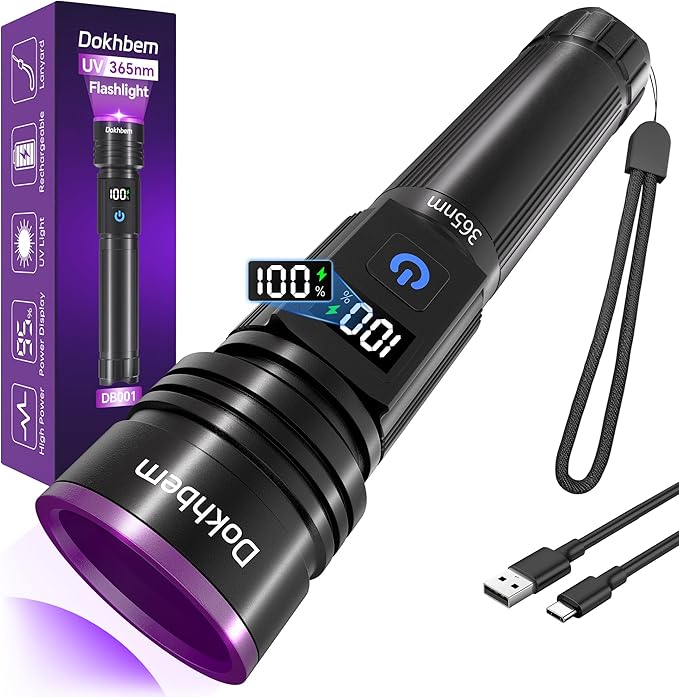
365nm UV Rechargeable Black Light Flashlight is designed for anyone needing a precise and powerful UV light, especially for identifying hidden marks or verifying authenticity. Its standout feature is the 365nm wavelength combined with an upgraded lamp bead setup that offers higher intensity and accuracy than typical UV black lights.
Setting up this flashlight is straightforward since it uses a rechargeable battery with USB input, fully charging in about 3 to 3.5 hours. Holding and operating it is comfortable due to its handheld design. The LCD power display helps keep track of remaining battery life, and its portability means you can easily take it outdoors or indoors without worry, thanks to the weatherproof and durable construction.
The light’s 365nm UV beam clearly reveals subtle details that many UV flashlights miss, making it excellent for careful inspection work. The build feels tough and reliable, suited for various conditions.
A common complaint is the limited 4-hour runtime, which might require charging during longer use.
The UV light delivers clear and accurate detail detection, praised for surpassing ordinary black lights. Commonly noted is the relatively short runtime of four hours, which might require multiple charges for longer tasks.
Those needing detailed UV inspection with occasional outdoor use will find this flashlight very capable. Users needing extended battery life should consider alternative models with longer runtimes.
Pros
- Clear and consistent UV light at 365nm wavelength
- Rechargeable with USB and fast charging time
- Durable and waterproof for outdoor use
- LCD display shows remaining battery power
Cons
- Limited 4-hour runtime per charge
- Uses just one AA battery, which may drain quickly
| Specification | Details |
|---|---|
| Light Source Type | UV |
| Power Source | Battery Powered |
| Battery Type | Alkaline |
| Number of Batteries | 1 AA battery required (included) |
| Water Resistance Level | Waterproof |
| Runtime | 4 hours |
12. Shortwave 254nm UVC LED Flashlight

Using a Shortwave 254nm UVC LED Flashlight is like having a small, handy tool designed to quickly spot fluorescent minerals. It’s great for anyone who needs precise shortwave UV light in a lightweight handheld design.
Its standout feature is the intense 254nm wavelength with a special optical filter, which makes mineral phosphors glow clearly.
Setup is simple because it comes with a rechargeable lithium-ion battery and a USB charger, so you don’t have to hunt for disposable batteries. The flashlight is crafted from aluminum alloy, giving it a solid yet portable feel.
Day-to-day use involves just turning it on and shining it on surfaces to see the fluorescent effects, with about 30 minutes of runtime before a recharge is needed. The black strap helps keep it secure during use.
Performance-wise, the four 254nm UVC LEDs deliver strong shortwave UV light that highlights fluorescent minerals effectively. The built-in ZWB3 optical filter improves visibility of the glowing minerals. Its aluminum alloy body is durable but not water resistant, so it requires care in damp conditions.
Most users praise its brightness and clarity. A common drawback mentioned is the limited 30-minute runtime, which might require recharging during extended use.
The flashlight’s intense UV light and effective optical filter allow clear detection of fluorescent minerals, but the short 30-minute runtime requires regular recharging. It’s solidly built with aluminum alloy, though the lack of water resistance means extra care is needed to avoid moisture damage.
People interested in mineral fluorescence or shortwave UV detection in dry settings will appreciate this tool. Anyone needing longer operating periods or outdoor use in wet environments may want to consider alternative flashlights with extended battery life or water resistance.
Pros
- Strong shortwave 254nm UVC LEDs
- Built-in rechargeable lithium-ion battery
- Aluminum alloy body for durability
- ZWB3 optical filter for better fluorescence
Cons
- Limited 30-minute battery runtime
- Not water resistant or suited for wet conditions
| Specification | Details |
|---|---|
| Light Source Type | UV |
| Number Of Light Sources | 4 |
| Power Source | Battery Powered |
| Battery Description | Lithium-Ion |
| Runtime | 30 minutes |
| Water Resistance Level | Not Water Resistant |
Best Shortwave UV Flashlights Comparison Table
| Product | Wavelength | Power Source | Battery Type | Water Resistance |
|---|---|---|---|---|
| Shortwave 254nm UV Light | 254nm | USB-C Rechargeable | – | – |
| Max10 254nm UVC LED | 254nm | Battery Powered | Lithium Polymer | Not Water Resistant |
| Triple-Core UV Flashlight | – | Manual | Lithium Polymer | Waterproof |
| ULTRAFIRE 254nm UV | 254nm | Battery Powered | Lithium Ion | Waterproof |
| Dual-Wave 254nm+365nm UV | 254nm+365nm | Manual | – | – |
| 365nm Black Light 2-Pack | 365nm | Battery Powered | Lithium Ion | Waterproof |
| Shortwave & Longwave UV LED | Shortwave & Longwave | Battery Powered | Lithium | Water Resistant |
| V3 365nm Black Light | 365nm | Batteries Included | Lithium Ion | Water Resistant |
| High Power 254nm UV | 254nm | Battery Powered | Lithium Polymer | Not Water Resistant |
| 20W 254nm Shortwave UV | 254nm | Battery Powered | – | Water Resistant |
| 365nm Rechargeable UV | 365nm | Battery Powered | Alkaline | Waterproof |
| Shortwave 254nm UVC LED | 254nm | Battery Powered | Lithium Ion | Not Water Resistant |
- Wavelength254nm
- Power SourceUSB-C Rechargeable
- Battery Type–
- Water Resistance–
- Wavelength254nm
- Power SourceBattery Powered
- Battery TypeLithium Polymer
- Water ResistanceNot Water Resistant
- Wavelength–
- Power SourceManual
- Battery TypeLithium Polymer
- Water ResistanceWaterproof
- Wavelength254nm
- Power SourceBattery Powered
- Battery TypeLithium Ion
- Water ResistanceWaterproof
- Wavelength254nm+365nm
- Power SourceManual
- Battery Type–
- Water Resistance–
- Wavelength365nm
- Power SourceBattery Powered
- Battery TypeLithium Ion
- Water ResistanceWaterproof
- WavelengthShortwave & Longwave
- Power SourceBattery Powered
- Battery TypeLithium
- Water ResistanceWater Resistant
- Wavelength365nm
- Power SourceBatteries Included
- Battery TypeLithium Ion
- Water ResistanceWater Resistant
- Wavelength254nm
- Power SourceBattery Powered
- Battery TypeLithium Polymer
- Water ResistanceNot Water Resistant
- Wavelength254nm
- Power SourceBattery Powered
- Battery Type–
- Water ResistanceWater Resistant
- Wavelength365nm
- Power SourceBattery Powered
- Battery TypeAlkaline
- Water ResistanceWaterproof
- Wavelength254nm
- Power SourceBattery Powered
- Battery TypeLithium Ion
- Water ResistanceNot Water Resistant
How to Choose the Right Shortwave UV Flashlight
Choosing a shortwave UV flashlight involves focusing on factors like wavelength accuracy, light intensity, and battery life to ensure effective detection and durability. Selecting the right features prevents frequent replacements and poor performance, saving time, money, and frustration in the long run.
Uv Wavelength and Intensity
Flashlights that claim to emit ultraviolet light often vary widely in their actual wavelength output. Models emitting near 254 nm are important because this wavelength effectively excites certain substances, causing them to fluoresce or reveal hidden markings.
Devices with wavelengths too far away from this mark won’t provide reliable detection, which can lead to wasted time or missed details.
The intensity of the light also makes a noticeable difference. A low-intensity beam might barely illuminate fluorescent materials, especially in daylight or brightly lit environments.
Flashlights providing at least 1000 µW/cm² at a short distance tend to perform well. Adjustable intensity settings offer practical value by allowing you to dial down brightness to conserve battery or increase it for stubborn stains or faint fluorescence.
Power Source and Battery Life
Battery type directly affects how easy it is to keep the flashlight ready for use. Rechargeable batteries add convenience and reduce long-term costs but may require carrying chargers or power banks. Replaceable batteries mean swapping out after use, which works well if standard sizes like AA or AAA are used, as these are easy to find almost anywhere.
Battery life varies greatly between models; running out of power mid-task causes frustrations. Look for watches lasting several hours on a full charge or set of batteries. Features such as battery level indicators prevent surprises, while power-saving modes extend runtime by lowering intensity when full brightness isn’t required.
Build Quality and Durability
Many flashlights fail quickly when exposed to knocks or moisture. Choosing one built with an aluminum alloy body or high-grade plastic often spells better durability. Such materials handle daily bumps and drops better than cheaper, brittle construction.
A sealed design or an IPX rating (IPX4 or above suggested) ensures resistance to rain or accidental splashes, enabling use outdoors or in damp environments. That said, bulkier, heavier devices tire your hand fast during prolonged use, so balance weight and toughness by opting for lightweight yet strong models wherever possible.
Safety Features
Ultraviolet radiation near 254 nm, while effective for fluorescence detection, can harm skin and eyes with extended exposure. Flashlights without any built-in safety risk causing discomfort or injury, especially during prolonged inspections.
Look for units featuring safety symbols or warnings on the body to remind users of proper handling. More advanced products incorporate automatic shutoff after a certain duration or if mistakenly pointed too close to skin.
A well-designed lens or casing can block out harmful infrared or visible light spillover, focusing solely on the intended UV band and reducing exposure to non-UV rays.
Ergonomics and Usability
Handheld use demands a comfortable, non-slip grip, especially since inspections can last several minutes. Small, lightweight flashlights making single-handed operation natural help avoid fatigue and improve accuracy during close examination.
Simple controls, such as a single button for power and mode switching, reduce distractions and errors. Being able to adjust beam focus or swap lenses allows tailoring of the light spread, whether illuminating a broad area or zooming in on a specific spot.
These elements together create greater ease and efficiency during routine or detailed work.
Effective Safety Precautions When Using Shortwave UV Flashlights
Shortwave UV flashlights emit radiation that can be harmful to skin and eyes if used improperly. Wearing protective eyewear specifically designed for UV protection is important to prevent eye damage. Avoid direct exposure of the light beam to your eyes or anyone else’s. Use the flashlight only in well-ventilated areas and limit the duration of exposure to reduce skin irritation or burns.
Keep the device away from children and pets to avoid accidental exposure. When not in use, store the flashlight in a case or cover the lens to minimize stray UV rays.
Regularly inspect the flashlight for any damage to the casing or lens that could alter the light output or safety. Avoid looking directly at the UV light or shining it on reflective surfaces, which can redirect harmful rays unpredictably. Following these basic safety steps will help you use a shortwave UV flashlight responsibly and safely.
Comparing Shortwave UV Flashlights with Other UV Light Types
Shortwave UV flashlights emit UV-C light, which has a shorter wavelength than UV-A or UV-B found in other UV lights. This makes them effective in applications requiring sterilization or fluorescence detection that shorter wavelengths can trigger more dramatically. UV-A lights, common in counterfeit detection or mineral inspection, are less intense and tend to be safer but less effective for germicidal use.
UV-B is mostly used in medical treatments and is not typical for handheld flashlights. Shortwave UV flashlights demand extra caution due to their higher energy output and potential hazards.
They also often require specific housing and filtering lenses to block visible light and protect users. Compared to LED UV torches emitting longer wavelengths, shortwave models may have shorter battery life due to higher power needs.
Choosing the right type depends on the intended application and required wavelength effects.
Maintaining and Extending the Lifespan of Your Shortwave UV Flashlight
Battery maintenance plays a critical role in the performance and longevity of shortwave UV flashlights. Remove batteries if the light will not be used for extended periods to prevent corrosion inside the compartment.
Use high-quality, compatible rechargeable or alkaline batteries to ensure steady power output. Keep the lens clean from dust, fingerprints, or residues that can reduce effectiveness by blocking UV rays. Use a soft, lint-free cloth with mild cleaning solutions appropriate for optical equipment.
Periodically check the flashlight for damage or loose parts, especially cracks in the lens that can let harmful UV rays escape. Store the flashlight in a cool, dry place away from direct sunlight and extreme temperatures.
Avoid dropping the light or exposing it to moisture, which can damage internal electronics. Routine care and gentle handling will help maintain brightness and extend the device’s usable life.
People Also Asked
How Long Does a Shortwave UV Flashlight Battery Usually Last?
A shortwave UV flashlight battery usually lasts between 2 to 6 hours depending on the brightness setting and battery type. Using rechargeable batteries may reduce running costs. It helps to carry spare batteries for longer use.
Is It Safe to Use a Shortwave UV Flashlight on Skin?
Shortwave UV flashlights are generally not safe for direct skin exposure and should be used with caution. Prolonged exposure can cause irritation or damage. Wearing gloves and avoiding direct contact are practical steps to minimize risk.
What Size UV Flashlight Do I Need for Detecting Stains?
A small to medium-sized UV flashlight is best for detecting stains. Compact models allow easy maneuvering over fabric and furniture without missing spots. Consider a size that fits comfortably in one hand for better control.
How Do I Properly Care for and Clean a UV Flashlight?
To care for and clean a UV flashlight, use a soft, lint-free cloth to gently wipe the lens and body after use. Avoid harsh chemicals as they can damage the lens coating. Regular cleaning keeps the light clear and effective.
Can Shortwave UV Flashlights Damage Lenses or Other Materials?
Shortwave UV flashlights can potentially degrade some lenses and plastic materials with frequent exposure. Avoid shining the light directly on sensitive or valuable lenses for long periods. Using a UV flashlight with care prevents unnecessary damage.
Conclusion
Choosing a shortwave UV flashlight comes down to a few key points. Brightness and wavelength affect how well it reveals hidden features or substances. Battery life matters for long use without frequent recharging or replacements.
Durability helps if the flashlight will be used outdoors or in rough conditions.
Consider how often you plan to use the flashlight and where you will use it. Smaller models fit in tight spaces, while larger ones often have stronger batteries but weigh more.
Check the comparison table and detailed picks above to find a model that fits your specific needs and budget.

