
Top 10 Best Survival Monocular That Will Blow Your Mind!
Trying to use a survival monocular that fogs up, feels flimsy, or offers a blurry view can turn a critical moment into a frustrating one. A cheap or poorly designed unit often fails when clarity and durability matter most. The best survival monocular combines clear optics with a compact, tough design that stays reliable in unexpected conditions.
Good survival monoculars usually have waterproof and fog-proof lenses, often coated to reduce glare. Magnification of around 8x and an objective lens diameter near 25mm hits the right balance between field of view and brightness.
The body should be lightweight but rugged, typically with rubber armor for grip and impact resistance. Ease of cleaning is essential since dirt and moisture can quickly degrade performance when it counts.
Need a Quick Check?
| Image | Product | Price |
|---|---|---|
Our Top Picks 1 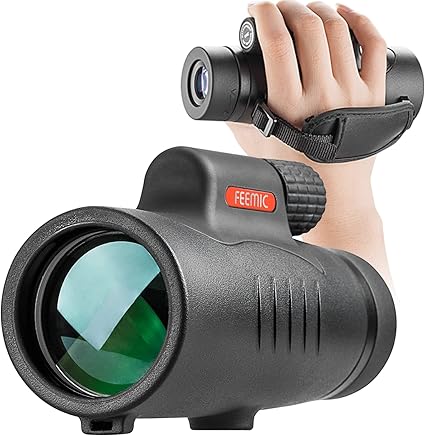 | Generic 8×42 Monocular | Check Price |
Our Top Picks 2  | RIX Pocket K3 Thermal | Check Price |
Our Top Picks 3  | AGM Taipan V2 Thermal | Check Price |
Our Selected Top 10 Survival Monocular You Can Trust
This list features reliable survival monoculars designed for outdoor enthusiasts and emergency preparedness. Each review covers performance, ideal users, and key advantages and disadvantages, providing clear insights to help you choose the right monocular for your specific needs and situations.
1. Monocular Telescope 8×42 Waterproof Compact
Ideal for outdoor enthusiasts, the Monocular Telescope 8×42 Waterproof Compact stands out with its wide-angle, high-definition view. It suits anyone needing a clear, magnified look at distant objects while hiking, camping, or birdwatching.
Its biggest strength is the combination of 8X magnification with a broad 42mm lens, offering detailed visuals over a large field of view.
Setup is quick since it uses manual focus, making adjustments simple while on the move. The nitrogen-filled, waterproof body means it works well in rain or fog without fogging up inside the lens.
The rubber finish provides a solid grip and protects against shocks, so it’s reliable when you’re on rough terrain. A dust cover keeps the lens clean, reducing maintenance.
Performance delivers sharp, bright images thanks to the fully multi-coated optics and BAK-4 prism elements. The wide field of view allows scanning over large distances with ease. The body holds up well under tough weather conditions, protected against dust, moisture, and impacts.
Common complaints include the manual focus which requires some getting used to, and occasional difficulty with precise focusing in low light.
The standout feature appreciated is its waterproof and fogproof ability combined with sharp, HD visuals from the fully multi-coated lens and BAK-4 prism. The most frequent issue is the manual focus mechanism, which demands patience and practice to achieve precise clarity, especially in lower lighting conditions.
This monocular will satisfy outdoor adventurers needing sturdy, clear optics in harsh environments. People wanting quick autofocus or easier low-light operation might prefer a different option.
Pros
- Wide field of view at 360ft/1000yards
- Durable waterproof and shock-resistant design
- Clear visuals with BAK-4 prism optics
- Compact and portable size
Cons
- Manual focus can be tricky in dim light
- Some users find focus adjustment slow
| Specification | Details |
|---|---|
| Magnification | 8X |
| Objective Diameter | 42mm |
| Field Of View | 360ft/1000yards |
| Coating | Fully Multi-Coated |
| Focus Type | manual focus |
| Special Feature | Waterproof, Shockproof, Fogproof |
2. RIX POCKET K3 Thermal Monocular
RIX POCKET K3 Thermal Monocular offers clear thermal imaging in a compact design, making it ideal for outdoor enthusiasts who need reliable night vision in a portable package. Its standout feature is the high-resolution 384×288 thermal sensor that captures detailed images at considerable distances.
Setup involves simply holding it in hand or mounting on a tripod using the standard 1/4-20 interface for stability during longer observations. Day-to-day use favors its lightweight and pocket-sized form, fitting easily on hikes or wildlife watching trips.
Wi-Fi connectivity supports quick image transfers, adding convenience when sharing or reviewing thermal data.
The monocular performs well, detecting heat signatures up to 853 yards under good conditions, although effectiveness varies with weather and surroundings. Build quality matches its outdoor focus, sturdy yet comfortable in hand.
Praises highlight the detailed thermal clarity, while common remarks note the zoom is fixed at 2×, limiting closer inspection capabilities.
The device impresses with its sharp thermal images and portability, allowing long-range detection up to 853 yards in ideal conditions. However, some users find the fixed 2× zoom limiting when trying to focus on smaller or more distant details.
Outdoor hobbyists valuing ease of carry and clear thermal vision will appreciate this monocular. Those who need variable zoom options or rely heavily on steady conditions for detection might consider alternative models better suited for their specific needs.
Pros
- Compact and fits comfortably in hand or pocket
- High-resolution thermal sensor for clear imaging
- Wi-Fi connectivity for easy image sharing
- Standard tripod mount for stable viewing
Cons
- Fixed 2× zoom limits detailed examination
- Performance depends heavily on environmental factors
| Specification | Details |
|---|---|
| Sensor Resolution | 384×288 |
| Objective Lens | 15mm |
| Zoom Ratio | 2× |
| Field Of View | 17.5° horizontal |
| Tripod Mount | Standard 1/4″-20 interface |
| Maximum Detection Range | Up to 853 yards (controlled conditions) |
3. AGM Taipan V2 Thermal Imaging Monocular
Using a thermal monocular like this is reassuring when visibility drops to zero. It suits outdoor enthusiasts and survivalists who require clear thermal detection in darkness.
Its biggest strength lies in pinpointing heat signatures clearly, making it easier to find animals or survey an area at night without guesswork.
Getting it ready takes minimal effort since it uses two included nonstandard batteries and connects easily to smartphones or tablets for viewing or recording. The 1.5x to 12x zoom levels allow quick switching between broad scans and detailed looks, while the autofocus handles shifting distances without manual fiddling. A wide 10-degree field of view helps monitor areas instead of concentrating on a tiny spot.
Performance matches the needs of nighttime observation well, generating sharp images through its sub-35mK thermal detector. Its build accommodates rough outdoor conditions, and the altazimuth mount adds steady, easy aiming. Many appreciate the built-in recording feature for documenting thermal activity, though some find the reflex finderscope less intuitive during fast moving scenarios.
Sharp and clear thermal images stand out as the main benefit, especially with its sensitive 12m detector that works well in the dark. A common drawback is the reflex finderscope, which some find less straightforward when tracking quick targets or moving rapidly.
This monocular fits those needing reliable nighttime thermal detection with recording options for later review. Anyone requiring quick reflex tracking or standard batteries might want to consider alternatives that focus more on ease of use in fast action situations.
Pros
- Clear thermal images even in total darkness
- Multiple digital zoom levels for versatile viewing
- Built-in recording for easy documention
- Smartphone compatibility via included mount
Cons
- Uses nonstandard batteries which may be harder to replace
- Reflex finderscope can be tricky with fast movements
| Specification | Details |
|---|---|
| Eye Piece Lens Description | Standard/Wide-field |
| Field Of View | 10 degrees |
| Zoom Ratio | 1.5x-12x |
| Focus Type | Auto Focus |
| Compatible Devices | Smartphone, Tablet |
4. Bushnell Legend 10×42 Monocular

Great for anyone needing a survival monocular with clear optics and solid durability, it shines in low light and tough weather. The biggest strength lies in its MIL-HASH reticle, which helps with precise range estimations and aiming adjustments.
Setting it up is straightforward thanks to the manual focus and twist-up eyecup design. Its lightweight build and rubber armor make it comfortable to hold all day. Carrying it in the field is easy due to its compact size, and you can mount it on a tripod or monopod when needed.
Waterproof and fog proof features mean you rarely worry about weather conditions impacting use.
Optical performance is impressive with ED Prime Glass and multiple coatings, so images stay sharp even as light fades. The rugged, FDE-colored exterior handles rough use securely.
Most praise goes to its clarity and precise targeting abilities. Some users, however, mention the lack of built-in illumination for the reticle as a downside in very dark environments.
The sharp optics combined with accurate MIL-HASH reticle help users make precise distance and wind drift calculations. A drawback often pointed out is the lack of reticle illumination, making it tougher to use in complete darkness.
People needing reliable clarity and precise targeting, especially outdoors in variable light, will find it a solid choice. Those who want quick auto-focus or illuminated reticles might look at alternatives instead.
Pros
- MIL-HASH reticle for accurate range estimation
- ED Prime Glass with multi-coatings for clear images
- Rugged, rubber-armored body for good grip
- Waterproof and fog proof for all-weather use
Cons
- No illumination for reticle in dark conditions
- Manual focus may require adjustment during quick use
| Specification | Details |
|---|---|
| Eye Piece Lens Description | Twist-up eyecup design |
| Focus Type | Manual Focus |
| Field Of View | 340 feet |
| Zoom Ratio | 10 multiplier_x |
| Waterproof | Yes |
5. High Power 12×50 Monocular Telescope
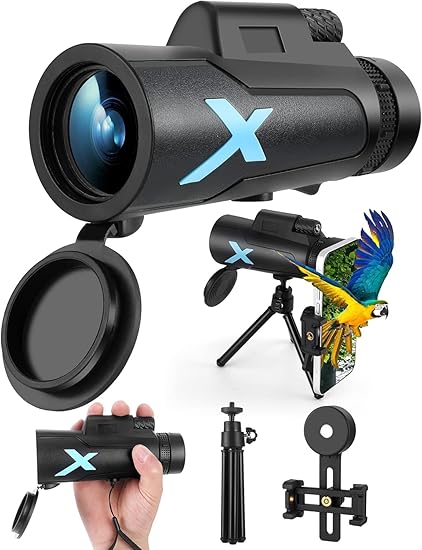
Built with a large 53mm objective lens and a sturdy BAK4 prism, the 12×50 Monocular is ideal for anyone needing clear, color-accurate views outdoors. Its biggest strength lies in the bright, high-contrast images thanks to its fully multi-coated optics, making it great for hiking or bird watching.
Setting it up takes just a moment since it’s handheld or mountable on a tripod with a standard 1/4-inch thread. Manual focus feels smooth and precise, so adjusting to see distant details is simple. The wide 6.5° field of view and 20mm eyepiece make it comfortable to use for long periods without dizziness, even when wearing glasses.
Image clarity holds up well under varied light conditions, delivering sharp views with minimal distortion. The body is compact yet solid, suited for rough outdoor use. Most praise focuses on its bright and clear images, while some note the manual focus requires attention in fast-moving situations.
The brightest, clearest views come from the big BAK4 prism and fully multi-coated lenses, making outdoor scenes vivid and sharp. However, the manual focus needs careful adjustment when tracking anything in motion, which can slow down quick glances.
Anyone who spends time on hiking, bird watching, or scenic viewing and values image brightness will appreciate this model. Those looking for a lightweight or quick-focus option might want to consider other designs better suited for fast action.
Pros
- Bright images from large 53mm objective lens
- Comfortable adjustable eye relief for long use
- Tripod-adaptable for stable viewing
- Sharp colors with multi-coated lenses
Cons
- Manual focus is tricky with moving subjects
- Heavier than some compact monoculars
| Specification | Details |
|---|---|
| Zoom Ratio | 12x |
| Field Of View | 6.5 degrees |
| Focus Type | Manual Focus |
| Mount | Handheld, Tripod-adaptable Mount With Standard 1/4-inch Thread |
| Coating | Fully Multi-coated (fmc) Green Film Optical Lens |
| Power Source | No Battery Required |
6. 4.0 Night Vision Binoculars

Sharp 4K UHD video and photo quality stand out immediately, making these night vision binoculars ideal for those who want clear images in dark conditions. Perfect for camping or wildlife watching, their biggest strength is capturing detailed visuals without needing extra lighting.
Setup involves just adjusting the manual focus and choosing between day and night modes. The 4.0 screen shows images clearly, and you can change the brightness with five levels to stay discreet in the dark.
The built-in camera and flash make recording easy, while tripod compatibility adds stability during longer waits.
Performance excels in very low light thanks to the 7-level IR illumination and a strong 50W IR illuminator. Magnification can zoom digitally up to 10X, though some mention digital zoom blur as a drawback. The device is solidly built but manual focus takes a bit of adjustment to get sharp images consistently.
Excellent image and video clarity stand out in total darkness with adjustable IR illumination, but some users find the digital zoom causes blurring at its highest magnification. Manual focus needs patience to master for consistently sharp results.
People wanting clear night visuals for camping or wildlife observation will appreciate the photo and video features. Those needing fast autofocus or higher optical zoom might want to explore other options.
Pros
- Stunning 4K UHD video and 48MP photos
- Seven levels of IR illumination for dark use
- 5 adjustable brightness levels on a large 4.0″ screen
- Tripod mountable for steady viewing
Cons
- Manual focus requires practice for sharp images
- Digital zoom can cause image blur at maximum setting
| Specification | Details |
|---|---|
| Objective Lens Diameter | 25 millimeters |
| Magnification Maximum | 10 x |
| Zoom Ratio | 10X |
| Features | Built-In Camera, Built-In Flash, Night Vision, Portable, Tripod Mountable |
| Focus Type | manual focus |
7. High Power 80×100 Monocular Telescope

High magnification paired with a large lens makes it perfect for anyone wanting detailed views in nature or at events. Its biggest strength lies in offering bright and clear images even at 80X zoom, which you won’t find in many monoculars at this price range.
Setting up involves just manual focusing, which takes a little patience but works well. The straight-through finderscope helps in quickly spotting distant objects.
Its ergonomic design means you can comfortably hold it with one hand during long hikes or while watching wildlife. Attaching your smartphone for photos is straightforward with the included adapter.
It performs well in delivering sharp, high-contrast images thanks to the FMC multi-coated lens and BAK4 prism. Build quality feels solid and suitable for outdoor use, though some users note that the high zoom can be tricky to stabilize without a tripod. The most common praise is for its bright, true-color image, while a common complaint involves the difficulty of keeping a steady view at maximum magnification.
The setup with manual focus takes getting used to but delivers sharp, high-contrast images with vivid color thanks to its FMC multi-coated lens and BAK4 prism. Users appreciate the bright view but often wish for easier stability at 80X magnification.
Bird watchers, hikers, and travelers seeking detailed distant views will enjoy this monocular. Those needing quick focus or steady shots at extreme zoom might prefer a model with lower magnification or built-in stabilization.
Pros
- 80X magnification offers impressive close-up views
- Large 100mm lens brightens images significantly
- Ergonomic design fits comfortably in one hand
- Smartphone adapter easy to use for photos
Cons
- Manual focus requires patience for sharp images
- High zoom can be hard to stabilize without support
| Specification | Details |
|---|---|
| Focus Type | manual focus |
| Finderscope | straight-through |
| Zoom Ratio | 80 |
| Compatible Devices | smartphone |
| Objective Lens Diameter | 100mm |
8. TOPDON TS004 Thermal Imaging Monocular

Spotting heat signatures in low light or dense woods often comes with blurry images and short battery life. Designed for outdoorsmen and survivalists, the TOPDON TS004 Thermal Imaging Monocular stands out by delivering clear thermal images that reveal every detail, even in complete darkness.
Setting it up takes just a moment thanks to its manual focus and monocentric eyepiece lens. Daily use revolves around its 8x zoom and 13.5-degree field of view, which help you pinpoint wildlife or potential hazards.
Wireless connection to your phone through the TopInfrared App lets you keep an eye on things without peering through the lens constantly.
It performs well with a sharp infrared resolution of 256×192 and supports smooth imaging through a 50Hz refresh rate. The build feels solid, and its strong 5000mAh battery delivers around 11 hours of continuous use, so you won’t have to worry about power during long expeditions.
Most praise how clear the images are, while some note the manual focus requires a bit of patience.
Images come out crisp thanks to the 256×192 IR resolution and 50Hz refresh rate, making it easy to see what’s around you. Users often mention the battery life as a strong point, though some express frustration with the manual focus slowing quick adjustments.
This unit suits those who want detailed thermal imagery on long trips without constant battery worries. Anyone needing a faster, auto-focus system or wider viewing angles might prefer exploring other monocular options.
Pros
- Clear thermal images with high IR resolution
- Long 11-hour battery life for extended use
- Wireless phone connection for live viewing
- Compact and solidly built for rugged outdoor use
Cons
- Manual focus can be tricky for quick targets
- Limited field of view at 13.5 degrees
| Specification | Details |
|---|---|
| IR Resolution | 256×192 |
| Refresh Rate | 50Hz |
| Battery Capacity | 5000mAh |
| Field Of View | 13.5 degrees |
| Zoom Ratio | 8x |
| Focus Type | Manual Focus |
9. Mini 30×25 HD Monocular
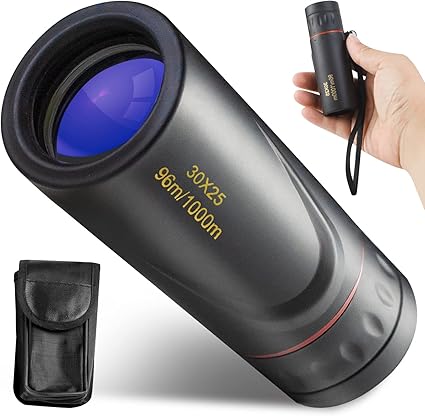
30x magnification fits the need of anyone wanting a compact, powerful monocular for outdoor use. Perfect for hikers, bird watchers, or even concertgoers who want to get a closer look, its small size makes it easy to carry without bulk. The biggest plus is how lightweight and pocket-friendly it is, without sacrificing viewing power.
Setup is straightforward with manual focus and an altazimuth mount to adjust the view angle quickly. The fully coated lenses provide a clear picture, and the rubberized exterior makes gripping comfortable in all conditions. It fits well in a pocket or small bag, making it easy to grab during walks, and connects easily with a smartphone for capturing distant images.
The 40mm focal length offers a decent 6-degree field of view, making it suitable for most outdoor scenes. Its metal mirror barrel and rubber outer layer resist weather well, keeping it waterproof and moisture-proof, so rain won’t be a problem. The main praise highlights its durability and compactness; a common complaint is related to manual focus sometimes needing steady hands to get it perfectly sharp.
Many find the build quality excellent for its size, with solid materials that hold up in bad weather. The view is clear once focused correctly, though some struggle with manual focusing under quick changes. Its waterproof feature truly allows use in damp or rainy situations without worry.
Ideal for outdoor enthusiasts needing a small, portable monocular with strong magnification and durability. Those wanting a wider field of view or autofocus may want to explore other options. It suits beginners and casual users well as long as some manual focusing is acceptable.
Pros
- Compact and lightweight, easy to carry everywhere
- Durable metal and rubber construction
- Waterproof and moisture-proof design
- Compatible with smartphones for photos
Cons
- Manual focus requires steady hands for sharp images
- Relatively narrow 6-degree field of view
| Specification | Details |
|---|---|
| Eye Piece Lens Description | Galilean |
| Mount | Altazimuth Mount |
| Focus Type | Manual Focus |
| Field Of View | 6 degrees |
| Zoom Ratio | 10:1 |
| Focal Length Description | 40 millimeters |
10. GOYOJO G210 Thermal Monocular

Great for outdoor enthusiasts who need reliable thermal imaging for survival or wildlife spotting. Its biggest strength lies in its advanced thermal sensing technology, allowing clear views in all lighting conditions with quick and precise detection.
Setup is straightforward, running on a single included lithium polymer battery. The fixed focus and Plossl eye piece keep things simple during use.
You can switch between six color palettes to suit different scenarios and zoom in up to 4x to get a closer look. The 16GB storage lets you capture images right from the device, and it pairs with smartphones for easy sharing.
Performance-wise, the 256×192 thermal camera sensor with a 12μm infrared detector delivers crisp thermal images. The multi-coated lens improves clarity through the 10mm focal length.
It’s built tough enough for handheld or tripod mounting, but some find the 2x zoom a bit limited. Most praise its reliable thermal detection; the lack of a finderscope is noted as a downside.
Users appreciate the fast, clear thermal detection provided by the high-resolution sensor and infrared detector, making it easy to spot heat signatures in the dark. The most common drawback mentioned centers on the fixed focus and limited zoom, which can restrict detailed views at varying distances.
Those needing a simple, reliable thermal monocular for spotting heat sources in survival or outdoor settings will find this a good fit. More demanding users seeking adjustable focus or higher zoom options may want to explore alternatives with those specific features.
Pros
- Clear thermal images in multiple color modes
- 16GB built-in image storage
- Battery included for immediate use
- Compatible with smartphones for easy sharing
Cons
- Fixed focus limits close-up adjustments
- No finderscope for easier targeting
| Specification | Details |
|---|---|
| Eye Piece Lens Description | Plossl |
| Focus Type | Fixed Focus |
| Zoom Ratio | 2 |
| Power Source | Battery Powered (1 Lithium Polymer battery included) |
| Field Of View | 17.5 degrees |
| Focal Length Description | 10 millimeters |
Best Survival Monoculars Comparison Table
| Product | Zoom Ratio | Focus Type | Mount | Battery |
|---|---|---|---|---|
| Generic 8×42 Monocular | – | Manual Focus | Altazimuth Mount | Manual Power |
| RIX Pocket K3 Thermal | 2× | – | 1/4″-20 tripod | – |
| AGM Taipan V2 Thermal | 1.5x-12x | Auto Focus | Altazimuth Mount | 2 Nonstandard Batteries |
| Bushnell Legend 10×42 | 10 | Manual Focus | Tripod Mount | AC/DC |
| High Power 12×50 Monocular | – | Manual Focus | Handheld, Tripod-adaptable | No Battery Required |
| 4.0 Night Vision Binoculars | 10X | Manual Focus | Tripod Mount | – |
| High Power 80×100 Monocular | 80 | Manual Focus | – | – |
| TOPDON TS004 Thermal | – | Manual Focus | Equatorial Mount | 1 Lithium Ion |
| Mini 30×25 HD Monocular | 10:1 | Manual Focus | Altazimuth Mount | – |
| GOYOJO G210 Thermal | – | Fixed Focus | Tripod Mount, Handheld | 1 Lithium Polymer |
- Zoom Ratio–
- Focus TypeManual Focus
- MountAltazimuth Mount
- BatteryManual Power
- Zoom Ratio2×
- Focus Type–
- Mount1/4″-20 tripod
- Battery–
- Zoom Ratio1.5x-12x
- Focus TypeAuto Focus
- MountAltazimuth Mount
- Battery2 Nonstandard Batteries
- Zoom Ratio10
- Focus TypeManual Focus
- MountTripod Mount
- BatteryAC/DC
- Zoom Ratio–
- Focus TypeManual Focus
- MountHandheld, Tripod-adaptable
- BatteryNo Battery Required
- Zoom Ratio10X
- Focus TypeManual Focus
- MountTripod Mount
- Battery–
- Zoom Ratio80
- Focus TypeManual Focus
- Mount–
- Battery–
- Zoom Ratio–
- Focus TypeManual Focus
- MountEquatorial Mount
- Battery1 Lithium Ion
- Zoom Ratio10:1
- Focus TypeManual Focus
- MountAltazimuth Mount
- Battery–
- Zoom Ratio–
- Focus TypeFixed Focus
- MountTripod Mount, Handheld
- Battery1 Lithium Polymer
How to Choose the Right Survival Monocular
Look for a survival monocular that balances clarity, durability, and weight to ensure reliable use in tough conditions. Choosing the right size, waterproof rating, and optical quality helps avoid frustration and costly replacements when you need it most.
Optical Performance
Trying to spot distant objects becomes frustrating fast when the magnification is too high or the field of view too narrow. A strong magnification narrows what you see, so you lose context, while too low means details vanish.
A good balance often lies between 6x and 8x magnification with a field of view around 300 to 400 feet at 1000 yards. That range gives a clear, wide view without making it hard to stay on target.
Lens quality matters most at dawn or dusk. Cheaper optics can feel dark and blurry, but models with multicoated lenses significantly brighten the image and boost clarity.
Eye relief over 15mm also makes a difference, preventing eye strain during longer observations and allowing use with glasses. Those are subtle changes that keep observations comfortable and sharp during long hours outdoors.
Durability and Build Quality
Equipment has a way of getting dropped or soaked in tough conditions. Without waterproof and fogproof seals, moisture seeps in and ruins the view, often permanently. Look for nitrogen or argon purging to keep fog off internal lenses.
Housing built with impact-resistant materials like rubber armor or aircraft-grade aluminum holds up better after falls or bumps on rocky terrain.
Heavy gear becomes a burden quickly. Surviving with this tool means favoring models that are compact and weigh around 150 to 250 grams. That keeps it easy to carry on hikes or in pockets without sacrificing durability.
Overbuilding adds bulk, but flimsy shells disappoint in the field.
Ease of Use
Hunting or scouting often lets no time for fiddling with tricky knobs. Smooth, precise focusing rings that can be turned quickly without catching or slipping speed up target acquisition.
Large, textured knobs help achieve this even when hands are wet or cold.
Steady hands are at a premium under pressure. An ergonomic grip with rubber or textured finishes reduces slipping and fatigue, especially in tense moments. Designs that accommodate gloved fingers and integrate with other survival gear without interference turn out more practical in cold or rugged conditions where protection gear is standard.
Battery Life and Illumination
Power running out in the middle of the woods is a critical mistake. A long battery life of at least 20 hours on a single type (AAA or CR2 batteries, which are easy to replace) keeps the optic ready for overnight or extended trips.
Some units include a manual reticle brightness control or a backup display mode that works even if batteries fail.
Reticle illumination is most useful in low light, but too bright can blind or drain the battery fast. Adjustable brightness levels allow customizing the glow to conditions and tasks, saving power and improving visibility without distractions.
Additional Survival Features
Attaching this optic to a tripod, helmet, or other gear increases its versatility. Models with standard mounts or built-in attachment points avoid awkward balancing acts or clumsy straps. Quick-release features add convenience.
Extra features like built-in compasses or basic rangefinders provide navigation help without extra tools, though they add some weight. Simple designs with easy lens cleaning options and maintenance access keep the device functional and clean during extended rugged use, cutting downtime and frustration in the field.
Maximizing Your Survival Monocular: Practical Usage Tips for Outdoor Adventures
Survival monoculars are compact tools designed for quick scouting and spotting over medium to long distances. Holding the monocular steadily improves image clarity, so brace your arm against your body or use a tripod if your model supports it.
Most come with adjustable focus rings; take a moment to fine-tune the focus rather than relying on the default setting for sharper details. A quality monocular often includes a built-in compass or rangefinder, useful for navigation during hikes or emergencies. Practice identifying landmarks at different distances before heading out to understand the monocular’s limitations and strengths.
Avoid looking directly at bright light sources to protect your eyes and the lenses. When using in low light, keep the lens clean and free of smudges as even slight dirt can reduce visibility.
Carry a small microfiber cloth for on-the-go cleaning and keep the monocular stored in a padded case to prevent scratches and damage.
Essential Maintenance and Care to Extend the Life of Your Survival Monocular
Routine maintenance extends the life of a survival monocular and ensures reliable performance. Wipe the lenses gently with a microfiber cloth after each use to remove dust, oil, and moisture.
Avoid using household cleaners, which can damage lens coatings; instead, use specialized lens cleaning fluid designed for optics. Store the monocular in a dry place to prevent mold growth, especially after exposure to rain or humidity. Check and tighten any loose screws or attachments periodically to keep components secure.
Protect the eyecup and lens covers during transit to shield fragile glass from scratches. Lubricate moving parts sparingly only if recommended by the manufacturer.
Inspect seals and O-rings annually if your model is waterproof to maintain their effectiveness. Small maintenance steps like these help the monocular hold its clarity and mechanical integrity over years of use.
Comparing Survival Monoculars to Binoculars: Which Is Better for Your Needs?
Survival monoculars and binoculars serve different purposes depending on your outdoor needs. Monoculars are lighter, smaller, and easier to carry for extended treks, making them convenient for quick observation. They require use of one eye, which can be less comfortable over long periods but allows the other eye to stay adjusted to the surrounding environment.
Binoculars provide depth perception and a wider field of view by using both eyes, which is helpful for detailed scouting or wildlife observation. However, they are bulkier and more prone to fatigue during prolonged use.
Battery-powered night vision or thermal monoculars offer advantages in darkness but come at higher cost and weight compared to standard binoculars. Selecting between them depends on the balance you need between portability, viewing comfort, and specific outdoor tasks. For minimalist survival kits, a monocular often fits better while binoculars suit more stationary activities.
People Also Asked
How Do I Properly Care for My Survival Monocular?
Keep your survival monocular clean and dry to maintain clarity and function. Use a microfiber cloth to wipe the lens and store it in a protective case when not in use. Avoid touching the glass directly to prevent smudges that can affect visibility.
What Size Monocular Is Ideal for Outdoor Survival Use?
A monocular between 6 to 8x magnification is practical for outdoor survival tasks. This size balances clear detail with a wide enough field of view, making it easier to scan large areas while staying compact and lightweight.
Is It Safe to Use a Survival Monocular at Night?
Regular survival monoculars without night vision are not effective in complete darkness. They work well at dusk or dawn when some ambient light is present but require infrared or night vision features for true night use.
How Long Do Survival Monoculars Typically Last with Regular Use?
With proper care, a survival monocular can last several years during regular use. The main wear points include the focusing mechanism and lens coatings, so gentle handling and cleaning help extend its life.
What Are Common Problems with Survival Monoculars and How to Fix?
Focusing problems and lens fogging are common issues. To fix focusing, gently turn the focus ring without forcing it. Prevent fogging by storing the monocular in a dry place and using silica gel packets in its case for moisture control.
Conclusion
Choosing the right survival monocular comes down to a few key factors: clear optics for reliable viewing, compact size for easy carrying, and durable build to withstand rough conditions. How well it performs in low light and its water resistance can also make a significant difference during outdoor activities.
Think about where and how often you will use the monocular, as well as your budget to narrow down the options. Check the comparison table and the detailed picks above to find one that fits your specific needs and environment.
