Top 10 Best Survival Transceiver That Will Save Your Life
Many people experience frustration when a survival transceiver fails just when they need it most. The best survival transciver promises reliable communication in emergencies, but cheap or poorly selected models often fall short due to weak signals or rapid battery drain. Missing a chance to send a distress call can have serious consequences for anyone venturing into remote areas.
A good survival transceiver usually stands out because of its durability, battery life, and signal range. Devices made from impact-resistant materials perform better under rough conditions.
Battery life of at least 24 hours on continuous use is common for dependable models. Signal range varies, but a practical device maintains communication over several miles in open terrain without losing connection from environmental obstacles.
Need a Quick Check?
| Image | Product | Price |
|---|---|---|
Our Top Picks 1  | BAOFENG BF-F8HP PRO Radio | Check Price |
Our Top Picks 2  | UV-88 Multi Band Radio | Check Price |
Our Top Picks 3  | Radtel RT-950 PRO GPS Radio | Check Price |
Our Selected Top 10 Survival Transciver for Every Budget
This list features reliable and versatile survival transceivers designed for various needs and budgets. Each review explains how the device performs, the type of user it suits best, and highlights its main strengths and weaknesses to help make an informed choice.
1. BAOFENG BF-F8HP PRO Tri-Band Ham Radio
Baofeng BF-F8HP PRO Tri-Band Ham Radio is designed for amateur operators who need reliable analog control and a large memory capacity. It suits those wanting clear, organized channel management and a durable radio that works well during outdoor or emergency communication. The biggest strength lies in its easy-to-understand menus and wide frequency coverage.
Setting up the radio is straightforward with its English menus and full keypad allowing simple changes to channels and zones. Day-to-day, scanning only picks up conventional analog channels but lets you skip busy ones temporarily.
Viewing channels shows frequency and names clearly, and Dual Watch keeps an ear on two channels. It’s practical for grouping home, travel, club, and event channels as usage grows.
The radio handles transmissions across three amateur bands well, offering clear voice communication up to 2 miles. Water resistance gives some protection against elements during outdoor use. Built to be weather resistant, it holds up for extended use.
Most praise focuses on its intuitive controls and channel management, while a common complaint is its inability to scan digital or trunked systems.
The radio receives praise for its logical menu system and the ability to organize channels into meaningful groups, making operation simple under pressure. The main drawback is its limitation to analog scanning, which excludes newer digital modes and trunked systems that some might require.
Operators relying on analog channels and needing extensive memory will find this radio suitable. Those needing digital capability or longer range should consider alternatives with digital scanning and more powerful output options. It’s ideal for amateur operators focused on straightforward analog use and portability.
Pros
- Clear English menus for easy navigation
- Large memory with 1,000 channels and 10 named zones
- Adjustable receiver sensitivity and noise reduction
- Weather resistant for outdoor use
Cons
- Cannot scan digital or trunked systems
- Limited talking range up to 2 miles
| Specification | Details |
|---|---|
| Number of Channels | 1000 |
| Frequency Range | 144-148 MHz, 222-225 MHz, 420-450 MHz |
| Water Resistance Level | Water Resistant |
| Voltage | 7.4 volts |
| Number of Batteries | 1 Lithium Ion battery required (included) |
| Talking Range Maximum | 2 mile |
2. UV-88 Multi Band HF UHF VHF Dual Band Ham Radio
Running this radio feels straightforward and reliable, suitable for anyone needing versatile communication on multiple bands. Its biggest strength lies in handling a wide range of frequencies, making it useful for a mix of hobbyists and practical communication needs.
Setting it up takes just a second thanks to the simple matching feature, which skips any complex cable programming. Daily use benefits from switching through 1024 channels with ease, targeting everything from ham bands to commercial and air communications. A moisture-resistant design means it handles outdoor environments better than some other models.
Performance meets expectations with solid reception across AM, FM, USB, LSB, and other modes, especially when paired with a shortwave antenna. The build feels sturdy and functional, though water tightness only extends to moisture resistance, so it’s best not to expose it to heavy rain.
Most praise highlights its extensive band support, while some note the battery life as a limitation.
The radio is praised for covering many communication bands and modes with decent weather resistance, but its power source often requires frequent battery replacement during extended use. Switching channels is fast and versatile, yet presence of only moisture resistance means care is needed in damp conditions.
People needing flexible band options and easy setup will appreciate this radio, especially in fair weather or controlled environments. Those expecting waterproof durability and longer battery life might want to consider alternatives better suited for harsh outdoor survival situations.
Pros
- Supports full-band AM, FM, USB, LSB, CW, and more
- Quick 1-second antenna matching for easy setup
- Weather resistant for outdoor use
- Wide frequency coverage for varied communication
Cons
- Battery powered by single 9V limits power longevity
- Only moisture resistant, not fully waterproof
| Specification | Details |
|---|---|
| Number of Channels | 1024 |
| Talking Range Maximum | 10 kilometer |
| Voltage | 12 volts |
| Water Resistance Level | Moisture Resistant |
| Number of Batteries | 1 9V batteries required (included) |
3. Radtel RT-950 PRO GPS/APRS Long Range Handheld Radio
Great for outdoor and emergency communications, the Radtel RT-950 PRO stands out with its high output power, covering substantial distances with clear audio. Ideal for those needing dependable long-range contact on the go, especially ham radio enthusiasts or professionals working in the field.
Setup is straightforward thanks to the Bluetooth app, which lets you program and manage the radio from a smartphone. Daily use simplifies with wireless frequency copy, avoiding cable hassles. The full-color display makes channel navigation easy, while GPS and APRS functions keep location tracking accessible without extra gear.
Performance shines in delivering strong signal reach, handling up to 6 kilometers with clarity. Its construction supports a solid experience despite lacking water resistance, which means care is needed in wet conditions. Common praise notes the clear reception and powerful output; the main drawback is that it isn’t waterproof, limiting use in rough weather.
Clear communication and long-range reach receive high praise for dependability in the field. Most find the lack of water resistance a constraint, especially when used outdoors where weather conditions can change rapidly.
People needing reliable, strong signal radios with modern programming options will appreciate this unit. Those requiring waterproof or rugged radios for extreme environments might want to look elsewhere.
Pros
- Strong output power for wide coverage
- Bluetooth app with wireless programming
- GPS and APRS position sending included
- Full-color display for easy use
Cons
- Not water resistant, needs careful handling
- Single lithium-ion battery only
| Specification | Details |
|---|---|
| Output Power | High Output Power |
| Number of Channels | 960 |
| Frequency Range | 144-148Mhz / 420-450Mhz |
| Talking Range Maximum | 6 kilometer |
| Voltage | 7.4 volts |
| Bluetooth Connectivity | Yes |
4. Radtel RT-950 PRO GPS/APRS 10W Handheld Transceiver
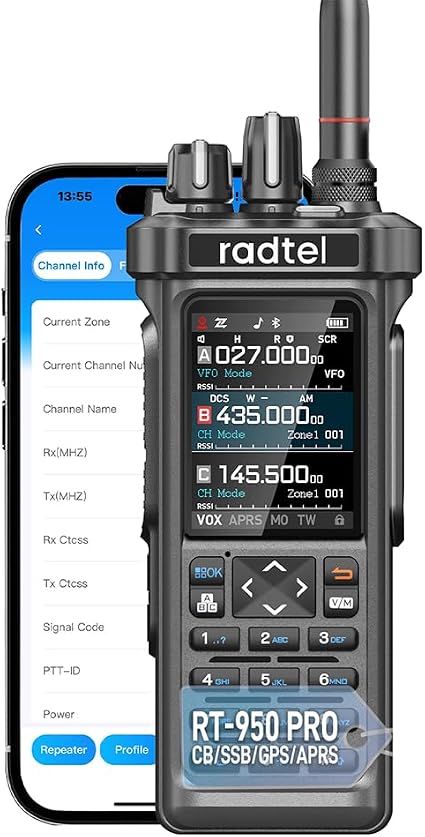
Constructed with practical features and a full-color display, the Radtel RT-950 PRO GPS/APRS 10W Handheld Transceiver suits anyone needing reliable communication outdoors. Its highest strength lies in delivering strong output power and clear voice quality, making it ideal for outdoor adventures and emergency situations.
Setup is straightforward with Bluetooth app programming that lets you configure the transceiver from your smartphone. Daily use benefits from the wireless frequency copy feature, simplifying the process of duplicating settings. The GPS/APRS function helps keep track of position transmissions, which is handy when out in the field.
Managing up to 960 channels gives plenty of options for communication.
Performance is solid with a maximum talking range of 6 kilometers and a high output power that ensures clear signals across that distance. The build feels functional rather than rugged, with a 7.4-volt power supply and 9V batteries included.
The most praised aspect is the strong signal and range, while a common complaint is the lack of water resistance, which limits use in wet conditions.
This transceiver is often praised for its strong range and voice clarity, which provides reliable communication in open areas. A recurring issue is its lack of water resistance, making it less suitable for harsh weather or wet environments. It’s a practical choice but requires some care regarding moisture exposure.
People who spend time outdoors needing dependable communication without heavy-duty weatherproofing will appreciate this radio. Anyone expecting to use it in wet or extreme conditions might consider a model with water resistance for more durability and convenience.
Pros
- High output power ensures clear signals
- Bluetooth app programming for easy setup
- GPS/APRS position transmission useful outdoors
- Supports large channel count of 960
Cons
- Not water resistant, limits use in rain
- Requires 9V battery, not rechargeable
| Specification | Details |
|---|---|
| Number of Channels | 960 |
| Frequency Range | 144-148Mhz/420-450Mhz |
| Maximum Talking Range | 6 kilometer |
| Voltage | 7.4 volts |
| Water Resistance Level | Not Water Resistant |
| Connectivity Protocol | Bluetooth |
5. Airiton AI-K28 4G LTE Long Range Walkie Talkies (2 Pack)

Covering up to 10,000 miles, these walkie talkies rely on 4G LTE networks instead of traditional radio signals, making them ideal for anyone needing reliable communication over vast distances. Their national coverage and lifetime free SIM card service are standout features that promise communication without range worries.
Setup is straightforward since the SIM cards come pre-installed; just power them on and start talking. The unlimited data plan included with the SIM means no monthly fees or subscriptions. Switching between one-on-one private calls and group encrypted conversations is convenient, fitting daily communication needs whether on a hike or coordinating a project far apart.
Communication quality depends on cellular coverage but generally delivers clear voice transmission over long distances, outperforming regular walkie talkies limited by radio range. The radios require two 9V batteries each, which are included but may need replacement depending on usage.
The unit’s build is solid but lacks water resistance, so they should be kept dry. Praise often highlights the vast range and free data, while a common complaint concerns vulnerability to water exposure.
Users appreciate the unlimited communication range without fees thanks to the pre-installed SIM card offering free lifetime data. At the same time, the radios’ lack of water resistance causes concern for outdoor use in wet or harsh environments.
Anyone needing reliable long-distance communication in areas with cell coverage will find these particularly useful. People requiring walkie talkies that can withstand exposure to rain or water should consider other options better suited for moisture resistance.
Pros
- Unlimited range anywhere with cellular coverage
- Lifetime free unlimited high-speed data
- Supports private and group encrypted calls
- Includes batteries for immediate use
Cons
- Not water resistant, vulnerable in wet conditions
- Dependent on cellular signal quality and availability
| Specification | Details |
|---|---|
| Talking Range Maximum | 10000 mile |
| Connectivity Protocol | LTE |
| Number of Channels | 200 |
| Number of Batteries | 2 9V batteries required (included) |
| Water Resistance Level | Not Water Resistant |
6. Motorola Talkabout T605 Waterproof Two Way Radios (2 Pack)

Perfect for outdoor enthusiasts needing reliable communication in wet environments, these radios stand out for their waterproof design and floating capability. They suit hikers, campers, and boaters who want durability without sacrificing long-range connection.
Setting up the radios takes moments thanks to easy pairing and multiple channel options, 22 channels combined with 121 privacy codes make finding a clear line simple. Daily use is comfortable with the backlit display, and the water-activated flashlight adds a practical touch during nighttime or emergencies.
USB-C charging keeps powering up quick and convenient.
Performance-wise, they deliver on a talking range up to 35 miles under ideal conditions, supported by 9 hours of battery life on the rechargeable 12V batteries. The waterproof casing feels solid, and the radios are designed to float face up for easy retrieval.
The most frequent praise highlights their strong waterproof feature, while some mention that real-world range often falls short of the maximum stated distance.
The radios receive praise for their dependable waterproof design and floating feature, which add real value outdoors. A common complaint is that the stated 35-mile range can be optimistic in normal use, often resulting in shorter distances.
Ideal users include anyone who spends time in wet or rugged settings needing solid communication gear. Those prioritizing longer consistent range or extended battery life might want to explore other models on the market.
Pros
- Waterproof and floats face up
- 22 channels with 121 privacy codes
- Easy USB-C charging
- Includes water-activated flashlight
Cons
- Real range may be less than 35 miles
- Batteries require charging every 9 hours
| Specification | Details |
|---|---|
| Number of Channels | 22 |
| Talking Range Maximum | 35 mile |
| Battery Average Life | 9 hours |
| Water Resistance Level | Waterproof (IP67) |
| Connectivity Protocol | FRS |
| Tuner Type | UHF |
7. Solar Hand Crank Emergency Radio

Power outages and outdoor trips demand a reliable way to stay informed and charged. Ideal for campers, hikers, or emergency preppers, this solar hand crank emergency radio shines with its large solar panel enabling fast solar charging even in low light, making it a solid choice for long-term off-grid communication and lighting.
Setting it up involves just unfolding the extra-large solar panel or hand cranking to power it up when sunlight is weak. Tuning into NOAA, AM, or FM bands is straightforward thanks to a long antenna and high-sensitivity chip that quickly locks on to signals. The built-in LED flashlight and reading lamp add convenience, and charging phones through the USB type-C port covers essential power needs on the go.
Performance excels in radio reception with clear sound, supported by noise-reduction circuitry that keeps updates audible during storms or outdoor adventures. The build feels sturdy yet portable, powered by a 12000mAh lithium battery combined with multiple charging methods.
Strongest praise centers on the solar panel’s size improving charging speed. The main complaint relates to the analog display, which some found less precise for tuning.
The radio delivers clear sound with rapid solar charging thanks to its large panel, which is often praised for keeping power steady even in low light. Common note revolves around the analog tuner, which some users find less convenient when aiming for precise station selection.
Those needing a tough, multi-powered radio with strong solar input and good reception will appreciate what this offers. People wanting a very compact device or digital tuning might want to explore other options better suited to those preferences.
Pros
- Fast solar charging from large panel
- Clear NOAA/FM/AM radio reception
- Multiple power sources including hand crank
- Built-in flashlight and reading lamp
Cons
- Analog display can make tuning tricky
- Bulkier than some compact radios
| Specification | Details |
|---|---|
| Power Source | Solar Panel | Hand Crank | 12000mAh Lithium Battery | Type-C Input 5V/2A | 3 AAA Batteries |
| Radio Bands Supported | NOAA | FM | AM |
| Speaker Maximum Output Power | 5 watts |
| Hardware Interface | USB Type C |
| Solar Panel Size | 8500mm² high-efficiency monocrystalline |
8. Global Rapid Lifetime Free Walkie Talkies

Global coverage with a maximum talking range of 9999 miles makes these walkie talkies perfect for those needing reliable communication across vast distances. Ideal for outdoor adventurers and survivalists, they connect using 4G-LTE cellular networks without any monthly fees, ensuring lifetime free data service wherever AT&T, T-Mobile, or Verizon signals are available.
Setup involves using the included SIM card which works immediately on supported cellular networks. Day-to-day operation is straightforward with up to 999 channels to choose from, letting you stay connected with your group securely via encrypted channels.
Water repellent design offers durability for outdoor conditions, and the battery lasts up to 7 days, so constant recharging isn’t necessary on extended trips.
Communication clarity is excellent thanks to high-quality voice transmission over the LTE network, with encrypted signals making conversations private. The build is solid and water repellent but not fully waterproof, so care around water is needed.
Most users praise the lifetime free data service, while some mention the required nonstandard battery as a minor inconvenience for replacements.
Lifetime free data service has strong praise for eliminating ongoing costs, while users most often note the inconvenience of the nonstandard battery when replacements are needed. The secure, encrypted communication stands out as a reliable feature for privacy.
Those needing unrestricted long-distance communication without monthly fees will find this device well suited. People looking for walkie talkies with easily replaceable batteries or full waterproofing may want to consider alternatives.
Pros
- Unlimited range via 4G-LTE networks
- Lifetime free data service included
- Secure AES encrypted communication
- Water repellent for outdoor use
Cons
- Nonstandard battery can be hard to replace
- Not fully waterproof, only water repellent
| Specification | Details |
|---|---|
| Talking Range Maximum | 9999 mile |
| Connectivity Protocol | LTE |
| Battery Average Life | 7 days |
| Number of Channels | 999 |
| Water Resistance Level | Water Repellent |
9. TIDRADIO TD-H8 10W Multi-Band Ham Radio (2 Pack)

Ideal for radio enthusiasts and survivalists needing reliable long-range communication, the TIDRADIO TD-H8 10W Multi-Band Ham Radio comes in a 2-pack and stands out with its multi-functional capabilities and durable design. It suits anyone who requires a rugged, versatile radio that handles a variety of frequencies and weather alerts.
Setting up the radio involves USB-C or Bluetooth programming, making it easy to customize channels and functions through a user-friendly 1.8-inch color display with three different modes. Messaging features and dual PTT buttons add convenience during extended use. Quick import of repeater settings simplifies daily communication, while the multi-band function covers Ham and GMRS requirements, making it suitable for different situations.
Performance shines with a maximum talking range of 20 km and clear audio, supported by AI noise reduction and NOAA weather alerts. The IP54 water-resistant rating helps it withstand outdoor conditions. Strong points include its long battery life of 50 hours, but some have noted occasional software glitches during firmware updates, which require attention.
The radio is praised for its strong battery life and the convenience of Bluetooth programming, which make day-to-day communication practical and flexible. The most common issue lies with firmware updates causing minor problems that need troubleshooting.
This set of radios fits well for those who want dependable long-range communication with multiple features in an outdoor or emergency setup. People looking for simpler, plug-and-play radios without software updates might want to look elsewhere.
Pros
- Multi-band support including Ham and GMRS
- Long battery life up to 50 hours
- Dual customizable PTT buttons
- Bluetooth programming and audio support
Cons
- Nonstandard batteries can be tricky to replace
- Firmware updates occasionally have glitches
| Specification | Details |
|---|---|
| Maximum Talking Range | 20 km |
| Battery Average Life | 50 hours |
| Number of Channels | 199 |
| Water Resistance Level | Water Resistant (IP54) |
| Voltage | 7.4 volts |
| Connectivity Protocol | Bluetooth |
10. BAOFENG UV-32 10W Long-Range Ham Radio

Boasting a long-range 10W output and multi-band capabilities, this device is well-suited for anyone needing reliable communication over large distances. Its standout feature is the built-in GPS and APRS location tracking, ideal for outdoor adventures or emergency situations.
It combines communication and location sharing in a single radio, a big plus for safety.
Setting it up is straightforward, especially with the Bluetooth app that lets you program frequencies without fiddling with cables. Daily use benefits greatly from its NOAA weather alerts via FM/AM, keeping you updated on storms or emergencies.
It feels comfortable carrying around thanks to its moisture-resistant build, protecting it in damp conditions without being fully waterproof.
Performance-wise, the radio delivers clear and consistent communication across UHF and VHF bands, living up to its long-range promise. It handles critical updates smoothly, with GPS adding an important safety layer.
The build takes moisture into account but does not fully seal against water, so cautious use in heavy rain is best. Praise often centers on location tracking, while some find the single channel limiting for complex setups.
The GPS and APRS location tracking receive the most praise for enhancing safety during outdoor or emergency use. Many users appreciate the Bluetooth app’s convenience but note that the single channel is a drawback in scenarios requiring multiple contacts.
Outdoor enthusiasts and those needing reliable long-range communication with location sharing find it valuable. People needing fully waterproof gear or multi-channel operation should consider other options better suited to those needs.
Pros
- Built-in GPS and APRS for position tracking
- NOAA weather alerts via FM/AM reception
- Bluetooth app programming, no cables needed
- Strong communication power with 10W output
Cons
- Only one channel limits multi-frequency use
- Moisture resistant but not fully waterproof
| Specification | Details |
|---|---|
| Number of Channels | 1 |
| Water Resistance Level | Moisture Resistant |
| Connectivity Protocol | Bluetooth |
| Impedance | 50 ohm |
| Additional Features | Long Range |
Best Survival Transceivers Compared Side by Side
| Product | Channels | Range | Water Resistance | Battery |
|---|---|---|---|---|
| BAOFENG BF-F8HP PRO Radio | 1000 | – | Weather Resistant | – |
| UV-88 Multi Band Radio | 1024 | 10 kilometer | Moisture Resistant | 1 9V battery |
| Radtel RT-950 PRO GPS Radio | 960 | – | – | – |
| Radtel RT-950 PRO 10W Radio | 960 | – | – | – |
| Airiton AI-K28 4G Walkie Talkies | 200 | 10000 mile | Not Water Resistant | 2 9V batteries |
| Motorola Talkabout T605 Radios | 22 | 35 mile | Waterproof | 2 12V batteries |
| Solar Hand Crank Radio | – | – | – | Solar, Hand Crank, AAA |
| Global Rapid Free Walkie Talkies | 999 | 9999 mile | Water Repellent | 1 Nonstandard battery |
| TIDRADIO TD-H8 10W Radios | 199 | 20 km | IP54 Rated | 7.4 volts |
| BAOFENG UV-32 10W Radio | 1 | – | Moisture Resistant | – |
- Channels1000
- Range–
- Water ResistanceWeather Resistant
- Battery–
- Channels1024
- Range10 kilometer
- Water ResistanceMoisture Resistant
- Battery1 9V battery
- Channels960
- Range–
- Water Resistance–
- Battery–
- Channels960
- Range–
- Water Resistance–
- Battery–
- Channels200
- Range10000 mile
- Water ResistanceNot Water Resistant
- Battery2 9V batteries
- Channels22
- Range35 mile
- Water ResistanceWaterproof
- Battery2 12V batteries
- Channels–
- Range–
- Water Resistance–
- BatterySolar, Hand Crank, AAA
- Channels999
- Range9999 mile
- Water ResistanceWater Repellent
- Battery1 Nonstandard battery
- Channels199
- Range20 km
- Water ResistanceIP54 Rated
- Battery7.4 volts
- Channels1
- Range–
- Water ResistanceMoisture Resistant
- Battery–
How to Choose the Right Survival Transceiver
Choosing a survival transceiver involves focusing on signal range, battery life, and durability to ensure reliable communication in emergencies. Prioritizing these features helps avoid costly replacements and prevents failures when you need help most, making your investment both practical and dependable.
Frequency Range and Channels
Many radios fall short because they can’t pick up the critical frequencies used by both local and international rescue teams. Without access to a wide frequency range, attempts to call for help might go unnoticed, especially if the device lacks dedicated emergency channels. Models that support multiple survival frequencies make a significant difference.
Staying connected means being able to tune in to standard emergency bands like channel 16 on marine VHF or FRS and GMRS channels for land-based rescues. Private channels can help avoid interference from other users during a crisis.
Look for devices offering a broad selection of channels, including at least one dedicated emergency frequency. Compatibility with common rescue frequencies ensures a better chance of signaling for help in diverse regions. Radios that can scan and switch between channels automatically reduce the risk of missing a distress signal.
Power Source and Battery Life
Running out of power in a survival situation can make even the best radio useless. Some come with rechargeable batteries that last around 8 to 12 hours of talk time; others accept replaceable AA or AAA batteries, which can be carried as spare packs.
Solar-powered units provide an important backup, especially during long outdoor stays without access to electricity. Knowing your radio’s battery life on continuous use and standby is crucial for trip planning.
Reliable power sources can mean the difference between maintaining communication or going silent. Radios with options to connect external power banks or use hand-crank charging offer extra security. Pay attention to battery type compatibility and average runtime, look for at least 10 hours of talk time and longer standby periods to avoid surprises.
Durability and Weather Resistance
Survival radios often get tossed, dropped, or exposed to rain and dust. Models built with shock-resistant cases and sturdy plastics handle impacts better and last through rough handling. Waterproof ratings such as IPX7 or higher are a practical necessity for dealing with heavy rain or accidental submersion, while dustproof features protect internal components in sandy or dirty environments.
Temperature resistance extends usability into colder or hotter climates without battery or circuitry failures. Radios designed to operate between -10°C and 50°C cover most survival scenarios.
Without these protections, a radio might fail just when it’s needed most, leaving you cut off from rescue efforts.
Transmission Range and Signal Clarity
Some radios can transmit signals several miles across open fields, but dense forests or urban areas reduce this range dramatically. Radios that offer 5 miles or more in ideal conditions also need good noise reduction and audio clarity to be useful.
Static, interference, and poor speaker quality lead to missed messages and frustration.
Signal stability can vary a lot with terrain. Units featuring frequency modulation (FM) and good antenna design maintain clearer transmissions in obstructed areas. Noise filtering features help distinguish voices from background sounds, reducing confusion during high-stress communication.
Ease of Use and Portability
In an emergency, fumbling with complicated controls wastes crucial time. Radios with simple button layouts and clear displays allow for quick channel changes and volume adjustments even under stress.
Compact and lightweight models fit easily in pockets or on belts, making them easy to carry during hikes or evacuations.
Consider radios with dedicated emergency alert buttons that send distress signals instantly. Quick access features reduce delays and simplify calling for help when every second counts.
Size and portability paired with intuitive design improve usability during fast-paced survival situations.
Tips for Effective Communication Using Survival Transceivers
Survival transceivers work best when both parties maintain clear and consistent communication protocols. Setting a fixed channel before heading into remote areas prevents wasted time hunting for a signal. Keep messages brief and focused on essential information like location, status, and immediate needs.
Using standard codes or phrases cuts down on confusion during stressful situations.
Understanding the device’s range limitation is crucial; dense forests or mountains reduce signal distance significantly. Regularly checking battery levels prevents unexpected power loss. Some models allow for group communication, using this feature can improve coordination for multiple people.
Most importantly, practice using the transceiver before an emergency to become familiar with its controls and sound alerts.
- Agree on specific channels and maintain them.
- Keep transmissions short and precise.
- Monitor battery status frequently.
- Use group functions for team communication.
- Practice beforehand to reduce operational errors.
Common Mistakes to Avoid When Operating Survival Transceivers
One common mistake involves neglecting to carry spare batteries or a charging method. Transceivers rely heavily on consistent power, and running out mid-use can leave you without communication.
Another error is not setting the correct frequency channel, resulting in failed contact attempts. Users sometimes talk at the same time, which causes message overlap and confusion.
Failing to test the device before heading into the field is another oversight. It prevents early identification of any malfunctions.
Some people underestimate environmental impacts that reduce signal strength, such as thick vegetation or heavy rain, which can cause frustration when messages do not get through. Remembering to speak clearly and slowly ensures your message is understood on the other end.
- Carry extra batteries or charging options.
- Verify channels prior to communication.
- Avoid speaking simultaneously to prevent overlap.
- Test devices in a safe setting before use.
- Be aware of environmental challenges.
Comparing Survival Transceivers with Alternative Emergency Communication Devices
Survival transceivers provide two-way voice communication, which is a practical advantage over simple signal mirrors or whistles that only send short signals. Unlike satellite messengers, transceivers do not depend on a satellite network and work well within a limited radius, usually up to a few miles under good conditions. This makes them valuable for local team coordination.
Compared to mobile phones, transceivers do not require cell towers, so they remain functional in remote locations. However, their range is typically less than satellite phones, which have global coverage but come with higher costs and power demands. Emergency radios can receive alerts from authorities but often can’t send signals back, limiting interaction during a crisis.
- Two-way voice communication is a key benefit.
- Does not rely on satellites or cell towers.
- Range is limited, usually suitable for local use.
- Cheaper and simpler than satellite phones.
- Less interactive than transceivers compared to emergency radios.
People Also Asked
How Do I Properly Care for My Survival Transceiver?
Keep your survival transceiver clean and dry, storing it in a protective case when not in use. Regularly check the battery and replace it as needed to avoid failure during an emergency. Moisture and impacts can damage the device’s internal components over time.
What Size Survival Transceiver Is Ideal for Hiking Trips?
A compact survival transceiver is best for hiking since it fits easily in pockets or packs without adding bulk. Look for a model that balances size with battery life to avoid carrying extra weight from frequent battery changes. Small enough to handle quickly but still functional in an emergency.
Are Survival Transceivers Safe to Use in All Weather Conditions?
Survival transceivers generally work well in most weather, including rain and cold, but they should be kept dry to prevent water damage. Some models offer water resistance but not full waterproofing, so using a waterproof pouch during heavy rain is a practical precaution. Extreme cold can reduce battery efficiency.
How Do I Pair My Survival Transceiver with Other Devices?
Pairing usually involves turning on the transceiver and placing it near the device you want to connect, then following the specific button sequence or pairing mode described in the manual. Keep devices close to avoid connection issues. Having fresh batteries ensures a stable pairing process.
What Common Problems Should I Expect with Survival Transceivers?
Batteries dying quickly or not holding charge is a frequent issue, often because of cold temperatures or long storage without use. Signal interference or weak transmission range can also occur in areas with dense foliage or rugged terrain. Regular maintenance and testing before trips help identify these problems early.
Conclusion
Choose a survival transceiver that offers reliable signal range and clear audio, since you need to communicate effectively in emergency situations. Battery life is also important so the device stays powered when you most need it.
Durability matters too, as the device should withstand rough conditions commonly faced outdoors.
Pick a transceiver that fits your specific needs and how often you plan to use it, whether for casual trips or more frequent outings. Check the comparison table above to review the options side by side, considering size, weight, and price to find the best match for your setup and budget.