Understanding Glock COA – A Comprehensive Guide
Many gun enthusiasts and collectors know the frustration of trying to confirm if a firearm is genuine.
You’re not alone—this can be tricky, especially with the rise of counterfeit guns in the market.
That’s where a Glock COA comes in. It’s an official document that confirms your firearm’s authenticity and adherence to the manufacturer’s standards.
It features security holograms, clear serial numbers, and detailed information about the gun.
Verifying its authenticity involves inspecting these security features, cross-checking serial numbers, and ensuring high-quality printing.
Having a valid COA protects you from counterfeit guns and boosts resale value.
To understand how to verify and request a COA, keep exploring this thorough guide.
Key Takeaways
- A Glock COA verifies the firearm’s authenticity, origin, and specifications. It helps protect against counterfeit and stolen guns.
- Look for features like holograms, accurate serial numbers, and high-quality printing. These details confirm that the COA is genuine.
- To request a Glock COA, contact official channels. You’ll need to provide proof of purchase and images of the firearm.
- Having a valid COA can increase resale value and aid in legal verification. It also boosts buyer confidence when you’re selling or buying a secondhand firearm.
- Overall, a COA offers important protection and peace of mind. It ensures you’re making an informed and secure firearm ownership decision.
What Is a Glock COA and Why Does It Matter?
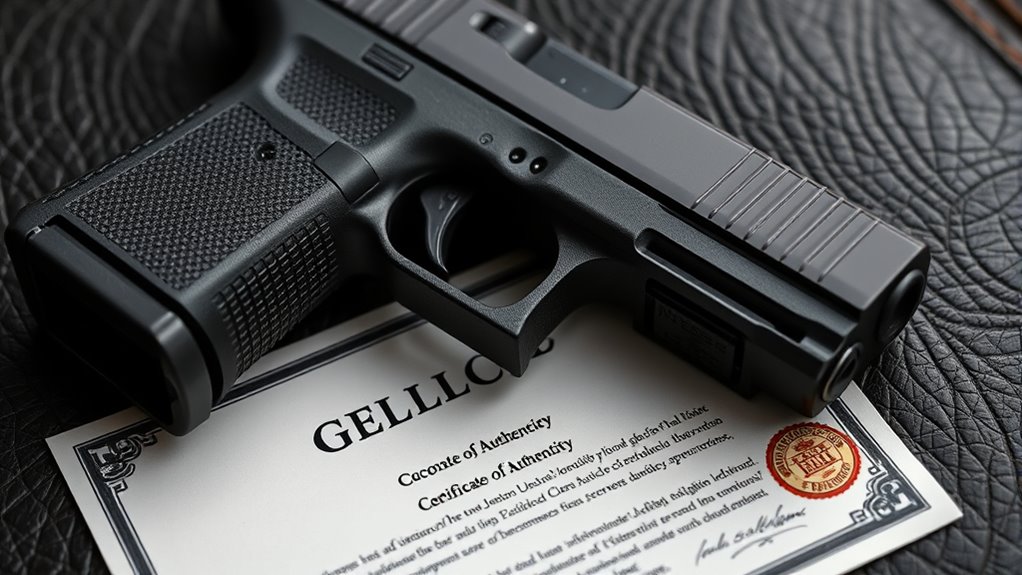
A Glock Certificate of Authenticity (COA) is an official document that verifies a firearm’s genuine origin and specifications. It confirms that your Glock is authentic and matches the manufacturer’s standards.
This certificate matters because it provides proof of legitimacy, especially if you’re buying secondhand or dealing with high-value firearms. A COA can help verify that the gun isn’t counterfeit or stolen, protecting you from legal issues.
It also assures you that the firearm has passed quality checks and meets the manufacturer’s standards. For collectors and enthusiasts, a COA adds value and authenticity to the firearm.
Ultimately, it’s your assurance that the Glock you own or are purchasing is genuine and legitimate.
How Can You Tell If a Glock COA Is Genuine?
You can confirm a Glock COA’s authenticity by checking the hologram for security features and making sure it looks real.
Next, examine the serial number details closely and compare them with official records.
Finally, cross-check the certificate with the manufacturer to verify its legitimacy.
Verify Authentic Hologram Features
Genuine Glock Certificate of Authenticity (COA) holograms have distinct visual security features that are hard to copy, making them a good sign of authenticity. Take a close look at the hologram’s design—real ones often show shifting colors and detailed patterns that change when you view them from different angles.
Authentic holograms also include tiny microtext or embedded logos that are difficult to counterfeit. Feel the texture—genuine holograms usually have a smooth, high-quality finish. Use a bright light source to check for embedded security features or hidden images that only show up under certain lighting or angles.
If the hologram looks blurry, lacks detail, or shows signs of tampering, it’s probably a fake. Checking these features carefully can help confirm that your COA is legitimate.
Examine Serial Number Details
Examining the serial number on a Glock COA is one of the simplest ways to verify if it’s authentic. Start by carefully inspecting the number itself. Look for clarity, proper font, and consistency with official Glock serial formats.
Next, cross-reference the serial number with Glock’s official records or authorized dealer databases. This step confirms whether the serial matches the firearm’s details.
Finally, check for any signs of tampering or alteration. Smudged ink, uneven spacing, or mismatched characters can indicate a fake.
Ensuring these details align with official standards helps you determine if the COA is genuine. Remember, a legitimate serial number is precise, correctly formatted, and matches official records.
Cross-Check With Manufacturer
To confirm a Glock COA’s authenticity, it’s important to cross-reference it with the manufacturer. Reach out to Glock directly through their official customer service channels or website.
Give them the serial number, purchase details, and any unique identifiers from the certificate. Genuine COAs are often registered or logged in their system, so they can verify if yours matches their records.
Be cautious of fake certificates; manufacturers usually don’t send COAs without a legitimate purchase. If possible, ask for a confirmation email or official documentation from Glock to verify its validity.
Doing these checks helps prevent counterfeit certificates and gives you peace of mind about your firearm’s history. Always verify with the official source before trusting the certificate’s appearance or perceived legitimacy.
What Features Indicate a Real Glock COA?
When verifying a Glock Certificate of Authenticity (COA), certain features stand out as clear indicators of legitimacy. First, check for high-quality printing with crisp, clear text and consistent alignment.
Second, look for authentic holographic security seals that are difficult to replicate. Third, examine the serial number and matching details; they should align perfectly with your firearm’s information.
Moreover, authentic COAs often include detailed specifications, a manufacturer’s signature, and official Glock branding. These elements show that the document is genuine and officially issued.
Be cautious of poor print quality, blurry images, or missing security features, as these can signal a fake. Recognizing these key features helps ensure you’re verifying an authentic Glock COA confidently.
Signs That a Glock COA Might Be Fake
If you notice poor printing quality or blurry text on a Glock COA, it could be a red flag. Missing hologram features or inconsistencies in serial numbers are also signs it might be fake.
Pay close attention to these details to help verify if you’re dealing with a legitimate certificate.
Poor Printing Quality
Poor printing quality on a Glock Certificate of Authenticity (COA) is a strong sign that it might be fake. If the text looks blurry, smudged, or uneven, that’s a red flag. Authentic COAs use high-quality printing methods, so any imperfections can suggest a counterfeit.
Here are three signs to watch for:
- Faded or inconsistent ink – the print should be crisp and uniform, not faded or patchy.
- Blurry or misaligned text – genuine COAs have precise, well-aligned lettering.
- Uneven borders or graphics – images and borders should be sharp and clean, not fuzzy or irregular.
Poor printing quality shows a lack of attention to detail, which often means it’s a fake COA.
Missing Hologram Features
Authentic Glock COAs usually have hologram features that are hard to copy. If these holograms are missing, it’s a strong sign the certificate could be fake.
Genuine holograms often show intricate designs, colors that shift when you move, and embedded security marks. Counterfeiters struggle to imitate these details. If they’re absent, it suggests the document wasn’t made with proper security or professionalism.
| Authentic Hologram Features | Fake Hologram Features |
|---|---|
| Intricate design | Simple, blurry image |
| Color-shifting elements | Flat, unmoving colors |
| Embedded security marks | No security features |
| Clear image quality | Poor, pixelated image |
Missing hologram features point to a possible forgery, so it’s worth investigating further.
Inconsistent Serial Numbers
Serial numbers on a Glock COA should match the firearm’s actual serial number without any discrepancies. If you notice mismatched or inconsistent serial numbers, it’s a red flag. Fake COAs often have serials that don’t align with the firearm’s markings or are poorly formatted.
To spot issues, check for these signs:
- The serial number on the COA differs from the firearm’s serial number engraved on the gun.
- The serial number’s font or style looks different from official Glock markings.
- The serial number on the COA appears suspiciously generic or poorly printed, with smudges or uneven spacing.
Always verify serial numbers carefully, as inconsistencies can indicate a counterfeit document or a stolen firearm. Accurate matching is essential to confirm the authenticity of your Glock COA.
How Do You Request a Glock Certificate of Authenticity?
Wondering how to request a Glock Certificate of Authenticity? First, visit Glock’s official website or contact an authorized dealer. You’ll need to provide proof of purchase, like a receipt or invoice, and clear images of the firearm’s serial number.
Next, fill out the Glock COA request form online or send it via email. Be prepared to pay a fee, which varies depending on your region. Once you submit your request, Glock will review it and authenticate the firearm.
Here’s a quick overview to help you understand the process:
| Step | Action | Tip |
|---|---|---|
| 1 | Gather proof of purchase and images | Ensure clarity and legibility |
| 2 | Submit request via website or email | Follow instructions carefully |
| 3 | Wait for Glock’s response | Be patient and reply promptly if needed |
Why Is Having a Valid Glock COA Important?
Having a valid Glock Certificate of Authenticity (COA) is essential because it verifies the firearm’s genuine origin and guarantees you’re dealing with an authentic product. Without it, you risk buying a counterfeit or misrepresented firearm. A valid COA gives you peace of mind by confirming the firearm’s provenance.
A valid Glock COA confirms authenticity, ensuring peace of mind and protection against counterfeit firearms.
Here’s why it matters:
- Authenticity assurance: It confirms the gun’s legitimacy and original manufacturing details.
- Legal protection: It helps verify ownership and authenticity during inspections or disputes.
- Resale confidence: A valid COA reassures buyers, making transactions smoother and more secure.
Having the COA guarantees you’re protected, informed, and confident in your firearm’s authenticity, reducing risks associated with counterfeit or tampered guns.
How a Glock COA Boosts Your Firearm’s Resale Value
A Glock COA significantly boosts your firearm’s resale value because it provides clear proof of authenticity and quality. Buyers feel more confident when they see an official certificate confirming the gun’s origin and specs.
This kind of proof helps reduce worries about counterfeit or tampered firearms, making your listing more appealing. Plus, a COA shows that your firearm has been properly inspected and verified, which is great for collectors and enthusiasts looking for genuine, high-quality pieces.
When you have a COA, you can justify asking a higher price because buyers value verified authenticity. Overall, the certificate acts as a trust signal, making the sale process smoother and increasing your chances of getting a better deal.
It’s a small investment that can really pay off through higher resale value.
Frequently Asked Questions
Can a Glock COA Be Transferred to a New Owner?
Yes, a Glock COA can be transferred to a new owner. You just need to follow the right legal steps, like notifying the authorities and updating records.
Both parties should make sure the transfer follows local laws, and you might need to fill out some paperwork. It’s a good idea to keep all documentation of the transfer for legal reasons.
Getting advice from local laws or a legal expert can help make the process smooth and legal.
How Long Is a Glock COA Typically Valid?
Think of a Glock COA like a passing train. It’s usually good for three years from the date it was issued.
During this time, you can rely on the certificate, knowing it shows the firearm’s original specs and setup.
After three years, it’s a good idea to renew or check on it. That way, your documents stay as solid and reliable as your Glock.
Are There Different Types of Glock COAS?
Yes, there are different types of Glock COAs (Certifications of Authenticity). You’ll find variations like standard COAs that verify genuine Glock products, and specialized ones for limited editions or custom models.
Some COAs include detailed info about the firearm’s manufacturing date, serial number, and specifications. Always check the type of COA you’re getting to make sure it matches your needs, especially if you’re buying or selling a collectible or authentic Glock firearm.
What Should You Do if Your Glock COA Is Lost?
If you lose your Glock COA, act quickly—about 60% of lost documents are recovered within a month.
First, contact Glock or your firearm dealer to report the loss and ask for a replacement. Provide proof of ownership, like your purchase receipt or serial number.
Also, notify local authorities to prevent misuse. Keep copies of your new COA in secure places to avoid future issues.
Does a Glock COA Include Warranty Information?
No, a Glock COA doesn’t include warranty information. The certificate mainly verifies your firearm’s serial number, model, and manufacturing details.
If you need warranty info, you’ll want to contact Glock directly or check their official website. Keep in mind, the COA is essential for proof of authenticity, but warranty details are often handled separately through your purchase documentation or Glock’s customer service.
Conclusion
Think of a Glock COA as a lighthouse guiding you safely through the stormy seas of counterfeit firearms. It’s your guiding light of authenticity, illuminating the true value and trustworthiness of your firearm.
When you hold a genuine COA, you’re anchoring yourself in confidence, knowing your weapon is legitimate and protected. Without it, you risk drifting into murky waters of deception.
Keep your lighthouse shining bright—verify your Glock’s COA and navigate with certainty.